10 Creative Ways Marketers Are Using ChatGPT (and How to Do It Right)

13 minutes

TL;DR
🤖 800M weekly ChatGPT users: 85% of US marketers use it, but most barely scratch the surface—using it for basic tasks when strategic applications could 10x their output
🎯 10 high-impact use cases: From social hooks and SEO ideation to ad copy variations, tone adjustment, persona development, content repurposing, strategy brainstorming, competitor analysis, and rapid asset creation
⚠️ Quality depends on execution: Vague prompts get generic results; specific context + iteration + human editing = content that actually stands out from AI slop
🚫 ChatGPT alone isn't enough: Context resets every conversation, strategic coherence suffers, and execution gaps remain massive—you need integrated systems that maintain brand context
✨ Averi integrates what ChatGPT fragments: Brand context persists across all content, strategic coherence is built-in, execution happens in one workspace with AI + expert humans—compounding value instead of constant restarts

Zach Chmael
CMO, Averi
"We built Averi around the exact workflow we've used to scale our web traffic over 6000% in the last 6 months."
Your content should be working harder.
Averi's content engine builds Google entity authority, drives AI citations, and scales your visibility so you can get more customers.
10 Creative Ways Marketers Are Using ChatGPT (and How to Do It Right)
Your cursor is blinking.
The deadline is in three hours. And you're staring at a blank document wondering how the hell you're supposed to write five social posts, three email subject lines, and a blog outline by lunch.
Welcome to modern marketing.
Here's the thing… 800 million people use ChatGPT weekly, and 85% of US marketers use it as a writing assistant. But most of them are barely scratching the surface of what's actually possible.
They're using a Ferrari to commute to the grocery store.
The marketers who have mastered ChatGPT aren't just asking it to "write a blog post about marketing trends."
They're using it strategically… to multiply their output, generate better ideas faster, and handle the tedious work that used to eat their entire day.
But here's the catch: use ChatGPT wrong and you'll generate the same generic slop everyone else is producing. Use it right and it becomes the strategic advantage that lets a lean team outperform competitors with 10x the resources.
Let's talk about how the best marketers are actually using ChatGPT, and more importantly, how to avoid the mistakes that make your content sound like every other AI-generated post clogging the internet.

Way 1: Social Media Hooks and Captions That Actually Stop the Scroll
Scroll-stopping social content isn't about being clever. It's about understanding what makes someone stop mid-scroll and actually read. Most marketers struggle because they're too close to their own content—they can't tell what's engaging versus what's just familiar to them.
Here's how smart marketers use ChatGPT for social:
Start with context, not just a request. Don't ask ChatGPT to "write 5 LinkedIn posts." That gets you generic content.
Instead:
"You're creating LinkedIn content for cybersecurity professionals who are tired of fear-mongering industry content. They want practical, tactical insights without the doom and gloom. Generate 10 hook options for a post about zero-trust architecture that feel refreshingly straightforward and helpful, not alarmist."
See the difference? You've given ChatGPT:
Target audience with specific psychographic (tired of fear-mongering)
Desired tone (straightforward, helpful, not alarmist)
Specific topic (zero-trust architecture)
Format constraint (10 hook options)
ChatGPT can now generate hooks that actually match your brand voice rather than sounding like every other generic AI post.
Pro tip: Platform specifics matter. LinkedIn hooks need to work with the "see more" cut-off (roughly 140 characters). Twitter/X needs immediate punch in under 280 characters. Instagram can go longer but needs visual thinking.
Prompt ChatGPT with platform constraints: "Make hook #3 work within LinkedIn's preview length—frontload the value, create curiosity, use specific numbers."
The biggest mistake: Accepting ChatGPT's first output without iteration. The first generation is always generic. Push back. "These sound too corporate. Make them feel like they're coming from a real human who's frustrated by how complex this topic has become. Use more conversational language and specific examples."
Way 2: SEO Keyword and Topic Brainstorms That Don't Waste Time
Keyword research used to mean hours in tools like Ahrefs or SEMrush, trying to find topics that have search volume but aren't too competitive. That's still part of the process—but ChatGPT can accelerate the brainstorming phase and help you identify angles competitors are missing.
The strategic approach to AI-powered content ideation:
Don't ask ChatGPT for "keyword ideas." Ask it to analyze the market and surface gaps:
"I'm targeting B2B SaaS companies struggling with customer churn. What are the adjacent topics and pain points these companies search for that connect to churn but aren't obviously about churn? Think: onboarding challenges, product adoption issues, success metrics they're tracking."
This surfaces semantic relationships and related searches that traditional keyword tools might miss—the questions your audience asks before they even know churn is their problem.
Layer in competitive intelligence: Feed ChatGPT your competitors' blog titles or topic categories and ask: "Based on these topics my competitors are covering, what angles are they missing? What related questions would their audience ask that aren't being addressed?"
Validate with real tools: Here's where you blend AI with actual SEO data. Take ChatGPT's topic suggestions and run them through Google Trends, Ahrefs, or SEMrush to see which have actual search volume.
ChatGPT generates the creative angles. Traditional SEO tools validate which angles have an audience.
Common trap: Asking ChatGPT for "trending topics" in your industry. Its training data has a cutoff, so it doesn't actually know what's trending right now. Use it for ideation and angle discovery, not trend reporting.

Way 3: Drafting and Editing Content at 3x Speed
Writer's block is expensive. Every hour you spend staring at a blank document is an hour you're not shipping content, running campaigns, or doing strategic work.
ChatGPT's real value isn't writing finished content—it's getting you from blank page to workable draft in minutes instead of hours.
How to use ChatGPT as your first-draft engine:
Start with structure before content: "Create a detailed outline for a 1,500-word blog post on [topic]. Include 5-7 H2 sections, 2-3 supporting points under each, and flag which sections need data/examples to be credible."
This gives you scaffolding. Now you're not figuring out what to write—you're filling in sections.
For the rough draft: "Write the introduction section using this structure. Make it conversational, start with a relatable problem, and transition into why this topic matters. Target audience: [specific persona]."
You'll get something 70% usable. Not perfect, but way better than starting from scratch.
The editing accelerator: This is where ChatGPT shines. Instead of struggling with how to improve weak copy, get specific AI assistance:
"This paragraph feels too formal. Rewrite it in a more conversational tone while keeping the key points."
"Shorten this section by 40% without losing the main argument."
"This transition between paragraphs is clunky. Suggest three ways to connect them more smoothly."
Critical rule: ChatGPT drafts. Humans refine. Never publish AI content without adding your own perspective, examples, and voice. The AI draft is raw material, not finished product.
Way 4: Ad Copy Variations for A/B Testing That Don't Take All Day
Creating A/B test variations manually is tedious. You write a headline. Then you stare at it trying to think of a meaningfully different version that tests a specific variable. Then you try to come up with a third variation. It's exhausting and time-consuming.
ChatGPT can generate dozens of variations in seconds:
The key is being specific about what you're testing:
"Generate 10 headline variations for a Facebook ad promoting [product]. Create 3 variations testing different value propositions (speed vs. cost savings vs. ease of use), 3 variations testing different formats (question vs. statement vs. command), and 4 variations testing different emotional angles (fear of missing out vs. frustration with current solution vs. excitement about results vs. curiosity)."
Now you have real test candidates that isolate specific variables instead of random alternatives.
For full ad copy: "Write 5 complete Facebook ad copy variations (headline + body + CTA) for [product]. Target audience: [specific ICP]. Keep each under 150 words. Variation 1 should emphasize ROI and include specific metrics. Variation 2 should address pain points emotionally. Variation 3 should focus on social proof and authority. Variation 4 should create urgency. Variation 5 should emphasize simplicity and ease of use."
Refine for platform specifics: ChatGPT can adapt your core message for different platforms: "Take the best performing variation and rewrite it for LinkedIn Ads (more professional), Google Search Ads (ultra-concise, keyword-focused), and Instagram Ads (visual-first, aspirational)."
Pro tip: Feed ChatGPT your past winning ads and ask it to identify patterns: "Here are three of our highest-performing ad headlines. What elements do they have in common? Generate 10 new headlines that follow similar patterns but for [new campaign]."

Way 5: On-Brand Tone Adjustments Without Starting Over
Your brand voice is the difference between content that feels like you and content that could come from anyone. But achieving consistent tone across everything, especially when you have multiple people creating content, is hard.
ChatGPT can help standardize tone without rewriting everything from scratch.
How to use AI for tone calibration:
First, define your brand voice clearly: "Our brand voice is: confident but never arrogant, data-driven but not dry, helpful but not hand-holding, slightly irreverent but never unprofessional. We use contractions, occasional profanity for emphasis (rarely), short paragraphs, and conversational language. We avoid buzzwords like 'leverage,' 'synergy,' and 'game-changing.'"
Now use that as context for tone adjustment: "Here's a draft email. Rewrite it to match our brand voice as defined above. Keep the key messages but adjust the tone."
Specific tone shifts: ChatGPT can help you dial tone in specific directions:
"Make this less salesy and more educational."
"Add more personality—it feels too generic right now."
"Tone down the excitement—it sounds too hype-y for our audience."
"Make this feel more authoritative—currently reads too casual for this topic."
Consistency across content types: Your brand voice might need to flex slightly across formats. Use ChatGPT to adapt: "This is our website hero copy (formal, clear value prop). Rewrite it as a casual social media post that maintains our brand personality but fits Instagram's vibe."
The human check: AI can get tone directionally right, but always review for authenticity. Sometimes AI over-corrects or introduces phrases that sound "AI-generated." Your final pass ensures it sounds genuinely like your brand.
Way 6: Generating Buyer Personas and Audience Insights in Minutes
Building detailed buyer personas traditionally requires customer interviews, surveys, data analysis, and synthesis. That's still valuable—but ChatGPT can help you develop working personas quickly when you're early-stage or entering a new market.
Strategic persona development with AI:
Start with what you know: "I'm targeting mid-market SaaS companies (50-500 employees) struggling with customer onboarding. The typical buyer is a VP of Customer Success or Head of Operations. Generate a detailed persona including: daily challenges, goals, objections to new solutions, information sources they trust, how they prefer to evaluate vendors, budget authority, and what success metrics matter to them."
ChatGPT can synthesize typical patterns for this buyer type based on its training data—giving you a solid starting hypothesis.
Validate with specifics: Take that draft persona and refine it: "This persona mentions 'limited time' as a challenge. Get more specific—what are the actual time-consuming activities this person deals with that create the pain point our product solves?"
Create anti-personas too: "Based on the persona we developed, who should we NOT target? Describe 2-3 anti-personas—people who might seem like they need our solution but actually aren't a good fit."
This helps focus your marketing and avoid wasting resources on poor-fit leads.
Generate persona-specific content guidelines: "For the persona we created, how should we communicate with them? What tone works? What kinds of proof do they need to trust us? What format do they prefer for consuming content? What objections will they raise and how should we address them?"
Now you have not just a persona, but practical guidance for creating content that resonates.

Way 7: Content Repurposing That Actually Makes Sense
You spent 8 hours writing a great blog post. It got decent traffic. And then... it just sits there. Most marketers know they should repurpose content but they don't because it feels like creating everything from scratch again.
ChatGPT makes repurposing systematic and fast:
Start with the core content: "Here's a 2,000-word blog post. Create a repurposing plan that includes: 5 LinkedIn posts pulling different angles from the article, 10 tweet-sized insights, an email newsletter version, a video script outline, and an infographic outline."
That gives you a roadmap. Now execute on pieces:
For social media: "Extract the 7 most compelling statistics or insights from this article and turn each into a standalone social media post with context. Target platform: LinkedIn. Keep each under 200 words."
For email: "Summarize this blog post into a 150-word email newsletter blurb that makes people want to click through to read the full article. Lead with the most surprising or valuable insight."
For video: "Create a 3-5 minute video script based on this article. Structure it as: hook (first 10 seconds), problem setup (30 seconds), framework overview (2 minutes), call to action (30 seconds). Make it conversational and include natural transitions."
For visual content: "Based on this article, create an outline for an infographic. Identify the 5-7 key data points or steps that would work visually. Suggest a logical flow and what types of visualizations would work for each section."
The multiplication effect: One high-quality pillar piece can become 20+ pieces of derivative content across formats and platforms—all in under an hour with ChatGPT assistance.
Way 8: Marketing Strategy Ideas and Campaign Frameworks
ChatGPT isn't going to build your entire marketing strategy—that requires deep knowledge of your business, customers, and competitive landscape. But it's excellent as a strategic sparring partner that can generate ideas you hadn't considered.
How to use AI for strategic brainstorming:
Frame the strategic question clearly: "We're launching a new project management tool for remote teams. Our budget for the first 3 months is $30k. Our team is 2 people. We're targeting companies with 20-100 employees. Generate 5 different go-to-market approaches that could work within these constraints. For each approach, outline: primary channel, expected CAC, timeline to first customers, and why this approach might be effective for this audience."
ChatGPT can synthesize patterns from similar launches and suggest strategic directions: content-led growth, partner channel focus, community-building approach, product-led viral mechanics, etc.
Validate channel fit: "We're considering these three channels: LinkedIn organic content, partnerships with HR software companies, and a Product Hunt launch. For each channel, outline: typical conversion funnel, timeline to results, resource requirements, and fit for our product. Which would you prioritize and why?"
Campaign ideation: "We want to launch a campaign around the theme 'remote work doesn't have to be chaotic.' Generate 10 campaign ideas that could bring this theme to life. Include: campaign mechanic, content formats, distribution channels, and what makes it shareable or engaging."
Competitive angle development: "Our main competitors position themselves as 'enterprise-grade' and 'feature-rich.' How could we position ourselves to capture a different part of the market? Generate 5 positioning angles that differentiate us without directly attacking competitors."
Reality check: Always validate AI strategy suggestions against what you know about your specific market. ChatGPT provides patterns and frameworks—you provide the context and judgment.

Way 9: Analyzing Competitor Content for Strategic Gaps
Competitive analysis traditionally means manually reviewing competitor websites, content, and marketing—then trying to identify patterns and gaps. It's time-consuming and you might miss things because you're too focused on what they're doing rather than what they're not doing.
ChatGPT can help systematize competitive content analysis:
Feed it competitor data: "Here are the titles of my top competitor's last 20 blog posts: [list titles]. Analyze these and tell me: What topics are they covering heavily? What angles do they consistently take? What topics are conspicuously absent? What does their content strategy reveal about who they're targeting?"
ChatGPT can identify patterns you might miss in manual review: "All their content focuses on enterprise use cases. None addresses small business challenges. They emphasize complex features over simplicity. They use very formal, corporate language."
Find positioning gaps: "Based on this competitor content analysis, what positioning opportunities exist? Where could we focus that they're ignoring? What audience needs are underserved by their content approach?"
Messaging analysis: "Here are three competitor homepage hero sections: [paste copy]. Compare their messaging strategies. What value propositions are they emphasizing? How do they differentiate from each other? What messaging angles are all of them missing?"
Warning: ChatGPT can only analyze what you feed it—it doesn't have real-time access to competitor sites or analytics. Use it for analyzing content samples you provide, not for comprehensive competitive intelligence gathering.
Better approach: Use ChatGPT to analyze competitor content you've manually collected, then validate insights with actual market research and customer conversations.
Way 10: Creating Marketing Assets at 10x Speed
There's a long tail of marketing writing tasks that aren't strategic enough to justify hours of focused time, but important enough that they can't be skipped: case study drafts, press release shells, FAQ responses, chatbot scripts, survey questions, quiz frameworks, etc.
ChatGPT excels at these structured, template-driven assets.
Case study drafts: "Create a case study outline for [company] who used our [product] to [achieve result]. Follow this structure: Challenge (what problem they faced), Solution (how our product helped), Implementation (what the process looked like), Results (specific metrics and outcomes), Testimonial (quote placeholder). Make it 600 words."
You get a workable first draft in 30 seconds instead of staring at a blank document for an hour.
Press releases: "Write a press release announcing our new [product/feature]. Include: compelling headline, summary paragraph with key facts, 2 quotes (one from our CEO, one from a customer), product details, company boilerplate. Tone should be newsworthy but not hyperbolic."
FAQ content: "Based on our product [describe product], generate 15 frequently asked questions customers might have. Organize them into categories: Product Features, Pricing & Plans, Implementation, Support, Security & Privacy. For each question, provide a clear, concise answer."
Chatbot scripts: "Create a customer support chatbot conversation flow for [common customer scenario]. Include: greeting, qualification questions to understand the issue, 3 potential resolution paths based on different customer needs, escalation to human support option, closing message. Keep responses friendly and helpful, under 50 words each."
Interactive content: "Create a 10-question quiz that helps [target audience] determine [outcome]. Make questions engaging and educational. Provide 3-4 answer options per question. At the end, create 4 result types with descriptions and personalized recommendations."
The pattern: For structured, format-driven content, ChatGPT is a massive time-saver. Provide the template structure and context, get a working draft in seconds, refine with your specific knowledge.
The Critical Distinction: Using ChatGPT vs. Using It Well
Here's what most marketers miss: ChatGPT is only as good as your prompts and your editing.
The marketers generating generic slop are the ones who:
Ask vague questions and accept first outputs
Don't provide strategic context or brand guidelines
Treat AI-generated content as final rather than first draft
Use ChatGPT in isolation instead of as part of a broader workflow
The marketers winning with ChatGPT are the ones who:
Craft detailed prompts with context, constraints, and desired outcomes
Iterate multiple times to refine output
Add their own perspective, examples, and brand voice to AI drafts
Use AI to accelerate research and drafting, not replace thinking
Integrate ChatGPT into cohesive marketing systems
The biggest risk: The internet is getting flooded with AI-generated content that all sounds the same. 63.5% of people couldn't accurately identify GPT-4 generated content, but 71.3% say they'll trust a brand less if it provides AI content without disclosing it.
Translation: you can fool people short-term, but when they realize your content is generic AI slop, you lose trust permanently.
The solution isn't to avoid AI. It's to use AI strategically while maintaining the human insight, brand voice, and strategic perspective that makes content actually valuable.

Why ChatGPT Alone Isn't Enough (And What Actually Is)
Everything above works. You can absolutely use ChatGPT for elements of social media, SEO brainstorming, content drafting, ad copy, tone adjustment, personas, repurposing, strategy ideas, competitive analysis, and asset creation.
But here's the problem with using ChatGPT in isolation:
Context doesn't persist. Every conversation is separate. You're constantly re-explaining your brand, your audience, your goals, your voice. It's exhausting and inefficient.
Strategic coherence suffers. Your social posts exist in one ChatGPT conversation. Your blog content in another. Your ad copy in a third. Nothing connects to a unified strategy.
Execution gaps remain massive. ChatGPT helps you create content faster. But then what? You still need to coordinate across channels, manage campaigns, brief any specialists you need, maintain brand consistency, and track what's working.
The gap between "ChatGPT helped me write some content" and "we have a functioning marketing operation" is still enormous.
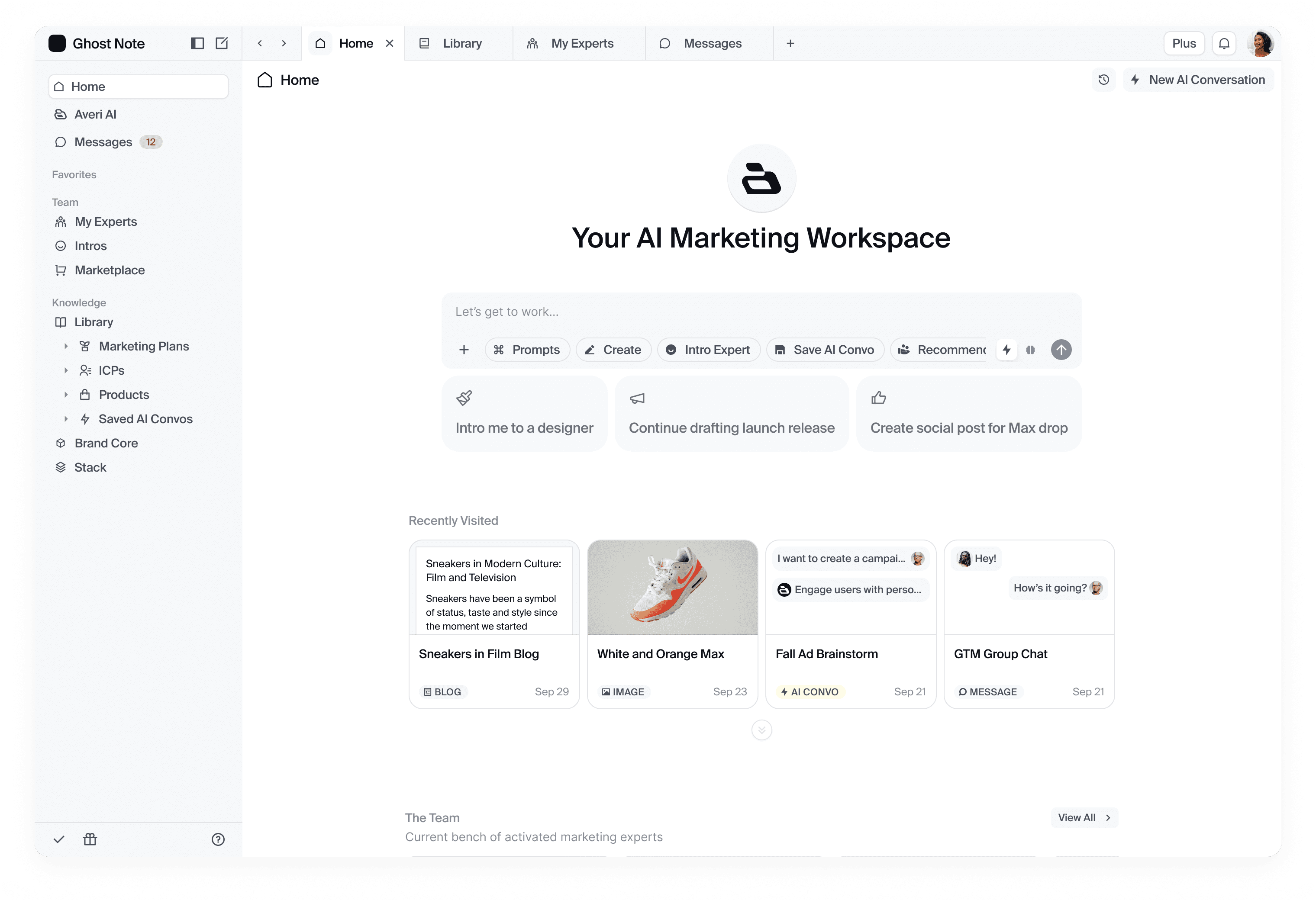
This is Exactly Why Platforms Like Averi Exist
Averi isn't just ChatGPT with a different interface. It's the strategic marketing workspace that maintains context across everything you do:
Your brand voice, positioning, and strategy live in one place. You train Averi once on how your brand communicates, who you target, and what matters. That context persists across every piece of content, campaign brief, and marketing asset you create. No more re-explaining yourself every time.
Strategic coherence by default. When you create social content, blog posts, ad campaigns, and email sequences in Averi, they're all informed by the same strategic foundation. Your messaging stays consistent because the system knows what you're trying to accomplish.
From strategy to execution without gaps. Averi combines AI-powered content creation with campaign management and access to vetted expert marketers. You're not just generating ideas—you're executing campaigns with everything coordinated in one workspace.
Think about the difference:
ChatGPT approach: Open ChatGPT. Explain your brand and campaign. Generate social posts. Open new ChatGPT conversation. Re-explain everything. Draft blog outline. Open new conversation. Describe audience again. Create ad variations. Now manually coordinate all this content, brief any external help, track what's working, iterate based on performance. Repeat tomorrow with fresh explanations.
Averi approach: Your brand context lives in the platform. You develop campaign strategy conversationally. Averi generates aligned content across all formats—social, blog, ads, email—while maintaining consistent voice and messaging. When you need specialized help (designer, paid media expert, content strategist), Averi connects you with pre-vetted professionals who receive full campaign context automatically. Everything stays coordinated. Performance informs future creation. Context compounds over time rather than resetting with each session.
This isn't about replacing ChatGPT with Averi.
It's about recognizing that using ChatGPT alone is like using a calculator when you need a full spreadsheet with formulas, data persistence, and collaboration features.
For casual content creation, ChatGPT works fine. For running actual marketing operations, you need strategic infrastructure.
The Bottom Line on AI in Marketing
92% of Fortune 500 companies are using ChatGPT, and 64% of marketing agencies rely on it for copywriting and campaign ideation. This isn't a trend you can ignore.
But the winners won't be the marketers who simply use ChatGPT. They'll be the ones who use it strategically—as part of integrated workflows that combine AI efficiency with human creativity, strategic thinking, and brand authenticity.
The 10 use cases above show what's possible when you use ChatGPT deliberately rather than defaultly. But they also reveal the limitations of using AI tools in isolation.
Your competitors are already using AI. The question is whether you'll use it better than they do—with more strategic prompts, better editing, clearer brand context, and integrated workflows that turn AI assistance into actual marketing outcomes.
Because at the end of the day, ChatGPT is a tool. A powerful one, but still just a tool.
What matters is whether you have the system to use it effectively.
Stop using AI tools in isolation.
See how Averi creates strategic coherence across your entire marketing operation →
FAQs
Will ChatGPT-generated content hurt my SEO?
Google doesn't penalize AI-generated content specifically—it penalizes low-quality content regardless of how it's created. 63.5% of people can't identify GPT-4 content, which means if it's well-edited and valuable, it performs fine.
The SEO risk isn't using AI—it's publishing generic, unhelpful content that provides no unique value. If you're using ChatGPT to create rough drafts that you then enrich with original insights, examples, and your brand perspective, you're fine. If you're publishing raw ChatGPT output with no human refinement, you're creating the kind of thin content Google explicitly devalues.
Best practice: use AI for ideation and first drafts, but always add human expertise, original research, and brand voice before publishing.
How do I make ChatGPT sound like my brand, not generic AI?
The secret is in the context you provide. Don't just ask ChatGPT to "write a social post." Give it your brand voice guidelines, target audience specifics, and examples of your best content.
Create a comprehensive brand voice prompt you reuse: "Our brand voice is [detailed description]. We write for [specific audience]. We avoid phrases like [banned terms]. Here's an example of our voice: [paste sample]. Now [specific request]."
Better yet, use a platform like Averi where your brand context persists across all content creation. You train it once on your voice, audience, and positioning—then everything generated maintains that context automatically.
Can I use ChatGPT for all my content creation?
You can, but you shouldn't. ChatGPT is excellent for:
Overcoming writer's block with first drafts
Generating variations for A/B testing
Repurposing existing content into new formats
Brainstorming angles and approaches
Handling routine marketing assets
It's not great for:
Original strategic thinking unique to your business
Content requiring recent data or trends (knowledge cutoff issues)
Building authentic brand personality without heavy editing
Creating truly differentiated positioning
The winning approach: use ChatGPT for 60-70% of the heavy lifting, then add the 30-40% of human insight, brand voice, and strategic perspective that makes content actually valuable.
How do I know if my ChatGPT prompts are good enough?
Your prompts are good enough when the first output is 70%+ usable with minor edits. If you're getting generic content that requires complete rewrites, your prompts need more specificity.
Good prompts include:
Clear audience definition with psychographic details
Desired tone and voice guidelines
Specific format or structure requirements
Examples of what "good" looks like
Constraints that narrow options
Bad prompts are vague: "Write a blog post about marketing."
Good prompts are specific: "Write a 1,200-word blog post for B2B SaaS marketers struggling with attribution. Tone should be practical and slightly skeptical of vendor claims. Include 3-4 H2 sections covering common attribution mistakes, what actually matters for tracking ROI, and a simple framework startups can implement. Target readability: 8th grade. Include 2-3 specific examples."
Does using ChatGPT mean I don't need human marketers?
No. 85% of US marketers use ChatGPT, but they're using it to augment their work, not replace themselves. AI handles routine creation and acceleration. Humans provide:
Strategic thinking about positioning and differentiation
Understanding of nuanced customer needs AI can't capture
Brand building that requires authentic personality
Creative direction and quality judgment
Relationship building with customers and partners
The most effective approach combines AI efficiency with human expertise. Platforms like Averi make this practical by connecting AI capabilities with vetted expert marketers when you need specialized skills—giving you the best of both without hiring full-time for every function.
What's the difference between using ChatGPT and using Averi?
ChatGPT is a general-purpose conversational AI. It's excellent for individual tasks but doesn't maintain context across your marketing operation, integrate with campaign execution, or connect to expert resources.
Averi is purpose-built for marketing operations.
Key differences:
Context persistence: Your brand voice, positioning, and strategic objectives live in Averi and inform all content creation. You don't re-explain yourself constantly.
Strategic coherence: All your marketing—social, content, ads, email—connects to unified strategy rather than existing in isolated conversations.
Execution integration: Averi combines AI content creation with campaign management and vetted expert marketplace. You move from strategy to execution without platform-switching.
Learning over time: Averi gets smarter about your brand as you work, while ChatGPT conversations reset each time.
Think of it this way: ChatGPT is like having a smart assistant for individual projects. Averi is like having an entire marketing department that understands your business and coordinates execution across everything you do.
How long does it take to see ROI from using AI in marketing?
For tactical time savings—generating social posts, drafting content, creating ad variations—you see ROI immediately. Tasks that took hours now take minutes.
For strategic impact—better campaign performance, improved conversion rates, more efficient resource allocation—expect 1-3 months as you refine your prompts, build brand-specific context, and learn what works for your audience.
The key accelerator: using an integrated platform rather than fragmented tools. Teams using Averi report faster ROI because the system maintains context and compounds learnings over time, while ChatGPT users often plateau after initial efficiency gains because they're constantly context-switching.
What are the biggest mistakes marketers make with ChatGPT?
Publishing raw output without editing. This creates the generic AI slop that's flooding the internet. Always add human insight and brand voice.
Vague prompting. "Write a blog post" gets generic results. Specific context and constraints get usable output.
Using it for everything. ChatGPT isn't good at original strategic thinking, real-time trend analysis, or authentic brand building. Know its limitations.
Not iterating. The first output is never the best output. Push back, refine, regenerate.
Treating it as set-and-forget. Marketing requires continuous optimization. AI should be part of an ongoing process, not a one-time solution.
Working in isolation. Using ChatGPT for individual tasks without connecting them to broader strategy creates fragmented, inconsistent marketing. Use integrated systems that maintain strategic coherence.
Should I disclose when I use AI to create content?
This depends on context and your brand values. 71.3% of people say they'll trust a brand less if it uses undisclosed AI content, suggesting transparency matters.
However, there's a difference between:
AI-assisted content (you use AI for drafting/ideation but add significant human insight and editing)
AI-generated content (minimal human input beyond prompting)
Most marketers use AI-assisted approaches and don't disclose because the final content reflects genuine human expertise and brand voice—AI was just a tool in the creative process, like spell-check or editing software.
If you're publishing mostly-raw AI output with minimal human input, disclosure is probably appropriate. If you're using AI as one tool among many in a human-led creative process, disclosure is less critical.
The ethical line: does the final content provide genuine value and reflect your actual expertise? If yes, you're probably fine. If it's just repackaged AI output with no original insight, that's when trust issues emerge.