Product-Led Growth vs. Sales-Led Growth: Which One is Right for You?

13 minutes

TL;DR
🚀 PLG is winning the growth game: Product-led companies grow 50% year-over-year vs 21% for traditional SaaS, with 83% of $100M+ ARR companies using product-led models and average company valuations double the public SaaS index
📊 The metrics tell the story: PLG delivers lower CAC, shorter sales cycles, and better scalability, while SLG provides higher CLTV and better enterprise conversion rates—but the best companies use hybrid approaches that combine both
🎯 Choose based on your reality, not trends: PLG works for intuitive products with broad appeal and network effects, while SLG excels for complex enterprise solutions requiring customization and relationship-building
🔄 Hybrid is the future: Product-led sales (PLS) combines self-service acquisition with human touch for high-value accounts, enabling companies to scale efficiently while capturing enterprise revenue
⚡ Execution beats strategy: The biggest failure isn't choosing wrong between PLG and SLG—it's poor execution of whichever approach you choose, which requires integrated systems, rapid experimentation, and teams that can adapt quickly to user feedback
The choice between PLG and SLG isn't binary anymore. It's about building systems that can execute both approaches effectively and knowing when to deploy each one.

Zach Chmael
CMO, Averi
"We built Averi around the exact workflow we've used to scale our web traffic over 6000% in the last 6 months."
Your content should be working harder.
Averi's content engine builds Google entity authority, drives AI citations, and scales your visibility so you can get more customers.
Product-Led Growth vs. Sales-Led Growth: Which One is Right for You?
The debate between product-led growth (PLG) and sales-led growth (SLG) has become one of the most contentious discussions in SaaS.
But here's the thing: it's not really a debate anymore.
The data has spoken, and the results are definitive. Product-led growth companies have a growth rate of 50% year over year, while traditional SaaS companies are growing at a more modest 21%. Meanwhile, 83% of public SaaS companies to achieve $100m ARR in their first five years use product-led models.
But that doesn't mean PLG is universally the right answer.
The most successful companies understand that the best growth strategy isn't about choosing sides—it's about understanding when each approach works, how they complement each other, and how to build execution systems that actually deliver results.
What Is Product-Led Growth (PLG)?
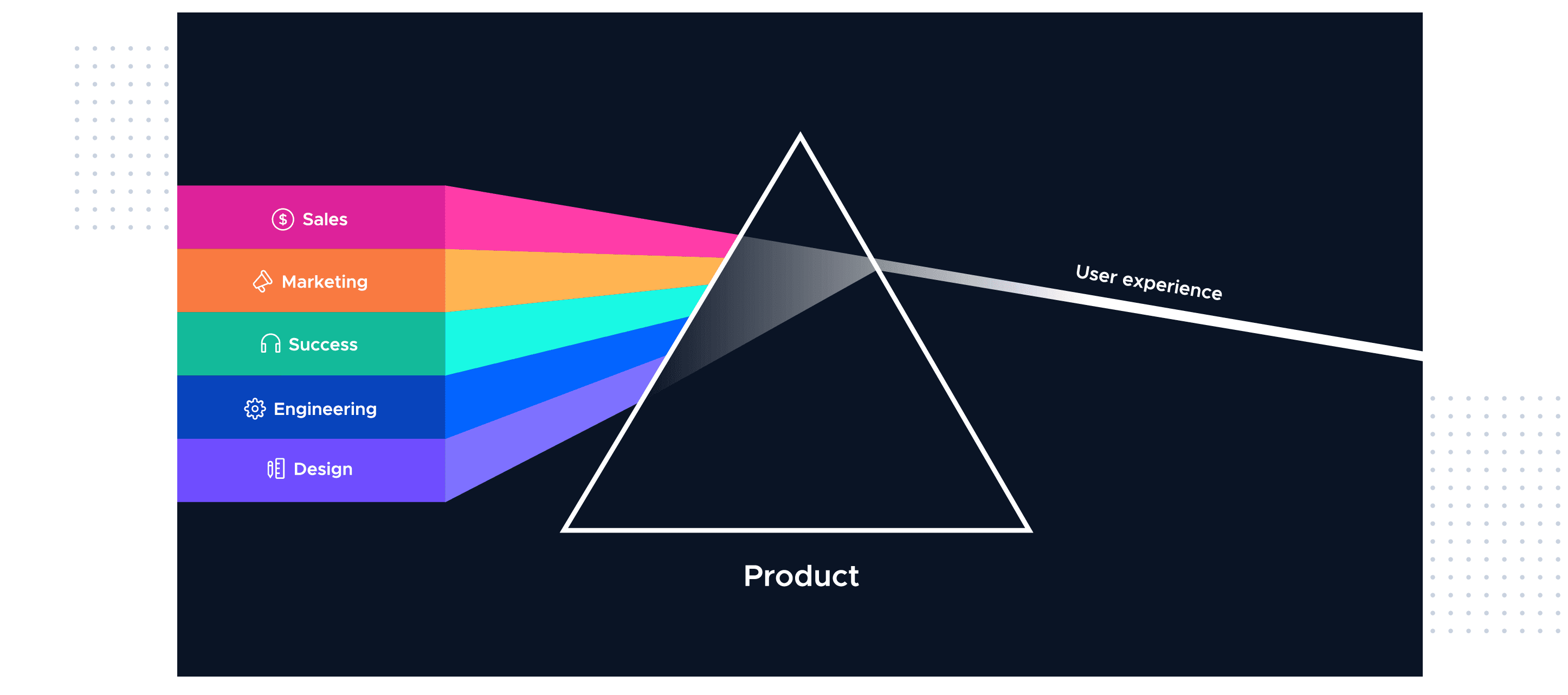
Product-led growth (PLG) is a business methodology in which user acquisition, expansion, conversion, and retention are all driven primarily by the product itself. It creates company-wide alignment across teams—from engineering to sales and marketing—around the product as the largest source of sustainable, scalable business growth.
The Core Elements of PLG
Self-Service Onboarding: In a product-led model, onboarding is designed to be self-serve. Customers can navigate the product independently, guided by in-app tours and onboarding checklists. This reduces the need for sales-assisted interactions and minimizes customer acquisition costs (CAC) while scaling the user base.
Freemium and Free Trials: Offering a freemium plan or a free trial is a cornerstone of PLG. By letting users try the product for free, SaaS businesses enable users to explore the product without upfront commitment.
Product Qualified Leads (PQLs): PQLs are users who have experienced an "aha moment" within the product and are more likely to convert into paying customers. By tracking user behavior, SaaS companies can identify these qualified leads and target them to close deals much more easily.
Viral Growth and Network Effects: The best promoter of your product is a satisfied user who recommends it to another. PLG leverages built-in product features that encourage sharing, collaboration, and inviting others.
The PLG Success Story
The numbers don't lie about PLG's effectiveness:
PLG market capitalization has grown from $21 billion in 2016 to $687 billion in 2020
The average PLG company is worth double the public SaaS index
Product-led companies are more than twice as likely to be growing quickly (100% year-on-year revenue growth) than their peers
Netflix provides a perfect example: Netflix has acquired 270 million subscribers without intervention from salespeople. Just through product-led growth and marketing.
What Is Sales-Led Growth (SLG)?
Sales-led growth (SLG) is a more traditional approach where a dedicated sales team drives customer acquisition, nurtures relationships, and works those leads to close deals. In this case, high-touch interactions, personalized outreach, and custom solutions are crucial.
The Core Elements of SLG
High-Touch Sales Process: In SLG, the sales process involves in-depth discussions, product demos, and negotiations. Sales reps work closely with potential customers, guiding them through every stage of the sales funnel and addressing specific pain points.
Personalized Outreach: Sales reps invest significant time in understanding the unique needs and goals of each client, creating customized solutions and building relationships that extend beyond the initial sale.
Account-Based Marketing (ABM): SLG strategies often focus on specific high-value accounts, using targeted approaches to reach decision-makers and stakeholders within organizations.
Relationship-Driven Revenue: Success depends on building long-term relationships with customers, often involving multiple touchpoints, demos, and negotiations before closing deals.
When SLG Still Dominates
Despite PLG's momentum, SLG remains essential in certain contexts:
Complex Enterprise Sales: When dealing with large organizations that require custom implementations, compliance considerations, and multiple stakeholder buy-in
High-Value Products: Products with significant implementation costs or complex integrations that require expert guidance
Regulatory Industries: Sectors where compliance, security, and risk management require human oversight and consultation

The Real Differences: PLG vs SLG Performance Metrics
Customer Acquisition Cost (CAC)
PLG Advantage: Product-led companies experience lower customer acquisition costs (CAC) and, therefore, better CAC payback than sales-led or marketing-led ones. The average CAC in 2024 is USD 8,000, but PLG companies often achieve significantly lower costs through self-service acquisition.
SLG Reality: For most SaaS firms, the customer acquisition cost is between $200 to $600, but enterprise SLG models often see much higher CACs due to longer sales cycles and resource-intensive processes.
Sales Cycle Length
PLG Speed: PLG often results in shorter sales cycles since users can self-serve and make buying decisions quickly. By reducing friction and streamlining the user experience, PLG allows customers to discover value and convert without extensive involvement from the sales team.
SLG Timeline: SLG typically involves longer sales cycles. Multi-stakeholder decision-making, contract negotiations, and pricing discussions extend the timeline, but the resulting deals tend to be larger and more profitable.
Customer Lifetime Value (CLTV)
PLG Volume Strategy: Product-led companies focus on acquiring a large volume of customers with lower lifetime value. The goal is to drive high user adoption at scale, then upsell or cross-sell additional features as your customer base grows.
SLG Value Strategy: Sales-led companies prioritize customers with higher CLTV from the get-go. While acquiring these customers requires more investment, the long-term value is substantial.
Conversion Rate Performance
The conversion metrics tell an interesting story:
Freemium Success Stories:
Slack offers a freemium conversion rate of over 30% by focusing on teams and network effects
Spotify had converted approximately 46% of its users from free to paid by 2022
Industry Averages:
The Market Shift: Why PLG Is Winning
Buyer Behavior Has Fundamentally Changed
The data on buyer preferences is clear:
More than half (53%) of buyers would prefer to buy without any interaction with sales at all
Three-quarters of B2B buyers prefer to self-educate rather than learn from a rep
21% of folks open up a mobile app once and then abandon it completely; by the 90-day benchmark, 71% of app users will have churned completely
The Economics Are Compelling
Capital Efficiency: Many SaaS businesses strive for $0 customer acquisition cost (CAC) and yet most still end up spending a small fortune acquiring each new customer. If you want to get to $0 CAC, product-led growth is the only way you're going to make it happen.
Scalability: PLG companies are 'always open' 24/7 and growth isn't constrained by how quickly a company can hire sales reps.
Resource Optimization: Instead of plowing funds into sales teams, PLG focuses on engineering spend that creates scalable, self-service experiences.
Post-Pandemic Acceleration
67% of survey respondents had their software budgets cut during the year, according to a 2023 Report by RevOps on the impact of economic downturn on the SaaS industry. This budget pressure has accelerated the shift toward self-service, cost-effective solutions.
When to Choose PLG vs SLG: The Decision Framework
Choose PLG When:
Your Product Is Intuitive: If your product requires little explanation and users can quickly understand its value, PLG is ideal. Think tools like Slack, Canva, or Trello where the value proposition is immediately clear.
You're Targeting Broad Markets: PLG might be the better way to go if you're looking to reach a broad audience with a scalable product, since sales assisted processes can't scale as well.
Network Effects Apply: If your product becomes more valuable as more people use it (like communication tools or collaboration platforms), PLG's viral growth mechanisms work exceptionally well.
You Have Low Marginal Costs: PLG works best when the cost of serving additional users is minimal, allowing you to offer free tiers sustainably.
Choose SLG When:
Complex Enterprise Needs: If your target market consists of enterprise clients or niche industries with specific needs, SLG may be more effective. These clients expect personalized service and are more likely to require multiple touchpoints before making a decision.
High-Touch Implementation: When your product requires significant customization, integration, or training, human guidance becomes essential.
Regulatory Requirements: In industries with strict compliance needs, buyers often require human consultation to understand how solutions meet their specific regulatory requirements.
High Contract Values: When deal sizes justify the investment in sales resources, SLG can deliver higher CLTV that offsets the increased CAC.
The Hybrid Reality: Product-Led Sales (PLS)
The most sophisticated companies aren't choosing between PLG and SLG—they're combining both approaches strategically.
What Is Product-Led Sales?
Product-led sales starts with the product at the forefront, enabling users to experience its value firsthand through free trials, freemium models, or other self-service options. Once users are actively engaged and see the product's benefits, a dedicated sales team steps in to further nurture these leads and guide them through the purchasing process.
The PLS Advantage
A new hybrid approach combines the best of both worlds — product-led sales (PLS). PLS recognizes that while a great product can attract customers, a personal touch is sometimes needed to seal the deal.
Benefits include:
Faster growth: PLS drives rapid customer acquisition and revenue expansion
Improved sales efficiency: Sales teams work with qualified leads, leading to higher conversion rates
Scalable model: PLS accommodates growth across various customer segments, from SMBs to enterprises
Real-World PLS Success
Dropbox's Evolution: Dropbox is a great example of a company that successfully implemented this model. They started with pure PLG for individual users and smaller teams, then added enterprise sales for large organizations requiring advanced security and administration features.
Slack's Approach: Slack demonstrates perfect PLS execution—teams can start using the product for free, experience the value, and then sales teams engage for enterprise features, compliance, and large-scale implementations.
Building Your Growth Strategy: Practical Implementation
Phase 1: Assess Your Current State
Product Complexity Audit:
Can users understand your core value proposition within 5 minutes of using your product?
Do users need training or extensive onboarding to realize value?
Can your product demonstrate value without human intervention?
Market Analysis:
What's your average deal size and sales cycle length?
Who are your ideal customers—SMBs, mid-market, or enterprise?
How do your competitors acquire customers?
Resource Evaluation:
What's your current CAC across different channels?
How much of your budget goes to sales versus product development?
What's your current conversion rate from trial/demo to paid customer?
Phase 2: Choose Your Primary Strategy
For PLG-First Approach:
Optimize Your Product Experience
Build intuitive onboarding flows that guide users to their first "aha moment"
Implement usage-based triggers that prompt upgrades at the right time
Create viral loops that encourage sharing and collaboration
Implement Self-Service Infrastructure
Design pricing tiers that create natural upgrade paths
Build in-product prompts that highlight premium features
Create comprehensive self-help resources and documentation
Track PLG-Specific Metrics
Product Qualified Leads (PQLs) based on usage patterns
Time to value and activation rates
Feature adoption and upgrade triggers
For SLG-First Approach:
Build Sales Infrastructure
Develop targeted outreach sequences for ideal customer profiles
Create demo environments and sales collateral
Implement CRM systems for relationship management
Optimize Sales Processes
Map customer journey stages and required touchpoints
Develop objection-handling frameworks and competitive battle cards
Create custom pricing and proposal templates
Track SLG-Specific Metrics
Sales Qualified Leads (SQLs) and conversion rates by stage
Average deal size and sales cycle length
Sales team productivity and quota attainment
Phase 3: Build Hybrid Capabilities
Even if you start with one approach, the most successful companies eventually incorporate elements of both:
PLG → PLS Evolution:
Start with self-service acquisition
Identify high-value users through product usage data
Engage sales for enterprise features and large deals
SLG → PLS Evolution:
Introduce free trials or freemium tiers
Use product usage to qualify and prioritize leads
Let the product assist in the sales process
Common Implementation Mistakes (And How to Avoid Them)
PLG Mistake 1: Too Much Too Fast
The Problem: Offering extensive free features without clear upgrade incentives.
The Solution: Successful freemium models require strategic feature limitations to encourage upgrades. Study Slack's approach—they provide significant value but create clear pain points (like message history limits) that drive upgrades.
PLG Mistake 2: Ignoring the Human Element
The Problem: Assuming the product can handle all sales situations.
The Solution: Even PLG companies need sales teams for enterprise deals, complex implementations, and relationship management. Build hybrid capabilities from the start.
SLG Mistake 1: Over-Engineering the Sales Process
The Problem: Creating complex, lengthy sales cycles that frustrate modern buyers.
The Solution: Incorporate self-service elements that let prospects experience value before engaging with sales. Use product demos and trials to accelerate the sales process.
SLG Mistake 2: Ignoring Product Experience
The Problem: Relying entirely on sales teams to convey value without investing in product experience.
The Solution: Even in SLG models, the product experience during demos and trials significantly impacts conversion rates. Invest in making your product intuitive and valuable from the first interaction.
Technology Stack Considerations
PLG Technology Requirements
Analytics and Tracking:
Product analytics tools to track user behavior and identify PQLs
Cohort analysis capabilities to understand activation and retention patterns
A/B testing infrastructure for onboarding and feature adoption
Automation Infrastructure:
Email automation for lifecycle messaging and upgrade prompts
In-app messaging systems for contextual feature promotion
Usage-based billing and subscription management
Self-Service Capabilities:
Comprehensive documentation and help centers
Community forums and user-generated content platforms
Live chat and chatbot support for immediate assistance
SLG Technology Requirements
CRM and Sales Infrastructure:
Robust CRM systems for lead and opportunity management
Sales automation tools for outreach and follow-up
Proposal and contract management systems
Relationship Management:
Account-based marketing platforms for targeted outreach
Video conferencing and demo platforms
Customer success platforms for post-sale relationship management
Hybrid Technology Stack
The most flexible approach involves platforms that support both PLG and SLG motions:
Unified Customer Data: Systems that track both product usage and sales interactions
Integrated Analytics: Platforms that provide insights across the entire customer journey
Flexible Billing: Solutions that support both self-service and custom enterprise pricing
The Averi Advantage for Hybrid Growth
This is exactly where Averi excels. Instead of forcing you to choose between PLG and SLG tools, Averi provides an integrated approach that:
Unifies Go-to-Market Intelligence: Combines product usage data with sales insights to identify the best approach for each prospect
Automates Hybrid Workflows: Seamlessly transitions prospects between self-service and sales-assisted experiences based on behavior and value signals
Connects Strategy to Execution: Provides both AI-powered optimization and human expertise to execute whatever growth strategy makes sense for your business
Whether you're building pure PLG motions, complex SLG processes, or hybrid approaches, Averi adapts to your strategy rather than forcing you into a specific playbook.
Measuring Success: KPIs for Each Approach
PLG-Specific Metrics
Acquisition Metrics:
Sign-up conversion rate from website traffic
Organic growth rate and viral coefficient
Cost per acquisition through different channels
Activation Metrics:
Time to first value and aha moment completion
Feature adoption rates and usage depth
Onboarding completion rates
Retention and Expansion:
User retention rates at 30/60/90 days
Feature usage progression and upgrade triggers
Net revenue retention from existing users
SLG-Specific Metrics
Pipeline Metrics:
Lead qualification rates and SQL conversion
Pipeline velocity and deal progression
Win rates by deal size and competitor
Sales Efficiency:
Sales cycle length and time to close
Average deal size and quota attainment
Sales productivity and activity metrics
Relationship Quality:
Customer satisfaction and Net Promoter Score
Upsell and cross-sell rates from existing accounts
Customer lifetime value and churn rates
Hybrid Model Metrics
Cross-Motion Effectiveness:
PLG to sales handoff conversion rates
Product usage influence on sales cycle length
Revenue attribution across PLG and SLG channels
Unified Customer Experience:
Customer journey completion rates across touchpoints
Experience consistency scores between self-service and sales
Overall customer satisfaction with hybrid interactions
Industry-Specific Considerations
SaaS and Technology
PLG Dominance: Most pure SaaS plays benefit from PLG approaches, especially for standardized tools with broad applicability. The self-service nature aligns with how technical buyers prefer to evaluate tools.
SLG Necessity: Complex enterprise software, security tools, and industry-specific solutions often require SLG approaches due to customization needs and compliance requirements.
Financial Services
Regulatory Requirements: In industries with strict compliance needs, buyers often require human consultation. SLG remains dominant for core financial services products.
Emerging PLG: Fintech startups are successfully using PLG for simpler products like expense management, payment processing, and financial analytics tools.
Healthcare and Life Sciences
Compliance-Heavy SLG: Traditional healthcare solutions require extensive validation, training, and compliance verification that necessitates human involvement.
PLG Opportunities: Consumer health apps, wellness platforms, and simple practice management tools can leverage PLG effectively.
E-commerce and Retail
Natural PLG Fit: Most e-commerce tools, marketing automation platforms, and retail analytics solutions work well with PLG approaches.
Enterprise SLG: Large-scale implementations, custom integrations, and omnichannel solutions often require SLG support.
Future Trends: The Evolution of Growth Models
AI-Powered Hybrid Models
Artificial intelligence is enabling more sophisticated hybrid approaches:
Predictive Routing: AI systems that automatically determine whether prospects should enter PLG or SLG tracks based on behavior and characteristics
Dynamic Pricing: AI-powered pricing that adapts based on user engagement and willingness to pay signals
Personalized Experiences: AI that customizes both product experiences and sales interactions based on individual user profiles
Customer-Led Growth (CLG)
Customer-led growth starts not with your funnel, but with your user. This approach is centered around real customer needs. Growth happens when teams build feedback loops and translate customer insights into action.
Unlike marketing-led growth, which broadcasts a message, or sales-led growth, which drives relationships through a team, customer-led growth is about co-creating value with your audience.
The Rise of Community-Led Growth
Community-driven approaches are emerging as a powerful complement to both PLG and SLG:
User Communities: Platforms where customers help each other, reducing support costs and increasing engagement
Partner Ecosystems: Networks of complementary tools and services that drive mutual growth
Content Communities: User-generated content that demonstrates value and drives organic acquisition
Making the Decision: Your Next Steps
Week 1-2: Diagnostic Assessment
Customer Analysis:
Survey recent customers about their buying journey preferences
Analyze support tickets and sales calls to understand complexity points
Map your customer segments by company size, industry, and use case
Product Evaluation:
Conduct user testing to measure time-to-value
Analyze current trial-to-paid conversion rates
Identify the core features that drive upgrade decisions
Competitive Benchmarking:
Research how direct competitors acquire customers
Analyze their pricing models and free offering strategies
Identify gaps in the market that your approach could fill
Week 3-4: Strategy Selection
Decision Framework Application:
Score your product across key PLG vs SLG factors
Calculate the ROI potential of each approach based on your metrics
Consider your team's current capabilities and resource constraints
Pilot Design:
Design a 90-day pilot to test your chosen approach
Set clear success metrics and timeline for evaluation
Identify the resources and tools needed for implementation
Month 2-3: Implementation and Testing
Rapid Experimentation:
Launch your pilot with a subset of prospects or existing customers
Implement tracking systems to measure key performance indicators
Gather qualitative feedback through user interviews and surveys
Iterative Optimization:
Weekly reviews of pilot performance data
Rapid adjustments based on user behavior and conversion metrics
Documentation of learnings and best practices
Month 4-6: Scale and Hybrid Development
Full Rollout Preparation:
Expand successful pilot elements to broader customer base
Build operational infrastructure to support chosen approach
Train team members on new processes and tools
Hybrid Capabilities:
Begin building capabilities for the complementary approach
Design handoff processes between PLG and SLG motions
Implement unified tracking and attribution systems

The Execution Reality
Here's what most growth strategy discussions miss: the execution gap.
You can have the perfect PLG or SLG strategy on paper, but if you can't execute it effectively, it's worthless. Most companies fail not because they chose the wrong approach, but because they couldn't implement it properly.
Common execution failures:
PLG companies that build terrible onboarding experiences
SLG companies with unprepared sales teams and poor follow-up
Hybrid companies with disconnected systems and inconsistent messaging
All companies that choose tools based on features rather than outcomes
What successful execution looks like:
Rapid testing and iteration based on real user feedback
Integrated systems that provide unified insights across the customer journey
Teams that understand both the strategy and the tactics needed to make it work
Technology that connects strategy to execution without gaps
This is the fundamental challenge that Averi was built to solve—not just helping you choose the right growth strategy, but ensuring you can execute it effectively with the right combination of AI optimization and human expertise.
Ready to build a growth strategy that actually gets executed?
See how Averi helps companies implement effective PLG, SLG, and hybrid approaches →