

In This Article
Turn real-time data into actionable campaign choices with AI: monitoring, forecasting, automated budget shifts, and human-guided safeguards.
Updated:
Trusted by 1,000+ teams
Startups use Averi to build
content engines that rank.
AI is transforming marketing campaigns by turning raw data into actionable strategies in real time.
Marketers no longer need to rely on guesswork or wait for end-of-month reports. AI tools like Averi AI and Copy.ai analyze campaign performance, predict outcomes, and even automate adjustments, saving time and boosting results. For example, Lenovo saved $16 million in a year by automating workflows, while other companies saw execution time cut by 40% and campaign performance improve by 25%.
Key highlights:
Real-time monitoring: Instantly track metrics like click-through rates (CTR) and conversions.
Predictive analytics: Forecast outcomes and optimize budgets proactively.
Automated adjustments: AI reallocates resources to high-performing channels.
Unified platforms: Tools like Averi AI integrate data, reducing reliance on multiple systems.
AI makes campaign tracking faster, smarter, and more efficient, but success requires clean data, clear KPIs, and human oversight to ensure alignment with brand goals.
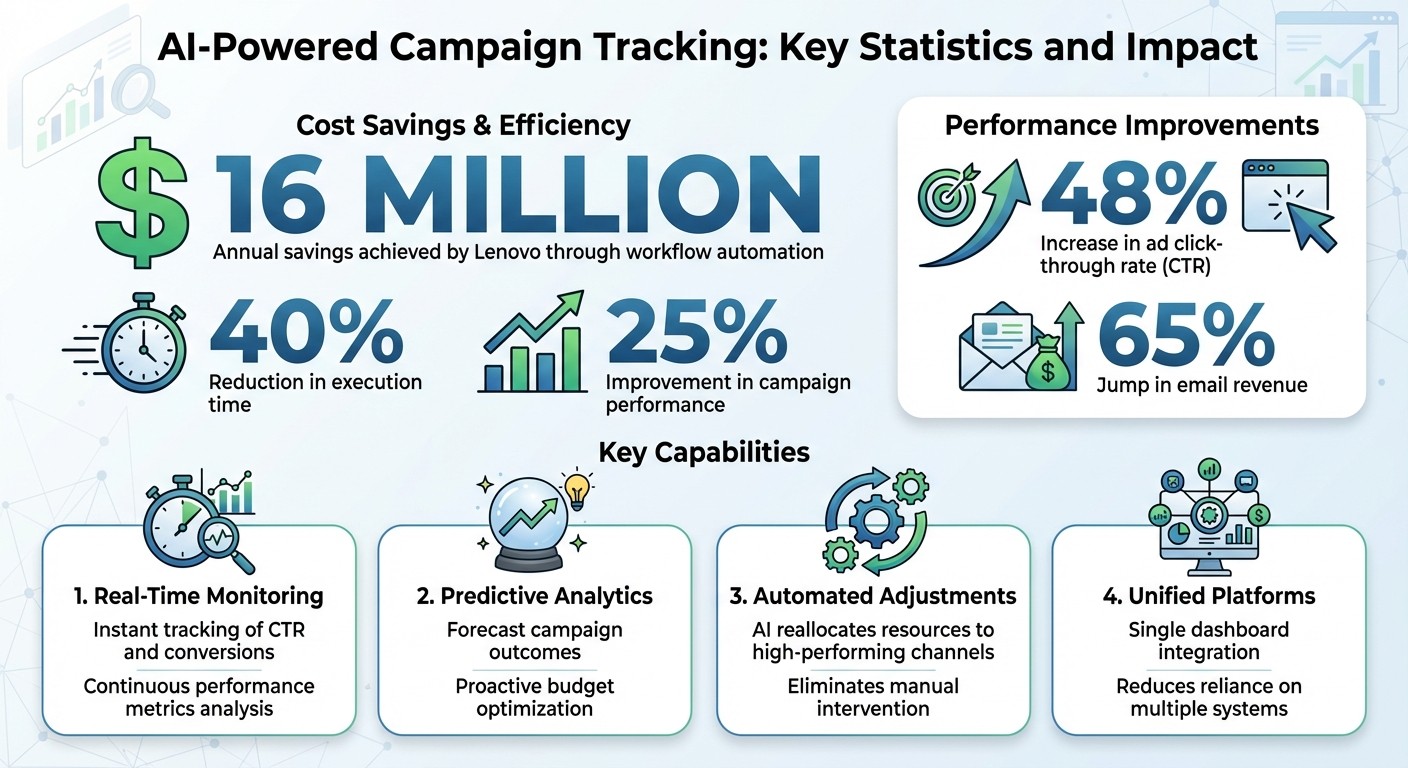
AI Campaign Tracking Benefits: Key Statistics and ROI Impact
From All-Nighters to AI: How a Marketer Automated Ad Monitoring
How AI Improves Campaign Tracking
AI has reshaped campaign tracking by handling tasks at a speed and scale far beyond human capability. It processes data in real time, identifies patterns, and provides actionable insights - eliminating the need to wait for end-of-month reports. Marketers can now instantly see what's working and what needs adjustment.
The real game-changer is how AI consolidates data and accelerates decision-making. By integrating information from revenue systems, analytics tools, and advertising platforms into a single, unified dashboard, AI removes the hassle of switching between multiple tools. This streamlined approach enables immediate analysis and action. For instance, if AI detects strong click-through rates on paid social ads but notices poor content retention, it not only flags the issue but also suggests channel-specific solutions and an actionable plan [1][2].
"Averi cut through the noise and gave us what we actually needed... a clear path from insight to campaign. No more guessing, no more wasted effort." – Laura, Cove & Current [1]
The impact of AI is evident across organizations, as it combines real-time monitoring, predictive analytics, and automated adjustments to deliver measurable results.
Real-Time Data Analysis and Monitoring
Real-time monitoring allows marketers to address issues before they become costly. AI continuously processes performance metrics from various channels, analyzing indicators like click-through rates as they are updated [1]. This ongoing analysis highlights both high-performing and underperforming areas, empowering teams to make informed decisions mid-campaign rather than waiting for post-campaign reviews.
The technology behind this capability is crucial. AI platforms pull data from advertising tools, analytics systems, and revenue databases, integrating it into a single, comprehensive view [1][2]. This eliminates the delays associated with manual data collection, giving teams instant access to performance updates.
Predictive Analytics for Better Planning
Predictive analytics shifts AI from merely reporting past performance to forecasting future outcomes. By analyzing historical trends alongside current data, AI can predict campaign results and recommend adjustments to prevent stagnation [1][2]. For example, Copy.ai's GTM platform uses its "Deal Coaching + Forecasting" feature to examine sales transcripts, score deals, suggest strategies, and predict close dates [2]. This forward-looking approach enables marketers to allocate resources to campaigns with the highest potential for success, optimizing performance in real time based on anticipated results [1].
Automated Adjustments and Smarter Budget Allocation
AI doesn't stop at making recommendations - it can execute changes automatically based on live performance data. If a campaign underperforms, AI can reallocate budget to better-performing channels [1]. This goes beyond simple budget redistribution; AI evaluates multiple factors, such as current metrics, historical performance, budget constraints, and campaign goals, to craft tailored solutions and implementation plans [1].
The financial benefits of these automated adjustments are substantial. Roman Olney, Lenovo's Head of Global Digital Experience, shared that Copy.ai saved the company $16 million in a single year by automating complex agency workflows [2]. By removing manual tasks and optimizing resource allocation, AI has proven its ability to deliver significant cost savings while enhancing campaign efficiency at scale.
AI Campaign Tracking Tools and Platforms
The landscape of AI-driven campaign tracking tools is vast, ranging from specialized analytics platforms to all-in-one marketing workspaces that combine monitoring, automation, and execution. As we’ve seen with AI’s role in real-time monitoring, understanding the differences between these tools is essential for finding the best match for your team.
Comparing Popular Tools
Traditional analytics platforms often require manual interpretation and multiple tools to manage content and execution. On the other hand, AI-native platforms simplify these processes by automating repetitive tasks and centralizing data. For example, tools like Copy.ai excel at automating go-to-market strategies and broader audience engagement but may lack the ability to make detailed, real-time campaign adjustments [2]. Among the available options, Averi AI distinguishes itself as a robust, full-service marketing workspace.
Averi AI: A Complete Marketing Solution
Averi AI takes a different approach by offering a unified marketing workspace instead of just another standalone tool. Built on Synapse and AGM-2, it combines strategy, content creation, and campaign execution into one seamless platform while also providing access to vetted specialists [1]. Unlike other tools that require constant switching between different dashboards, content editors, and project management systems, Averi streamlines the entire workflow in one place.
"Averi doesn't just give us insights, it helps us act on them. That's the gap every other platform misses. We're finally turning data into real campaigns." – David, Thorn [1]
One company replaced a patchwork of disconnected tools with Averi, reducing execution time by 40% and improving campaign performance by 25% [1]. Its Brand Core feature customizes the AI to align with specific business data, ensuring that all outputs reflect the brand’s unique voice and strategy. This balance of AI-driven efficiency and human oversight highlights the platform’s ability to deliver actionable results without compromising on brand integrity.
Best Practices for AI-Powered Campaign Tracking
Running successful AI-powered campaigns hinges on setting clear KPIs, blending human expertise with AI capabilities, and staying alert to performance shifts. These elements are critical for keeping campaigns efficient and responsive.
Focus on Key Performance Indicators (KPIs)
Zero in on metrics that align with your business goals. With AI capable of tracking a vast range of data points, it’s easy to get overwhelmed. Instead, concentrate on KPIs that directly impact your objectives. Metrics like click-through rate (CTR), customer acquisition cost (CAC), email revenue, pipeline growth, organic traffic, content retention, and speed-to-lead are often the most telling. For example, Micah J, a graphic design professional leveraging Averi AI, improved ad CTR by 48%, while Emily Z saw a 65% jump in email revenue by refining their focus on targeted KPIs [1]. AI’s strength lies in recognizing patterns across these metrics in real time, helping you quickly pinpoint high-performing campaigns or areas needing intervention.
Leverage AI for actionable insights. Beyond tracking, AI tools can interpret KPI data and suggest next steps. For instance, if Averi AI detects strong CTRs in paid social campaigns but notices a drop in content retention, it might recommend: "Your paid social CTRs are strong, but content retention is lagging - want me to map fixes by channel?" [1]. This capability turns raw data into actionable strategies, saving your team hours of manual analysis.
While AI highlights opportunities and issues, human judgment remains essential for making meaningful decisions based on these insights.
Combine AI with Human Oversight
AI handles speed and volume; humans bring strategy and creativity. The most effective campaigns strike a balance: AI automates data analysis and drafts initial content, while humans refine strategies, ensure brand consistency, and make final calls. As Averi AI aptly states, "Gen AI plus human expertise, not instead of" [1]. Training your AI to understand your brand’s voice, values, and goals ensures its outputs align with your identity from the start. Tools like Averi's "/create Mode" combine AI-generated drafts with human editing, enabling quicker production of polished content [1].
Establish clear boundaries for AI-driven actions. While AI can automate adjustments, it needs human-defined guardrails to ensure its decisions align with your strategic goals. Platforms like Copy.ai’s "Agents" integrate automation with human oversight, creating a system where AI operates within limits set by experts [2].
"The AI handles what it should, and my team handles what we do best. No confusion about roles, no redundant work. Just better marketing, faster." – Kevin, Fieldgrade [1]
This balance between automation and human input ensures campaigns stay on track without sacrificing strategy or creativity.
Use Real-Time Alerts and Sentiment Analysis
Monitor performance shifts with real-time alerts. AI tools can instantly flag sudden changes in metrics like CTR, conversion rates, or engagement levels, enabling your team to act quickly. Whether it’s capitalizing on unexpected successes or addressing potential issues, these alerts keep your campaigns agile. Additionally, AI platforms that analyze customer interactions - such as sales transcripts or social media comments - can extract sentiment insights. These insights not only guide immediate campaign adjustments but can also enhance deal coaching and customer engagement strategies [2].
The goal is to move beyond passive monitoring and use these insights to drive proactive, real-time improvements to your campaigns.
Challenges and Future Directions
While AI holds immense potential, marketers still face significant hurdles in creating campaign tracking systems that truly deliver. One of the most pressing issues is data fragmentation. Marketing teams often deal with "GTM bloat", where disconnected tools fail to work together. Paid social data, email metrics, and content performance often live in separate silos, making it difficult for AI to provide cohesive insights. To overcome this, consolidating these scattered data sources into a unified foundation is critical. However, this process demands a considerable upfront investment and ongoing maintenance [2]. The fragmented nature of these systems highlights the growing need for integrated platforms built specifically with AI in mind.
Another challenge is poor data quality, which only makes integration more difficult. Issues like inconsistent naming conventions, duplicate records, incomplete customer profiles, and outdated campaign tags can severely impact performance. Without standardized and clean data, even the most advanced AI systems struggle to offer reliable recommendations.
Maintaining AI systems also requires constant calibration and fine-tuning. Marketers need to curate data carefully, adhere to brand guidelines, and establish ethical boundaries. This is not a one-time effort; it’s an ongoing process that evolves alongside campaigns and the AI itself [2].
Looking to the future, the industry is shifting toward consolidated, AI-native platforms. These platforms aim to replace fragmented tools with unified systems that streamline workflows and improve tracking. Emerging technologies like AI Agents, which can automate specific tasks using decision-making frameworks, and advanced workflows embedded with marketing best practices, promise deeper personalization. These innovations also enable more sophisticated predictive modeling, allowing marketers to anticipate changes in campaign performance before they occur. By addressing fragmentation, these platforms are poised to deliver smarter, real-time decision-making.
The path forward requires marketing teams to move beyond isolated tools and embrace AI-human collaboration. This approach balances the speed and efficiency of AI with the strategic insights that only humans can provide [2].
Conclusion
AI-powered campaign tracking has reshaped the way marketers monitor and refine their efforts. By building on earlier insights, these systems enable ongoing improvements through automated processes. Features like real-time data analysis and predictive analytics allow marketers to anticipate outcomes before they occur. Automated budget adjustments and precise targeting remove much of the guesswork, ensuring campaigns evolve and improve without requiring constant manual oversight.
This underscores the importance of adopting unified AI solutions. The challenge isn’t merely using AI but implementing it effectively. As mentioned earlier, fragmented and low-quality data remain significant hurdles. The answer lies in AI-native platforms that seamlessly integrate tools, combining the speed of AI with the strategic thinking only humans can provide.
Averi AI stands out by offering complete workflow integration. Instead of being just another standalone tool, it acts as a comprehensive AI Marketing Workspace. Here, marketing-trained AI collaborates with human experts in a unified process. For example, Indy from Lucid AI noted a 40% faster execution time and a 25% improvement in performance when using this approach [1]. This illustrates how blending advanced analytics with human insight can revolutionize campaign tracking. It’s not about AI replacing marketers - it’s about creating systems where the two work in harmony.
The real edge now belongs to teams that can transition seamlessly from insights to execution. Platforms like Averi close the gap between analyzing data and executing campaigns, ensuring tracking insights lead to tangible performance gains. As these technologies advance, the collaboration between AI and human expertise will continue to redefine how marketing campaigns are executed.
FAQs
How does AI enhance real-time campaign tracking and decision-making?
AI takes real-time campaign tracking and decision-making to the next level by offering constant performance monitoring and rapid data analysis. It spots emerging trends, forecasts potential outcomes, and suggests adjustments, helping marketers refine their strategies on the fly. This ensures campaigns remain aligned with goals and quickly adapt to shifting circumstances without missing a beat.
What challenges might arise when using AI for campaign tracking?
Using AI for campaign tracking isn't without its hurdles. One of the biggest is maintaining accurate and consistent data. AI tools depend heavily on clean, well-integrated data to produce meaningful insights. If the data foundation is shaky, the reliability of performance monitoring takes a hit.
Another obstacle involves data privacy and compliance. With laws like GDPR and CCPA in place, marketers must carefully navigate how data is gathered and used, adding layers of complexity to the process. On top of that, integrating AI tools into pre-existing marketing systems or workflows can be technically challenging, often requiring significant time and effort.
Finally, while AI excels at delivering insights, human oversight remains indispensable. Interpreting the findings, making strategic calls, and fine-tuning campaigns still demand a human touch to ensure success.
How do AI tools like Averi AI stay aligned with your brand's goals?
Averi AI ensures your brand's identity remains intact by using advanced training on your unique brand assets, guidelines, and tone. This approach guarantees that every piece of content it generates stays consistent with your brand's voice.
To make the process even more precise, Averi combines AI capabilities with human expertise. Skilled professionals review and fine-tune the AI's outputs, making sure they align with your brand's standards and objectives. Over time, the platform evolves, allowing for continuous updates to match any shifts in your brand strategy.
Related Blog Posts

Zach Chmael
CMO, Averi
"We built Averi around the exact workflow we've used to scale our web traffic over 6000% in the last 6 months."
Your content should be working harder.
Averi's content engine builds Google entity authority, drives AI citations, and scales your visibility so you can get more customers.