

In This Article
Practical guide to implement AI attribution: set goals, unify privacy-compliant data, choose suitable models, run pilots, and act on insights for smarter budgets.
Updated:
Trusted by 1,000+ teams
Startups use Averi to build
content engines that rank.
AI attribution models are transforming how businesses understand customer journeys and allocate marketing budgets. By analyzing data across multiple platforms and channels, these models provide actionable insights to improve performance and efficiency. Here's a quick breakdown of the key takeaways:
Set clear goals: Define measurable outcomes like reducing Customer Acquisition Cost (CAC) or increasing organic traffic.
Ensure clean, privacy-compliant data: Consolidate and standardize data from all marketing tools while respecting privacy laws.
Choose the right model: Multi-touch, algorithmic, or hybrid models should align with your sales cycle and data complexity.
Start small: Test AI models with pilot campaigns before scaling gradually.
Act on insights: Use attribution data to reallocate budgets in real-time for better results.
Refine continuously: Validate and adjust models regularly to reflect changing customer behavior.
Integrate insights into workflows: Automate and embed attribution insights into daily marketing tools.
Document processes: Maintain clear governance and compliance records to ensure transparency and accountability.
These steps help turn attribution insights into immediate actions, driving smarter marketing decisions and improving campaign outcomes.
Digital Marketing Attribution in 2025: Challenges and Solutions
1. Define Your Attribution Goals and Scope
Before diving into an AI-powered attribution model, it’s essential to establish clear, measurable goals. Vague ambitions won’t cut it. Pinpoint specific outcomes like lowering Customer Acquisition Cost (CAC), generating more pipeline, or driving up organic traffic. Other goals might include boosting email revenue or increasing ad click-through rates. Companies that approached AI attribution with well-defined objectives have seen impressive results - pipeline growth of 220%, a 65% uptick in email revenue, and a 380% surge in organic traffic [1]. Having this clarity upfront lays the foundation for a more effective attribution strategy.
Your next step? Broaden the scope to include every touchpoint that plays a role in conversions. Don’t just focus on the obvious ones. Incorporate data from revenue platforms, analytics tools, and advertising channels across your entire go-to-market strategy. This means accounting for prospecting efforts, content performance (like SEO, thought leadership, and social media), inbound lead handling, account-based marketing, and even deal coaching [2]. The more comprehensive your scope, the better AI can pinpoint which interactions are truly driving results.
It’s also vital to align your attribution goals with your business’s key performance indicators (KPIs). This ensures that marketing activities are directly tied to revenue outcomes, turning attribution into a strategic tool rather than just a reporting mechanism.
Finally, use attribution insights to streamline operations. For instance, focus on reducing lead response times, improving conversion rates, or gaining a deeper understanding of target accounts and personas. These insights can help shape your attribution model into a key driver of both performance and efficiency [2].
2. Build Clean, Privacy-Compliant Data Foundations
The effectiveness of your AI attribution model hinges on the quality of the data it processes. To ensure accuracy, start by bringing together data from all corners of your marketing stack into a single, accessible foundation. This means integrating information from your CRM, ad platforms, email marketing tools, web analytics, and any other system that interacts with your customers. Without this consolidation, your AI could end up working with incomplete or conflicting information, leading to unreliable insights.
Once your data is unified, centralize it in a single repository that serves as the ultimate source of truth. This repository should house everything from product details and brand guidelines to customer segments and campaign performance metrics. This setup ensures that your attribution model consistently pulls accurate and harmonized data, eliminating the need to reconcile discrepancies from multiple sources.
Respecting privacy is non-negotiable. Before diving into tracking and attribution, ensure your data collection practices align with regional privacy laws. This includes implementing consent mechanisms, being upfront about what data is being tracked, and giving users control over their information. Make privacy safeguards an integral part of your data strategy from the start, not an afterthought.
Standardization is critical for seamless data flow. Inconsistent naming, tagging, or formatting across teams can create chaos for your attribution model. Establish clear standards for campaign labels, data tags, and file formats, and ensure everyone follows them. Document these guidelines and make them accessible to all team members to avoid confusion.
Lastly, prioritize security by using a reliable platform to manage your data. Since your attribution system will handle sensitive customer and revenue information, robust security measures are essential to protect data integrity and prevent breaches. A secure platform ensures that your system remains trustworthy while maintaining compliance with privacy regulations.
3. Select Attribution Models That Fit Your Business
Choosing the right attribution model depends on your specific business needs. Factors like the length of your sales cycle, the mix of marketing channels you use, and the data you have available all play a role. For instance, a B2B software company with a six-month sales cycle will need a different approach than an e-commerce brand that closes sales within hours.
Here’s a closer look at the three main attribution models: multi-touch, algorithmic, and hybrid.
Multi-touch attribution assigns credit to every touchpoint along the customer journey. This model works well when you rely on multiple channels - like paid search, email, social media, and content - that interact to drive results. However, it has its limitations. By default, it credits each touchpoint equally unless you apply custom weighting, which can introduce bias into your analysis.
Algorithmic attribution leverages machine learning to distribute credit based on patterns found in your data. It’s ideal for businesses with large datasets and complex customer journeys, as it uncovers relationships that manual models might miss. That said, it requires a significant amount of data - usually thousands of conversions - to function effectively. Additionally, it can be challenging to explain how the system assigns credit, which may cause concerns among stakeholders.
Hybrid models blend rule-based logic with machine learning insights. For example, you could use a multi-touch framework to ensure certain touchpoints consistently receive credit while allowing AI to optimize the rest. This approach offers a balance between strategic control and the advanced pattern recognition of machine learning. It’s particularly useful for businesses transitioning from manual to AI-driven models, as it combines human judgment with data-driven insights.
To find the best fit, map out your customer journey and identify key touchpoints. If your journey is straightforward, a simpler model may suffice. But for multi-session, multi-channel journeys, a more sophisticated approach will provide deeper insights. Ultimately, the model you choose should align with the way your customers make buying decisions.
4. Roll Out AI Models in Phases
Start small by launching a pilot campaign to test the waters and manage variables effectively. Focus on one channel or campaign - whether that’s paid search, email marketing, or a specific product launch.
With clear goals and a solid data foundation, kick off your pilot to conduct targeted testing. Be sure to monitor key performance metrics closely. For instance, AvDerm AI ran a micro-influencer campaign as a pilot and achieved a 65% increase in referral traffic within just one month [1].
Once the pilot wraps up, compare the results against a baseline to evaluate its success. You can either measure the AI model’s performance against your previous attribution method or run both approaches side by side for a few weeks. Look for measurable improvements, such as faster execution, better cost efficiency, or more precise channel credit allocation. If the pilot delivers clear benefits, document what worked and what didn’t. Use these findings to guide the next steps.
From there, scale up gradually. Add one channel at a time, applying the lessons learned from the pilot. This step-by-step process gives you the chance to fine-tune the model’s parameters, train your team on new workflows, and address any data quality issues before they affect broader operations. Treat each phase of expansion as its own pilot, complete with a validation period. These incremental steps will help you seamlessly integrate AI attribution into your overall marketing strategy.
5. Connect Attribution Insights to Budget Decisions
Once you've established strong data foundations and phased rollouts, the next step is to let actionable insights guide your spending decisions. Attribution data becomes valuable only when it drives immediate shifts in budget, redirecting funds from underperforming channels to those delivering results.
Focus on critical metrics like Customer Acquisition Cost (CAC), Click-Through Rate (CTR), and pipeline generation, as these directly influence your bottom line. AI tools can uncover patterns - such as high CTRs on paid social campaigns paired with low content retention - and suggest targeted fixes for specific channels. This data-driven strategy allows for quick and effective budget reallocation.
The real advantage lies in acting on these insights without delay. AI platforms that combine revenue, analytics, and advertising data offer a unified view, making it easier to adjust budgets on the fly [1]. Instead of juggling reports and spreadsheets, these systems analyze performance and suggest precise budget shifts. For instance, if display ads generate high impressions but fail to convert, the AI might propose reallocating part of that budget to channels with stronger conversion rates.
The key isn't just having better data - it's the ability to turn those insights into real-time campaign optimizations.
6. Test, Compare, and Refine Your Models
To ensure your attribution models accurately reflect customer conversions, ongoing validation is essential. A proven method is holdout testing, where you exclude a segment of your audience from certain marketing touchpoints. By comparing actual outcomes from this group with the predictions of your model, you can gauge how well the model aligns with real-world behavior.
Another valuable approach is running controlled experiments. Set up a control group that doesn’t receive specific interventions, then compare their conversion rates with those of the group exposed to the interventions. If the results are too similar, it might indicate that the model is overvaluing that particular channel, signaling the need for recalibration.
Dive into your conversion data and compare it against the model’s output to spot patterns of over- or under-crediting specific channels. For instance, you might need to adjust factors like time-decay settings, the weight assigned to each touchpoint, or how assisted conversions are treated compared to last-click attribution.
Pay attention to key parameters like the lookback window, channel weightings, and how conversions are defined. If you notice high engagement but low conversion rates, it might be time to tweak these settings. For example, extending the lookback period could offer a clearer view of customer journeys, especially if your audience tends to take longer to make decisions.
Keep a close eye on performance metrics and refine the model as customer behavior shifts. Regular updates will not only improve accuracy but also provide insights that can guide smarter budget allocation.
7. Integrate Attribution into Your Marketing Workflow
Make sure your attribution insights are part of your everyday marketing tools, not buried in dashboards that no one checks regularly. When there's a disconnect between data and action, it can stall progress. Teams need insights delivered directly into the platforms they already rely on.
The key is embedding these insights into your core systems. Start by linking your attribution platform to essential tools like your CRM, ad platforms, CMS, and analytics software. Some platforms offer thousands of integrations, making it easier to bring attribution data into your workflow without missing a beat. For example, when Copy.ai automated Lenovo's manual agency processes, it saved the company $16 million in just one year by cutting out unnecessary manual steps [2].
Set up automated alerts to keep your team informed when critical attribution metrics shift. For instance, Averi AI spotted that a client's paid social campaigns had strong click-through rates but struggled with content retention in Q3. The system didn't wait for the next report - it sent a concise alert to the right team member with actionable fixes mapped out [1]. This kind of automation ensures insights are acted on immediately, not delayed until the next review.
AI-powered workflows can take this a step further by automating your response to attribution data. If a channel is underperforming, the system can generate a brief, notify the relevant team member, and create a task - all without manual input. This eliminates delays and ensures campaigns are adjusted in real-time. By removing manual steps, these workflows make it easier to turn insights into consistent, actionable strategies.
Integrating attribution into your daily operations ensures your team can quickly adapt campaigns and budgets based on real-time insights. This approach keeps your marketing efforts agile and responsive.
8. Document Governance and Compliance Practices
Thorough documentation is essential for maintaining transparency, consistency, and accountability in your AI attribution model. By clearly outlining decision-making processes, responsibilities, and safeguards, you can avoid compliance challenges, inconsistent outcomes, and the difficulties of tracing errors back to their origins.
Start by codifying your AI attribution processes into well-defined written policies. These should include detailed steps, data sources, and decision-making criteria. Incorporating AI-powered workflows to automatically log these processes can further enhance accuracy and accountability.
Next, establish clear guardrails to define the boundaries of your model. These should specify its limitations, outline how sensitive customer data is handled, and identify situations where human oversight is necessary. These safeguards help ensure that automated tasks remain controlled and compliant with regulatory standards. Once these guardrails are in place, ensure your documentation is well-organized for easy access and auditing.
Centralizing all documentation - such as governance policies, audit logs, model configurations, and compliance records - into a single, accessible repository is crucial. A centralized, queryable system allows you to quickly review the data inputs and outputs of your attribution models. This makes it easier to respond to audits or address stakeholder questions, ensuring every decision is fully traceable.
Finally, store both your models and documentation on a secure, compliant platform. This not only protects your audit trails and compliance records but also ensures they remain intact over time. Regularly reviewing and updating your documentation will help keep your governance practices aligned with evolving standards and requirements.
Comparison Table
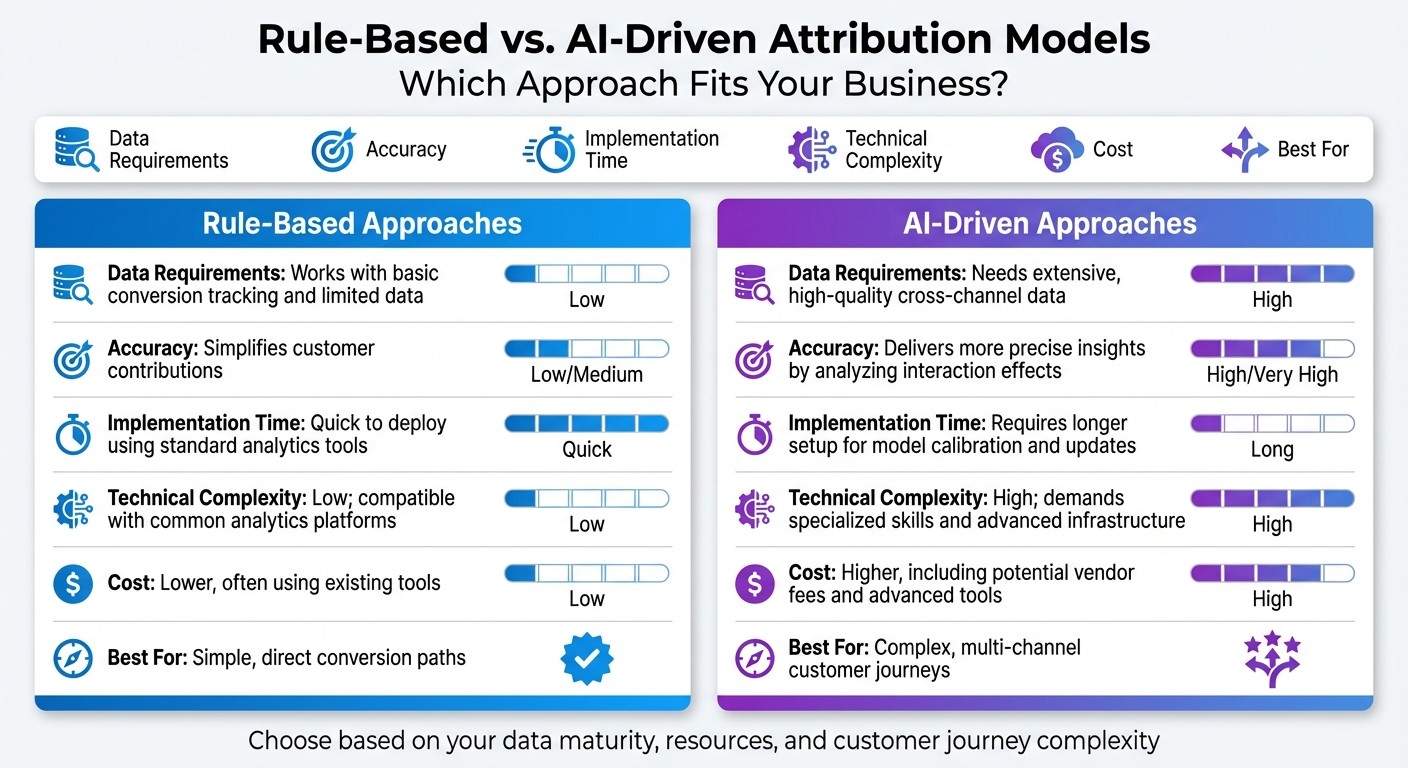
Rule-Based vs AI-Driven Attribution Models Comparison
Deciding between rule-based and AI-driven attribution models depends on your current data setup, team expertise, and the intricacy of your customer journey. Rule-based models - like first-touch, last-touch, and linear attribution - are simple to implement using basic conversion tracking. They deliver quick, directional insights but can oversimplify by applying fixed rules that may not fully reflect customer behavior.
On the other hand, AI-driven methods - such as data-driven multi-touch attribution, marketing mix modeling, and hybrid approaches - examine patterns across numerous customer interactions to better assess the impact of each touchpoint. These methods demand a robust amount of historical data and specialized expertise or platforms, but they provide more precise results in complex marketing scenarios.
Factor | Rule-Based Approaches | AI-Driven Approaches |
|---|---|---|
Data Requirements | Works with basic conversion tracking and limited data | Needs extensive, high-quality cross-channel data |
Accuracy | Simplifies customer contributions | Delivers more precise insights by analyzing interaction effects |
Implementation Time | Quick to deploy using standard analytics tools | Requires longer setup for model calibration and updates |
Technical Complexity | Low; compatible with common analytics platforms | High; demands specialized skills and advanced infrastructure |
Cost | Lower, often using existing tools | Higher, including potential vendor fees and advanced tools |
Best For | Simple, direct conversion paths | Complex, multi-channel customer journeys |
These differences help you tailor your attribution model to match your business needs, ensuring your marketing strategy aligns with the complexity of your operations.
Conclusion
AI attribution models are not here to replace your analytics - they’re here to turn your data into actionable strategies. To make the most of them, start with well-defined goals, ensure your data is accurate and organized, and implement these models gradually to identify what delivers results. The most effective setups go beyond just tracking performance; they directly influence how you allocate budgets and plan campaigns, enabling swift execution instead of mere reporting.
One of the biggest challenges marketing teams face is bridging the gap between insights and action. Seamlessly integrating these insights into your decision-making process is key to staying nimble in today’s fast-moving marketing landscape.
Platforms like Averi AI address this challenge by combining AI built specifically for marketing with human expertise, all within one streamlined workflow. This eliminates the need to juggle disconnected tools and processes, allowing you to transition smoothly from understanding attribution insights to implementing campaigns.
"Averi doesn't just give us insights, it helps us act on them. That's the gap every other platform misses. We're finally turning data into real campaigns." - David, Thorn [1]
FAQs
What’s the best way to select an AI attribution model for my business?
When choosing an AI attribution model for your business, it's essential to align the choice with your specific goals, the quality of your data, and the complexity of your campaigns. Popular options include last-touch, multi-touch, and data-driven models, each providing distinct perspectives on customer journeys and how they interact with your marketing efforts.
For a balanced and efficient approach, look into platforms that blend AI-powered efficiency with human insights to refine attribution and boost campaign outcomes. Be sure to assess elements like cost, data management capabilities, and how well the model integrates with your existing tools and team structure to ensure it meets your marketing objectives.
How can I ensure my marketing data complies with privacy regulations?
To ensure your marketing practices respect data privacy regulations, here are some essential steps to follow:
Encrypt sensitive data both when it's being transmitted and while it's stored to protect it from unauthorized access.
Regularly perform privacy audits to identify and address any potential vulnerabilities.
Incorporate privacy-by-design principles when creating systems to prioritize user privacy from the start.
Collect personal information only after obtaining clear and explicit consent from users.
Implement and enforce robust data retention and deletion policies to manage information responsibly.
Adhere to legal requirements such as GDPR and CCPA to remain compliant with international and state-level regulations.
Limit access to personal data strictly to authorized personnel to minimize risks.
Marketers can also benefit from AI tools that integrate privacy and security features. Platforms like Averi AI provide enterprise-grade privacy controls, making it easier to protect user data while running effective campaigns.
How can I use AI attribution insights to improve my marketing campaigns?
To make the most of AI attribution insights, it’s essential to start with a solid foundation. Ensure your AI system is trained specifically on your brand’s data to deliver results that are both accurate and relevant. Tailor the attribution metrics to align with your campaign goals, focusing on the data that truly reflects your objectives. Partnering with marketing professionals can also help you interpret these insights effectively and apply them strategically in your decision-making process.
Tools like Averi AI simplify this journey by automating complex data analysis and turning it into actionable insights. These insights can then be seamlessly integrated into tasks such as content creation, campaign planning, and fine-tuning strategies. By leveraging this approach, you can make smarter, data-driven decisions, achieve quicker outcomes, and ultimately boost your ROI.
Related Blog Posts

Zach Chmael
CMO, Averi
"We built Averi around the exact workflow we've used to scale our web traffic over 6000% in the last 6 months."
Your content should be working harder.
Averi's content engine builds Google entity authority, drives AI citations, and scales your visibility so you can get more customers.