

In This Article
LLMs streamline social media by turning competitor insights into platform-ready posts, accelerating creation while preserving brand voice.
Updated:
Trusted by 1,000+ teams
Startups use Averi to build
content engines that rank.
Social media content creation has changed. Large language models (LLMs) now enable faster, more tailored, and scalable workflows for brands. By combining AI efficiency with human creativity, businesses can produce platform-specific content that resonates with audiences and drives results.
Here’s a quick breakdown of the process to maximize LLMs for social media:
Analyze competitors: Use AI to identify trends and high-performing content.
Generate ideas: Create platform-specific topics aligned with your brand.
Build briefs: Develop clear, actionable content plans using AI.
Draft and edit: Let AI generate drafts, then refine with human input.
Repurpose content: Adapt posts for multiple platforms to save time.
Optimize performance: Leverage AI to track metrics and improve your strategy.
LLMs are transforming how brands approach content creation. With the right steps, you can simplify workflows, save resources, and deliver posts that engage your audience.
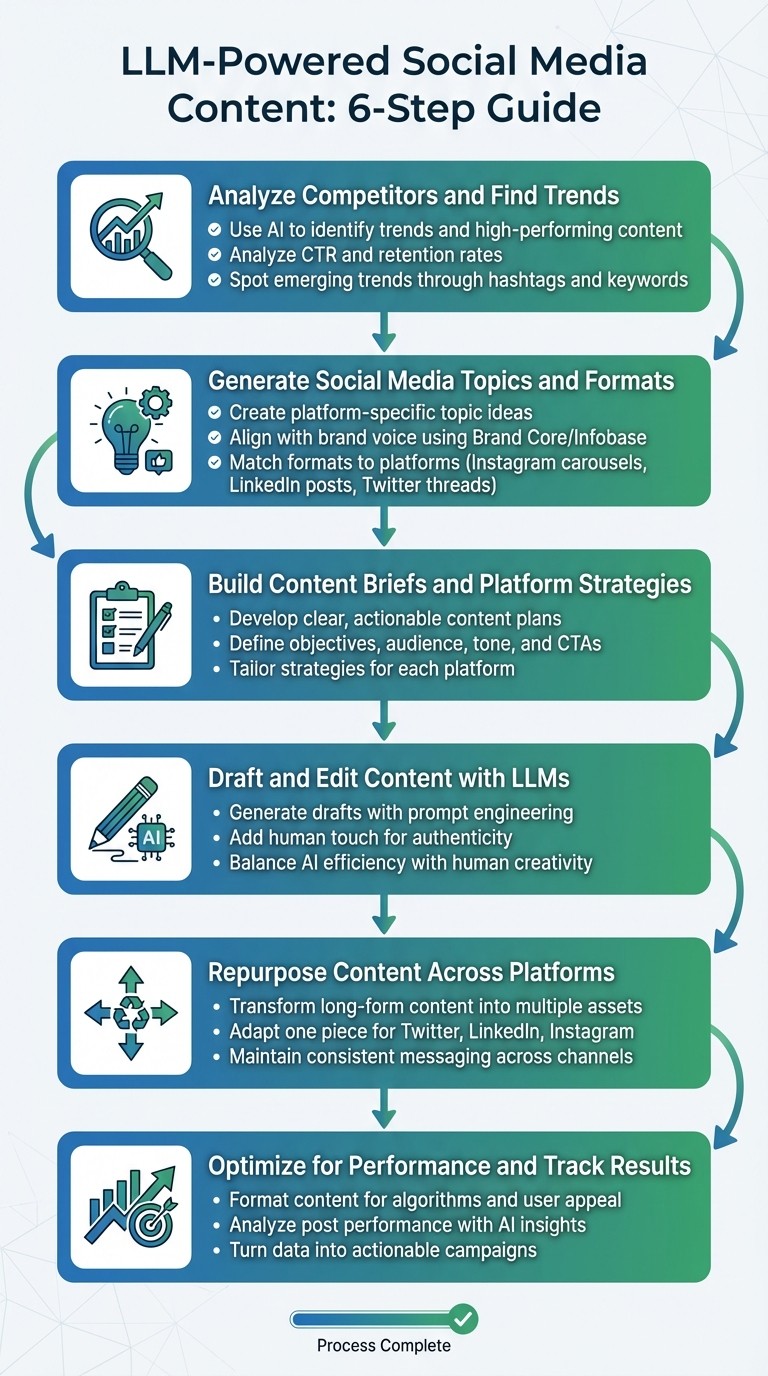
6-Step Process for Creating LLM-Powered Social Media Content
Build an AI Social Media Content Generator in 20 Minutes | AI Agents with LangGraph and Llama 3.1
Step 1: Analyze Competitors and Find Trends
Understanding what clicks with your audience starts with a deep dive into what’s working in your industry. Large language models (LLMs) excel at processing vast amounts of competitor data, uncovering patterns that would take ages to spot manually. This helps you pinpoint what content resonates with audiences and refine your strategy accordingly.
Modern AI-driven tools can break down metrics like click-through rates (CTR) on paid social campaigns or content retention stats. They not only highlight what’s working for your competitors but also expose gaps and opportunities in your own campaigns, giving you a clearer picture of what drives engagement [1].
Leverage LLMs for Sentiment and Engagement Analysis
Feed competitor content into an LLM to assess sentiment and engagement levels. By focusing on key indicators like CTR and retention rates, you can quickly determine which posts are connecting with audiences and why [1]. LLMs make it easy to analyze multiple posts at once, revealing common threads among successful campaigns and helping you identify what sets high-performing content apart.
Spot Trends Early with LLM Prompts
LLMs can go beyond competitor analysis to scan broader industry conversations, helping you catch emerging trends before they hit their peak. By analyzing hashtags, keywords, and popular content formats, these tools can uncover what’s gaining traction across your industry.
AI marketing platforms also provide in-depth insights into key accounts, industry dynamics, and audience personas [2]. The secret is to dig deeper than surface-level stats and focus on the elements that drive real engagement with your audience.
These insights build a strong foundation for crafting targeted content ideas in the next steps.
Step 2: Generate Social Media Topics and Formats
After analyzing your competition, the next step is turning those insights into content ideas tailored specifically to your brand. This is where large language models (LLMs) step in, helping streamline the creative process by quickly generating ideas that align with your brand's identity. The trick is to provide the AI with enough context - your brand’s personality, goals, and audience - so the output feels genuine and not generic. This groundwork ensures the ideas resonate with your brand voice and meet the requirements of each platform.
Create Topic Ideas That Reflect Your Brand Voice
To ensure the content ideas align with your brand, feed the AI with details about your tone, audience, and objectives. Many platforms make this easier with tools like "Brand Voice" features or centralized information hubs (often referred to as an "Infobase"), where all necessary brand details are stored for the AI to access [2].
For example, you could prompt the AI with something like: "Generate five LinkedIn posts that position our SaaS product as a leader in workflow automation for mid-sized marketing teams." The more specific you are about your audience, goals, and platform, the more useful the suggestions will be. Whether you’re looking for SEO-driven posts or thought leadership content, this method ensures the ideas align with your broader strategy [2].
Match Ideas to Platforms and Formats for Maximum Effect
Once you’ve got a pool of content ideas, the next step is tailoring them to the unique formats of each social platform. Every platform has its own style - Instagram thrives on visual content like carousels and Reels, LinkedIn performs best with detailed posts and document carousels, and Twitter (now X) favors concise threads. You can guide the AI to organize your ideas accordingly by asking: "Sort these ten content ideas into three Instagram carousels, four LinkedIn posts, and three Twitter threads."
AI workflows can simplify this categorization process [2]. By matching content formats to platform algorithms and audience preferences, these workflows help ensure your ideas are positioned to perform well. The outcome? A well-structured content calendar that’s ready to move into the next phase of development.
Step 3: Build Content Briefs and Platform Strategies
Transform your content ideas into actionable briefs that clearly outline objectives, target audience, tone, and calls-to-action. By using large language models (LLMs) trained on your brand's core information, you can quickly create thorough and effective content briefs. These briefs act as a roadmap, guiding your strategies across different platforms with precision.
Write Detailed Content Briefs with LLMs
To craft impactful briefs, start by aligning the LLM with your brand’s voice, tone, and key messaging. Centralized repositories, like an Infobase or Brand Core, ensure that essential brand details are consistently reflected in every brief. For instance, you could prompt the AI with something like this:
"Draft a content brief for a LinkedIn post aimed at mid-sized SaaS companies. The goal is to generate leads for our workflow automation tool. Use a professional but conversational tone, and include a call-to-action to download our free guide."
The result? A comprehensive outline that defines the post’s purpose, target audience, messaging, and specific call-to-action, all tailored to your brand’s identity.
Tailor Strategies for Each Platform
Once you have your content briefs, refine them to fit the unique demands of each platform. For example, Instagram thrives on eye-catching visuals and concise captions, LinkedIn is ideal for in-depth thought-leadership pieces, and Twitter (now X) requires short, engaging posts. LLMs can assist in fine-tuning your content by adjusting tone, format, and messaging to align with these platform-specific needs.
AI-powered workflows can further simplify this process. For instance, you might set up a workflow to create Instagram briefs that focus on visual storytelling and hashtag strategies, while another workflow generates LinkedIn posts with a professional tone and detailed insights. This ensures your content isn’t just tailored to each platform’s style but is also optimized to resonate with your audience and perform well within each platform’s algorithm.
Step 4: Draft and Edit Content with LLMs
Once your content briefs are ready, it's time to create social media posts. Leveraging large language models (LLMs) allows you to generate drafts almost instantly. However, pairing their efficiency with human oversight ensures the final product feels genuine and aligns with your brand's voice. This step seamlessly bridges the gap between strategy and execution.
Write Engaging Content with Prompt Engineering
To maintain consistency, train LLMs to reflect your brand's voice. Tools like a centralized Brand Core repository can help ensure every draft aligns with your company's tone, messaging, and style.
When creating prompts, be clear and detailed about the format, platform, and desired outcome. For instance, you might say: "Write a Twitter thread (5 tweets) announcing our new feature launch. Use an enthusiastic but professional tone, include a statistic about time savings, and end with a link to our blog post." This level of specificity helps the AI deliver drafts that match your expectations. Additionally, AI workflows can incorporate best practices to ensure accuracy and alignment with your strategy [2].
Once the AI produces a draft, it’s time to refine it with a human touch.
Add a Human Touch to AI-Generated Content
AI drafts serve as an excellent starting point, but human editing is what makes the content truly resonate with your audience. While the AI provides the foundation, manual adjustments ensure the final piece feels authentic and relatable. This is especially crucial for thought leadership pieces where a unique perspective adds value.
Start by reviewing the draft and weaving in specific examples from your own experiences. Adjust the phrasing to reflect the way your audience communicates, and double-check that any claims or statistics are accurate. Kevin from Fieldgrade highlights this collaborative approach:
The AI handles what it should, and my team handles what we do best. No confusion about roles, no redundant work. Just better marketing, faster
[1]. This balanced workflow - AI for speed and humans for authenticity - creates content that’s both efficient to produce and engaging to read. By combining the strengths of both, you can deliver content that feels polished and personal.
Step 5: Repurpose Content Across Platforms
Once you've streamlined content creation and editing, the next step is to make your content work harder for you by repurposing it across different platforms. Crafting entirely new content for every channel can be a drain on time and resources. Instead, leverage large language models (LLMs) to transform one comprehensive piece into multiple, platform-specific assets. This method keeps your messaging consistent while tailoring it to fit the unique style and demands of each platform.
Transform Long-Form Content into Social Media Posts
Start with a substantial piece of content - like a blog post, webinar recording, or whitepaper - and let LLMs do the heavy lifting by breaking it into bite-sized, platform-ready pieces. To ensure the output aligns with your brand identity, train your LLM using your brand's core guidelines. Payton, VP of Marketing at Broadside, shared their experience with this strategy in 2025:
I've been testing it against ChatGPT…I love how it's customized to the information that I have in there in terms of my brand and tone
[1].
For instance, imagine you have a 2,000-word blog post detailing product updates. You could prompt your LLM to distill the key takeaways into a Twitter thread, a five-slide LinkedIn carousel, and three Instagram Story frames. The AI can handle the heavy lifting - condensing paragraphs, crafting engaging hooks, and formatting for each platform - while ensuring your brand's voice stays consistent. Once the AI generates the content, you can fine-tune it to meet the specific nuances of each platform.
Tailor Content with Format-Specific Adjustments
Every social platform has its own style and audience expectations. Twitter thrives on concise, conversational threads. LinkedIn favors professional insights backed by data. Instagram demands visually engaging, story-driven content. By training your LLM on your brand's core elements and high-performing examples, you can ensure it produces outputs that feel authentic and resonate with your audience.
When prompting your LLM, be as specific as possible about the structure and tone you need. Instead of a vague request like "make this a LinkedIn post", try something more detailed: "Turn this section into a LinkedIn post with an engaging question hook, three bullet points emphasizing ROI, and a call-to-action. Use a professional yet approachable tone." Providing clear instructions helps the AI create content that feels natural for the platform while staying true to your brand's message. The result? Content that looks and feels native to each channel, amplifying your reach without sacrificing quality.
Step 6: Optimize for Performance and Track Results
Creating and repurposing content is just the beginning. The real game-changer lies in analyzing performance data to fine-tune your strategy. Large language models (LLMs) can sift through metrics, spot trends, and recommend actionable adjustments, giving you the tools to optimize content for both algorithms and audience engagement.
Format Content for Algorithms and User Appeal
The way you structure your content can make or break its impact. LLMs can help you tailor your posts to fit both algorithmic preferences and audience expectations. For example, they can transform dense paragraphs into easy-to-read bullet points, introduce strategic line breaks for better mobile viewing, or craft engaging question hooks that spark interaction.
Let’s say you’re working on a LinkedIn post. Instead of a general prompt, you could specify: "Reformat this post with a compelling one-sentence hook, three concise bullet points outlining key benefits, and an engaging question at the end to drive comments. Limit it to 150 words." This kind of precise instruction ensures that the output aligns with platform-specific best practices while staying true to your brand’s voice. The result? Content that feels natural to the platform and resonates with both algorithms and your audience.
Leverage LLMs to Analyze Post Performance
Once your content is live, the next step is to analyze its performance. Instead of manually poring over analytics dashboards, you can ask an AI to identify patterns and suggest improvements. For instance, you might say: "Review our Q3 social media campaigns. Highlight which post formats had the highest engagement and pinpoint trends in underperforming content."
David from Thorn shared how this approach transformed their workflow:
"Averi doesn’t just give us insights, it helps us act on them. That’s the gap every other platform misses. We’re finally turning data into real campaigns."
Conclusion: Using LLMs for Social Media Success
By now, you've walked through the entire process - analyzing competitors, spotting trends, drafting content, repurposing ideas, and fine-tuning for maximum impact. The true advantage lies in combining speed, consistency, and the ability to act on insights without the hassle of disjointed workflows or time-consuming manual tasks.
Large Language Models (LLMs) go beyond just speeding up content creation. They adapt to your brand's voice, evaluate performance, and turn raw data into actionable campaigns. The real magic happens when AI handles repetitive tasks, freeing up your team to focus on strategy and creative innovation. This synergy between AI's efficiency and human expertise fuels impactful results.
To fully embrace these benefits, it’s crucial to streamline your workflow with tools that integrate seamlessly. Platforms like Averi AI provide a solution by combining marketing-savvy AI with expert human input. They’re designed to help you think strategically, produce content efficiently, and execute campaigns without the inefficiency of scattered processes. Take the leap - train the AI to reflect your brand, and watch as insights evolve into campaigns that deliver results.
The tools to revolutionize your social media approach are already at your fingertips. Are you ready to turn fragmented efforts into a unified, high-performing strategy?
FAQs
How can LLMs improve my social media content strategy?
Large Language Models (LLMs) can reshape your approach to social media content by simplifying every step of the process - from generating ideas to hitting publish. They make it possible to create content quickly while keeping it engaging and aligned with your brand's voice.
These models also excel at customizing content to connect with U.S. audiences, factoring in cultural subtleties and fine-tuning for SEO. Platforms like Averi AI take this a step further by blending AI capabilities with human expertise, offering a seamless mix of strategy, creativity, and execution. This allows marketers to produce top-tier content in less time and with greater efficiency.
How can I repurpose content effectively for different social media platforms?
To make the most of your content across different platforms, start by defining a clear and engaging core message that connects with your audience. Tailor the tone and style to fit the platform - keep it professional for LinkedIn and more casual for Instagram. Adjust the format and length to suit each medium, like crafting bite-sized updates for Twitter or expanding into detailed articles for blogs. Pay close attention to visuals and videos, ensuring they meet the specific requirements of each platform, and localize elements like currency (e.g., $), date formats (MM/DD/YYYY), and other regional details.
Timing is also key - schedule posts thoughtfully based on when users are most active on each platform. Continuously monitor performance metrics to fine-tune your strategy. Tools such as Averi AI can help simplify this process by automating content adjustments and improving team collaboration.
How can I make sure AI-generated content reflects my brand's voice?
To make sure AI-generated content reflects your brand's personality, begin by familiarizing the AI with your brand guidelines, preferred tone, and writing style. Share examples of previous content along with clear instructions during the setup process to help the AI capture your distinct voice.
For even better results, pair AI-generated drafts with human oversight. Reviewing and fine-tuning the AI’s output ensures the final content remains consistent and genuinely represents your brand. This blend of technology and human touch strikes the perfect balance for maintaining authenticity.
Related Blog Posts

Zach Chmael
CMO, Averi
"We built Averi around the exact workflow we've used to scale our web traffic over 6000% in the last 6 months."
Your content should be working harder.
Averi's content engine builds Google entity authority, drives AI citations, and scales your visibility so you can get more customers.