How to Optimize Blog Content for ChatGPT, Perplexity, and Gemini

Averi Academy
Averi Team
8 minutes

In This Article
Guide to structuring and marking up blog posts so AI tools can extract, cite, and surface your content on ChatGPT, Perplexity, and Gemini.
Updated:
Trusted by 1,000+ teams
Startups use Averi to build
content engines that rank.
AI tools are changing how people find information. By September 2025, ChatGPT reached 800 million weekly users, and AI-driven searches are expected to reduce traditional search volume by 25% by 2026. For B2B websites, this shift has already caused a 34% drop in SEO-driven traffic, but traffic from AI systems delivers visitors who are 4.4 times more valuable, with doubled conversion rates.
To stay competitive, your content must align with how AI platforms like ChatGPT, Perplexity, and Gemini retrieve and process information. These platforms prioritize clear, structured, and authoritative content over traditional SEO tactics like keyword stuffing or backlinks.
Key strategies include:
ChatGPT: Use question-based headers and concise answers; focus on third-party validation (e.g., reviews) and ensure your site is accessible to Bing crawlers.
Perplexity: Keep paragraphs short, prioritize recent updates, and use FAQ schema to structure content for easy extraction.
Gemini: Leverage Google's ecosystem, including YouTube and Knowledge Graph entities, and apply multimodal schema for better indexing.
Quick Tip: Focus on making your content easy for AI systems to extract and cite by providing clear answers, using structured formats, and regularly updating key pages. AI-driven traffic is already reshaping digital visibility - acting now ensures your content remains relevant in this evolving landscape.
The ultimate guide to AEO: How to get ChatGPT to recommend your product | Ethan Smith (Graphite)
How ChatGPT, Perplexity, and Gemini Process Content
Knowing how different AI platforms handle content can help fine-tune your blog strategy. Each platform has its own approach, which impacts how they retrieve and present information.
ChatGPT combines its training data with real-time Bing Search results to generate responses [8][2][1]. When prompted, it breaks down your query into more specific questions, allowing it to pull in a wide range of information [9][7]. The platform analyzes content on a semantic level, extracting passages that directly address the query [3][7][5]. It leans heavily on community-driven content, with sources like Reddit, Wikipedia, and third-party review sites playing a major role. Notably, Wikipedia alone accounts for 47.9% of its top citations [10].
Perplexity, on the other hand, focuses on real-time verification and prioritizes credibility. It updates its index daily, making it particularly effective for trending topics [8]. This platform is highly selective about its sources, favoring authoritative domains like .edu sites and established media outlets over newer or less-reliable sources [8]. Perplexity also prefers content structured in short, clear sections with headers, concise answers, and bulleted lists. This format simplifies the process of extracting and citing information [11][2]. What sets Perplexity apart is its transparency - it shows the web searches it performs in the background to build its responses [6].
Gemini takes a broader, multimodal approach by processing content in various formats, including text, images, video, and voice [4]. It uses Google's Knowledge Graph to identify entities - specific people, places, brands, or objects - helping it determine context. For example, it can distinguish whether "Apple" refers to the fruit or the tech company [12]. Gemini also relies on keyword co-occurrence patterns to connect brands with topics and establish semantic relevance [4]. By using Retrieval-Augmented Generation (RAG), it pulls real-time data from external sources, ensuring its answers are both current and accurate [13]. Impressively, Google AI Overviews, which are powered by Gemini, now appear in 88% of informational search queries and cite the top 10 organic search results 85.79% of the time [4].
"Ranking in Google doesn't guarantee you'll show up in AI tools. SEO is still table stakes. But generative engines don't just lift the top results. They scan at a semantic level, fan queries out into dozens of variants, and stitch together answers from multiple sources." - Leigh McKenzie, Head of SEO, Backlinko [7]
Each platform's unique method of processing and retrieving information highlights why a one-size-fits-all content strategy won’t work. ChatGPT aggregates input from community-driven sources, Perplexity emphasizes accuracy and timeliness, and Gemini integrates multiple content formats while leveraging Google's vast knowledge base. By understanding these differences, you can tailor your content to align with each platform’s preferences and retrieval methods.
How to Optimize Content for Each Platform
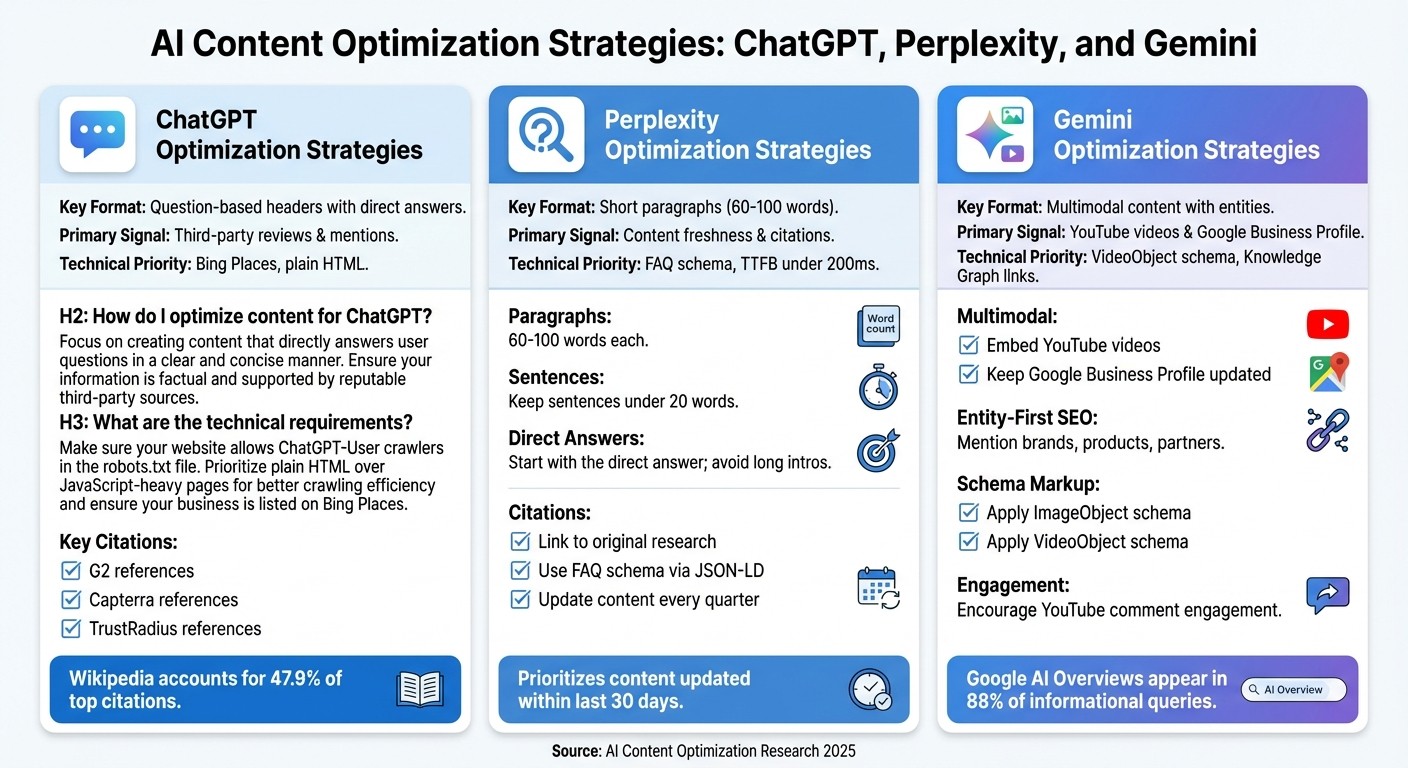
How to Optimize Content for ChatGPT, Perplexity, and Gemini: Platform Comparison Guide
To ensure your content stands out across various AI platforms, it’s important to tailor your approach based on how each tool processes and retrieves information. What works for ChatGPT might not be as effective for Perplexity or Gemini. By understanding the unique methodologies of these platforms, you can maximize your content’s visibility and relevance.
Structuring Content for ChatGPT
ChatGPT pulls from Bing's search index and places a strong emphasis on conversational, user-focused content. To align with its preferences, structure your headers (H2 and H3) as questions - for example, "How do I optimize my blog for ChatGPT?" - rather than using generic titles like "Content Optimization Tips." Follow each header with concise answers, ideally 2–4 sentences long, to make it easier for ChatGPT to extract relevant information.
Since ChatGPT values third-party validation, include references from credible review platforms like G2, Capterra, or TrustRadius. These sources enhance your authority in the platform’s eyes [8]. Additionally, ensure your site’s robots.txt file permits access to ChatGPT-User crawlers and maintain a presence on Bing Places for Business. Stick to plain HTML for your content, as AI crawlers often struggle with JavaScript-heavy pages [7].
"AI systems and LLMs don't read like you or I do. LLMs scan for structure, semantic signals, and want clear labels. Writing GEO effective content often means thinking less like a writer and more like a formatter." - Shawn Pence, DemandDrive [5]
Creating Content for Perplexity
Perplexity operates as an answer engine, synthesizing information from multiple authoritative sources in real time. It prioritizes content updated within the last 30 days and relies heavily on high-authority domains such as .edu sites and major news outlets [8][15]. To cater to Perplexity, use short, self-contained paragraphs of 60–100 words with sentences under 20 words. This format makes it easier for the platform to extract and attribute information [14].
Start with a direct answer - avoid lengthy introductions. Link to original research and data to boost credibility, as Perplexity emphasizes content supported by authoritative evidence [15]. Use FAQ schema via JSON-LD to define clear Q&A pairs [5][14]. Regularly refresh high-performing content, ideally every quarter, to maintain "freshness" signals. Lastly, ensure your site’s Time to First Byte (TTFB) is under 200ms to optimize crawler performance [15][8].
Tailoring Content for Gemini
Gemini taps into Google’s ecosystem, including YouTube, Google Business Profile, and the Knowledge Graph. Embedding YouTube videos and encouraging user engagement through comments can significantly enhance your visibility, as Gemini uses these interactions as training signals [8]. For local relevance, keep your Google Business Profile updated with accurate information, photos, and reviews [8].
Adopt "entity-first SEO" by mentioning specific brands, products, and partners in your content. This helps Google’s Knowledge Graph link your blog to recognized entities [14]. Additionally, apply multimodal schema markup, such as ImageObject and VideoObject, to improve how your multimedia content is indexed [15]. A case study from December 2025 highlights how Linkflow.ai helped an enterprise mentorship platform achieve 92% AI visibility - far surpassing competitors’ 55.3% - by tailoring content to different customer profiles and leveraging YouTube comment engagement for Gemini. This strategy also resulted in five times higher conversions from LLM-driven traffic [8].
The table below summarizes the key strategies for optimizing content across these platforms:
Platform | Key Format | Primary Signal | Technical Priority |
|---|---|---|---|
ChatGPT | Question-based headers with direct answers | Third-party reviews & mentions | Bing Places, plain HTML |
Perplexity | Short paragraphs (60–100 words) | Content freshness & citations | FAQ schema, TTFB under 200ms |
Gemini | Multimodal content with entities | YouTube videos & Google Business Profile | VideoObject schema, Knowledge Graph links |
Optimization Techniques That Work Across All 3 Platforms
Although each AI platform has its own nuances, some strategies can enhance your content's visibility across ChatGPT, Perplexity, and Gemini at the same time. These methods focus on making your content easier for AI systems to extract, interpret, and cite, ensuring your efforts resonate no matter which platform is in play.
Using Conversational Structure
To optimize content for AI-powered retrieval, start with a concise, standalone answer (30–50 words) at the beginning of each section. This makes it easier for AI systems to extract the key takeaway. For instance, you might write: "To improve AI search visibility, use question-based headers, keep paragraphs under 100 words, and apply FAQ schema."
Headers formatted as natural language questions - such as "How can I reduce cart abandonment?" - perform better than generic ones. Keep paragraphs short, ideally between 60 and 100 words, starting with a clear statement and ending with a reinforcing point to maintain clarity and context.
Organizing your content into topic clusters is another effective approach. A central pillar page linking to several detailed supporting posts signals a comprehensive understanding of the subject to AI systems. When mentioning your brand, incorporate it directly into factual statements, such as "Acme Software achieved a 25% increase in conversions", ensuring your brand remains tied to the extracted data.
Adding Schema Markup and Metadata
Schema markup acts as a guide for machine readers, helping AI systems understand your content's purpose and relevance. Use FAQPage schema for question-based content, HowTo schema for instructional guides, and Article schema with datePublished and dateModified properties to highlight freshness. Always validate your schema using tools like Google’s Rich Results Test.
Including FAQ and HowTo schema can significantly improve your chances of appearing in AI-generated responses. For longer articles (2,000+ words), consider adding 12–15 FAQ schema entries, even if only a portion appears on the page, to create multiple extraction points without overwhelming the visible content. Strengthen trust signals by adding Author or Organization schema with the sameAs property linking to authoritative profiles like LinkedIn or Wikipedia.
Use semantic HTML tags such as <article>, <main>, and <aside> instead of generic <div> tags. These help AI systems better understand your content’s structure and hierarchy.
Creating In-Depth, Authoritative Content
AI platforms favor content that provides thorough coverage of a topic and is backed by credible data. Incorporating original research and specific metrics - like "a 27% increase" - can boost credibility. Studies show that content with concrete numbers is 30% to 40% more likely to be cited by language models. For SaaS companies, this approach can lead to a 27% increase in citations from AI systems.
Consistency is key when it comes to product names, pricing tiers, and features. Uniform terminology across your website, social media, and third-party directories prevents confusion for AI models and enhances citation accuracy. To bolster your E-E-A-T (Experience, Expertise, Authoritativeness, Trustworthiness), include detailed author bios with credentials and links to professional profiles. These elements help AI systems verify expertise.
Regularly updating high-value content - every 3 to 6 months - ensures it stays relevant. Refresh statistics, add new examples, and consider appending "2025 Edition" to titles to signal recency. Visitors referred by AI-generated answers are 4.4 times more valuable than those from traditional search, spending up to three times longer on vendor sites. Investing in well-researched, authoritative content pays off: AI-optimized pages rank 49.2% higher and increase user engagement by 25%. These strategies create a strong foundation for further fine-tuned content adjustments.
Conclusion: What to Remember About AI Content Optimization
AI-driven search is already reshaping how users interact with content. If your content isn’t optimized for this shift, you risk missing out on an audience that’s growing exponentially.
The key takeaway? It’s about being extractable, not just rankable. AI tools don’t simply rely on top search results - they analyze content at a deeper, semantic level, pulling together answers from various sources. To stay relevant, focus on delivering clear, structured information, and leverage tools like FAQ and HowTo schema to make your content easier for machines to process.
"Ranking in Google doesn't guarantee you'll show up in AI tools. SEO is still table stakes. But generative engines don't just lift the top results. They scan at a semantic level" [7].
This underscores the importance of strategies discussed earlier, emphasizing how to make your content more accessible to AI systems.
Different platforms have unique citation patterns, making it crucial to establish authority not just on your website but also on trusted review platforms like G2, Capterra, and Reddit. The reward? Visitors referred by AI tools are 4.4 times more valuable than those from traditional search, and they engage with vendor sites for up to three times longer [2].
To capitalize on these opportunities, start by ensuring your site is technically accessible. Check that AI crawlers such as GPTBot and PerplexityBot aren’t blocked in your robots.txt file. Next, build credibility by creating in-depth topic clusters instead of chasing isolated keywords. Regularly refresh your high-performing content - every three to six months - to signal relevance. These steps can position your content as a trusted source for AI systems.
The urgency is clear, especially in the B2B space, where adoption of generative AI for research is three times higher, with 46% of businesses already using it [2]. Acting now can help secure your competitive edge and ensure your content thrives in this evolving AI-driven environment.
FAQs
How can I optimize my blog content to perform well on ChatGPT, Perplexity, and Gemini?
To ensure your content performs well on platforms like ChatGPT, Perplexity, and Gemini, focus on keeping it straightforward, well-organized, and easy for AI to interpret. Begin by using a question-and-answer format to directly address common user inquiries. Start with a clear, concise response in plain language, and then expand with examples or data to provide depth and context. This approach aligns with how these platforms prioritize delivering quick, accurate answers.
Structure your content with a logical heading hierarchy, such as H1, H2, and H3, to make it easier for AI systems to navigate and reference. Additionally, incorporating structured data like schema.org FAQ or Article markup can enhance AI's ability to process and cite your material. Support your claims with reliable sources, include internal links to related pages, and develop content clusters to build a strong foundation of expertise.
To broaden your content’s appeal, incorporate various formats like bullet points, tables, or visuals - think infographics or downloadable PDFs. Keep your content fresh by updating it regularly, and pay attention to how it appears in AI-driven search results. Adjust your strategy based on trends or citation patterns to stay relevant and maintain visibility across these platforms.
What changes should I make to my blog structure to improve AI visibility and usability?
To make your blog more useful and accessible for AI tools like ChatGPT, Perplexity, and Gemini, focus on creating content that is clear, well-structured, and technically optimized. Begin with a concise summary or TL;DR at the top of each post to offer a quick and quotable overview. Use descriptive, hierarchical headings (H1-H3) that match common user queries, and break down key information into easy-to-scan bullet points or short paragraphs.
Incorporate schema markup for FAQs or how-to sections to help AI systems extract and interpret your data accurately. On the technical side, ensure your site remains accessible by avoiding paywalls on critical content and allowing AI crawlers through your robots.txt file. These adjustments can significantly improve how AI tools process and highlight your content.
Why is traffic from AI-powered platforms more valuable than traditional search traffic?
Traffic from AI-driven platforms holds greater value due to its highly targeted nature. Visitors arriving via these systems are typically further along in their decision-making journey, which translates to notably higher conversion rates.
Studies show that traffic referred by AI can be up to 4.4 times more impactful than traditional organic search traffic, with conversion rates exceeding double the usual rates. This happens because AI tools excel at delivering personalized and context-specific results, making it easier for users to quickly find precisely what they’re looking for.
Related Blog Posts

Zach Chmael
CMO, Averi
"We built Averi around the exact workflow we've used to scale our web traffic over 6000% in the last 6 months."
Your content should be working harder.
Averi's content engine builds Google entity authority, drives AI citations, and scales your visibility so you can get more customers.