5 Specialized AI Tools Not Named ChatGPT That Marketers Should Know

9 minutes

TL;DR
ChatGPT is the Swiss Army knife of AI—decent at everything, exceptional at nothing specific. 88% of marketers use AI daily, but the smart ones use specialized tools or integrated platforms:
AI Copywriting - Best Choice: Averi
Purpose-built for marketing copy with brand voice that actually sticks across all content. Unlike standalone tools that exist in isolation, Averi integrates copywriting with strategy, design, team collaboration, and execution in one workspace. Maintains context across projects, allows human expert refinement when needed, and eliminates tool-switching overhead. AI drafts + human polish when you need it = consistent, high-quality copy at scale.
Also for Copywriting: Jasper, Copy.ai - 100,000+ businesses use Jasper standalone. Good if you only need text generation and are comfortable managing integration yourself.
AI Design (Midjourney, Canva AI): 19M+ Midjourney users generate 1-2.5M images daily. Canva's AI has 90% success rate generating usable images and reduces manual adjustments by 62%. Use when you need custom visuals that don't look like stock photos or AI slop.
AI Video (Synthesia, Pictory): 60% of Fortune 100 companies use Synthesia; AI video generation increased 220% in 2025. 70% cost reduction and 60% time savings vs. traditional video production. Use when video is "too expensive" otherwise.
AI Analytics (ThoughtSpot, GA Intelligence): 74% of marketers use AI for customer segmentation; 82% say predictive analytics improves decisions. Connects to your data stack and surfaces insights automatically—no manual prompting required. Use when drowning in data from multiple platforms.
The Integrated Advantage:
Averi combines best-in-class copywriting with design, video, analytics, and human expertise in one workspace. Strategy → content → collaboration → execution with maintained context throughout. No tool-switching chaos. No context loss. No managing a Frankenstack of separate subscriptions.
The Verdict: Generalist AI democratized access. Specialized AI delivers results. Integrated platforms like Averi eliminate tool-switching chaos while combining AI speed with human expertise. The AI marketing market hit $47.3B in 2025 because specialized solutions measurably outperform generalists.
Two paths forward:
Build a stack of specialized tools (Jasper + Midjourney + Synthesia + analytics) and create a system for managing context between them
Use Averi where copywriting, strategy, design, collaboration, and execution work together with maintained context
Most teams choose #2 because copywriting doesn't exist in isolation—it's part of campaigns that need strategy, visuals, and execution. Why manage separate tools when you can work in one integrated workspace?
Start with Averi free - Test with real projects. Measure what actually changes. The proof is in execution speed, not feature lists.

Zach Chmael
CMO, Averi
"We built Averi around the exact workflow we've used to scale our web traffic over 6000% in the last 6 months."
Your content should be working harder.
Averi's content engine builds Google entity authority, drives AI citations, and scales your visibility so you can get more customers.
5 Specialized AI Tools Not Named ChatGPT That Marketers Should Know
ChatGPT is everywhere.
Your inbox. Your Slack. Your boss's "brilliant new strategy" for content. And look, it's useful… when you need a quick brainstorm, a first draft, or someone to argue with at 2 AM about the Oxford comma.
But here's what they don't tell you in those "10X Your Marketing with AI!" LinkedIn posts: ChatGPT is a generalist. It's the Swiss Army knife of AI—decent at everything, exceptional at nothing specific.
Meanwhile, 88% of marketers now use AI daily, and the smart ones stopped asking ChatGPT to do everything six months ago.
They've assembled a specialized AI stack—tools purpose-built for copywriting, design, video, analytics—that actually move the needle instead of just generating more...stuff.
Or, they've skipped the Frankenstack entirely and gone straight to integrated platforms like Averi that combine AI capabilities with human expertise in one workspace. More on that in a minute.
If you're still copying ChatGPT outputs into Google Docs and calling it done, you're playing marketing on hard mode. Let's fix that.

The One-Size-Fits-All Problem (Why ChatGPT Can't Do Everything)
ChatGPT is phenomenal at conversation. It understands context. It can write in almost any style if you prompt it right. But ask it to:
Generate an ad that sounds exactly like your brand voice across 50 variations? It'll drift.
Create a custom illustration for your landing page? Wrong tool.
Turn your 3,000-word blog post into a professional video? Not happening.
Analyze your campaign data and tell you why your CTR tanked? It'll guess.
The marketing teams winning in 2025 aren't using one AI tool—they're using the right AI tool for each job. Think of it like hiring specialists instead of asking one generalist to do everything.
Let's break down five categories where specialized tools absolutely smoke ChatGPT for marketing tasks.
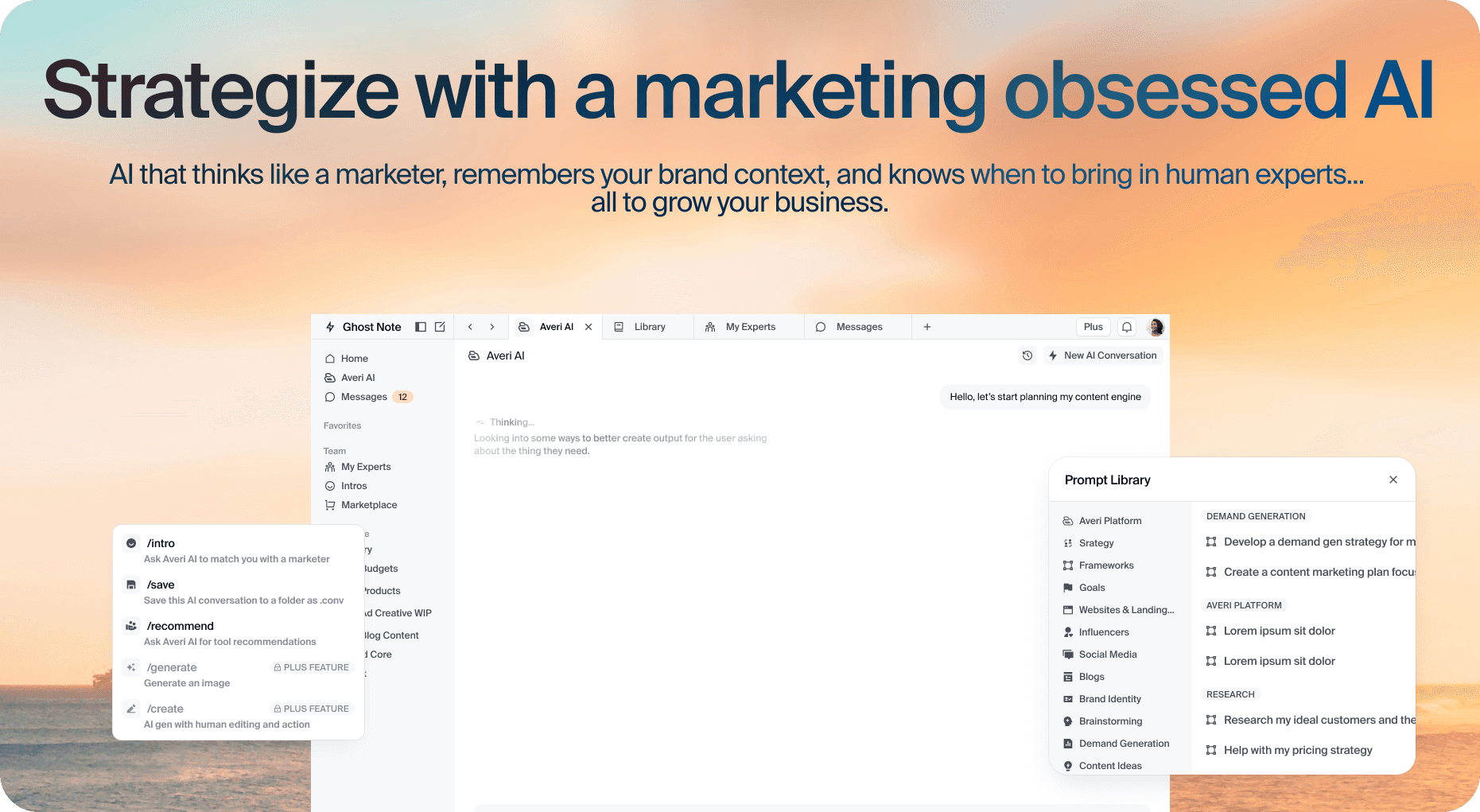
Tool #1: AI Copywriting That Actually Maintains Your Brand Voice
The Best Choice: Averi
Also Worth Considering: Jasper, Copy.ai, Writesonic
Why They All Beat ChatGPT: These platforms are trained specifically on marketing copy—not Wikipedia and random Reddit threads. They understand the structure of high-converting ads, product descriptions, and landing pages because that's literally all they do.
Here's the difference: ChatGPT will write you a decent Facebook ad. Specialized copywriting tools have templates for every format (Facebook headlines, Google descriptions, LinkedIn copy, email sequences, landing pages) and maintain your brand voice across thousands of assets.
But here's where most copywriting AI tools fall short: they exist in isolation. You generate copy in Jasper, then paste it into Google Docs, then brief it to a designer, then move it to your project management tool, then lose context somewhere along the way.
Why Averi is the better choice for copywriting:
Averi does everything Jasper and Copy.ai do for copywriting—but integrated into your actual marketing workflow where execution happens:
Brand Voice That Actually Sticks
Upload your existing content and Averi learns your brand voice, tone, and messaging. Unlike tools that "forget" after one conversation or require re-prompting, Averi maintains this context across every piece of content you create—blogs, ads, emails, social posts, landing pages.
Copywriting + Context + Execution
Most copywriting tools spit out text and leave you to figure out what to do with it. Averi connects copywriting to your campaign strategy, visual assets, and team collaboration—all in one workspace. The AI knows what campaign you're working on, what assets you've already created, and how they all fit together.
AI + Human Copywriting Where You Need It
Sometimes AI nails the copy. Sometimes you need a human copywriter to add nuance, humor, or strategic positioning. In Averi, you can generate AI drafts and activate a professional copywriter to refine them—in the same workspace where the brief and context already exist. No briefing lag. No "let me get up to speed" calls.
Built for High-Volume Content Production
Need 50 product descriptions? Done. Weekly email campaigns? Easy. Multi-channel ad variations? No problem. Averi handles high-volume copywriting while maintaining brand consistency and allowing human oversight where it matters.
Integration With Your Entire Marketing Workflow
Your copywriting doesn't exist in a vacuum. It's part of campaigns that need strategy, visuals, distribution, and performance tracking. Averi connects all of this so your copy informs design, your strategy guides messaging, and your data improves future content.
How Averi compares to standalone copywriting tools:
Feature | ChatGPT | Jasper/Copy.ai | Averi |
|---|---|---|---|
Marketing-specific templates | ❌ | ✅ | ✅ |
Brand voice training | ❌ | ✅ | ✅ |
Context maintained across projects | ❌ | Limited | ✅ |
Integrated with campaign workflow | ❌ | ❌ | ✅ |
Human expert access | ❌ | ❌ | ✅ |
Team collaboration | ❌ | Limited | ✅ |
Strategy → Copy → Design → Execution in one place | ❌ | ❌ | ✅ |
The standalone tool stats are impressive:
Jasper is used by over 100,000 businesses with an 85% customer retention rate. 70% of users recognize Jasper provides better long-form content than competitors. One agency reported 60% faster editing time and 30% improvement in SEO rankings after switching from ChatGPT.
But here's what those stats don't tell you: How much time they spend moving content between tools. How often brand voice drifts when different team members use the tool differently. How many versions get lost in Google Docs. How long it takes to brief freelancers when AI drafts need refinement.
Averi eliminates those hidden costs while delivering the same copywriting quality—plus the strategic and execution workflow around it.
When to use specialized copywriting AI:
When you're producing high-volume content that needs to sound consistently like your brand, not "AI wrote this." Think: 50 product descriptions, weekly email campaigns, or multi-channel ad campaigns where voice consistency directly impacts performance.
The decision:
Use standalone tools like Jasper or Copy.ai if you only need copywriting and you're comfortable managing the integration with other tools yourself
Use Averi if you want copywriting integrated with strategy, design, collaboration, and execution in one workspace—especially if you value the option to bring in human copywriting expertise without leaving the platform
Most marketing teams choose Averi because the copywriting quality is equivalent to standalone tools, but the workflow integration eliminates hours of tool-switching overhead.
Try it free and compare.
Tool #2: AI Visual Design Tools (Because Stock Photos Are Dead)
The Players: Midjourney, Canva's AI features, Adobe Firefly
Why They Beat ChatGPT: ChatGPT can't see, can't draw, and can't generate images that don't look like they came from a 2012 stock photo site.
Midjourney has 19 million registered users generating 1-2.5 million images daily. That's not just hobbyists—designers use it for client work because it produces genuinely original visuals that don't look like AI slop.
Meanwhile, Canva has 60+ million users and integrated AI features that let you generate custom graphics, remove backgrounds, and resize designs for every platform with one click. Their AI successfully generates 90% usable images from creative prompts, compared to other tools at 70%.
What these tools do better:
Custom visual content on demand: Need a hero image for your SaaS landing page? A social graphic in your brand colors? An illustration for your blog header? Generate it in minutes instead of paying Shutterstock $200/year for images that all look the same.
Style consistency across campaigns: Train Midjourney on your brand aesthetic, and every image maintains that look. ChatGPT can't do this. At all.
Actual design workflows: Canva's Magic Design suggests layouts, resizes for every platform (Instagram, Facebook, email header, billboard), and even generates copy to match your visuals. It's an integrated design system, not just an image generator.
Time savings that compound: Simple video edits that traditionally required 8 hours were completed in 45 minutes using Canva AI. That's 10x faster.
Real-world impact: Agencies report 62% reduction in manual adjustments when using Canva AI for brand consistency across client assets. That's hours saved per project.
When to use it: When you need custom visuals that actually match your brand—not generic stock photos or that distinct "AI-generated" look that screams "we used DALL-E." Perfect for social content, blog headers, ad creative, and anything requiring original imagery at scale.

Tool #3: AI Video Generators (Your $10K Video Budget Just Became $200)
The Players: Synthesia, Pictory, HeyGen
Why They Beat ChatGPT: ChatGPT can write you a video script. That's step one of twelve. These tools produce the actual video—avatars, voiceovers, B-roll, captions, everything.
Over 60% of Fortune 100 companies use Synthesia for training and communication videos. AI-generated videos increased by 220% in 2025 because marketing teams realized they could produce professional video content without cameras, studios, or Hollywood budgets.
What these platforms deliver:
Turn scripts into full videos: Synthesia offers 230+ AI avatars in 140+ languages—pick your "presenter," paste your script, and get a professional-looking video in minutes.
Repurpose written content: Pictory automatically converts blog posts, articles, and URLs into videos by extracting key points and pairing them with relevant stock footage. Your 2,000-word article becomes a 90-second social video.
Scale video production impossibly fast: Need personalized sales videos for 100 prospects? Explainer videos in 12 languages? Product demos for every feature? These tools make it economically viable.
No technical skills required: Over 50,000 companies now use AI video generators because the barrier to entry dropped from "hire a videographer" to "paste your script."
Cost comparison that'll make your CFO happy: Traditional video production: $5,000-$15,000 per video. Synthesia subscription: $89-$199/month for unlimited videos. You break even after your first project.
Real-world impact: Companies report 70% reduction in production costs and 60% less time creating videos compared to traditional methods. AI video tools deliver $3.71 for every dollar spent.
When to use it: When you need video at scale—training modules, product demos, social content, personalized sales outreach, or multilingual marketing. Basically, anytime the alternative is "we just won't do video because it's too expensive."
Tool #4: AI Marketing Analytics (The "Why Did This Campaign Fail?" Whisperer)
The Players: Google Analytics Intelligence, ThoughtSpot, Customfit.ai, various predictive analytics platforms
Why They Beat ChatGPT: ChatGPT can explain what data means if you paste it in. These tools connect directly to your data sources, identify patterns automatically, and tell you what to do about it—without you needing to prompt anything.
Here's the reality: 74% of marketers now use AI for customer segmentation, and 82% say predictive analytics improves their decision-making. They're not manually feeding data into ChatGPT—they're using purpose-built analytics tools that do the heavy lifting.
What specialized analytics AI actually does:
Connects to your entire stack: These platforms pull data from Google Analytics, your CRM, ad platforms, email tools—everywhere. ChatGPT needs you to manually copy-paste everything.
Automatic insight surfacing: Instead of asking "what happened last quarter?", the AI proactively alerts you: "Your CTR dropped 23% in the 25-34 demo because your ad creative is stale." 40% of marketers use AI specifically for this research capability.
Predictive modeling: These tools forecast what will happen if you change your budget, adjust your targeting, or launch a new campaign. ChatGPT gives educated guesses at best.
Natural language queries: ThoughtSpot lets you literally ask "which campaigns had the best CPA last quarter and why?" in plain English and get actionable answers with visualizations.
The competitive advantage is real: 83% of companies using AI analytics report higher customer satisfaction, and sales teams with AI-powered insights close deals 28% faster.
Real-world impact: Marketing teams using AI analytics report 45% faster deployment of analytics insights and 15% reductions in operational expenses through process automation.
When to use it: When you're drowning in data from multiple platforms and need actual answers instead of pretty charts. Perfect for attribution analysis, customer journey mapping, campaign performance diagnosis, and "why the hell did our conversions tank?" investigations.
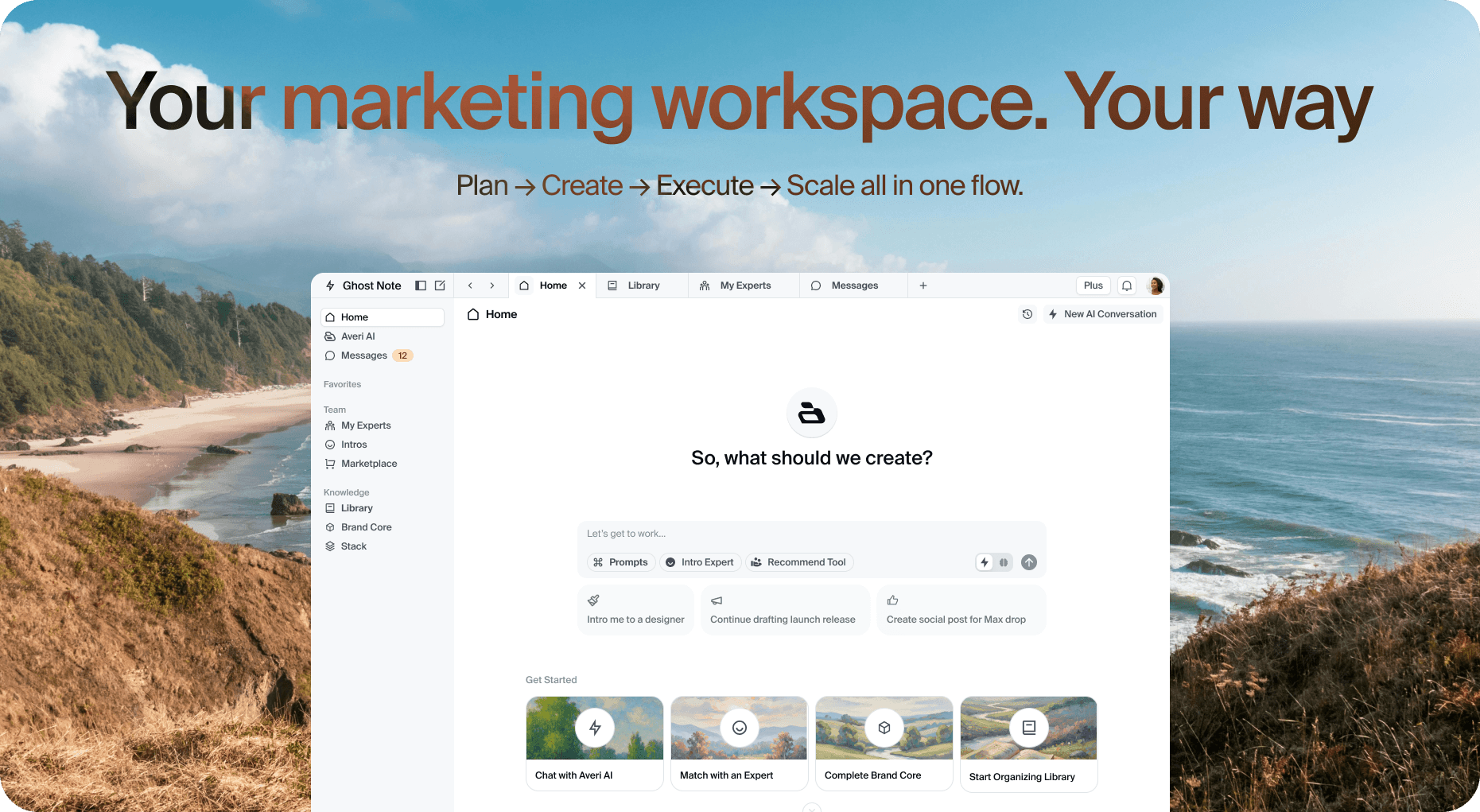
Tool #5: Averi AI (The "Stop Tool-Switching, Start Executing" Platform)
Why It's Different: Everything above? Averi does it in one workspace.
But here's what makes it actually matter: it's the only platform that combines AI speed with human expertise in the same workflow.
Here's what changed in 2025: marketers realized that jumping between ChatGPT (for ideas), Jasper (for copy), Canva (for visuals), Google Docs (for collaboration), Asana (for project management), and fifteen other tools was creating chaos instead of solving it.
You'd spend more time copying context between tools than actually creating. Your brand voice would drift. Your team would lose track of what version they're working on. And God forbid someone new joined the project—they'd need a map just to find where the work was happening.
Averi was built specifically to solve this problem.
What Averi actually does:
Plan → Create → Execute → Scale. All in one place.
Strategic AI that maintains context: Have conversations about your campaign strategy, and that context flows through to content creation, expert collaboration, and final execution. The AI remembers your brand guidelines, past decisions, and strategic direction across your entire project—not just the last 8,000 words.
AI + Human expertise, integrated: Need AI to draft 50 product descriptions? Done. Need a strategist to pressure-test your positioning? Activate an expert in the same workspace. Need a designer for your launch assets? They work in the platform where the brief already lives. No briefing lag, no context loss, no "wait, what were we doing again?"
Content creation at scale with quality control: Generate blogs, ads, emails, social content—all with AI that's trained on your brand voice. Then refine with human experts when it matters. The draft-to-final workflow happens in one environment, not across seven tools.
Integrated data and performance insights: Connect your analytics, CRM, and ad platforms. Averi surfaces insights to inform your strategy and automatically improves recommendations based on what's actually working for you.
Why this approach matters more than tool collection:
Most teams think they need "the best copywriting tool + the best design tool + the best video tool + the best analytics tool." What they actually need is one platform where all of this works together with maintained context and human expertise available on-demand.
Here's the real difference: With separate tools, you're managing a supply chain. With Averi, you're running an assembly line.
The execution advantage: When 75% of marketing staff work is shifting to strategy and away from execution grunt work, you need a platform that handles both—the strategic AI thinking and the tactical execution—without losing the thread between them.
Real-world workflow example:
Think: Brief Averi on your Q4 campaign. The AI asks clarifying questions, suggests positioning angles, and drafts a strategic framework.
Create: Generate first drafts of your campaign assets (landing page, email sequence, social content, ads). AI maintains brand voice and strategic direction across everything.
Refine: Activate a copywriter to polish your flagship landing page. Bring in a designer for hero images. They work in the same platform where the brief and AI drafts already exist.
Execute: Finalize assets, track performance, adjust based on data—all without leaving Averi or losing context.
This isn't "AI plus your workflow." It's AI integrated into how marketing actually gets done.
When to use Averi: When you're managing real campaigns with multiple stakeholders, not just generating one-off content pieces. When tool-switching overhead is killing your velocity. When you need the speed of AI with the precision of human expertise, working together instead of separately. When you're tired of your "AI stack" creating more chaos than it solves.
Why Specialized Tools Matter More Than You Think
Every marketing team that's still trying to do everything in ChatGPT is effectively saying: "We'll use the general practitioner for everything, including brain surgery."
The tools above exist because generalist AI can't:
Maintain brand consistency across hundreds of assets (copywriting tools solve this)
Generate production-quality visuals that don't scream "AI made this" (design tools solve this)
Produce actual video content at scale without a camera (video tools solve this)
Connect to your data sources and surface insights automatically (analytics tools solve this)
Maintain context and collaboration across your entire team and workflow (platforms like Averi solve this)
The AI marketing market hit $47.3 billion in 2025 and is growing 36.6% annually because specialized tools deliver measurably better results than generalists.
But here's the catch: accumulating specialized tools creates its own problem.
The Frankenstack Problem (And Why Integration Beats Accumulation)
You can absolutely assemble a Frankenstack of specialized tools. Jasper for copy. Midjourney for images. Synthesia for video. ThoughtSpot for analytics. Asana for project management. Slack for communication. Google Drive for storage. Notion for documentation.
Congrats, you now have:
8 monthly subscriptions
8 login credentials
8 different interfaces to learn
Zero context flow between any of them
A full-time job just managing the stack
This is why platforms like Averi are gaining traction—they integrate the capabilities of specialized tools without the chaos of managing separate systems.
The best platforms don't make you choose between AI speed and human quality. They give you both—AI for scale and velocity, humans for nuance and strategy—working together in one workspace where context actually flows.

How to Actually Use These Tools (Without Creating More Chaos)
Step 1: Audit Your Current Bottlenecks
Where is your team actually stuck? Content creation? Visual assets? Video production? Data analysis? Tool-switching overhead? Context loss between handoffs?
List your three biggest pain points and what they're costing you in time and money.
Step 2: Decide on Your Approach
You have two paths:
Path A: Build a specialized stack
Pick individual tools for your biggest bottlenecks. Start with copywriting (Jasper/Copy.ai), add design (Midjourney/Canva), layer in video (Synthesia/Pictory), then analytics. Accept that you'll need a system for managing context between them.
Path B: Start with an integrated platform
Use a workspace like Averi that combines multiple AI capabilities with human expertise in one place. Fewer tools to manage, maintained context, faster execution. Then add specialized point solutions only if you need capabilities beyond what the platform provides.
Most teams in 2025 are choosing Path B because tool management overhead has become a bigger problem than feature gaps.
Step 3: Test With Real Projects (Not Toy Examples)
Don't test AI tools with "write me a blog post about marketing." Test them on actual work:
That Q4 campaign you've been postponing
Those 50 product descriptions sitting in a spreadsheet
The explainer video you "don't have budget for"
The data analysis that would take your team 20 hours
If you're trying Averi specifically: Start free, pick a real campaign, and run the full workflow—strategy → content → expert collaboration → execution. Track your time from start to finish.
Step 4: Measure What Actually Changes
Track metrics that matter:
Time to ship: Campaign launch used to take 3 weeks. Now it takes ___?
Cost savings: Used to spend $X on freelancers. Now spending ___?
Output increase: Used to produce Y campaigns per quarter. Now ___?
Quality consistency: Brand voice used to drift. Now ___?
The ROI calculation is simple: (Time saved × your hourly rate) + (freelancer costs eliminated) - (tool costs) = profit or loss.
Step 5: Don't Accumulate—Integrate
This is critical: Adding seventeen AI tools doesn't make you 17x more productive. It makes you 17x more scattered.
If you're building a stack of specialized tools, you need a system for how they work together. Notion for documentation? Airtable for workflow? Slack for communication? You're still managing a complex system.
If you're using an integrated platform like Averi, the system is built in. Strategy, creation, collaboration, and execution happen in one place with maintained context.
The goal isn't to use more AI tools. It's to execute marketing faster without adding chaos.
The Uncomfortable Truth About Generalist AI
ChatGPT democratized AI. That's genuinely amazing. But democratization doesn't mean optimization.
Your competitors who are crushing it in 2025 aren't using ChatGPT for everything. They've either:
A) Built specialized tool stacks (Jasper for copy, Midjourney for design, Synthesia for video, ThoughtSpot for analytics) and created systems to manage context between them.
B) Moved to integrated platforms like Averi that combine AI capabilities with human expertise in one workspace where context flows naturally.
Most are choosing B because they learned the hard way: the tool-switching tax is expensive.
Meanwhile, teams still copy-pasting ChatGPT outputs into Google Docs are wondering why their AI strategy isn't moving the needle.
The gap between "we use AI" and "we use the right AI for each job" is the difference between checking a box and actually gaining competitive advantage.
The Five-Minute Experiment That Changes Everything
Here's your homework… and it only takes one project to see the difference:
Pick one piece of content you need to create this week. Generate it three ways:
Option 1: ChatGPT Everything
Use ChatGPT for strategy, content, and execution. Count how many times you copy-paste between tools. Track time from start to finished asset.
Option 2: Specialized Tool Stack
Use Jasper or Copy.ai for copywriting, Canva for design, Synthesia for video (if applicable). Note the quality improvement but also the context-switching overhead.
Option 3: Averi
Start free and run the same project through Averi's integrated workspace. Strategy → content → expert refinement (if needed) → final execution, all in one place with maintained context.
Compare:
Output quality
Time to completion
Number of tools touched
Context lost between steps
Whether you'd actually want to do this at scale
Most marketers realize within five minutes why integrated platforms exist.
Ready to Stop Playing Marketing on Hard Mode?
The AI marketing market hit $47.3 billion in 2025 because generalists don't cut it anymore.
You can assemble a Frankenstack of specialized tools and manage the integration yourself.
Or you can work in a platform designed for how marketing actually happens—where AI speed meets human expertise, strategy flows into execution, and campaigns ship faster without the chaos.
Try Averi free and run a real campaign. See what changes when you stop managing tools and start shipping work.
The proof isn't in the feature list. It's in whether you actually execute faster with less overhead.
Most teams know within their first project whether Averi is the answer.
The question is: will you test it on real work or keep wondering why your current approach feels so inefficient?
FAQs
Why can't I just use ChatGPT Plus for everything and save money?
Because you're not just paying for AI—you're paying for the system around it. ChatGPT Plus costs $20/month and exists in its own silo. Every time you generate something, you're copying it somewhere else, briefing someone new, or losing context when the conversation gets too long.
Here's the real cost: your time. How many hours per week does your team spend switching between tools, re-briefing people, tracking versions, and searching for "wait, where did we put that draft?" If that number is more than 5 hours/week, you're losing $500-2,500/month in wasted time (depending on your team's hourly rates).
Averi eliminates that tax. Strategy, creation, collaboration, and execution happen in one place with maintained context. The AI remembers your brand, your past decisions, and your strategic direction. Human experts can jump in without needing a 30-minute catch-up call. Everything ships faster with fewer handoffs.
Plus: Jasper's Pro plan at $125/month seems pricier than ChatGPT—until you realize one freelancer costs $2,000-5,000/month. Averi combines AI capabilities with on-demand expert access for less than most companies spend on one fractional hire.
How is Averi different from just using Jasper + Canva + other specialized tools?
Averi integrates what those tools do separately—but here's what really matters: the context flows through.
With separate tools:
Generate campaign strategy in ChatGPT → copy into Google Doc
Write copy in Jasper → paste into project management tool
Create visuals in Canva → download and upload somewhere else
Brief freelancer → they ask 10 clarifying questions because they don't have context
Lose 30 minutes every time someone new touches the project
With Averi:
Strategy conversation with AI informs content creation in the same workspace
Generate multiple asset types (blogs, ads, emails, social) with consistent brand voice
Activate human experts who can see the full project context immediately
Everyone works in one environment with full visibility
Ship campaigns in days, not weeks
The difference isn't features—it's integration. Separate tools are a supply chain. Averi is an assembly line.
Plus, Averi's unique differentiator: AI + human expertise in the same workflow. Need AI to draft 50 variations? Done. Need a strategist to validate your positioning? Activate them in the same workspace where the AI drafts live. Need a designer for launch assets? They see the full brief without another handoff.
What's included in Averi that I can't get elsewhere?
Three things you can't assemble yourself:
1. Unified AI workspace with persistent context
The AI maintains memory across your entire campaign—not just the last conversation. Your brand guidelines, strategic decisions, past performance data, and project history flow through everything. ChatGPT forgets. Individual tools don't talk to each other. Averi remembers.
2. Integrated expert network
Need a copywriter? Strategist? Designer? SEO specialist? They're available on-demand, work inside Averi where your project context already exists, and integrate with AI workflows seamlessly. No briefing lag. No "let me get up to speed" meetings. They see everything and start adding value immediately.
3. End-to-end campaign execution in one platform
From strategic thinking to final assets to performance tracking—all in one place. Most "AI platforms" are content generators that spit things out for you to manage elsewhere. Averi is where the actual work happens.
Think of it this way: You can buy all the ingredients for a kitchen (ChatGPT, Jasper, Canva, Asana, Slack). Or you can work in a professional kitchen where everything's already integrated and you have expert chefs available when you need them. That's Averi.
Q: I'm on a small team. Is Averi overkill for us?
Small teams benefit most from Averi because you have the least capacity for tool-switching overhead.
Here's what small teams tell us:
Before Averi:
"I spend 2 hours/day just moving things between tools"
"We can't afford a full marketing team so campaigns take forever"
"Every project requires briefing 3 different freelancers who don't talk to each other"
"Our brand voice is inconsistent because we use different tools and people"
After Averi:
AI handles the bulk work (drafts, variations, first passes)
Activate experts only for the 20% that really matters
Context stays intact so nothing falls through cracks
Ship campaigns 3-5x faster with the same (small) team
Small teams don't have time to waste on tool management. Averi gives you the leverage of a much larger team without the overhead.
Can I try Averi with a real project before committing?
Absolutely. And you should—because the difference between "I watched a demo" and "I used this on actual work" is enormous.
Here's how to test it properly:
Pick a real campaign you need to launch (not a toy project)
Start free with Averi and use it for the full workflow—strategy, content, assets
Activate an expert (your first consultation is included) for something you'd normally hire a freelancer for
Track your time from start to finish and compare against your normal process
Most teams realize within one project why integrated platforms matter. The proof isn't in feature lists—it's in whether you actually ship faster with less chaos.
Start with Averi free and see what changes when strategy, AI, and human expertise work together in one place.
How do I convince my boss/team to try a new platform?
Lead with the problem, not the tool.
Frame it like this to your boss:
"We're currently spending X hours/week switching between tools and briefing people. That's $Y in wasted time monthly. We're also spending $Z on freelancers who take days to get up to speed on each project. I found a platform that integrates AI and expert access in one workspace. Can we test it on [specific upcoming campaign] and measure time-to-ship and costs?"
Frame it like this to your team:
"I know learning new tools sucks. But we're currently using 8 different platforms for one campaign. This consolidates it into one place where context flows through. Less copy-pasting, fewer handoffs, fewer 'wait, where did we put that?' moments. Can we try it on the next project?"
What usually happens: Once one person on the team tries Averi and ships something notably faster, everyone else wants access. The proof of concept sells itself.
What if we've already invested in other tools? Do we have to abandon them?
Nope. Averi integrates with your existing stack—CRM, analytics, ad platforms, whatever you're already using.
Most teams start by using Averi for campaign development and content creation while keeping their existing tools for specific functions (analytics dashboards, ad management, email platforms). Over time, they naturally consolidate more work into Averi because it's easier.
Think of it as a hub, not a replacement. Your data sources plug in. Your performance metrics flow through. Your specialized tools still work—Averi just becomes the workspace where strategy, creation, and collaboration happen.
How long does it take to actually get productive with Averi?
Day 1: Generate your first campaign assets with AI. See how maintained context works across content types.
Week 1: Complete your first project end-to-end. Understand how to activate experts and collaborate within the platform.
Week 2-3: Ship your first full campaign and measure time savings vs. your old workflow.
This isn't enterprise software with 6-month implementations. It's built for marketers by marketers. If you can use Google Docs and Slack, you can use Averi.
Most teams report being genuinely productive within their first real project—not after months of training.
What types of companies get the most value from Averi?
Three profiles consistently tell us Averi transformed their operations:
1. Growth-stage companies (10-200 people)
Need to scale marketing output without scaling headcount proportionally. Can't afford full-time specialists for everything, but need expert-level work. Averi gives them AI velocity + on-demand expertise at a fraction of building a full team.
2. Lean marketing teams at larger companies
Expected to deliver enterprise-level campaigns with startup-size teams. Drowning in tool management and context-switching. Averi consolidates their workflow and multiplies their output capacity.
3. Marketing agencies managing multiple clients
Need to maintain distinct brand voices, manage numerous campaigns simultaneously, and scale expert labor efficiently. Averi's workspace keeps client projects organized, AI maintains brand consistency, and experts can be deployed across accounts flexibly.
Common thread: Teams that are skilled but capacity-constrained. They don't need more tools—they need a system that helps them execute faster without sacrificing quality.
If you're constantly thinking "we'd do this if we had more time/people/budget," Averi is built for you. Start free and run a real campaign to see the difference.