Best AI Content Creation Tools Compared (2026) — Honest Reviews

5 minutes

TL;DR
📊 85% of marketers use AI for content creation in 2026. Adoption is settled. The performance gap comes from architecture: integrated system vs. disconnected tool stack.
✍️ Writing tools (Jasper $49/seat, Copy.ai $49, Writesonic $16, ChatGPT $0–$20): Each does one thing well. None handles keyword strategy, SEO/GEO scoring, or CMS publishing.
📈 Optimization tools (Surfer $89, Clearscope $170, Frase $15–$115): Score content quality but don't produce content, publish it, or track post-publish performance.
⚙️ Content engines (Averi $99): Strategy → creation → scoring (55% SEO + 45% GEO) → CMS publishing → analytics in one system. 2 hrs/week for 2–4 published posts.
🚫 The stack problem: 6+ tools at $205–$382/month. You're the integration layer. Every handoff costs time and introduces errors.
🎯 Choose by need: Writing assistant? ChatGPT. Content optimization? Surfer. End-to-end system on limited time? Averi. Large writing team? Jasper + SEO tool.
⚡ Start free with Averi. 14-day trial. Compare the output against your current stack.

Zach Chmael
CMO, Averi
"We built Averi around the exact workflow we've used to scale our web traffic over 6000% in the last 6 months."
Your content should be working harder.
Averi's content engine builds Google entity authority, drives AI citations, and scales your visibility so you can get more customers.
The Best AI Content Creation Tools for Marketers in 2026
Your content calendar is staring at you.
Blog posts due this month, social content for three platforms, email sequences for a product launch, and that thought leadership piece your co-founder has been asking about for weeks.
You're not alone in feeling perpetually behind.
85% of marketers now use AI for content creation, up from 61% in 2023. Teams report 62% faster content production and 3.8x higher output with AI assistance. The adoption question is settled.
The tool question isn't.
42% of marketers use AI for content creation daily. Yet many are still juggling 6–10 subscriptions, copying outputs between platforms, and spending more time managing tools than creating content. 52% of consumers reduce engagement when they suspect AI-generated content, which means speed without quality control is counterproductive.
The solution isn't more AI tools.
It's the right architecture: tools that understand your brand, enforce quality standards, and integrate into how you actually work.
The Problem With the Tool-Stacking Approach
Before evaluating individual tools, understand why the "best tool for each job" approach breaks down.
The average marketing team pays for a keyword research tool ($99–$140/month), an AI writing tool ($20–$49), an SEO optimization tool ($49–$89), a social scheduler ($15–$49), a design tool ($12–$30), and project management ($10–$25).
That's 6 tools at $205–$382/month before you've produced a single piece of content.
The tools don't connect. You research keywords in one tab, draft in another, optimize in a third, copy-paste into your CMS, schedule social posts in a fifth platform, and check analytics in a sixth.
You're the integration layer.
Every handoff between tools costs 5–15 minutes and introduces errors: formatting breaks, forgotten meta tags, inconsistent voice.
93% of marketers report new AI features added to tools in their tech stack. More features. More complexity. More tabs. The stack grows. The output doesn't grow proportionally.
This context matters when evaluating the tools below. Each one is good at what it does. The question is whether you need 6 good tools or one integrated system.

The AI Writing Tools: What Each Does Best
Jasper — Best for Enterprise Teams With Multiple Writers
Jasper built its reputation on brand voice consistency across large teams. You define your brand voice, and Jasper enforces it across every writer's output. With over a dozen language models and collaborative workflows, it's designed for marketing departments, not solo founders.
Pricing: $49/month per seat (Creator). Business plan with custom pricing for teams.
Best for: Marketing teams of 5+ people who need voice consistency across multiple writers and campaign types.
Strengths: Brand voice training, campaign-level content planning, team collaboration features.
Limitation: Per-seat pricing scales quickly for larger teams. Primarily a writing tool — doesn't handle keyword strategy, SEO scoring, or CMS publishing.
Copy.ai — Best for Sales and GTM Copy Variations
Copy.ai shifted from general AI writing toward sales enablement and go-to-market workflows. Its strength is producing rapid copy variations: email sequences, ad copy, product descriptions, landing page variants. The workflow automation features handle repetitive copy tasks at scale.
Pricing: Free plan available. Pro at $49/month.
Best for: Sales teams and performance marketers who need rapid A/B testing variations and platform-specific ad copy.
Strengths: GTM workflow automation, rapid variation generation, sales enablement copy.
Limitation: Less suited for long-form content (blog posts, guides, thought leadership). No SEO or GEO optimization.
Writesonic — Best for Long-Form Blog Content
Writesonic generates long-form content that requires less editing than most AI writing tools. Its Chatsonic feature combines conversational AI with real-time web data, which helps when drafting content that needs current statistics or recent examples.
Pricing: Free plan available. Individual plans from $16/month.
Best for: Content creators focused on blog posts and articles who want a solid first draft with current information.
Strengths: Long-form structure, real-time data integration, multiple language support.
Limitation: Writing tool only — no keyword strategy, content scoring, or publishing integration.
ChatGPT — Best Free Starting Point
ChatGPT is used by 44% of marketers for content creation, making it the most widely adopted AI writing tool. The free tier handles brainstorming, outlining, and rough drafting. The Plus plan ($20/month) adds web browsing and image generation.
Pricing: Free. Plus at $20/month.
Best for: Anyone starting with AI content creation who needs a flexible, general-purpose writing assistant.
Strengths: Versatility, free tier, conversational interface, web browsing for current information.
Limitation: No brand voice memory between sessions (without custom GPTs), no SEO scoring, no publishing integration. You write in ChatGPT, then copy-paste everywhere else.
The SEO and Optimization Tools
Surfer SEO — Best for On-Page Content Scoring
Surfer analyzes top-ranking pages for your target keyword and provides a real-time content score as you write. The NLP-driven term suggestions show which topics to cover and how much depth each section needs.
Pricing: Essential at $89/month. Scale at $129/month. Best for: Content teams with an existing writing workflow that need a scoring/optimization layer. Strengths: Real-time content scoring, SERP-based recommendations, Google Docs and WordPress integrations. Limitation: Optimization only — doesn't generate content, research keywords, or track AI citations. Traditional SEO focus without GEO scoring.
Clearscope — Best for Content Quality Grading
Clearscope assigns letter grades based on semantic relevance, topic coverage, and content depth. It integrates into Google Docs and WordPress, so writers can optimize while writing rather than running content through a separate tool afterward.
Pricing: Starting around $170/month. Best for: Teams prioritizing content quality over volume who want rigorous scoring against competitors. Strengths: Deepest content grading in the market. Trusted by enterprise teams (HubSpot, Shopify). Limitation: Expensive for small teams. Scores content but doesn't produce it. No AI visibility or GEO features.
Frase — Best for Research-to-Brief Workflow
Frase turns a keyword into a structured content brief by analyzing what's currently ranking. The AI-assisted drafting fills in the brief, and the GEO Score evaluates citation readiness across 8 AI platforms.
Pricing: Solo at $15/month (4 articles). Team at $115/month (unlimited). Best for: Writers and content strategists who need help going from keyword to structured outline to draft. Strengths: Fast brief generation, GEO Score for AI citation readiness, affordable entry at $15/month. Limitation: Solo plan's 4-article limit restricts weekly publishers. No direct CMS publishing.

The Specialist Tools
Synthesia — Best for Video Content at Scale
Video content delivers ROI 49% faster than text. Synthesia produces professional video using AI avatars (230+) speaking 140+ languages, without cameras, studios, or actors. For training videos, product explainers, and marketing announcements, it replaces traditional video production at a fraction of the cost.
Pricing: Starting at $29/month.
Canva — Best for Visual Content Creation
Canva's AI features (Magic Write, text-to-image, background removal) make it the default design tool for non-designers. For social media graphics, presentation slides, and basic brand assets, nothing else comes close at the price point.
Pricing: Free. Pro at $15/month.
The Missing Category: Content Engines
Every tool above handles one or two phases of content production. None handles all of them. That's the gap.
A keyword tool identifies what to write about. A writing tool generates the draft. An optimizer scores it. A CMS publishes it. An analytics platform measures it. Five tools, five tabs, five subscriptions, and you connecting them manually.
A content engine connects all six phases into one workflow: strategy → creation → optimization → publishing → distribution → analytics. The output of each phase feeds the next. No copy-paste. No tab-switching.
Averi — The AI Content Engine for Startups
Full disclosure: this is our product.
We built it because we faced the same stack-fragmentation problem described above.
Here's what it does, honestly.
What it handles:
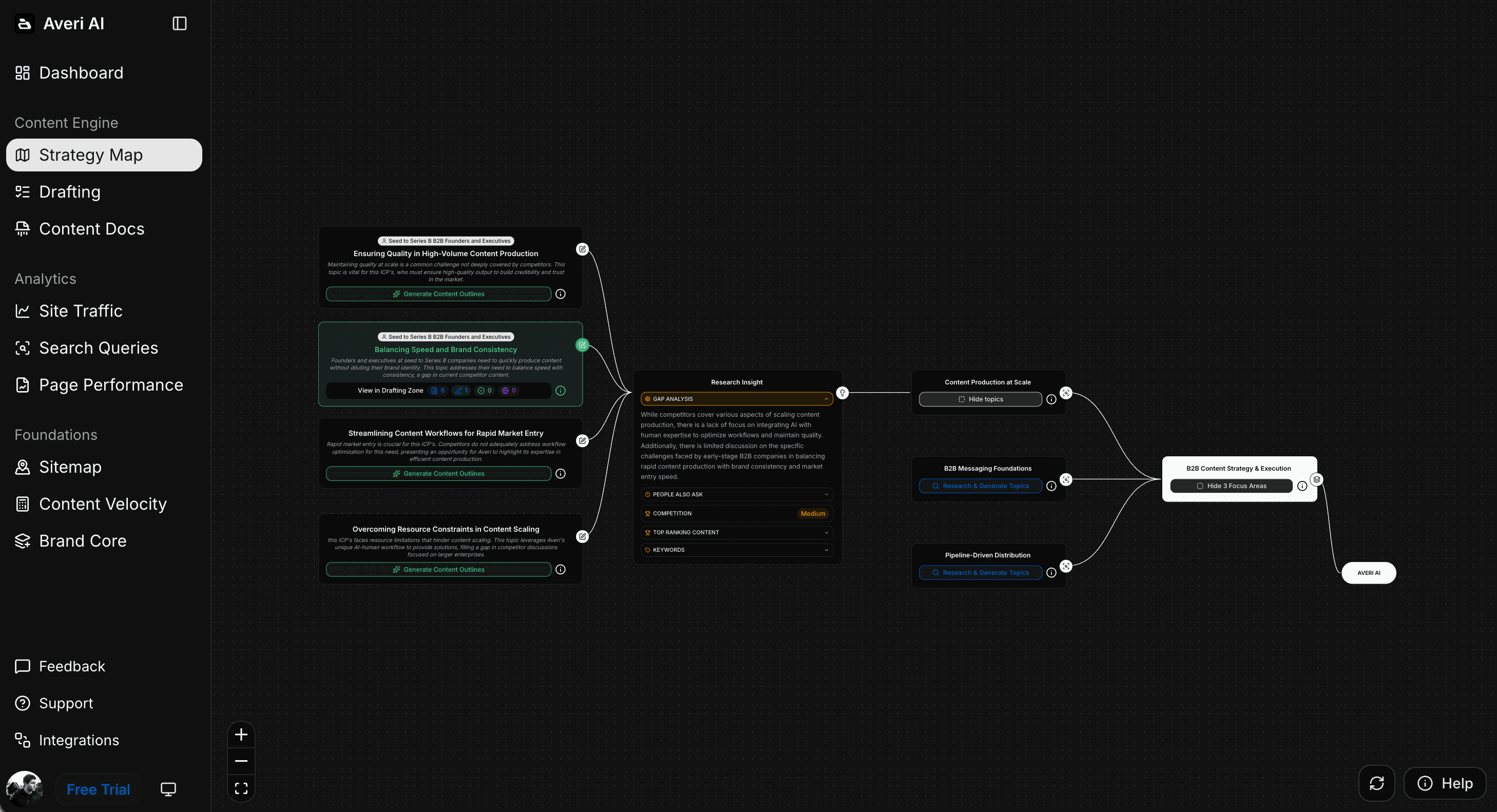
Strategy Map: Generates keyword-targeted topic recommendations from your Brand Core (ICP, positioning, product capabilities). You approve topics in 5–10 minutes/week instead of spending 30–60 minutes on manual keyword research.
Content Queue: Produces AI-assisted drafts structured for both SEO and GEO. Answer capsules, 15–20 hyperlinked statistics, FAQ sections, 120–180 word extractable blocks. You edit for 30–45 minutes, adding your voice and expertise.
Content Scoring: 55% SEO + 45% GEO evaluation before publishing. Catches citation readiness gaps, missing statistics, weak FAQ answers, and promotional tone before the content goes live.
CMS Publishing: Direct integration with WordPress, Webflow, and Framer. Content publishes with formatting, meta tags, images, and URL slugs intact. No copy-paste.
Analytics: Google Analytics and Search Console data connected to your content library. Pages with declining traffic get flagged for refresh. Top performers get identified for topic expansion.
LinkedIn Post Generation: Extracts insights from blog content for LinkedIn distribution.
Pricing: $99/month (Solo Plan). 14-day free trial, no credit card.
Best for: Seed-to-Series-A founders running content marketing without a dedicated marketing team. The 2-hour/week time investment produces 2–4 published, scored, optimized posts per week.
What it doesn't do: Email marketing (pair with beehiiv or Customer.io), paid ads management, CRM, video production, or social media for platforms beyond LinkedIn. It's a content engine, not a full marketing suite.
The results: 6,000% organic traffic growth in 10 months using the same system available to users. Those results required 10 months of consistent publishing. The early months were flat. The compounding hit mid-timeline.
The Comparison Table
Tool | Category | Starting Price | Produces Content? | SEO Scoring? | GEO/AI Scoring? | CMS Publishing? |
|---|---|---|---|---|---|---|
Jasper | AI Writing | $49/seat | Yes | No | No | No |
Copy.ai | Sales/GTM Copy | Free–$49 | Yes | No | No | No |
Writesonic | Long-Form Writing | Free–$16 | Yes | No | No | No |
ChatGPT | General AI | Free–$20 | Yes | No | No | No |
Surfer SEO | Content Optimization | $89 | No | Yes | No | WordPress only |
Clearscope | Content Grading | $170 | No | Yes | No | WordPress/Docs |
Frase | Research + Writing | $15–$115 | Yes | Yes | Partial | No |
SE Ranking | SEO Suite | $65 | No | Yes | AI tracking | No |
Averi | Content Engine | $99 | Yes | Yes | Yes | Yes (3 CMS) |
The column that matters most for small teams: "CMS Publishing?"
Content that stays in Google Docs or needs copy-pasting into your CMS has a friction point that kills publishing consistency.
Publishing weekly drives 3.5x more conversions than monthly.
Anything that makes publishing harder reduces the cadence that compounds.
How to Choose: The Decision Framework
You need a writing assistant (not a system)
Choose ChatGPT ($0–$20) or Writesonic ($16). You'll write content, manually optimize it, manually publish it, and manually track it. Total time per post: 4–6 hours across 3–4 tools. Works if you have the time and enjoy the process.
You need content optimization for existing writers
Choose Surfer ($89) or Clearscope ($170). Your writers produce content, these tools ensure it's optimized. You still need a separate writing workflow, keyword research, and CMS publishing process.
You need an end-to-end content operation on limited time
Choose Averi ($99). Strategy through publishing in one system. 2 hours/week for 2–4 optimized posts. Best for founders who can't afford 10+ hours/week on content marketing but need the organic growth it produces.
You have a team of 5+ writers
Choose Jasper ($49/seat) for brand voice consistency across multiple writers, plus an SEO tool (Surfer or SE Ranking) for optimization. Total: $150–$200+/month. The per-seat model makes sense when multiple people produce content simultaneously.
The Real Question: Tools or Outcomes?
94% of marketers plan to use AI in content creation in 2026. The adoption gap has closed. The performance gap hasn't. Only 23.3% of companies have AI agents fully integrated into their marketing stack. The rest use AI in silos: disconnected tools that don't share context, maintain brand voice, or compound in value.
The competitive advantage has shifted from "using AI" to "having AI integrated into a system." The tool matters less than the workflow. A $20/month ChatGPT subscription in a disciplined weekly workflow outperforms a $500/month tool stack with no system behind it.
Pick the architecture that matches your time, your budget, and your growth goals. Then execute consistently. Content compounds. The tool just determines how fast.
Start free with Averi. 14-day trial. No credit card. See whether the integrated approach produces more output in less time than your current stack.
FAQs
What's the best AI content creation tool for marketers in 2026?
It depends on your team size and workflow needs. For solo founders who need an end-to-end system on limited time, Averi ($99/month) handles strategy through CMS publishing in one tool at 2 hours/week. For teams of 5+ writers needing voice consistency, Jasper ($49/seat) plus an SEO tool is the standard approach. For marketers who want a flexible writing assistant, ChatGPT Plus ($20/month) is the most widely adopted starting point. The "best" tool depends on whether you need a writing assistant, a scoring layer, or a complete content system.
Is AI content good enough for marketing in 2026?
With human editing, yes. 85% of marketers use AI for content creation and 68% report increased content marketing ROI. The catch: 52% of consumers reduce engagement when they suspect AI-generated content. The teams producing the best results use AI for research, structure, and first drafts, then edit heavily for voice, expertise, and perspective. 73% combine AI with human writing, the approach producing the strongest results. Only 5% rely mostly on AI without human oversight.
How many AI content tools does a marketing team need?
Most teams use 6–10 but only need 3–5. The marketing tool consolidation checklist identifies which tools overlap and where one integrated system replaces 3–5 disconnected ones. A minimal effective stack: a content engine for production ($99), an email platform (free–$49), and Google's free analytics tools (GSC + GA4). Total: $99–$148/month vs. $205–$382 for a typical 6-tool stack.
Should I use ChatGPT or a dedicated content tool?
ChatGPT is excellent as a writing assistant but requires manual work for everything around the writing: keyword research, SEO optimization, GEO structuring, CMS formatting, and performance tracking. If you're producing 1–2 posts/month and have time for the manual workflow, ChatGPT Plus ($20/month) is sufficient. If you're targeting weekly publishing with SEO + GEO optimization, a dedicated content engine saves 3–4 hours per post by handling the full workflow.
Do I need to optimize content for AI citations in 2026?
Yes. AI Overviews appear in ~50% of searches. 60% of Google searches produce zero clicks. Content optimized only for traditional SEO misses the AI answer layer where buyers increasingly discover and evaluate solutions. Look for tools that include GEO scoring (answer capsule quality, factual density, FAQ structure, citation readiness) alongside SEO optimization. Currently, most writing and optimization tools only handle traditional SEO. Averi's dual scoring at 55% SEO + 45% GEO and Frase's GEO Score are among the few that evaluate both.
What's the ROI of AI content tools?
Brands investing in AI content tools see 420% ROI, 62% faster production, and 32% higher engagement. For the specific tool investment: a $99/month content engine that saves 8–12 hours/week of founder time (valued at $100–$200/hour) produces $800–$2,400/month in time savings. Against the $99 cost, that's an 8–24x monthly return before counting the organic traffic value the content generates. Content marketing delivers $3 for every $1 invested over a 36-month horizon.
How do I avoid AI content sounding generic?
Two requirements. First, use a tool with brand voice training or context (Jasper's brand voice, Averi's Brand Core, or a custom GPT in ChatGPT). Second, edit every piece personally. The highest-quality AI content workflow: AI handles research, structure, and initial drafting. The human adds expertise, first-person experience, contrarian perspectives, and editorial voice. 67% of marketers say original research remains more valuable than AI-generated content. Your unique data and perspective are what make AI-assisted content sound like you, not like everyone else.