

In This Article
Use AI to automate research, drafting, publishing, and analytics for scalable, data-driven content strategies while preserving human editorial control.
Updated:
Trusted by 1,000+ teams
Startups use Averi to build
content engines that rank.
AI is transforming content strategy by automating research, drafting, and publishing while improving performance and reducing costs. Businesses using AI report better results, with 58% seeing improved content performance and 54% noting cost savings. Tools like Averi AI streamline workflows, enabling companies to scale content production without compromising quality. For example, Wyndly increased article output fivefold and boosted organic traffic twentyfold using AI between 2023 and 2025.
Key Takeaways:
AI's Impact: Automates tasks like keyword research, audience analysis, and content drafting. This includes AI-assisted content ideation to identify data-driven opportunities.
Performance Boost: 58% of marketers report better outcomes using AI.
Efficient Workflows: Tools like Averi AI manage strategy, creation, and analytics in one system.
Scalability: AI enables faster production cycles and improved ROI.
Human-AI Balance: AI handles repetitive tasks, while humans focus on refinement and storytelling.
AI is a game-changer for content marketing, helping businesses stay competitive by optimizing every step of the process.
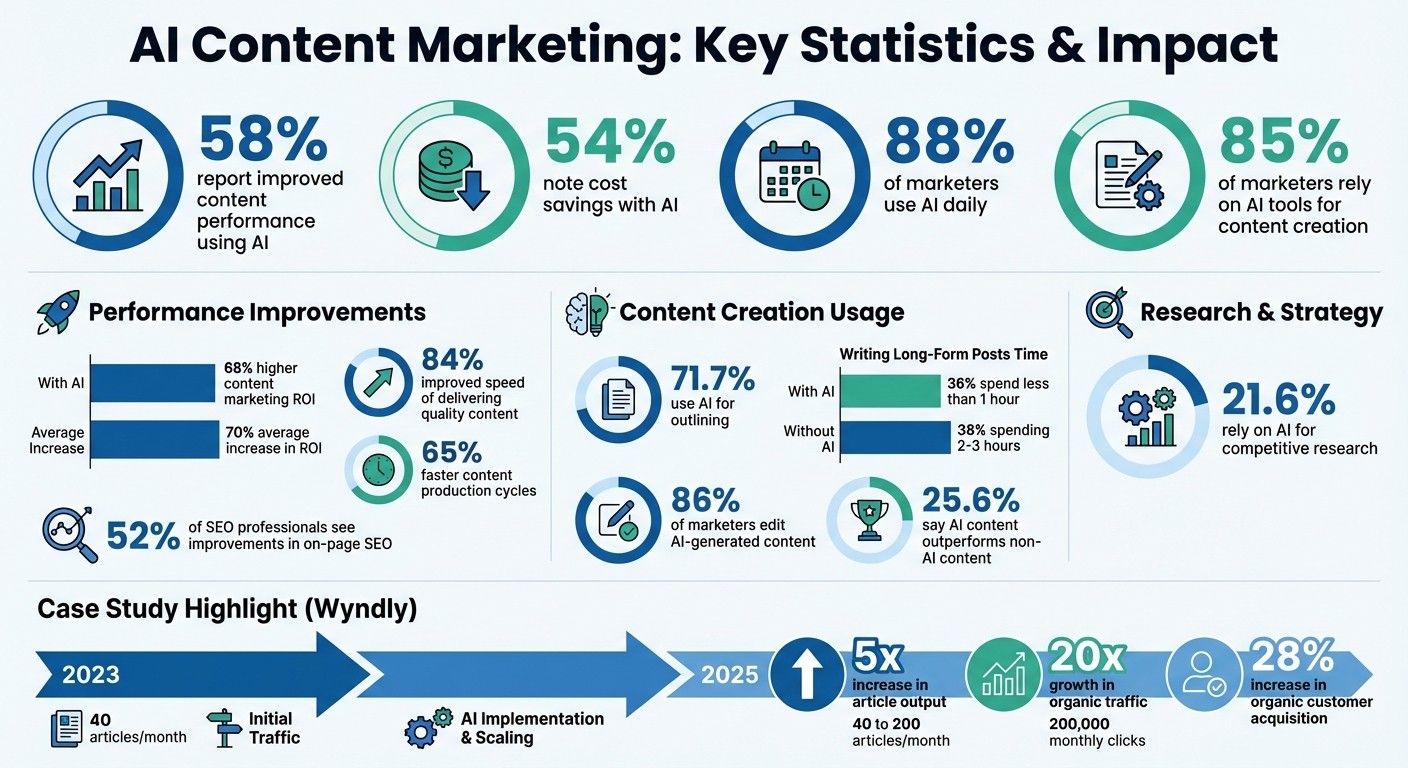
AI Content Marketing Statistics and Impact 2025
How to Build a Content Strategy with AI (ChatGPT + NotebookLM Guide)

Building a Data-Driven Content Strategy with AI
A data-driven content strategy takes the guesswork out of content creation by analyzing search trends, social engagement, website analytics, and customer feedback. This approach uncovers patterns that reveal your audience’s needs while highlighting areas competitors may be overlooking.
With 88% of marketers using AI daily and 58% reporting improved content performance [1], AI has become a game-changer for turning raw data into actionable insights.
For example, Averi’s Strategic Planning Module simplifies this process by analyzing your website, creating detailed customer profiles, and generating content calendars tailored to your growth goals. Its Synapse architecture ensures your brand voice remains consistent throughout. When you feed it quality inputs - like sales transcripts, discovery calls, or support tickets - it delivers highly accurate content themes that directly address your audience’s challenges.
Using AI to Analyze Audience Behavior
AI dives deep into search habits, purchase patterns, social interactions, and website activity to segment your audience into precise personas.
"My team now uses AI to generate an outline and structure, which frees us up to focus on adding insights and making sure the content feels human and aligned with our brand." – Colleen Barry, Head of Marketing, Ketch [2]
The process begins with intent categorization. AI organizes keywords into categories like informational, navigational, commercial, and transactional, linking them to specific stages of the buyer’s journey. For instance, a search for "what is content strategy" signals early-stage research, while "Averi AI pricing" indicates a readiness to make a decision. This categorization helps determine what type of content to create and where it fits in your funnel.
Funnel Stage | Customer Mindset | AI Content Focus |
|---|---|---|
Awareness | "I have a problem but don’t know solutions exist." | Educational blogs and social content addressing pain points. |
Consideration | "I’m researching and comparing solutions." | Case studies, comparison guides, and webinars. |
Decision | "I’m ready to choose and need validation." | Product demos, ROI calculators, and testimonials. |
Success | "I want to maximize the value of my purchase." | Tutorials, onboarding guides, and community content. |
AI doesn’t just analyze static data - it tracks real-time behavioral shifts. For example, if interest in a specific topic surges, the system flags it as a priority for new content. Similarly, if one format, like comparison guides, outperforms others in driving conversions, AI suggests focusing more on that format.
Beyond audience behavior, AI is also a powerful tool for analyzing your competitors and identifying gaps in their strategies.
Competitor Research and Content Gap Analysis
Gone are the days of manually combing through competitor websites and spreadsheets. AI automates competitor research by mapping their content strategies, analyzing keyword rankings, and identifying areas they’ve left untapped.
21.6% of marketers already rely on AI for competitive research [2], largely because of how efficient it is. AI benchmarks competitor performance, spots high-volume search terms they’re missing, and uncovers opportunities for your brand to step in with relevant content.
For instance, in 2025, Cushman & Wakefield, a global real estate firm, used AI to streamline tasks like writing website copy and taglines. This saved them 50% of the time previously spent on these tasks, freeing up their creative teams for more strategic work [5].
AI clusters competitor content into themes, identifies which ones drive the most traffic, and highlights gaps in your library. If competitors dominate rankings for "content marketing strategy" but ignore "AI content workflows", that’s your chance to step in.
"AI can help you find content gaps, cluster topics, and brainstorm angles. But it should not decide... what positioning you take." – Montana Thomas, QuickSprout [4]
AI also emphasizes entity-level optimization, focusing on broader concepts and topics rather than just individual keywords. This approach, often structured around "topic clusters" (3-5 core topics supported by 8-12 subtopics), helps establish authority and boosts visibility across both Google and AI-powered search engines like ChatGPT and Perplexity.
In addition to competitor insights, AI refines your understanding of your audience and improves keyword research.
Automated ICP and Keyword Suggestions
AI streamlines the creation of ideal customer profiles (ICPs) by analyzing your business goals, market trends, and existing customer data. It identifies distinct audience segments, each with unique needs, decision-making processes, and content preferences.
Averi simplifies this by scanning your website, analyzing your positioning, and suggesting 3-4 specific audience segments, each with tailored content strategies. These aren’t generic personas - they’re grounded in data, ensuring every piece of content you create resonates with your audience.
"The biggest benefit has been how much faster we can repurpose knowledge from inside the company into customer-facing content. Instead of relying only on subject matter experts' limited time, AI helps us capture their expertise and scale it." – Dirk Alshuth, CMO, Emma [2]
Keyword research also benefits from AI’s precision. Instead of treating keywords as isolated terms, AI groups them into topic clusters, aligning with modern search engines’ focus on topic authority over keyword density.
71.7% of content marketers use AI for outlining, and 68% use it for content ideation [1]. The reason? It’s fast and precise. AI identifies high-opportunity keywords based on search volume, competition, and relevance to your ICPs, then organizes them into a prioritized content queue.
Some tools, like Semrush, even offer "Personal Keyword Difficulty" (PKD%) scores. These scores use AI to evaluate your specific site’s ability to rank for certain terms, replacing generic difficulty metrics with actionable insights tailored to your domain authority and existing content.
As you publish and analyze content performance, AI continuously refines its recommendations, helping you decide what to focus on next. This iterative process ensures your content strategy evolves and delivers measurable results.
Simplifying Content Planning and Execution
Once you’ve established a data-driven strategy, the next step is to automate execution. AI takes the hassle out of content planning, turning what was once a labor-intensive process into a seamless system that generates ideas, drafts, and publishes content - all while improving based on performance data.
Automating Content Calendars and Topic Queues
Gone are the days of juggling spreadsheets and manually tracking competitors. AI keeps a constant eye on your market, analyzing keyword opportunities, monitoring trends, and spotting content gaps that others overlook.
At the core of this process is topic cluster architecture. AI organizes your content into 3-5 broad themes or pillar topics, each supported by 8-12 subtopics that align with different stages of the buyer journey [1]. These priorities are set based on search volume, competition, and how well they match your target audience.
The impact is clear: 55.05% of marketers recognize AI’s ability to scale content creation across multiple channels without sacrificing speed [1]. For example, in 2025, Wyndly, a telehealth platform, used AI workflows to boost content production from 40 to 200 articles per month - a 5x increase. This effort led to a 20x growth in organic traffic, reaching 200,000 monthly clicks, while organic customer acquisition jumped 28% [3].
AI also enables batch drafting, where related content pieces are created together, leveraging shared research for efficiency [1]. With planning handled, the focus shifts to creating high-quality drafts.
AI-Powered Drafting and Editing Workflows
AI excels at laying the groundwork for content creation, but its true power comes when paired with human expertise. The ideal balance follows the 80/20 rule: AI takes care of 80% of the work - research, outlining, and drafting - while humans focus on the remaining 20%, adding strategy, storytelling, and refinement [6].
AI simplifies drafting by producing detailed outlines first, then developing content section by section. This step-by-step method ensures logical flow, depth, and inclusion of essential SEO elements [1][4].
The time savings are notable: 36% of marketers using AI spend less than an hour writing long-form blog posts, compared to 38% of non-users who take 2-3 hours [1]. Companies leveraging AI-driven systems report content production cycles that are up to 65% faster [6].
Editing is where human input becomes indispensable. 86% of marketers take the time to refine AI-generated content [1]. A multi-layer review process works best: start with an automated check for grammar and SEO optimization, then have a subject matter expert ensure accuracy, and finally, conduct an editorial review for style and tone [1][4].
Workflow Phase | AI Role | Human Role |
|---|---|---|
Ideation | Keyword research, trend analysis, gap detection | Strategic prioritization, aligning with goals |
Drafting | Outline creation, initial drafts, content depth | Adding insights, case studies, and expertise |
Editing | Grammar checks, SEO optimization | Fact-checking, tone adjustments, final review |
Repurposing | Adapting content for different formats | Ensuring consistent messaging across channels |
Modern AI tools also optimize drafts for AI search engines like ChatGPT and Perplexity by incorporating answer blocks and question-based headings, enhancing visibility beyond traditional Google search [4][3].
Once drafting and editing are complete, AI simplifies publishing and ongoing content management.
Publishing and Managing Content
AI doesn’t stop at content creation - it streamlines the publishing process through direct CMS integration. Platforms like Averi can push finalized content, complete with formatting and metadata, directly to systems like WordPress, Webflow, and Framer via APIs [6][1].
Automated metadata and SEO optimization ensures that every piece is primed for performance. AI generates optimized title tags, meta descriptions, image alt text, and proper heading structures, meeting the requirements of both search engines and AI discovery platforms [2][1].
"The biggest benefit has been how much faster we can repurpose knowledge from inside the company into customer-facing content." – Dirk Alshuth, CMO, Emma [2]
AI also handles content maintenance by scanning your library for outdated statistics, broken links, or underperforming pieces, and then recommending updates [4][1].
The results speak volumes. 58% of marketers using generative AI report improved content performance, and 54% note cost savings [1]. Companies leveraging AI for content production see an average 70% increase in ROI, while 65% report better SEO outcomes [6].
The secret lies in creating an AI-native editorial workflow. Instead of treating AI as an add-on, it becomes an integral part of every step - from research to publication. This approach builds a self-sustaining content system where each new piece strengthens the AI’s understanding of your brand and audience needs [4].
Measuring Performance and Improving with AI
Publishing content is just the beginning. The real magic happens when you continuously refine and improve - and AI transforms this process from reactive guesswork into a precise, data-driven strategy.
Tracking Key Metrics with AI Analytics
AI-powered analytics tools are game-changers when it comes to monitoring content performance. These modern systems automatically audit your content library, flagging pages with declining traffic or engagement. They also compare your older content to newer competitors, helping you identify gaps or outdated information that might be holding you back [4].
The results speak for themselves. 58% of marketers using generative AI have reported better content performance, and 52% of SEO professionals have seen noticeable improvements in on-page SEO tasks through AI [1]. Beyond that, AI tools now track your visibility in AI ecosystems, monitoring how often your brand appears in tools like ChatGPT and Perplexity. They even capture the specific questions users are asking that connect to your business [2].
Here’s a snapshot of key metrics AI can track:
Metric Category | Key AI-Tracked Metrics | Purpose |
|---|---|---|
Business Impact | Revenue Attribution, Pipeline Influence, CAC | Linking content directly to financial outcomes |
Visibility | AI Mentions, LLM Citations, Keyword Rankings | Measuring presence in both traditional and AI-driven search |
Engagement | Scroll Depth, Share/Save Rates, Comment Quality | Gauging how well content resonates with real readers |
Operations | Content Velocity, Production Cost per Piece | Tracking efficiency and productivity of content creation |
AI also brings predictive analytics into the mix, helping you anticipate performance before you even hit publish. Tools like Averi analyze impressions, clicks, and keyword rankings, then provide actionable recommendations. For example: "This piece is ranking #8 - here’s how to push it to page 1", or "This keyword has low competition and high relevance - consider adding it to your content queue" [3].
These insights empower marketers to refine their strategies on the fly, ensuring content stays relevant and impactful.
Updating Content Based on Performance Data
Armed with these insights, you can take a proactive approach to updating your content. Think of your content as a living, evolving asset - not something you publish and forget. AI helps identify "refresh candidates", or pages that are losing rank but still have strong potential due to their historical value [4].
By analyzing your archive, AI pinpoints missing subtopics, outdated information, and even broken elements compared to top-performing competitors [4]. It can recommend updates like adding "answer blocks" to improve your position in AI-generated search summaries [4].
The numbers back this up: 25.6% of marketers say AI-generated content outperforms content created without AI assistance [1]. To keep up, many teams establish a review cadence, conducting weekly performance reviews to track traffic trends and monthly deep dives to evaluate ROI and competitive standing [1]. AI can even automate internal linking, scanning your content library to suggest connections that strengthen topic clusters and boost underperforming pages [3].
This approach turns content creation into a cycle of continuous improvement. Instead of a one-and-done checklist, your content becomes a dynamic system, delivering better results over time.
Averi AI vs. Other Tools: Choosing the Right Fit
With 85% of marketers now relying on AI tools for content creation [1], the key decision isn't whether to use AI but which platform best suits your workflow. To simplify, there are different types of AI content marketing tools to consider: AI workspaces (like Averi, which integrate automation with human input), AI point tools (like Jasper, focused on content drafting), and talent marketplaces (like Fiverr, which connect you with freelancers).
Each option serves a distinct purpose. AI workspaces provide an all-in-one solution, covering strategy, creation, and publishing. Point tools are excellent for quick drafting but require separate tools for research, SEO, publishing, and analytics. Talent marketplaces offer flexibility but demand significant time - up to 20–30% - for managing freelancers and projects.
Averi AI vs. Jasper
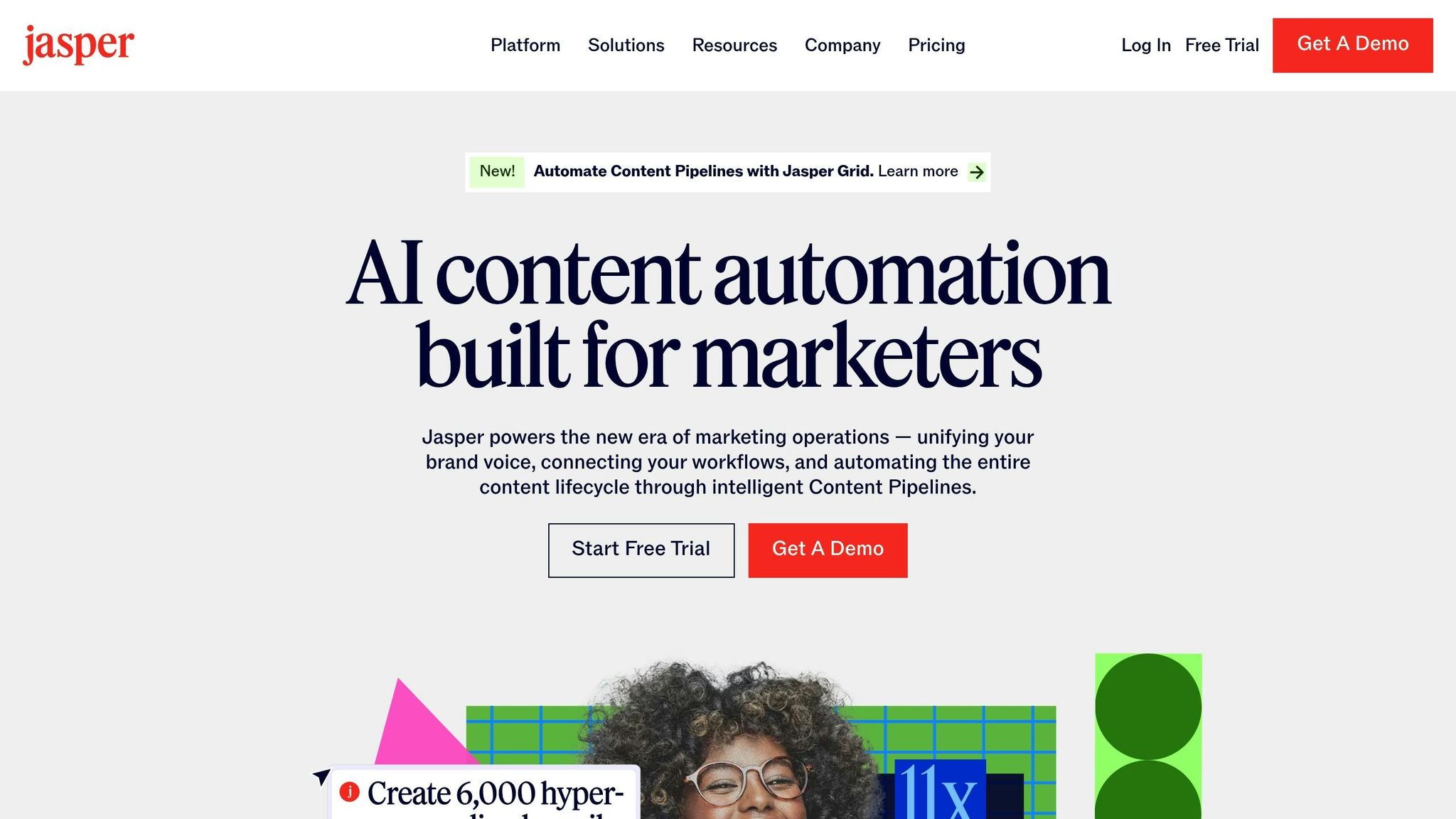
Jasper is recognized for its speed and template-based content creation. It’s ideal for teams needing quick drafts of blog outlines, social media posts, or ad copy. Features like "Content Pipelines" streamline workflows, while "Brand IQ" ensures consistency across large teams [5]. Pricing starts at $29 per month, with advanced plans like Boss Mode at $59 per month [7].
However, Jasper focuses exclusively on drafting. Tasks like strategy, SEO, and publishing require additional tools. As Colleen Barry, Head of Marketing at Ketch, notes:
"My team now uses AI to generate a solid outline and structure, which frees us up to focus on adding insights and making sure the content feels human and aligned with our brand" [2].
This human touch remains vital - 86% of marketers still edit AI-generated content [1].
Feature | Averi AI | Jasper |
|---|---|---|
Primary Focus | End-to-end workflow (research → publishing) | AI-powered writing and drafting |
Quality Controls | Centralized brand memory (Synapse) + collaborative editing | Brand IQ style guides + templates |
Integrations | Direct publishing to platforms like Webflow, WordPress | API integrations for custom workflows |
Best For | Teams needing a full content solution | Teams with existing strategy systems needing fast drafting |
If your team already has strategists and managers, Jasper can be a good fit. For those wanting a single system to handle everything - from research and planning to publishing - Averi AI simplifies the entire process [5][7].
Averi AI vs. Fiverr

Fiverr operates as a marketplace, connecting you with freelancers for project-based work. You define the project, review proposals, select a freelancer, and manage revisions and final delivery. While this approach offers flexibility, it comes with challenges like managing consistency and dedicating significant time to coordination.
Consistency can be particularly tricky - every new freelancer requires onboarding to your brand’s voice, guidelines, and expectations. Quality also varies depending on the freelancer.
Feature | Averi AI | Fiverr |
|---|---|---|
Delivery Method | Automated AI workflows with expert input as needed | Manual freelance marketplace |
Costs | Predictable monthly fee ($100/month Plus plan) | Variable project fees + coordination overhead |
Consistency | Centralized brand memory that evolves over time | Fragmented across multiple freelancers |
Management Time | AI-managed workflows with approval checkpoints | 20–30% for coordination and quality control |
Fiverr works well for one-off projects, niche needs, or when you prefer direct human involvement and have time to manage freelancers. On the other hand, Averi AI offers consistent, scalable content production with predictable costs and minimal oversight. Its system learns your brand’s voice over time, allowing you to focus on approvals instead of micromanaging projects.
The numbers back this up: 68% of businesses report higher content marketing ROI with AI [1], and 84% of marketers say AI has improved the speed of delivering quality content [1]. The right choice ultimately depends on whether your priority is flexibility, speed, or a streamlined, comprehensive workflow.
Conclusion: Building Scalable Content Strategies with AI
AI-driven content strategies aren't about sidelining human creativity - they're about eliminating bottlenecks that slow teams down. The conversation has shifted from debating AI adoption to figuring out how to use it effectively. With projections showing that 90% of content marketers will integrate AI by 2025, the results are hard to ignore: a 68% boost in content marketing ROI and an 84% improvement in delivering high-quality content faster [1].
The secret lies in striking the right balance. AI can take on tasks like research, drafting, and technical SEO, while humans focus on strategy, refining the brand voice, and performing final quality checks. A practical ratio - 80% AI support and 20% human oversight - ensures content stays genuine while production scales seamlessly [6].
Platforms like Averi AI exemplify this synergy by combining strategy, execution, and publishing into one efficient workflow. Instead of juggling multiple tools or managing freelancers, teams can rely on a system that refines brand messaging, identifies critical topics, and automates CMS publishing. With each piece of content, the system learns and improves, making future efforts even smarter and more aligned.
Whether you opt for an AI-powered workspace, a specialized tool, or a freelance marketplace, the key to success lies in structured frameworks rather than scattered solutions. Establish clear objectives, implement strong quality controls, and let AI handle the repetitive tasks. This frees your team to focus on what truly matters - strategic thinking, creative storytelling, and connecting with your audience in meaningful ways.
FAQs
How does AI enhance content performance while cutting costs?
AI has transformed the way content is created and managed by taking over repetitive tasks, analyzing data to craft highly targeted and engaging material, and maintaining quality with human supervision. It enables brands to fine-tune their messaging for specific audiences, driving higher engagement and making content more impactful.
By simplifying workflows and cutting down on time spent on manual work, AI significantly reduces costs. Teams can accomplish more with fewer resources, eliminating the need for extra creators while speeding up delivery times - all without sacrificing quality. This makes AI an invaluable asset for producing effective content while staying within budget.
How does AI help create a data-driven content strategy?
AI has revolutionized how marketers approach content strategy by turning vast amounts of raw data - such as search trends, social media activity, and performance metrics - into practical insights. By pinpointing the most effective topics, formats, and publishing schedules, it takes the guesswork out of planning, saving teams valuable time and energy.
In addition, AI simplifies the content creation process by automating tasks like generating outlines, drafts, and editorial calendars. This allows teams to move seamlessly from brainstorming to publication. However, while AI handles these repetitive tasks, the human touch remains essential. Marketers still shape the narrative, maintain the brand's unique voice, and oversee final approvals to ensure the strategy aligns with both data insights and the brand's standards.
How can AI help identify gaps and opportunities in my content strategy?
AI simplifies the challenge of spotting content gaps and opportunities by processing massive datasets far beyond human capacity. It examines your existing content, competitor sites, keyword trends, and search behavior to pinpoint high-demand topics that your strategy may be missing. This means you can focus on high-volume, low-competition keywords or emerging themes that resonate with your audience.
Beyond just identifying gaps, AI helps translate insights into actionable steps. It can generate research summaries, propose content angles, and even draft outlines tailored to the identified needs. While AI takes care of the heavy lifting, human strategists refine the output to ensure it aligns with your brand's voice and overall goals. This partnership accelerates the journey from uncovering opportunities to producing impactful content.
AI-powered tools also play a role in organizing these ideas into a content calendar, optimizing when and where to publish for maximum engagement. By continuously monitoring performance data, AI ensures your strategy evolves with your audience’s changing preferences.
Related Blog Posts

Zach Chmael
CMO, Averi
"We built Averi around the exact workflow we've used to scale our web traffic over 6000% in the last 6 months."
Your content should be working harder.
Averi's content engine builds Google entity authority, drives AI citations, and scales your visibility so you can get more customers.