

In This Article
Practical SEO for startups: target low-competition, high-intent keywords, fix technical issues, use AI to scale content, and earn authoritative backlinks.
Updated:
Trusted by 1,000+ teams
Startups use Averi to build
content engines that rank.
SEO is a game-changer for startups. Unlike paid ads that stop delivering once the budget runs out, SEO builds a long-term traffic engine. By focusing on high-intent keywords, fixing technical issues, and leveraging AI tools, you can compete with larger players - even on a tight budget.
Key Takeaways:
Target low-competition, high-intent keywords like "alternatives to [competitor]" to attract ready-to-convert users.
Use free tools like Google Search Console to address technical SEO basics, such as improving page speed and fixing crawl errors.
Automate AI-optimized content creation with AI tools to save time while maintaining quality.
Build authority through content clusters and high-quality backlinks, focusing on niche topics that showcase expertise.
Track performance with tools like GA4 and monitor AI-driven traffic, which surged 527% in 2025.
Startups can achieve meaningful results by prioritizing speed, precision, and data-driven strategies. This guide breaks down the essential steps to build an SEO system that delivers sustainable growth.
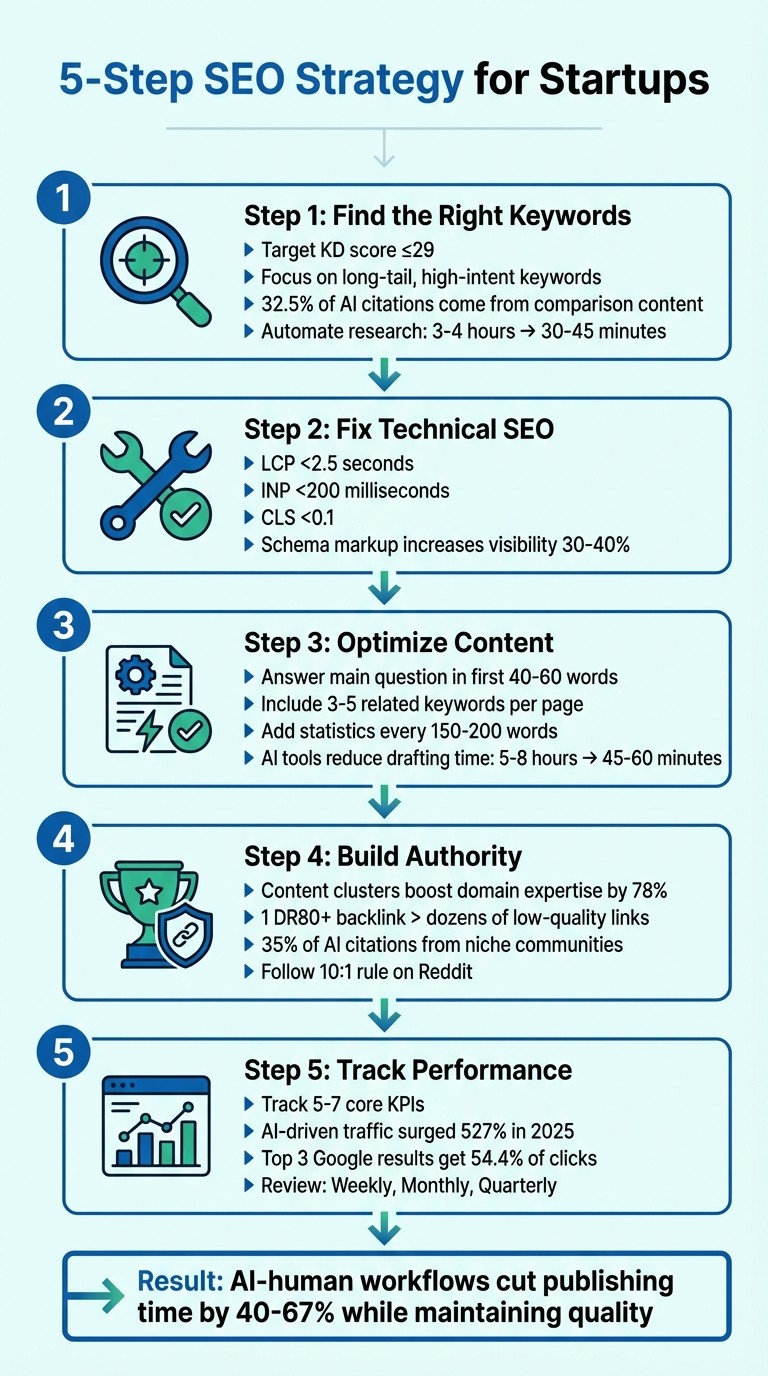
5-Step SEO Strategy for Startups: From Keywords to Performance Tracking
SEO for Startups: How to Build a Foundation That Scales
Step 1: Find the Right Keywords for Your Startup
Keyword research is the foundation for attracting customers ready to make a purchase. For startups competing with well-established brands, the key is to focus on high-intent, low-competition keywords that often slip under the radar of larger competitors. Here’s how you can make this work.
Start by talking to your customers and sales team. Pay attention to the challenges your customers face and map those pain points to search queries - a method called Jobs-to-be-Done keyword mapping [1]. For instance, if a customer mentions, "we needed a way to track support tickets without Zendesk's pricing", you might uncover valuable keyword opportunities like "Zendesk alternative for small teams" or "affordable ticket tracking software."
Focus on Long-Tail Keywords
Long-tail keywords are highly specific phrases that often signal a buyer closer to making a decision. Instead of targeting broad terms like "project management software", which are highly competitive and lack clear intent, aim for phrases such as "project management tool for remote design teams" or "Asana alternative for agencies under 10 people."
For measurable results, target keywords with a Keyword Difficulty (KD) score of 29 or lower. Prioritize bottom-of-funnel (BOFU) queries, such as "{competitor} vs {you}", "{tool} alternatives", or "how to {specific task}." These types of searches are particularly impactful - 32.5% of AI citations in search engines come from comparison-focused content like "vs" or "alternative" pages [2].
Analyze Competitor Keywords
Tools like Semrush and Ahrefs can help you conduct a competitor gap analysis. By filtering out branded terms, you can identify untapped keywords your competitors are ranking for [7]. This process highlights the topics and pain points resonating with their audience, giving you a clear pathway to attract similar prospects.
Automate Your Keyword Research
Manual keyword research can be time-consuming, often requiring 3–4 hours per topic cluster. Automation tools can cut this down to just 30–45 minutes [6]. Free options like Google Search Console, Ahrefs Webmaster Tools, and ChatGPT can support the creation of 5–6 articles each month. A modest budget of $50–$100 per month can scale this output to 8–10 articles, while $150–$250 can push it to 12–15 [6].
For an even more streamlined approach, platforms like Averi AI continuously monitor your market, tracking competitor content, analyzing keywords, and queuing up high-potential topics tailored to your business. By reviewing and approving AI-generated recommendations, you can transform keyword research from a time-intensive task into an automated, efficient workflow. Over time, the system learns your brand’s needs, improving its recommendations with each published piece.
Step 2: Fix Technical SEO Without Breaking the Budget
Improving technical SEO doesn’t have to empty your wallet. By focusing on crawlability, clarity, and ranking, startups can address major technical issues using free tools and a few hours of dedicated effort. The goal isn’t to achieve a flawless setup but to ensure search engines can effectively crawl, understand, and rank your key pages. As Searcle.ai aptly states:
"Stable technical health is the cheapest growth accelerant you'll ever buy." [1]
For startups working with limited resources, these targeted efforts can lead to lasting SEO benefits. A great starting point is optimizing performance metrics to establish a solid technical base.
Check Core Web Vitals and Mobile Performance
Google Search Console is your best friend here - it’s free and highlights pages that Google finds difficult to crawl or index. Pay close attention to the Core Web Vitals and Mobile Usability reports. Strive for these benchmarks: LCP (Largest Contentful Paint) under 2.5 seconds, INP (Interaction to Next Paint) under 200 milliseconds, and CLS (Cumulative Layout Shift) under 0.1. Tools like PageSpeed Insights or Lighthouse can provide actionable suggestions for underperforming pages.
Even small adjustments can produce significant results. For example, a local HVAC company saw a 28% increase in organic traffic within three weeks by simply improving mobile touch targets [1]. Similarly, a fitness studio resolved HTTPS mixed content errors in just two hours, regaining their #1 ranking for "yoga classes [city]" and adding $1,200 in monthly revenue [1].
Add Schema Markup and Internal Links
Schema markup is essential for helping both traditional search engines and AI-driven platforms like ChatGPT and Perplexity better understand your content. Adding JSON-LD schema for elements like Organization, Products, and FAQs can increase visibility by 30–40% [2]. Additionally, ensure your robots.txt file allows AI crawlers like GPTBot and PerplexityBot to access your site - ranking #1 on Google means little if AI platforms can’t process your content properly [2].
Simplify your site’s structure so that key pages are no more than 3–4 clicks away from the homepage. This not only improves search engine indexing but also enhances the user experience for visitors.
Focus on High-Impact Fixes First
Once core performance and content structure are in place, direct your attention to fixes that maximize crawl efficiency. When resources are limited, it’s crucial to protect your crawl budget and prioritize indexation. Mark non-essential pages - like admin panels or thank-you pages - as "noindex" to ensure search engines focus on what matters. Use tools like Screaming Frog (free for up to 500 URLs) to standardize URLs with 301 redirects and fix broken links. Aim for 90–95% of your critical pages to be indexed in Google Search Console. If the percentage falls short, it’s a sign of a technical issue that needs attention.
Step 3: Optimize Your Content for Search Engines
With your technical SEO in place, it’s time to focus on crafting content that not only ranks but also converts. Clear, structured, and consistent content is key. Studies show that optimized content can boost domain expertise by 78% and improve productivity by 40% [2][5].
A hybrid approach works best here - use AI for repetitive tasks like SERP analysis, drafting, and internal linking, while humans oversee strategy, tone, and fact-checking. This combination allows teams to publish regularly without feeling overwhelmed [3].
Structure Content for SEO
Search engines favor content that’s easy to navigate and quickly answers user queries. Aim to address the main question within the first 40–60 words. Doing so improves your chances of ranking for featured snippets and being cited by AI platforms [2]. For longer pieces, include a TL;DR section of 50–75 words at the top to summarize key points [2].
Organize your content with clear H2 and H3 headers that align with search intent, and consider adding an FAQ section to capture related questions. On-page enhancements like structured data (e.g., FAQPage, Product, Organization) can increase snippet eligibility and improve visibility by 30–40% [2]. Additionally, include a "Last Updated" date - AI platforms like Perplexity often favor and cite updated content within 1–2 weeks if it includes fresh data [2].
While structure is critical, AI tools can help streamline and polish your overall content workflow.
Use AI Tools for Content Creation
AI tools not only speed up the content creation process but also ensure consistency across pieces. For example, automated solutions can reduce keyword research time from 4–6 hours to just 15–30 minutes, cut content brief creation from 1–2 hours to 5 minutes, and shorten drafting time from 5–8 hours to 45–60 minutes [4]. Tools like Averi AI handle everything from research and drafting to internal linking and meta description creation, while maintaining your brand’s voice and ensuring accuracy.
Using prompt chains can further enhance efficiency. These chains turn SERP signals into outlines, drafts, and even optimized meta tags [4]. AI can also monitor for "content decay", generating refresh briefs to update outdated statistics and ensure alignment with current search intent [5].
Include Related Keywords and Phrases
Search engines use context to understand your content, so avoid focusing solely on a single keyword. Instead, incorporate 3–5 semantically related queries per page to establish topical authority [1]. Include "named entities" like specific tools, company names, or real-world examples, as AI search engines prioritize these for categorization [2]. Comparison phrases such as "vs", "alternatives", and "pros/cons" are especially effective, as 32.5% of AI citations come from comparison-based content [2].
To further boost visibility, include statistics with sources every 150–200 words, as this can lead to 30–40% higher visibility in AI-generated responses [2]. A "What is [Topic]?" section with a concise definition in the first 40–60 words also improves your chances of being featured in snippets [2].
As Single Grain explains:
"The more machine-readable your outputs are (entities, topics, schema, internal link maps), the more compounding effects you'll see over time." [5]
Step 4: Build Authority with Content and Backlinks
Once your content is optimized and your technical foundation is solid, the next step is establishing authority. This involves building credibility through high-quality backlinks and demonstrating expertise with well-structured content clusters. Together, these tactics help showcase your niche knowledge and earn trust from search engines and users alike.
For startups with tight budgets, focusing on quality is crucial. A single backlink from a high-authority domain (DR80+) can outweigh dozens of links from lower-quality sites [8]. Similarly, creating interconnected content around core topics has been shown to boost domain expertise scores by 78% [2]. The goal is to prioritize impactful actions, such as leveraging existing relationships for backlinks and crafting content that reinforces your authority.
Create Content Clusters Around Key Topics
Content clusters are an effective way to structure your website. They revolve around pillar pages that cover broad topics and supporting articles that explore related subtopics in depth. For instance, if your startup offers project management software, your pillar page might be "Complete Guide to Project Management for Remote Teams", supported by articles like "How to Run Async Standups" or "Best Tools for Remote Collaboration."
This approach not only helps search engines understand your expertise but also makes it easier for AI platforms to reference your content. To increase visibility, include a 100–150 word "canonical answer" at the top of each pillar page. This concise summary can be directly pulled by AI-powered search tools [2][3]. Adding expert quotes and proprietary data enhances credibility and aligns with E-E-A-T standards [2][1]. For example, if you've conducted a customer survey, publish the results and integrate them into your cluster content.
Distribution is just as important as creation. Share your content in niche communities, which contribute to about 35% of AI answer inclusions [2]. If you're active on platforms like Reddit, follow the 10:1 rule: for every self-promotional post, make 10 helpful, non-promotional contributions to build trust and credibility [2].
With a robust content cluster in place, you can shift your focus to earning backlinks through outreach and digital PR.
Get Backlinks Through Outreach and PR
Building backlinks requires a thoughtful strategy. Start with digital PR, which involves creating data-driven insights or newsworthy content that journalists want to feature. Tools like HARO (Help a Reporter Out) can connect you with reporters seeking expert opinions. A single backlink from outlets like Forbes or Business Insider can deliver more SEO value than multiple links from smaller sites [9].
Comparison content is another powerful tactic. Articles comparing products or services (e.g., Averi vs. Jasper) account for 32.5% of AI citations [2]. These pieces attract backlinks from users researching alternatives and are frequently cited by AI systems. To increase the chances of being cited, include a TL;DR summary and direct answers within the first 40–60 words [2].
Don't overlook unlinked brand mentions. Tools like Google Alerts or Ahrefs can help you identify mentions of your brand, and you can reach out to request a link. This "quick win" strategy is both simple and effective [8]. As Single Grain notes:
"AI can support ethical link earning and digital PR... identify journalist beats, synthesize story angles from proprietary data, and draft tailored pitches - not to mass-spam." [4]
Ask Your Network for Links
Your existing network can be a valuable resource for backlinks. Reach out to investors, advisors, customers, and industry contacts who manage blogs or contribute to publications. A straightforward request like, "Would you be open to linking to our guide on [topic]?" can result in high-quality backlinks from trusted sources.
Guest posting on niche blogs and publishing LinkedIn articles are also effective ways to gain visibility and backlinks. LinkedIn articles, indexed by search engines, appear in 15.2% of Google AI Mode responses [2], making them a strategic channel for boosting your presence.
Finally, keep your content current and relevant. AI platforms like Perplexity favor recently updated material, so refreshing your resources with the latest statistics for 2025–2026 can lead to new citations within just a couple of weeks [2].
Step 5: Track Performance and Make Improvements
Laying the groundwork for SEO is just the beginning - what truly drives long-term success is monitoring your progress and fine-tuning your approach. For startups, this means equipping yourself with the right tools, regularly analyzing data, and using AI insights to guide your next steps. This process ensures your SEO strategy evolves into a system that supports sustained growth.
To avoid overwhelm, focus on tracking 5–7 core KPIs rather than trying to monitor everything [6]. Group these metrics into two categories: leading indicators like technical health, impressions, and crawl rates, which help catch issues early, and lagging indicators like conversions, pipeline, and revenue, which reveal your efforts' business impact [1][2].
Set Up Analytics Tools
Start with free essentials like Google Analytics 4 (GA4) and Google Search Console (GSC) to monitor impressions, clicks, and keyword rankings. GSC can help you pinpoint which queries are driving traffic and identify areas for improvement. In GA4, set up goals to measure organic traffic conversions, whether they’re demo requests, sign-ups, or downloads.
It’s also crucial to track AI-driven traffic separately. AI-referred sessions surged 527% in the first half of 2025 [2]. Use a regex filter in GA4 (e.g., .*chatgpt\.com.*|.*perplexity.*) to isolate visits from AI platforms. This helps you evaluate how AI-driven traffic compares to traditional search and which content is being cited.
For deeper insights, link GSC and GA4 data to your CRM. This integration connects keywords to qualified leads and closed deals, giving you a clearer picture of which terms are driving not just clicks but meaningful outcomes [5][4].
Review Data on a Regular Schedule
Establish a consistent review schedule - weekly, monthly, and quarterly - to stay on top of technical health, refine your content strategy, and adjust your SEO roadmap [1][2]. Use a unified dashboard with annotations for release dates and campaign launches, making it easier to tie performance shifts to specific actions. For instance, if traffic spikes two weeks after publishing a content cluster, you can confidently link the growth to that effort.
"The top three Google search results receive 54.4% of all clicks. This means most important SEO metrics - like traffic, CTR, and conversions - directly depend on your search ranking." - Ravi Pandya, Author [7]
This structured review process, combined with AI-driven insights, helps you refine your strategy and accelerate improvements.
Follow AI-Driven Recommendations
AI tools can analyze your performance data and suggest targeted actions, such as updating specific content, targeting new keywords, or exploring trending topics. Platforms like Averi simplify decision-making by providing actionable insights. For example, Averi might highlight that a piece ranking at #8 could reach the first page with specific updates or suggest adding a low-competition, high-relevance keyword to your content queue. This eliminates guesswork and prioritizes actions backed by data.
"The more machine-readable your outputs are (entities, topics, schema, internal link maps), the more compounding effects you'll see over time." - Single Grain [5]
For startups, the aim is to build a self-improving system. Each piece of content contributes to a growing library, making future AI suggestions more precise. By closing the loop with performance data, you’ll know what to amplify, what to tweak, and what to create next. Over time, this compounding process enhances visibility, freeing you to focus on your core business.
Here’s a quick framework for summarizing key metrics:
Metric Category | Key KPIs to Track | Frequency |
|---|---|---|
Visibility | Keyword Rankings (Top 3/10), Impressions, AI Citations | Weekly |
Engagement | Click-Through Rate (CTR), Bounce Rate, Time on Page | Monthly |
Technical | Core Web Vitals, Crawl Errors, Indexation Status | Weekly |
Business Impact | Organic Conversions, Assisted Conversions, Pipeline Revenue | Monthly/Quarterly |
Conclusion: Build an SEO System That Grows Over Time
Achieving SEO success as a startup isn't about the size of your budget or team - it's about creating a system where every effort works together seamlessly. By following a flywheel process - Analyze, Brief, Draft, Review, Publish, Measure, Learn - you can generate momentum that builds on itself over time [3][5]. This approach turns individual tasks into a self-reinforcing growth engine.
Unlike paid ads, which stop driving traffic the moment you pause spending, SEO creates lasting benefits. The strategies outlined - targeted keyword research, technical improvements, content creation, and link-building - combine to form a solid foundation. The work you do in the first 30 days to address technical issues, the content hubs you develop in the next 30 days, and the optimization cycles you establish by day 90 all contribute to sustainable traffic growth [1][2]. Leveraging AI–human workflows can further streamline this process, cutting publishing time by 40–67% while maintaining quality, making it possible to compete even with a lean team [6].
As search increasingly shifts toward AI-driven platforms like ChatGPT and Perplexity, it's crucial to optimize your content for concise, well-supported answers that these systems can reference. This not only broadens your reach but also keeps your SEO strategy aligned with evolving search trends.
"SEO is a long-term investment and can take time to see significant results. This transparency builds trust and helps manage expectations." - Semrush [7]
Lay the groundwork with a 90-day plan: resolve technical issues, launch content clusters, and establish a system for tracking progress. From there, let your integrated approach take over. Each new piece of content strengthens your SEO engine and increases your visibility on AI-driven platforms. This system not only levels the playing field against larger competitors but also evolves with every iteration, allowing you to focus on growing your product.
FAQs
What should I do in my first 30 days of SEO?
In the first 30 days of tackling SEO, it's all about laying the groundwork. Start by addressing technical issues that might hinder your site's performance. Dive into keyword research to understand what your audience is searching for, and align your website content with their intent. Begin optimizing your pages to match search intent more effectively, and focus on creating content that resonates with your target audience. At the same time, start building backlinks to strengthen your site's authority. These initial efforts will set the stage for better visibility and steady growth.
How do I track traffic from AI tools in GA4?
To monitor traffic from AI tools in GA4, you can implement a few strategies: create custom segments based on referrer headers, use UTM parameters in your links, or configure custom channel groups to pinpoint AI-driven traffic. Keep in mind that some AI traffic might show up as "Direct" because of missing referrer information. These approaches can give you clearer insights into AI-related traffic trends.
Which SEO tasks should I automate vs do manually?
Automate time-consuming SEO tasks like keyword research, creating content outlines, and performance tracking with AI tools to streamline processes and boost productivity. This frees up your time to focus on high-value, strategic efforts that require human insight, such as editing content, building backlinks, and conducting technical audits. By blending automation for routine tasks with manual input for strategic decisions, startups can maintain quality, ensure originality, and drive sustainable SEO growth.
Related Blog Posts

Zach Chmael
CMO, Averi
"We built Averi around the exact workflow we've used to scale our web traffic over 6000% in the last 6 months."
Your content should be working harder.
Averi's content engine builds Google entity authority, drives AI citations, and scales your visibility so you can get more customers.