

In This Article
Use AI in SEO responsibly: prioritize human review, follow E-E-A-T, avoid scaled content abuse, and validate AI outputs to prevent penalties.
Updated:
Trusted by 1,000+ teams
Startups use Averi to build
content engines that rank.
AI is transforming SEO by making tasks like keyword research, content creation, and meta tag optimization faster and more efficient. However, improper use of AI can lead to penalties, as seen in Google's March 2024 Core Update, which penalized over 1,400 websites for "scaled content abuse." To avoid risks, focus on quality, originality, and compliance with Google's E-E-A-T (Experience, Expertise, Authoritativeness, Trustworthiness) standards. Follow these key practices:
Use AI for support, not shortcuts: AI can help with drafting and research but requires human oversight to ensure accuracy and quality.
Avoid spam-like practices: Over-optimization, bulk content creation, and keyword stuffing can lead to penalties.
Prioritize human review: Fact-check AI outputs, refine tone, and add personal insights to align with search engine guidelines.
Leverage AI for efficiency: Use it for keyword clustering, metadata creation, and technical tasks, but always validate results manually.
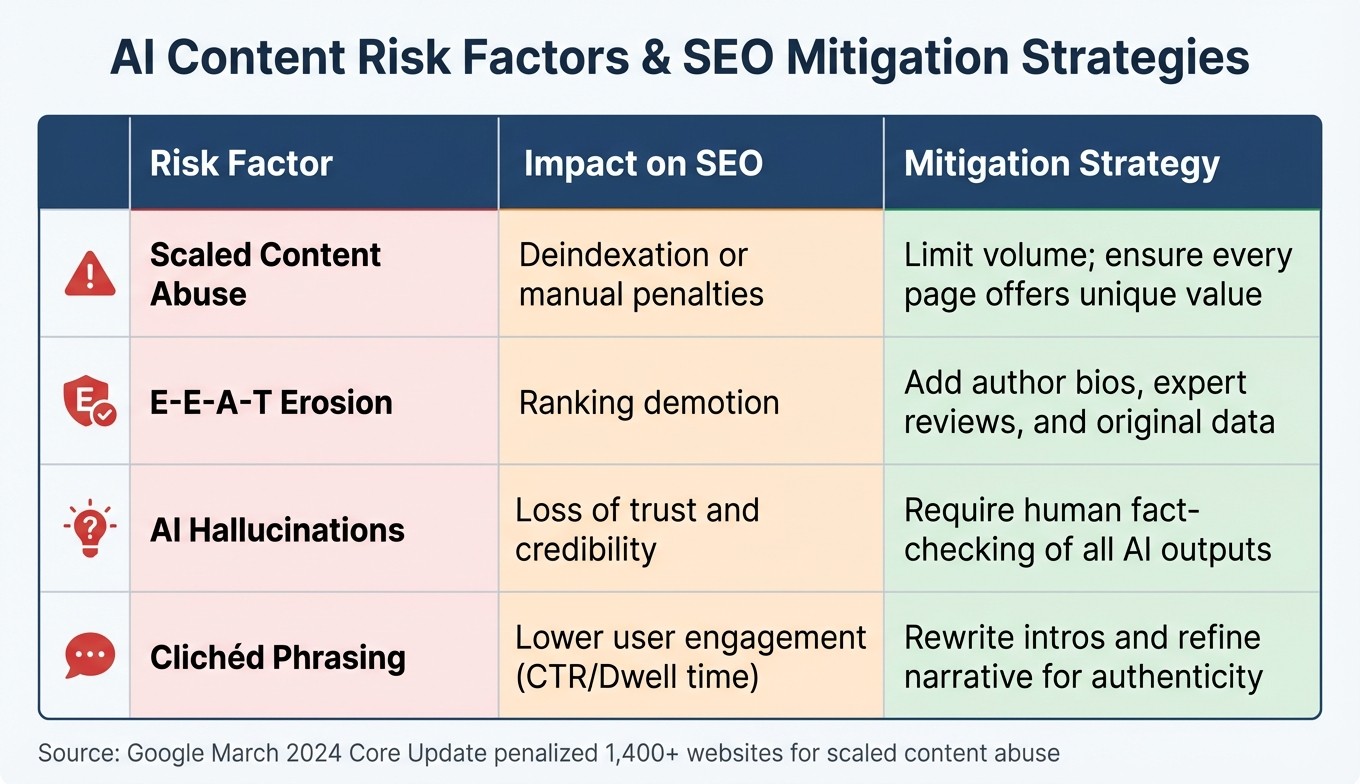
AI Content Risk Factors and SEO Mitigation Strategies
AI SEO in 2026: The New Rules
What Search Engines Allow for AI-Generated Content
Google doesn’t automatically penalize content just because it’s created by AI. Instead, the focus is on quality, originality, and usefulness [5]. In fact, 19% of content currently ranking in Google’s top 20 results is likely AI-generated [10]. This means AI content can perform just as well as human-written material if it aligns with Google's standards.
The key is meeting Google’s E-E-A-T framework - Experience, Expertise, Authoritativeness, and Trustworthiness. Notably, 86% of marketers modify AI-generated content to add authentic expertise [3][9]. AI often struggles with the "Experience" aspect since it can’t provide firsthand insights or real-world testing. This highlights the importance of prioritizing quality over quantity, as outlined in Google's guidelines.
"Appropriate use of AI or automation is not against our guidelines. This means that it is not used to generate content primarily to manipulate search rankings, which is against our spam policies."
– Google Search Central [5]
In March 2024, Google’s Core Update addressed "scaled content abuse", where AI was used to flood the web with low-value pages designed solely to manipulate rankings [10]. The lesson here? AI is acceptable for creating content, but it shouldn’t be misused to overwhelm search engines with bulk output.
Why Human Review Matters for AI Content
Given the limitations of AI, human review is essential to ensure quality and accuracy. AI generates text by predicting patterns, which means it can produce fabricated or misleading information - a phenomenon researchers call "hallucinations." One study revealed that AI search tools referenced incorrect sources 60% of the time [3], underscoring the need for thorough fact-checking.
Human oversight also compensates for AI’s inability to provide firsthand experience. Since AI can’t conduct interviews, test products, or share personal insights, these elements must be added manually. This is especially critical for Your Money or Your Life (YMYL) topics - like health, finance, or legal advice - where Google demands a higher level of expertise and experience. Without human input, AI-generated content risks sounding generic, losing its brand voice, and failing to engage readers.
Kyle Byers, Head of Organic Search at Semrush, highlights this necessity:
"Human review is probably the most important thing to do in terms of avoiding risk. Every AI tool is known to hallucinate sometimes. So, make sure to check for accuracy."
– Kyle Byers, Head of Organic Search, Semrush [8]
Stephanie Wallace, SVP of Marketing at Nebo Agency, adds:
"The 'savings' offered by switching to AI gets eaten by fact-checking, sourcing, SME reviews, tone rewrites, and legal sign-off."
– Stephanie Wallace, SVP of Marketing, Nebo Agency [3]
Positioning AI as a helpful assistant, rather than an expert, ensures errors are caught before they damage credibility.
How to Avoid Spam When Using AI Tools
While quality is critical, avoiding spam-like practices is equally important. Google’s spam policies target content designed to manipulate rankings rather than provide real value to users. One common pitfall is over-optimization - such as keyword stuffing, forced internal links, or creating dozens of shallow pages. For example, a February 2025 experiment by SE Ranking found that 20 AI-generated websites initially gained rankings, but Google’s spam-detection quickly removed them [9].
Another issue is overused or clichéd phrasing. Phrases like "in today’s fast-paced world" or "let’s delve into" can make content feel low-effort to both readers and search engines [2]. Editing out these patterns and adding a distinct, human tone helps make the content more engaging.
To stay compliant with Google’s guidelines, focus on creating value rather than volume. Use AI for tasks like outlining, generating FAQs, or creating schema markup to support your content structure, rather than relying on it to write entire posts from scratch [7]. Avoid letting AI handle internal linking or keyword placement without manual review, and consider labeling content as "AI-assisted" or including human reviewer bylines to maintain transparency [2].
Risk Factor | Impact on SEO | Mitigation Strategy |
|---|---|---|
Scaled Content Abuse | Deindexation or manual penalties | Limit volume; ensure every page offers unique value. |
E-E-A-T Erosion | Ranking demotion | Add author bios, expert reviews, and original data. |
AI Hallucinations | Loss of trust and credibility | Require human fact-checking of all AI outputs. |
Clichéd Phrasing | Lower user engagement (CTR/Dwell time) | Rewrite intros and refine narrative for authenticity. |
How to Use AI for Keyword Research
AI can quickly churn out keyword ideas, cutting down research time that used to take hours. In fact, 60% of marketers now rely on AI tools like ChatGPT for keyword research [4]. However, while AI speeds up the process, its suggestions still need to be validated using traditional SEO tools that provide real-time data on search volume and competition. By combining AI's efficiency with manual verification methods (explored below), you can also uncover content gaps and organize keywords into actionable clusters.
Finding Topics and Content Gaps with AI
AI tools can help you identify opportunities where competitors are excelling, but you’re falling short. For example, you can use platforms like ChatGPT or Gemini to compare your website with a competitor's URL and pinpoint the topics they’ve covered that you haven’t [7]. A simple prompt like, "Compare my website [your URL] with [competitor URL]. List the high-value topics they cover that are missing from my site", can uncover subtopics, FAQs, and keyword themes worth targeting.
In addition, AI excels at grouping keywords into topic clusters. These clusters help you build a central "pillar" page supported by subpages, which collectively boost your authority on a topic. AI can also categorize keywords by search intent - whether users are looking for information, navigating to a specific site, comparing options, or ready to make a purchase [4][6][11]. For instance, you might ask, "Generate 20 long-tail, question-based keywords for small business owners evaluating CRM software." This approach can reveal niche opportunities tailored to different stages of the buyer’s journey.
"The most popular SEO use case for AI is keyword research. An impressive 60% of our polled marketers state they use ChatGPT and similar tools to research keywords for their content."
– Cecilia Meis, Senior Editor and Strategist, Semrush [4]
Once AI has helped you compile potential keywords and topics, the next step is to validate their relevance and feasibility.
Verifying AI Keyword Suggestions
While AI can generate a long list of keyword ideas, human oversight is essential to ensure those suggestions hold up. AI models don’t have access to real-time data on search volume, keyword difficulty, or ranking trends [4][6]. Instead, they rely on patterns from their training data, which means they might suggest keywords that seem relevant but have little to no search demand or are highly competitive. To avoid wasting time on such keywords, always validate AI-generated lists using SEO tools like Semrush, Ahrefs, or Moz [4][6].
Manual verification also helps weed out "AI hallucinations" - keywords that sound plausible but lack actual search interest [7][3]. Checking live search engine results (SERPs) is another crucial step. This ensures that suggested keywords are not only relevant but also align with the type of content ranking at the top. For example, if a keyword suggestion leads to a SERP filled with product pages, it’s likely unsuitable for an informational blog post.
"AI tools are known to hallucinate, or provide seemingly concrete answers that are wrong or misleading. Even robots need fact-checking."
– Stephanie Wallace, SVP of Marketing, Nebo Agency [7]
Lastly, look out for intent mismatches. AI might suggest transactional keywords like "buy CRM software" for content designed to educate rather than sell [3]. Carefully review each keyword to ensure it aligns with your goals and matches the audience's stage in their journey - whether they’re exploring options, comparing solutions, or ready to make a purchase.
How to Create Quality Content with AI
AI can speed up content creation, but speed alone doesn’t equal quality. Google doesn’t penalize AI-generated content just because it’s AI-made. What truly matters is whether the content genuinely helps users and reflects Experience, Expertise, Authoritativeness, and Trustworthiness (E-E-A-T) [5][8]. As we've previously discussed, AI should be seen as a collaborative tool - great for generating drafts but still requiring your expert refinement [7][6].
"Think of AI as the brush and humans as the artist. AI can lay the strokes, but human oversight brings the masterpiece to life."
– Margarita Loktionova, Content Marketer, Semrush [8]
The best results come from a hybrid approach: let AI handle the structure and initial draft, then layer in originality, fact-checking, and brand voice. Without this human touch, content risks sounding generic or, worse, containing factual errors (often called AI "hallucinations") that can harm credibility [7][3].
Using AI to Build Outlines and First Drafts
AI is particularly effective at creating structured outlines and initial drafts for process-driven content. In fact, 38% of marketers use AI to create content briefs and outlines, while only about 20% rely on it for drafting full articles. This shows that most teams prefer to keep humans in the driver’s seat when it comes to writing, with AI playing a supporting role [4].
To get the best results, provide detailed instructions using the 5Ws and H framework: What (the task), Who (the audience), Where (context), When (timing), Why (the goal), and How (tone and structure) [1]. For instance, instead of a vague prompt like, “Write a blog about CRM software,” try something more specific:
"Act as a senior SaaS marketing manager. Create a 1,500-word how-to guide for small business owners (10–50 employees) evaluating CRM software for the first time. Use a friendly, educational tone. Include sections on key features, pricing considerations, and implementation tips. Target the keyword 'how to choose CRM software.'"
This level of detail helps AI produce drafts closer to your vision, reducing the amount of editing needed.
To maintain control over the narrative, draft section-by-section rather than asking for an entire article at once [10][4]. Start with the introduction, review it, and then move on to the next section. This step-by-step process ensures the content stays on track and aligns with your goals.
Another useful technique is leveraging AI-driven SERP analysis to strengthen your content. Ask the AI to summarize the top-ranking pages for your target keyword, identifying common themes and gaps your content could address [4]. For example:
"Analyze the top 5 results for 'best project management tools' and list the features, comparisons, and FAQs they cover. Identify what’s missing that we could add."
This approach ensures your content provides information gain - offering unique insights or data that competitors haven’t included [3][8].
Once the draft is outlined, it’s time to focus on adding your unique perspective and brand voice.
Adding Original Insights and Brand Voice
AI-generated drafts often lack the personal touch needed to make content stand out. That’s where your expertise comes in. Start by priming your AI tool with brand-specific details: upload your style guide, audience personas, banned phrases, and examples of successful content [7][3]. Many AI platforms, like Jasper or custom GPTs, allow you to create a "brand memory", ensuring consistency in tone and style without constant re-instruction [7].
Human editors should focus on adding Experience - the part of E-E-A-T that AI struggles with most. This means incorporating firsthand accounts, case studies, original research, or expert interviews. For example, instead of a generic AI-generated line like, “Social media marketing is important,” you could write:
"We increased Instagram engagement by 340% using carousel posts that featured customer testimonials" [13].
Specific, verifiable details like these not only enhance credibility but also improve search rankings.
It’s also crucial to fact-check claims and replace vague statements with concrete data. AI can invent statistics or misattribute sources up to 60% of the time [3]. Look out for “AI thumbprints” - phrases like “in today’s fast-paced world” or “it’s important to note” - and rewrite them to sound more natural and engaging [3][8].
To keep readers engaged, break up the monotony of AI-generated text by adding variety every few paragraphs. This could include a relevant quote, a unique visual, a mini case study, or even a contrarian opinion [3]. These elements help prevent "content fatigue" and make your writing more dynamic.
The ultimate goal is to use AI for efficiency and structure, then elevate the draft with the creativity, nuance, and authenticity that only human input can provide.
How to Optimize On-Page SEO with AI
AI can streamline tasks like optimizing meta titles, headers, schema markup, and internal links - provided humans validate the results. Google doesn’t penalize AI-generated metadata or structured data as long as it adheres to their spam policies and isn’t designed to manipulate rankings [5][2]. As discussed earlier, the key lies in pairing AI’s efficiency with human oversight to ensure accuracy and relevance. This partnership demonstrates how AI can speed up SEO processes while still relying on human judgment for quality control.
Here’s an interesting insight: 26% of marketers use AI to generate page titles and meta descriptions [4], and 52% of SEO professionals report better performance after applying AI to on-page tasks [11]. However, AI isn’t a “set-it-and-forget-it” tool. Most marketers still review AI-generated content to ensure it meets their standards. This highlights AI’s role as a drafting assistant rather than a replacement for human expertise. By handling repetitive tasks, AI allows teams to focus on refining and improving content.
Using AI for Technical SEO Tasks
AI can save hours when it comes to scaling on-page optimizations. For meta titles and descriptions, tools like Semrush or Yoast AI can generate concise meta titles (under 60 characters) and descriptions (under 160 characters) to avoid truncation. AI can also identify pages missing metadata and create bulk replacements using platforms like Numerous.ai or SEOTesting.com [1].
When crafting AI prompts for metadata, precision is crucial. Instead of a vague request like “Write a meta description,” try something more detailed: “Write a meta description under 160 characters for a guide targeting small business owners searching for 'CRM software setup.' Include the secondary keyword 'CRM implementation tips' and a clear call-to-action." [1]. This approach reduces the need for heavy editing later.
For schema markup, AI can generate JSON-LD code, which Google recommends for its scalability and reliability during site updates [15][17]. Specify the schema type, such as Article, Product, or FAQPage, and include essential properties like the headline, publication date, and author [15]. When implemented correctly, structured data can boost click-through rates by 20-30% [17].
AI also excels at finding internal linking opportunities by analyzing your site’s structure and identifying related content. For instance, a mid-sized e-commerce company used AI in 2025 to review their blog archives, uncover topical gaps, and suggest internal links between related articles. Within six months, they experienced a 35% increase in organic traffic and a 20% improvement in time-on-page [18]. Tools like Surfer SEO or NeuronWriter can recommend descriptive anchor text and strategic link placements, helping you build topic clusters that enhance your site’s authority [20].
Once AI completes these tasks, the next step is to carefully review its outputs to ensure they align with your brand’s standards and data accuracy.
Checking AI Recommendations Manually
While AI can generate metadata, schema, and links quickly, it lacks the ability to verify facts or tailor content to your brand’s voice. Since AI tools are prone to inaccuracies in source citation [3], manual review is essential. Fact-check any claims in AI-generated meta descriptions or schema, especially those involving dates, prices, or product details. Incorrect or outdated structured data can confuse search engines and erode user trust [16].
After technical optimizations, ensure that AI-driven elements meet both user expectations and your brand’s tone. Look for generic, automated phrasing - sometimes called "AI thumbprints" - such as “in today’s fast-paced world” or “it’s important to note.” Rewrite these to sound more natural and specific [2][3]. For schema markup, validate AI-generated JSON-LD using Google’s Rich Results Test and the Schema.org Validator before publishing [15][16][17]. This step ensures your code is free from errors and eligible for rich results.
When reviewing internal links, confirm that they genuinely enhance the user experience rather than serving purely algorithmic purposes. Ask yourself: Would a reader naturally click this link? If not, adjust the anchor text or placement. Use descriptive anchor text that clearly indicates what the linked page offers - avoid vague terms like “click here” or “read more” [19][20].
Finally, schedule regular audits to review schema and internal links after updates to your CMS, templates, or content. This prevents issues like “schema drift” or broken links from building up over time [15][17]. While AI can flag problems at scale, only a human can ensure the fixes align with your site’s goals and provide a seamless user experience.
How to Review and Publish AI Content
While certain AI content tools can churn out content at lightning speed, but publishing it without thorough human review can lead to penalties and erode trust. Google's March 2024 update penalized over 1,400 sites, highlighting the importance of a meticulous review process [3]. To confidently publish AI-assisted content while safeguarding your site's visibility, it's essential to establish a structured workflow for fact-checking, refining, and performance monitoring.
Human Review Steps for AI Content
A solid review process starts with a two-pass system: one editor focuses on ensuring factual accuracy and maintaining a consistent tone, while an SEO specialist optimizes the content for search visibility [3]. Since Since many AI content creation tools often cite incorrect sources - up to 60% of the time [3] - it's critical to verify all statistics, claims, and references against primary sources. Double-check dates, product details, and pricing to prevent outdated or inaccurate information from undermining user trust and search rankings.
Strip out typical "AI thumbprints" like phrases such as "leverage", "powerful", or "in today's fast-paced world", which can make content feel generic and automated [3]. Replace these with language that reflects your brand's personality, and incorporate personal anecdotes, expert quotes, or unique insights that AI cannot replicate. This not only enhances authenticity but also aligns with Google's E-E-A-T (Experience, Expertise, Authoritativeness, Trustworthiness) standards [2][3].
"AI = intern, not expert. Treat AI as an intern who can get work started – don't rely on it as you would an expert on your team."
– Stephanie Wallace, SVP of Marketing, Nebo Agency [7]
For sensitive topics like health, finance, or legal matters - often categorized as "Your Money or Your Life" (YMYL) content - apply stricter oversight. Consider red-team reviews to spot potential inaccuracies or risks that could lead to liability [3][1]. Use plagiarism detection tools like GPTZero or Grammarly to ensure the content isn't too similar to existing material, as duplicate content could result in deindexation [7][1]. Additionally, tag AI-assisted content in your CMS to track its performance separately from human-authored pieces [2]. After rigorous review, ongoing performance monitoring is key to maintaining quality and compliance.
Tracking Performance and Making Improvements
Once AI-assisted content is live, keep a close eye on its performance to identify strengths and areas for improvement. Use your CMS or content database to tag these pieces, allowing you to compare their metrics against human-authored content [2]. Monitor traditional SEO indicators like rankings, impressions, and clicks, but also pay attention to crawl rate changes or drops in indexation, which could signal that search engines view the content as low-value automation [2].
AI analytics can help streamline performance reviews by summarizing key insights from tools like Google Search Console and GA4. These systems excel at spotting patterns, seasonal trends, and ranking fluctuations that might go unnoticed in manual analysis. For instance, AI can flag pages ranking between positions #11–20 and suggest optimizations to push them onto the first page.
To keep AI-assisted content relevant, implement a 90-day refresh cycle. This ensures the information remains accurate and up-to-date [3]. If a piece starts losing rankings, use AI to analyze top-ranking competitors and identify areas of "content decay", such as outdated details or emerging subtopics since publication. However, always have a human marketing expert review AI-generated performance summaries to ensure the recommendations align with your broader business objectives.
How to Choose the Right AI Tools for SEO
When picking an AI tool for SEO, consider how it fits into your team's workflow. Options generally fall into three categories: workspaces, which blend AI and human oversight; point tools, designed for specific tasks; and marketplaces, which connect you with freelance support. This ties back to the earlier point about balancing AI with human input to achieve SEO success. Choosing the wrong tool can waste time, money, and even hurt your rankings.
Start small by testing AI on about 10 pages (roughly 5% of your content) to spot quality issues or workflow snags before scaling up [2][14]. This pilot phase helps you refine processes early. Marketers who adopt generative AI report a 10–20% revenue boost, but only when they treat AI as an "intern" rather than an expert [14][7]. AI tools are best suited for repetitive tasks like keyword clustering, drafting meta descriptions, or triaging technical audits, while humans should oversee strategy and final approval.
AI Workspaces vs. Point Tools vs. Marketplaces
Each type of AI tool has its strengths and trade-offs. AI workspaces such as Averi combine AI-generated content with human review and integrate well with other tools like CMS and analytics platforms. Point tools like Jasper are excellent for quick drafts but require manual quality checks. Marketplaces like Fiverr offer human-created content but lack automation and consistent quality.
Criteria | AI Workspaces (e.g., Averi) | Point Tools (e.g., Jasper) | Marketplaces (e.g., Fiverr) |
|---|---|---|---|
Pricing | Mid-to-High (Subscription + Service) | Mid (Monthly Subscription) | Low-to-High (Per Project) |
Review Process | High (Built-in human-in-the-loop) | Medium (Requires manual review) | Variable (Depends on freelancer) |
Integrations | High (CMS, GA4, GSC workflows) | Limited (Browser/app-based) | None (Manual delivery) |
Time to Results | Medium (Due to quality gates) | Fast (Instant generation) | Slow (Human turnaround time) |
Best For | Teams scaling content with governance | Fast drafting and ideation | One-off projects with flexible budgets |
Understanding these differences ensures the tool’s capabilities align with your goals. For example, poorly chosen drafting tools can lead to wasted editing time. Additionally, AI search tools are known to cite incorrect sources 60% of the time, so it’s critical to pick one that supports robust verification workflows [3].
Matching Tools to Your Team Size and Goals
Small teams and startups should focus on automating one or two high-impact workflows instead of trying to do everything at once. Lightweight tools can handle tasks like technical audits or refreshing older content without straining limited resources [12][21]. For brainstorming, generic chatbots costing around $20/month work well, while dedicated SEO tools like Semrush or Moz provide reliable keyword metrics and ranking insights [7][4]. It’s worth noting that 60% of marketers use AI primarily for keyword research, making it the most popular application [4].
Enterprise teams, on the other hand, need more rigorous review protocols to maintain E-E-A-T (Experience, Expertise, Authoritativeness, Trustworthiness) standards [2]. When applied correctly, AI-driven workflow automation can boost workforce productivity by 40% within a year. However, this requires investing in advanced "agentic SEO" systems that connect large language models (LLMs) to data warehouses and CMS platforms via APIs, enabling large-scale execution [21][12]. Evaluate whether a tool integrates seamlessly with your existing stack - like Google Search Console, GA4, or your CMS - to create a responsive system that adapts to real-time data [12][21].
"AI = intern, not expert. While AI is a great tool for repetitive tasks and simple analysis, you are the marketing expert."
– Stephanie Wallace, SVP of Marketing, Nebo Agency [7]
Best Practices for Using AI in SEO
To harness the power of AI in SEO effectively, it's crucial to strike a balance between automation and quality. Google's stance is straightforward: it rewards helpful, high-quality content, regardless of how it's created, but penalizes low-quality, mass-produced material aimed at gaming the system. This was evident following Google's March 2024 Core Update, where over 1,400 sites saw penalties or lost indexing, resulting in a combined loss of 20 million monthly visitors due to poor automated content practices [2][3][5]. AI is a tool to enhance your strategy - not a shortcut to success. Here’s how to use it responsibly and effectively.
Combine AI Efficiency with Human Oversight
Delegate repetitive tasks like research, outlining, or drafting to AI, but always leave the final say to human experts. Editing and fact-checking AI-generated content is non-negotiable - 86% of marketers already revise AI drafts to ensure accuracy and quality [3]. Kyle Byers, Head of Organic Search at Semrush, underscores this:
"Human review is probably the most important thing to do in terms of avoiding risk. Every AI tool is known to hallucinate sometimes. So, make sure to check for accuracy." – Kyle Byers, Head of Organic Search, Semrush [8]
AI tools can incorrectly cite sources up to 60% of the time, so always verify statistics and claims with primary sources [3].
Prioritize E-E-A-T: Experience, Expertise, Authoritativeness, Trustworthiness
AI cannot replicate the personal experience and unique insights that build trust with both readers and search engines. For thought leadership or YMYL (Your Money or Your Life) topics, rely on human writers to create content that resonates. Use AI for structured, repetitive tasks like generating schema markup, meta descriptions, or keyword clustering. To maintain quality, implement layered reviews involving SEO specialists, editors, and subject matter experts [2][6].
Test, Monitor, and Improve AI Workflows
Start small when integrating AI into your content strategy. Test workflows on a limited scale - such as 5% of your content (around 10 pages) - to identify potential quality issues before expanding [2][14]. Track your "edit delta", or the percentage of AI-generated text revised by humans, to measure efficiency and ensure standards are met [3]. Regularly audit your content against competitors to confirm its unique value [3].
Preserve Transparency and Brand Voice
AI can sometimes produce generic content that lacks personality. Avoid this by using custom GPTs tailored to your brand's style guides and audience personas. Using an AI content engine can help maintain this consistency across all marketing channels. Steer clear of overused phrases like "in today's fast-paced world" or "leverage", which can give away AI involvement [2][7]. For accountability, tag AI-assisted content in your CMS for performance tracking and disclose AI involvement where appropriate to maintain user trust [2].
By following these practices, you can integrate AI into your SEO strategy without compromising quality or trust. As Google's Danny Sullivan aptly puts it:
"Does it matter that you write a blog post using AI? No. Does it matter that it creates a great user experience and features unique thoughts and ideas? Yes." – Danny Sullivan, Google [8]
FAQs
How can I make sure AI-generated content meets Google’s E-E-A-T standards?
To meet Google’s E-E-A-T standards - Experience, Expertise, Authoritativeness, and Trustworthiness - it's essential to prioritize quality and authenticity in your content. Collaborate with subject-matter experts to ensure everything is accurate and well-informed. Incorporate verifiable facts, proper citations, and detailed author credentials to establish credibility and trust.
Focus on creating content that genuinely helps users rather than trying to game search rankings. By emphasizing originality, relevance, and usefulness, your pages will deliver meaningful value to readers while adhering to search engine guidelines.
What’s the best way to use AI for keyword research without risking penalties?
AI can speed up keyword research and make the process more streamlined, but it’s crucial to maintain a balanced approach to ensure compliance with search engine guidelines. Start by leveraging AI tools like ChatGPT or Jasper to expand your initial keyword list into broader topic clusters, uncover related long-tail keywords, and spot content gaps. Once you have these suggestions, cross-check them using traditional SEO platforms like SEMrush or Ahrefs. This step allows you to evaluate critical metrics such as search volume, keyword difficulty, and overall relevance, ensuring you’re targeting the most impactful keywords.
However, it’s important to use AI-generated keywords as a source of inspiration rather than a quick fix. Avoid overloading your content with AI-suggested terms, and ensure that keywords are integrated naturally into your writing. Additionally, always have a subject-matter expert review the final keyword list to confirm it aligns with your brand’s tone and meets the needs of your audience. By combining the efficiency of AI with thoughtful human oversight, you can optimize your content effectively while adhering to best practices.
How can I use AI for SEO without risking penalties?
To stay in line with Google’s spam policies and E-E-A-T guidelines (Experience, Expertise, Authoritativeness, Trustworthiness), use AI as a supporting tool to craft original, high-quality, and audience-focused content. Before publishing, carefully review and edit AI-generated content to ensure it reflects your brand’s tone and meets your quality standards.
Let AI amplify human creativity rather than attempt to replace it. Avoid practices like keyword stuffing or over-optimization, which can harm your site's credibility. By focusing on delivering genuine value to your audience and sticking to ethical SEO principles, you can seamlessly incorporate AI into your content strategy while staying on the right side of search engine rules.
Related Blog Posts

Zach Chmael
CMO, Averi
"We built Averi around the exact workflow we've used to scale our web traffic over 6000% in the last 6 months."
Your content should be working harder.
Averi's content engine builds Google entity authority, drives AI citations, and scales your visibility so you can get more customers.