

In This Article
Compare Averi, AirOps, and Zapier - three AI tools to automate content planning, creation, SEO, and publishing so teams can scale and save time.
Updated:
Trusted by 1,000+ teams
Startups use Averi to build
content engines that rank.
Content teams in 2026 are under pressure to produce more content faster while using fewer resources. The right AI tools can simplify marketing workflows, cut production time by up to 80%, and boost output by as much as five times with AI productivity strategies. This article highlights three top solutions: Averi, AirOps, and Zapier, each serving different needs in content strategy, creation, and automation.
Averi: An all-in-one platform that manages the entire content lifecycle - from planning to publishing. It’s ideal for teams seeking a unified system with SEO optimization and performance tracking. Pricing starts at $100/month.
AirOps: A custom workflow builder for teams with unique data needs. It integrates GPT-4, company data, and APIs to scale content creation and optimize SEO. Free plan includes 1,000 tasks/month; pricing scales with usage.
Zapier: A tool for automating workflows across 7,000+ apps. It connects existing tools to streamline tasks like scheduling and publishing. Plans start at $19.99/month.
Each tool offers unique strengths:
Averi: Simplifies content creation with automation and expert collaboration.
AirOps: Tailors workflows for scaling and SEO-focused teams.
Zapier: Automates repetitive tasks by linking apps and tools.
Choose based on your team’s needs: Averi for full-stack execution, AirOps for scaling SEO, or Zapier for system integration.
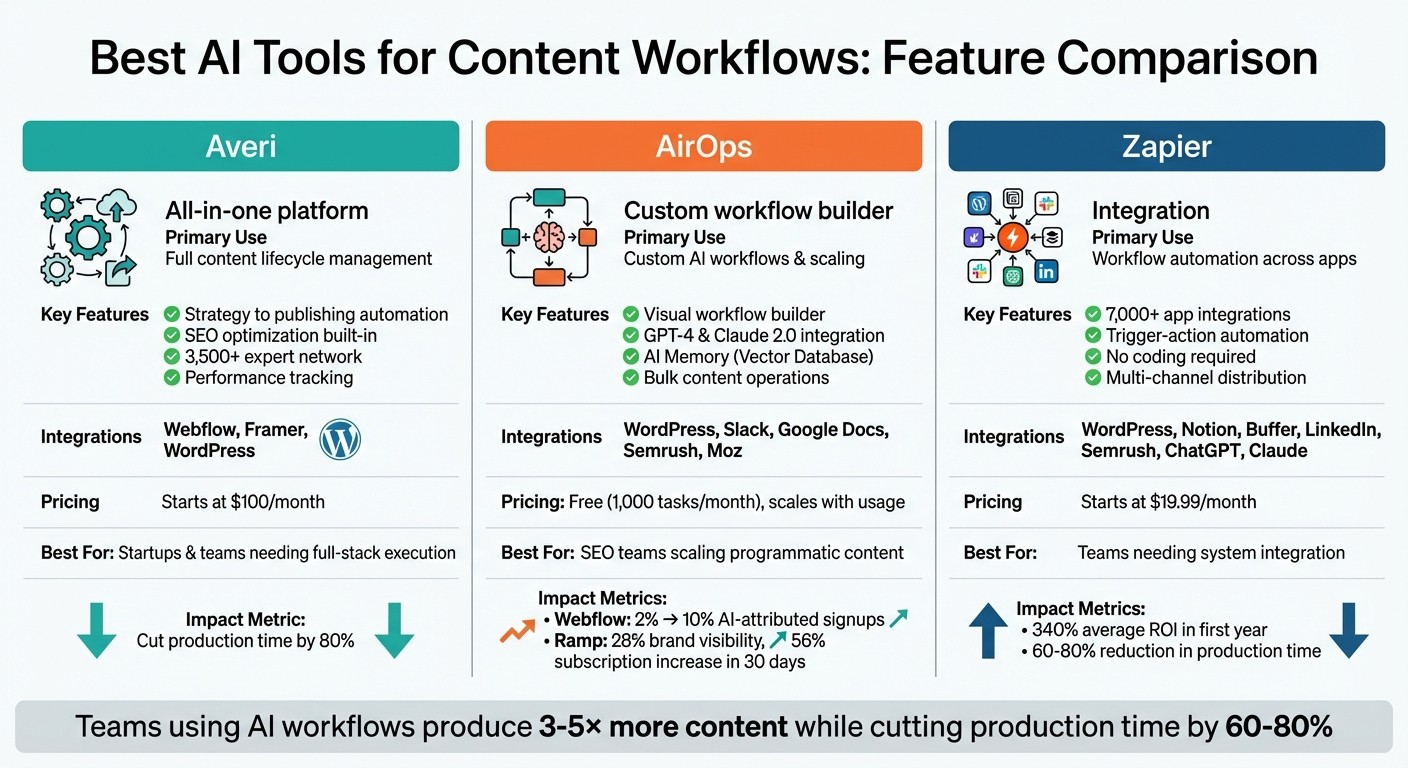
Comparison of Averi vs AirOps vs Zapier AI Content Tools
Ultimate AI For Content Creation Workflow [TUTORIAL]
1. Averi
Averi is designed to simplify the complexities of content creation by combining strategy and execution into one seamless platform. Acting as a standalone AI content engine, it manages every aspect of the content lifecycle - from planning and research to drafting, editing, and publishing - all within a single, cohesive system. This eliminates the hassle of juggling multiple tools and platforms.
The onboarding process begins with Averi analyzing your website to understand your product, messaging, and positioning. This initial setup customizes the platform to align with your brand. From there, Averi identifies ideal customer profiles, evaluates competitor content gaps, and generates a comprehensive content marketing strategy. This smart approach sets the foundation for an entirely automated workflow.
Workflow Automation
Averi transforms the traditional, fragmented content creation process into a streamlined, automated system. It takes care of market research, tracks industry trends, monitors competitors, and identifies high-value keywords. Based on this research, it generates content ideas sorted by type - such as listicles, how-to guides, or comparisons. Once you approve the topics, Averi handles the heavy lifting: conducting research, drafting content, structuring it for SEO, and suggesting internal links from your existing content library. When it’s time to publish, the platform integrates directly with Webflow, Framer, or WordPress.
This integrated approach sets Averi apart from traditional workflows that often require multiple tools and manual coordination. Instead of relying on several platforms or hiring additional managers, Averi provides access to a network of over 3,500 experts who step in when human input is essential - whether it’s refining tone, adjusting voice, or validating strategy.
SEO and Content Optimization
Averi is built to optimize content for both traditional search engines and AI-driven platforms like ChatGPT and Perplexity. Each draft comes equipped with FAQ sections, TL;DR summaries, and hyperlinked sources for easy verification. The platform also generates meta descriptions and suggests internal links to enhance SEO. Over time, every published piece enhances Averi's understanding of your brand, allowing it to produce even more tailored and effective content.
The editing process is collaborative, with a real-time canvas where team members can work together. This centralized review system eliminates the chaos of scattered email threads or shared documents. As content quality improves, integrated publishing and performance tracking ensure the entire process remains efficient and results-driven.
Integrations and Scalability
Averi integrates seamlessly with platforms like Webflow, Framer, and WordPress, with plans to expand its CMS compatibility. Beyond tracking basic metrics like impressions, clicks, and keyword rankings, it provides actionable insights - recommending which content to update, identifying trending topics in your industry, and highlighting low-competition keyword opportunities. This performance data not only measures success but also informs your next steps, ensuring your content strategy stays ahead of the curve.
The Plus Plan, priced at $100/month, includes self-serve onboarding and a free, personalized marketing plan. For startups and small teams, Averi offers a scalable solution to ramp up content production without the need for additional managers or the complexity of coordinating freelancers across multiple tools.
2. AirOps
AirOps is one of the best AI tools for content marketing designed for teams looking to create custom AI workflows. With its visual builder, it allows users to seamlessly combine GPT-4, Claude 2.0, their own data, APIs, and logic. This approach lets teams tailor AI workflows to their specific processes rather than forcing them to conform to rigid, pre-set structures.
The platform employs a step-based approach to workflow creation. Users can visually link LLM calls, data sources, code snippets, and conditional logic to build solutions that align with their business needs. For instance, you could set up a workflow that extracts data from a SQL database, processes it with GPT-4 using custom prompts, and then exports the results - like product descriptions - directly into a Google Sheet. This adaptability makes it an ideal choice for businesses with unique data demands or scaling requirements.
Workflow Automation
AirOps shines in bulk content operations and targeted automation. With tools like a Google Sheets plugin and a CSV batch runner, it’s perfect for high-volume tasks such as managing expansive e-commerce catalogs or handling multiple client accounts efficiently.
One of its standout features is its managed "AI Memory" (Vector Database). This automates embedding pipelines and manages Pinecone DB, ensuring that workflows are informed by proprietary company data rather than relying solely on generic LLM outputs. By integrating data from sources like Google Docs, SQL databases, or direct file uploads, AirOps enables the creation of content that’s both accurate and aligned with your brand.
The results speak volumes. Webflow increased AI-attributed signups from 2% to over 10% within a year, all without expanding their team. Josh Grant, VP of Growth at Webflow, shared:
"With AirOps, we grew AI-attributed signups from 2% to over 10% in under a year with zero headcount growth. Just sharper workflows and faster loops" [5].
Similarly, Ramp boosted its brand visibility score to 28% after revamping its content with AirOps, leading to a 56% increase in subscriptions within just 30 days [5].
SEO and Content Optimization
AirOps doesn’t just automate content creation - it also optimizes it for both traditional SEO and AEO (AI Engine Optimization), ensuring strong performance on Google and emerging AI-driven search platforms. The platform simplifies content updates by refreshing copy, links, and structure to close competitive gaps. It also integrates with leading SEO tools like Semrush and Moz, allowing teams to pull in keyword data and competitor insights directly into their workflows.
George Bonaci, VP of Growth and Demand at Ramp, highlighted the platform’s impact:
"Our brand visibility score hit a high of 28% after we refreshed content. We saw a 56% increase in subscriptions in 30 days that corresponds to content engineered for agents" [5].
AirOps also generates detailed content briefs and enhanced articles designed to perform well for both human readers and AI search engines. This dual focus makes it an invaluable resource for teams navigating the rapidly evolving landscape of AI search channels.
Integrations and Scalability
AirOps offers seamless integrations that enhance workflow efficiency. It connects with WordPress for publishing and integrates with productivity tools like Slack, Google Docs, and Google Sheets [4]. For developers, it provides a Frontend Web SDK and versioned APIs, ensuring stable production environments. Features like app versioning allow teams to test and refine prompts and logic in a staging environment before rolling updates into production.
The platform’s free plan includes 1,000 tasks per month [4], making it accessible for smaller teams exploring AI workflows. For larger-scale operations, AirOps provides execution logs and bulk evaluation tools, enabling teams to monitor performance and maintain quality across high-volume projects. Nick Fairbain, VP of Growth Marketing at Chime, remarked:
"AirOps is unlike any other AI tool we've seen. We've been able to drop our agency and focus on the highest value initiatives in weeks" [5].
3. Zapier
While platforms like Averi and AirOps offer specialized AI-driven solutions, Zapier stands out as a master of integration, connecting over 7,000 apps to automate workflows without requiring coding skills [1]. Instead of focusing solely on content creation or optimization, Zapier streamlines the entire content lifecycle - covering everything from planning and drafting to review, publishing, and distribution across various channels [2].
At its core, Zapier operates on a simple trigger-action system. For example, when a new task is added to your content calendar, Zapier can automatically queue a social media post, update your CMS, or notify your team via Slack. This seamless integration makes it easy to connect and maximize the tools you already use.
Workflow Automation
Zapier eliminates repetitive tasks by automating essential content processes. For instance, it can link your calendar to your CMS or social media platforms, ensuring posts are queued or published on time while notifying teams as deadlines approach [2]. It simplifies content review by integrating CMS systems with SEO tools, enabling instant analysis, routing feedback into editing workflows, and automatically publishing updates once issues are addressed [2].
For content curation, Zapier can filter user-generated submissions using AI or preset rules, flagging policy violations and assigning quality scores automatically [2]. It also creates dynamic editorial calendars by pulling due dates from project management tools and visualizing them, helping teams better allocate their workloads [2]. According to Digital Applied, workflow automation delivers an average ROI of 340% in the first year, and AI-enhanced workflows can cut content production time by 60–80% [1].
SEO and Content Optimization
Zapier connects your content pipeline with AI tools to ensure blog posts and articles meet SEO and quality standards before they go live [2]. For example, as soon as new content is uploaded to your CMS, automated Zaps can work with AI systems like ChatGPT or Claude to identify optimization opportunities. Integrations with tools like Semrush Site Audit also allow visibility issues to be flagged and sent directly to project management platforms for resolution [3].
By automating these processes, Zapier removes time-consuming manual steps, allowing your team to focus on refining strategy and perfecting the brand voice.
Integrations and Scalability
Zapier boasts the largest app library among marketing automation tools, making it a powerful bridge between AI writing tools (e.g., ChatGPT, Claude), SEO platforms (e.g., Surfer SEO, Semrush), CMS systems (e.g., WordPress, Notion), and distribution channels (e.g., Buffer, LinkedIn) [1]. It supports multi-channel distribution by syncing data across CRMs, databases, and collaboration tools, reducing manual data entry while maintaining consistency as teams grow [2].
With paid plans starting at $19.99/month [1], Zapier is an affordable option for growing teams. Its extensive integration capabilities make it the perfect backbone for organizations looking to unify AI tools with existing digital ecosystems. By doing so, teams can scale their content output by 3–5× without sacrificing quality [1].
Pros and Cons
Here’s a quick look at what each tool brings to the table, along with their potential limitations.
Averi stands out as a one-stop shop, managing everything from strategy and drafting to optimization and publishing - all within a single platform. This makes it a great fit for startups looking for a streamlined content solution. Its Plus Plan costs $100 per month, offering solid value for its all-in-one capabilities.
AirOps shines when it comes to scaling content creation across various formats and channels. Its workflow builder allows users to link AI-driven tasks - like research, drafting, and SEO optimization - into repeatable processes. However, it may demand some technical know-how and additional configuration. Pricing varies based on usage, which could make it less predictable.
Zapier excels in integrating tools, boasting compatibility with over 7,000 apps. Starting at $19.99 per month, it’s perfect for teams needing to automate workflows between existing systems. That said, it doesn’t handle content creation or optimization directly, so you’ll need other tools to fill those gaps[2][3].
Conclusion
Selecting the right AI tool hinges on understanding your team's specific goals and pain points. For startups or lean teams aiming to manage their entire content workflow - from strategy and drafting to publishing and analytics - without relying on agencies or freelancers, Averi is a strong choice. Its all-in-one approach simplifies content creation for those seeking a comprehensive solution.
For SEO teams and growth marketers focused on scaling programmatic content and improving search visibility, AirOps is designed to deliver results. By driving measurable growth without increasing team size, it’s a great fit for those prioritizing higher Google rankings and mentions by AI tools like ChatGPT or Perplexity.
Meanwhile, Zapier specializes in automation, connecting over 7,000 apps to streamline repetitive tasks. It syncs updates, schedules posts, and reduces manual work between tools like your CMS, CRM, and social platforms[2]. However, since Zapier doesn’t create or optimize content, you’ll need additional tools to cover those areas.
The shift to integrated AI workflows is undeniable - teams leveraging these tools produce 3-5 times more content while cutting production time by 60-80%[1]. The key is to match the tool to your team's setup, technical expertise, and primary challenges. For full-stack content execution, Averi is the way to go. If scaling SEO efforts is your focus, AirOps will deliver. And for seamless system integration, Zapier is the ideal choice. Choose the solution that aligns with your unique needs to supercharge your content strategy.
FAQs
What’s the difference between Averi, AirOps, and Zapier for automating content workflows?
Averi, AirOps, and Zapier each tackle content workflow automation in their own way, tailored to different user needs.
Averi offers an AI-powered workspace infused with human expertise. It brings together tools for research, AI-generated drafts, expert reviews, and publishing - all within a single platform. This eliminates the hassle of switching between multiple apps, making it a solid choice for teams seeking a comprehensive solution to manage content creation and distribution seamlessly.
Zapier, by contrast, functions as a general automation tool that connects various apps through customizable workflows known as "Zaps." It excels at tasks like syncing calendars, automating CMS updates, and scheduling posts. However, it lacks built-in content creation or editorial review features, relying instead on external AI tools or human writers to fill those gaps.
As for AirOps, the details about its workflow automation capabilities are scarce, making it difficult to directly compare it with Averi or Zapier based on the available information.
What should I consider when deciding between Averi, AirOps, and Zapier for my content team?
When deciding between Averi, AirOps, and Zapier for your content team, it's important to weigh the following factors:
Cost and value: Averi integrates AI tools with human expertise, which can lead to higher costs compared to Zapier’s pricing model, which charges per task or per user. AirOps' pricing varies based on its specific features and usage.
Workflow delivery: Averi provides an all-in-one solution for content creation, editing, and publishing. Zapier, on the other hand, shines at automating straightforward, repetitive tasks by connecting various apps. AirOps is generally tailored for specific AI-driven tasks and workflows.
Quality control: Averi includes built-in review processes and ensures alignment with your brand’s voice. Zapier relies on automation rules defined by the user. The quality control features of AirOps depend on how it is configured and its intended use.
Integration and scalability: Zapier is highly compatible with a wide range of tools, making it an excellent choice for smaller teams looking to automate tasks quickly. Averi, however, is a better fit for larger teams that need a more comprehensive content workflow platform.
If your team is small and focused on automating repetitive tasks, Zapier could be the ideal option. For larger teams that require a mix of AI capabilities and human oversight to produce polished content, Averi might be the better choice. As for AirOps, take the time to explore its features to determine if it meets your team’s specific requirements.
Can AI tools connect with platforms like WordPress and Google Sheets?
Yes, many AI content tools work effortlessly with platforms like WordPress and Google Sheets. For instance, tools like Zapier enable you to automate workflows by connecting AI writers with your CMS or Google-based applications. This allows you to automatically send drafts to WordPress or update Google Sheets with data for tracking purposes.
Similarly, AI tools like Jasper come with built-in integrations or API connections designed to simplify your workflow. You can set up triggers, such as generating a new article, and automate actions like publishing directly to WordPress or updating a spreadsheet. These integrations help streamline your editorial calendar, publishing tasks, and reporting processes, minimizing manual work and saving valuable time.
Related Blog Posts

Zach Chmael
CMO, Averi
"We built Averi around the exact workflow we've used to scale our web traffic over 6000% in the last 6 months."
Your content should be working harder.
Averi's content engine builds Google entity authority, drives AI citations, and scales your visibility so you can get more customers.