

In This Article
A practical five-step GEO framework to help seed-stage startups target high-potential regions, create localized AI-optimized content, and lower CAC.
Updated:
Trusted by 1,000+ teams
Startups use Averi to build
content engines that rank.
Seed-stage startups often face tight budgets and stiff competition. A geographic strategy (GEO) offers a focused way to grow by targeting specific regions or local searches where demand is high, competition is manageable, and resources can be allocated efficiently. This approach helps startups bypass traditional SEO challenges and achieve faster results by prioritizing local, high-intent searches like "best coffee shop near Union Square."
Key Insights:
78% of location-based searches lead to offline purchases within 24 hours.
Geographic targeting can lower customer acquisition costs (CAC) by 23%.
AI tools now prioritize structured, fact-based content, allowing startups to compete with established brands.
Nearly 47% of brands still lack a defined geographic strategy, leaving room for early movers.
This guide outlines a practical, five-step framework to implement GEO strategies, from identifying high-potential regions to creating localized content and leveraging AI tools for efficiency. By focusing on specific markets and using affordable tools like Averi AI, startups can gain visibility, reduce costs, and achieve measurable growth.
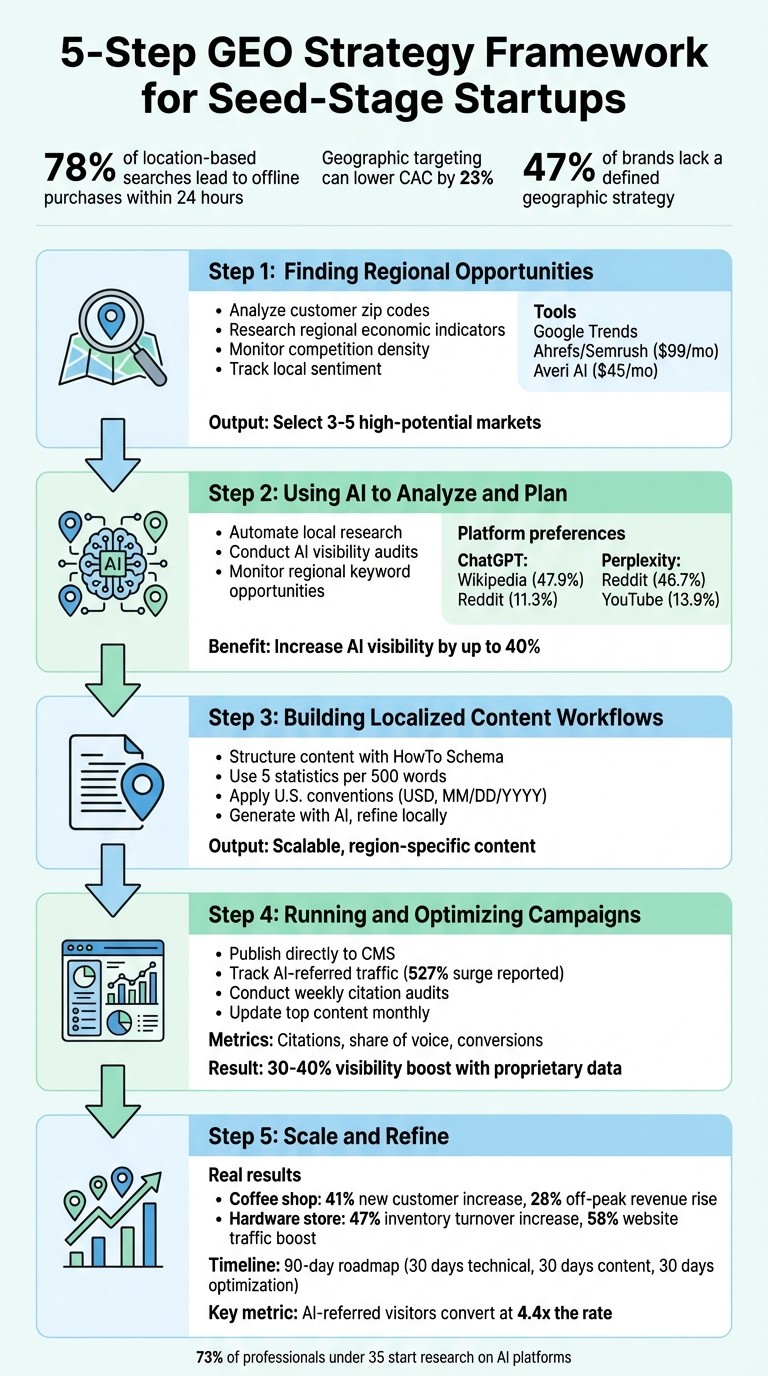
5-Step GEO Strategy Framework for Seed-Stage Startups
How to Outrank ANY Local Business on Google (2025 Local SEO Tips)
Step 1: Finding Regional Opportunities
For seed-stage startups, focusing on specific regions where demand is evident, competition is reasonable, and budgets can be effectively allocated is a smart way to maximize impact.
How to Choose Regions
Start by analyzing customer zip codes to identify areas where your business is already gaining traction. These early clusters can provide valuable insights into where to concentrate your efforts.
Next, dig into regional economic indicators. Look for areas with strong GDP growth, increasing employment in your industry, and favorable demographic trends. For instance, if you're in B2B software, consider cities like Austin, Denver, or Raleigh, which often have thriving startup ecosystems, instead of defaulting to larger hubs like San Francisco or New York. AI tools can help you track local employment and housing trends, offering a glimpse into spending patterns for the next 3–6 months [2].
Pay attention to competition density, but don't assume that a high concentration of businesses in your category always means opportunity. In some cases, it could signal a saturated market where customers are overwhelmed with choices. Research whether your target market operates under "winner-take-all" dynamics, where a few top players dominate. For example, businesses with 4.0+ star ratings tend to receive 89% more customer inquiries than those with 3.5 stars [2]. If the leading competitors in a region have stellar reviews and significant resources, you might find better opportunities in less crowded markets.
To get ahead of the curve, monitor local sentiment through platforms like community hashtags, regional Facebook groups, and subreddits. These channels can reveal emerging needs before your competitors notice. For example, if multiple posts on r/Austin highlight a lack of affordable coworking spaces, that could signal an opportunity for your business.
Once you've gathered these insights, use AI tools to refine your strategy and take action.
Tools for Regional Market Data
You don’t need to break the bank to gather regional market data. Start with free tools like Google Trends, which allows you to check search interest by metro area or state. Simply type in your core keywords and filter by region to see where demand is strongest.
For more detailed insights, consider tools like Ahrefs or Semrush, which provide regional search volumes and competitive analysis. These tools start at $99/month but can be worth the investment for deeper data. Another option is AnswerThePublic, which helps uncover region-specific questions people are asking.
If you're willing to dedicate 1–2 hours a week, manual tracking can also yield useful insights. This might involve using tools like ChatGPT, Perplexity, and Google Search Console to see what content is ranking and identify gaps. For example, ChatGPT often favors sources like Wikipedia (47.9%) and Reddit (11.3%), while Perplexity leans heavily on Reddit (46.7%) and YouTube (13.9%) [1]. Understanding these preferences can help you create content that performs well on AI-driven platforms.
For a more streamlined approach, Averi AI offers an all-in-one solution starting at $45/month [1]. This platform lets you analyze regional opportunities, generate localized content, and track performance without juggling multiple tools.
Once you've gathered and analyzed your regional data, it's time to narrow your focus based on market potential.
Selecting Your Focus Areas
With your research in hand, prioritize 3–5 high-potential states or metro areas. While major markets like California, Texas, and New York are often appealing due to their size and economic activity, let your data guide your decisions rather than relying on assumptions.
Consider a tiered approach to allocate your resources wisely. Choose one primary market where you'll concentrate the majority of your efforts, two secondary markets to test strategies and gather insights, and one or two experimental markets with early but unproven signals of potential. This way, you can adapt your strategy without spreading yourself too thin.
Set clear benchmarks to define what makes a market "high-potential" for your business. This could include metrics like search volume, a minimum number of target customers in the region, or low competition scores. Having these criteria in place ensures you stay focused on markets that align with your growth goals and avoid distractions from vanity metrics or less promising opportunities.
Step 2: Using AI to Analyze and Plan Geographic Strategies
Once you've pinpointed promising regions, the next step is to turn that raw data into actionable campaigns. AI-powered tools can take much of the heavy lifting off your plate, handling tasks that would otherwise demand extensive manual effort. With your target regions mapped out, it's time to refine your strategy using AI-driven insights.
How Averi AI Enhances Geographic Strategy
Averi AI offers several features designed to streamline regional planning and execution. The Synapse feature automates local research by integrating key regional details into your workflows. This allows you to create tailored content for cities like Austin, Denver, or Raleigh without starting from scratch every time. It’s a time-saver that ensures your campaigns are both efficient and relevant.
The Brand Core feature acts as a centralized hub for your brand voice and regional guidelines, keeping your messaging consistent across all markets. Meanwhile, the Human Cortex connects you with U.S.-based regional experts who can verify local nuances, ensuring your content resonates authentically with each audience.
For startups focused on GEO (Generative Engine Optimization), Averi's GEO Plays templates are a game-changer. These templates structure your content in an "answer-first" format, which significantly boosts the chances of being cited by AI platforms like ChatGPT and Perplexity. By implementing GEO strategies, you can increase visibility in AI-generated responses by up to 40% [1]. This approach not only enhances your presence on emerging AI platforms but also helps capture traffic from traditional search engines, building on your earlier efforts to target high-value markets.
Automating Regional Keyword Research
AI can also simplify the often tedious process of regional keyword research. Instead of manually analyzing keywords for every market, AI tools can sift through customer data and engagement patterns to uncover "geo-behavioral" targets - audiences whose behaviors align with high-value customers in specific regions [2].
Start by auditing your current AI visibility. Test various query types, such as category queries ("best project management software for startups"), problem-based queries ("how to manage remote teams"), and comparison queries ("Asana vs. Monday"), across platforms like ChatGPT, Perplexity, and Google AI. Document where your brand appears - or doesn’t. Different platforms favor different content sources; for instance, ChatGPT frequently cites Wikipedia (47.9%) and Reddit (11.3%), while Perplexity leans heavily on Reddit (46.7%) and YouTube (13.9%) [1]. Additionally, 32.5% of AI citations come from comparison content [1], making "vs" pages for regional competitors an effective strategy for improving visibility.
AI tools can also monitor local events and trends to optimize your content for emerging searches. For example, if a major tech conference is happening in Austin, AI can flag the event and suggest relevant content ideas. While specialized tools for tracking AI citations typically cost between $50 and $200 per month [1], Averi AI includes these capabilities in its core offering for $100 per month, making it a cost-effective solution for businesses looking to stay ahead in regional markets.
Step 3: Building Localized Content Workflows
With your regional goals defined and AI tools in action, the next step is creating content that truly connects with local audiences. A structured workflow ensures that every piece you produce - whether it’s a how-to guide for tech entrepreneurs in Austin or a comparison article tailored for SaaS buyers in Denver - stays consistent while addressing the nuances of each region. This is where you transition from planning to crafting content that speaks directly to the unique needs of each locale.
Structuring Regional Content
Different types of content serve distinct purposes in a geographic strategy. For instance, how-to guides are most effective when organized with numbered steps and enhanced with HowTo Schema markup, making them easily accessible to AI platforms. Similarly, listicles benefit from HTML tables that include comparison columns, such as pricing or feature breakdowns, which improve visibility. To make your content more AI-friendly, use structured elements like clear headings, numbered lists, and a high density of facts - aim for five statistics per 500 words - to boost both discoverability and relevance [1][3].
Tailoring Content to U.S. Conventions
When targeting U.S. audiences, align your content with local conventions. Use USD pricing (e.g., $100/month), MM/DD/YYYY date formats (e.g., 01/14/2026), American spelling, Fahrenheit for temperature, miles for distance, pounds for weight, and commas as thousand separators. These small but crucial details signal that your content is tailored to the preferences and expectations of the U.S. market.
Refining Content with Averi AI
Once you’ve applied standardized U.S. formatting, you can refine your content further using Averi AI’s intuitive editing tools. After the AI generates a draft based on your brand’s guidelines and regional requirements, you can adjust tone and clarity directly within the platform. Highlight specific sections to prompt Averi for rewrites, expansions, or localized tweaks - all without needing to juggle multiple tools. The platform also streamlines technical SEO by automatically generating internal linking suggestions and meta descriptions. Each completed piece is saved in your Library, providing context that sharpens future drafts and simplifies scaling your regional strategy. This efficient workflow ensures your content stays relevant to local audiences while laying the groundwork for broader geographic expansion.
Step 4: Running and Optimizing Geographic Campaigns
Launching Regional Campaigns
Once your content is finalized and polished, Averi AI takes care of publishing it directly to your CMS - whether you're using Webflow, Framer, WordPress, or another platform. It streamlines the entire process by automating publication with complete metadata, internal links, and structured markup included. Every article is also saved to your Library, allowing the AI to learn from each deployment and refine future campaigns. This automation is a game-changer for smaller, seed-stage teams, removing common bottlenecks. After publication, the next step is to measure your campaign's performance by tracking key metrics.
Tracking Campaign Performance
Averi AI provides valuable insights to help you track your campaign's success. Start by configuring Google Analytics 4 with a regex filter: .*chatgpt\.com.*|.*perplexity.*|.*gemini\.google\.com.*|.*copilot\.microsoft\.com.*. This setup ensures you can monitor traffic originating from AI-driven platforms. Conduct weekly audits of 10–15 critical regional queries to evaluate citation frequency, sentiment, and share of voice. Some brands have reported dramatic increases, with AI-referred sessions climbing by as much as 527%. Beyond traditional metrics like impressions and clicks, test queries on platforms like ChatGPT, Perplexity, and Google AI to confirm your link citations and see how your citation share of voice compares to competitors [1].
Improving Based on Data
With performance data in hand, you can fine-tune your strategy. Averi AI turns these insights into actionable recommendations, helping you refine your regional marketing plan. For instance, if content clusters like "Midwest Tech Hubs" are driving more citations, the platform might suggest expanding those clusters with additional guides or articles addressing common pitfalls. It also identifies gaps in citations - queries where competitors are mentioned but your brand isn't - offering opportunities to create targeted content to close those gaps. Content that incorporates proprietary data or unique statistics can boost visibility in AI-generated responses by 30–40%. To keep your momentum going, update top-performing regional pieces with fresh data monthly and conduct quarterly AI audits to stay ahead [1].
Step 5: Geographic Strategy Examples
After streamlining workflows and launching targeted campaigns, let's look at how real-world businesses have successfully implemented geographic strategies to drive growth.
Example: Targeting Tech Hubs
A small coffee shop found success by focusing on hyperlocal search terms like "coffee shop with meeting space near [Local Landmark]" and "wifi cafe downtown parking" instead of relying on broad, generic phrases. This hyperlocal SEO approach led to a 41% increase in new customer acquisition and a 28% rise in off-peak revenue within just six months[2]. Leveraging AI tools made it easier to pinpoint and optimize for these key regional phrases, saving time and effort.
The same principles apply to businesses targeting tech-centric areas like Silicon Valley, Austin, or Seattle. By incorporating specific local data - such as hiring trends, market size, or funding activity - companies can enhance their credibility with both traditional search engines and AI-driven platforms. It's worth noting that 73% of professionals under 35 now begin their research on AI platforms rather than traditional search engines[4].
Another business in a completely different market applied a similar localized approach and saw equally impressive results.
Example: Expanding in the Midwest
A hardware store identified an opportunity in neighborhoods filled with 1920s homes. By creating DIY restoration content tailored to this niche, the store achieved a 47% increase in inventory turnover and a 58% boost in website traffic[2].
For startups looking to break into underserved Midwest markets - like roofing software providers - the key is addressing regional concerns. Instead of focusing on coastal topics, they emphasized inland-specific issues such as "snow load and ice dam prevention"[4]. With nearly 47% of brands still lacking a defined geographic strategy, businesses that adopt this approach early can gain a substantial first-mover advantage[1].
These examples demonstrate how creating locally relevant content can deliver tangible results. A well-executed geographic strategy, supported by AI marketing automation, offers a scalable path for startups to achieve meaningful growth.
Conclusion: Building a Scalable Geographic Strategy
Creating a successful geographic strategy hinges on selecting markets based on data and implementing systems that grow without overextending your resources. The rise of AI-generated answers has sparked a staggering 527% surge in AI-referred traffic [1][5]. Yet, with nearly half of brands - 47% - still lacking a deliberate geographic approach [1], there’s a huge opportunity to gain a competitive edge.
Key Takeaways
These insights lay out a clear path for scaling your geographic strategy effectively:
Adopt a 90-day roadmap: Dedicate the first 30 days to technical groundwork, the next 30 to developing citation-worthy content clusters, and the final 30 to optimizing for performance [1]. By producing content rich in facts, backed by credible statistics, and peppered with direct quotes, you can boost your AI-driven visibility by 30–40% [1].
Focus on quality over volume: AI-referred visitors convert at 4.4 times the rate of traditional organic search visitors [5]. This makes creating high-quality, targeted content far more impactful than chasing sheer traffic numbers.
Tailor your strategy for each platform: ChatGPT values encyclopedic authority, Perplexity prioritizes fresh content and community validation, and Google AI Overviews favor already high-ranking material [1]. Your geographic strategy should adapt to these platform-specific preferences while ensuring your brand message remains consistent across all channels.
Track and refine your AI visibility: Monitor your AI Share of Voice weekly, aiming to grow it by 10–20% beyond your traditional market share [5]. Use these insights to adjust your AI-optimized content strategy, focusing on the sources that are actively citing your work.
With these principles, you can confidently build a scalable strategy that aligns with your brand’s goals.
Next Steps for Founders
To put this framework into action, start by evaluating your current visibility. Test your category, problem, and brand queries across ChatGPT, Perplexity, and Google AI Overviews to see where you stand [1]. Claim and optimize your profiles on high-authority platforms like G2, Capterra, and LinkedIn - frequent sources for AI models [1].
Next, establish topical authority by creating content clusters. Begin with a foundational pillar article of 2,000+ words, supported by 6–8 related, shorter pieces that complement the main topic [1]. This approach helps position your brand as a trusted source in your niche.
For startups operating on lean budgets of $0–500 per month [1], tools like Averi AI can streamline the process. These tools can handle research, drafting, optimization, and even publishing, freeing your team to focus on core product development while your content strategy runs in the background. Start small, track your results, and let the data guide your expansion into new markets.
FAQs
How can seed-stage startups identify the best regions for their GEO strategy?
Seed-stage startups can uncover promising regions by blending data analysis with AI tools to sharpen their focus. A good starting point is examining regional funding patterns to identify areas where early-stage investors are most engaged. While hubs like California continue to lead the U.S. market, states like Texas and Florida are emerging as attractive options, presenting fresh opportunities for growth.
AI-powered platforms, such as Averi AI, can take this a step further by assessing key factors like funding activity, the availability of skilled talent, and local search trends. These tools are particularly useful for pinpointing regions where a well-planned marketing effort can deliver the most impact, even when working with tight budgets.
To round out the analysis, consider qualitative factors like the presence of incubators, mentorship opportunities, and the cost of local advertising. By combining data-driven insights with practical knowledge, startups can zero in on regions that offer the best chances for early traction and investor attention.
How can AI tools like Averi AI help seed-stage startups with geographic marketing strategies?
AI-powered tools like Averi AI are transforming the way seed-stage startups leverage geographic data to create effective marketing strategies. By automating tasks such as analyzing local search trends, auditing regional schemas, and generating tailored content for specific areas, startups can increase their visibility by as much as 40% in just 4–8 weeks - dramatically faster than traditional, manual methods.
One of Averi AI's key features is its ability to design region-specific workflows, such as "audit → content → backlinks." These workflows simplify processes, cutting founder involvement down to just 5–10 hours per week, all while keeping costs manageable at $0–$500 per month. The tool doesn’t just stop there - it continuously updates content and backlink strategies using real-time insights from platforms like Google AI or ChatGPT. This ensures startups attract higher-quality traffic and generate more qualified leads. In fact, businesses using this approach often achieve a 20–30% higher ROI compared to conventional methods.
For startups with limited budgets and resources, Averi AI offers a practical, data-driven way to grow and thrive in targeted markets.
How does using a GEO strategy affect customer acquisition costs for startups?
Implementing a GEO strategy tends to push the average customer acquisition cost (CAC) to around $559, representing a 14.4% increase compared to non-GEO methods. While this might appear steep at first glance, the additional expense often mirrors the advantages of more precise and localized marketing. These efforts typically result in higher-quality leads and improved customer loyalty over the long term.
Related Blog Posts

Zach Chmael
CMO, Averi
"We built Averi around the exact workflow we've used to scale our web traffic over 6000% in the last 6 months."
Your content should be working harder.
Averi's content engine builds Google entity authority, drives AI citations, and scales your visibility so you can get more customers.