

In This Article
Build a repeatable content engine that pairs AI with human editors, integrates with your CMS, and uses analytics to boost traffic, leads, and growth.
Updated:
Trusted by 1,000+ teams
Startups use Averi to build
content engines that rank.
Content engines are critical for startups aiming to scale efficiently. They combine AI tools with human expertise to produce and manage content that drives traffic, builds credibility, and accelerates growth. Startups like Grammarly, HubSpot, and Averi have achieved exponential results by implementing structured content systems. Here’s how you can replicate their success:
Start with Strategy: Define your ideal customer profiles (ICPs) and align content with their needs across the buyer’s journey.
Leverage AI and Human Collaboration: Use AI content tools that amplify creativity for research and drafting, while humans refine and add depth for quality content.
Organize and Automate: Integrate directly with your CMS to streamline publishing and maintain an organized content library. Implementing a structured AI content creation framework ensures consistency from ideation to repurposing.
Track and Optimize: Use analytics to measure performance, update content regularly, and refine strategies based on data.
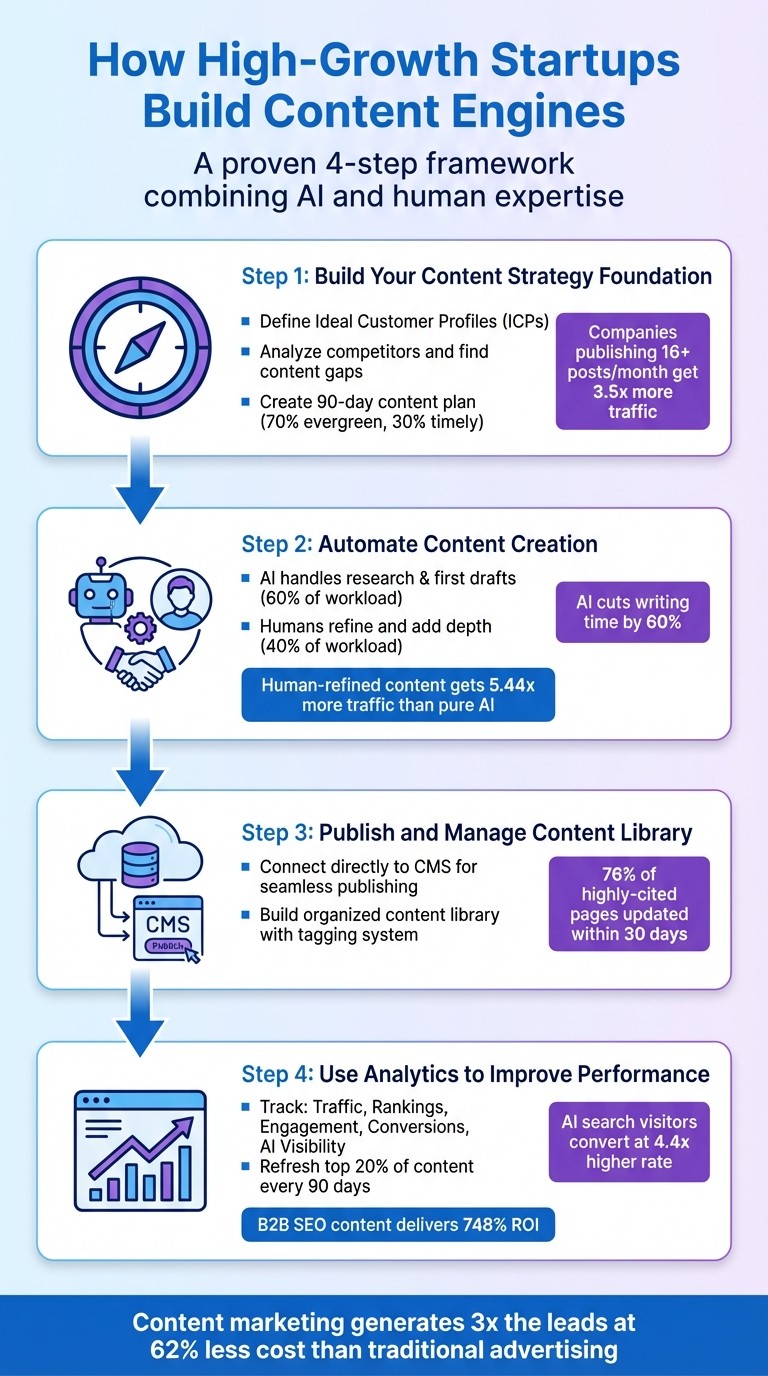
4-Step Framework for Building a High-Growth Content Engine
If I Started in 2025, Here’s My B2B SaaS Content Strategy for $1M ARR
Step 1: Build Your Content Strategy Foundation
Before diving into automation, it’s crucial to establish a clear understanding of your audience and messaging. This ensures your content efforts drive meaningful growth rather than adding to the digital noise.
Define Your Ideal Customer Profiles (ICPs)
Start by getting everyone on the same page. Bring together key stakeholders for a focused session to outline your brand’s core values and identify the real challenges your target audience faces[1]. This goes well beyond basic demographics. Instead, zero in on behavioral insights: what your potential customers are searching for, the content they engage with most, and where they tend to drop off in your sales funnel.
Use data tools to validate your assumptions. Platforms like Google Analytics can reveal which types of content resonate with different audience segments. Tools such as AnswerThePublic can help uncover the exact questions your audience is asking, while social listening platforms like Sprout Social or Hootsuite provide insights into where your audience spends their time online and what topics they’re discussing. The ultimate goal? Focus on high-intent prospects - those actively searching for solutions - rather than casting a wide net over less engaged audiences.
Once you’ve mapped out these profiles, align them with the different stages of the buyer’s journey. For example:
Awareness stage: Prospects here need educational content that highlights problems they might not even know have solutions.
Consideration stage: These individuals are researching options and will value vendor comparisons and content that builds trust.
Decision stage: Buyers at this stage are looking for product demos, pricing details, and customer testimonials.
With a firm grasp of your audience, the next step is to uncover opportunities your competitors might be overlooking.
Analyze Competitors and Find Content Gaps
Competitive analysis isn’t about mimicking others - it’s about identifying what they’ve left undone. Use tools like Ahrefs or SEMrush to see which keywords your competitors rank for and, more importantly, which ones they’ve neglected. The sweet spot lies where your audience’s search interests overlap with gaps in your competitors’ content.
In today’s landscape, you’ll need to evaluate two key visibility channels: traditional Google search and AI search engines like ChatGPT and Perplexity. These newer AI-driven platforms are reshaping how users find information, so staying ahead of trends in both spaces is essential.
"The companies that win aren't publishing more content. They're building better systems." - Zach Chmael, Head of Marketing, Averi[3]
Look for GEO (Generative Engine Optimization) opportunities alongside traditional SEO strategies. For example, include concise, 40–60 word answer blocks and define entities clearly - features that are often missing in older competitor content. This is especially important since AI-driven search visitors convert at a rate 4.4 times higher than traditional organic traffic[3]. For startups and businesses focused on generating qualified leads, these gaps represent a golden opportunity.
Once you’ve identified these gaps, it’s time to translate your insights into a sustainable content plan.
Create a Long-Term Content Plan
A solid content plan provides structure while leaving room for flexibility. Start by defining your brand voice, documenting your ICPs, pinpointing competitive gaps, and setting clear goals - whether that’s driving more traffic, generating leads, or earning AI citations. Aim for a 70/30 mix of evergreen and timely content[1], balancing long-term value with immediate relevance.
Consistency is key. Companies that publish 16 or more posts per month attract 3.5 times more inbound traffic compared to those with irregular schedules[3]. However, quality and regularity matter more than sheer volume. A steady rhythm of 2–4 posts per week, maintained over time, often outperforms sporadic bursts of daily publishing.
Break your 90-day content plan into three distinct phases:
Days 1–30: Lay the groundwork by refining your strategy and preparing foundational content.
Days 31–60: Focus on execution, publishing content regularly and tracking performance.
Days 61–90: Optimize based on results, refining your approach using real performance data.
Incorporate a weekly cycle where AI tools analyze performance and suggest new topics. This creates a feedback loop, ensuring your strategy evolves based on data rather than guesswork.
Step 2: Automate Content Creation
Once your strategy is set, the real challenge lies in execution. Many startups hit a wall here because creating quality content demands significant resources. But the solution isn’t about choosing between the speed of AI and the quality of human input - it’s about creating a system where the two work hand in hand. Here’s how to seamlessly integrate AI tools with human expertise.
Use AI for Research and First Drafts
AI shines when it comes to laying the groundwork. It can analyze competitor content, gather "People Also Ask" queries, and determine keyword density before the writing even begins. This preparation can cut writing time by roughly 60% [1][4].
Think of AI as the framework, not the final product. Start by training it to understand your brand’s unique qualities. Provide it with 10–15 examples of your top-performing content, a glossary of key terms, and tone guidelines [2]. This "Brand Core" helps AI drafts align with your voice from the outset. Use a step-by-step process: begin with a detailed outline, then generate content section by section rather than creating an entire draft in one go [2].
For efficiency, group related topics into clusters so the AI can reuse research across similar pieces. Companies using this approach report content production cycles up to 65% faster [4]. Some marketers even find that drafting a long-form blog post now takes less than an hour, compared to 2–3 hours without AI [2].
Once the AI generates a draft, the human team steps in to refine and add depth, ensuring the final product resonates with your audience.
Refine Content with Human Editors
While 88% of marketers use AI for content creation, only 25% report seeing substantial value [3]. The difference? Human refinement. AI is great for structure and research, but humans bring in the unique perspectives, case studies, and storytelling that make content truly engaging [3]. In fact, content shaped by humans receives 5.44 times more traffic than purely AI-generated material. Hybrid teams, combining AI and human input, produce 40% more content without compromising quality [3].
"AI handles the work that slows you down, humans provide the insights that enhance its impact."
Zach Chmael, Head of Marketing at Averi [3]
Clearly define roles: let AI handle research, outlining, and AI-optimized content creation, while humans focus on strategic direction, refining the brand voice, and ensuring accuracy [3]. Equip editors with a quality assurance checklist to verify facts and eliminate errors - AI occasionally "hallucinates" details [4]. Additionally, create a list of banned buzzwords or jargon to keep your tone authentic and relatable [2].
Balance Speed and Quality
The key to consistent publishing lies in balancing speed with quality. It’s not about cranking out content as fast as possible or striving for perfection every time - it’s about maintaining a steady pace with dependable standards. A winning formula assigns AI about 60% of the workload for structure and research, leaving the remaining 40% for humans to add voice, perspective, and critical judgment [3].
Automate tasks like quality scoring and formatting but keep final approvals in human hands. This approach frees your team to focus on engaging with your audience and building relationships [2]. With this system, you can maintain a manageable rhythm - publishing 2–4 posts per week - without overextending your team or compromising on quality.
Step 3: Publish and Manage Your Content Library
Once your content is polished and ready, the next challenge is getting it published efficiently and keeping it organized. Many startups hit a snag here, bogged down by manual processes like endless copy-pasting, formatting tweaks, and disorganized files. The solution is simple: integrate directly with your CMS and build a content library that streamlines future efforts.
Connect Directly to Your CMS
Manual publishing is a time sink. Tasks like reformatting drafts, fixing layouts, and manually uploading content can eat up hours. With Averi, content is pushed directly to your CMS, bypassing these tedious steps [8]. You simply review and approve the final draft, and it’s published with all the essential elements - like structure, meta descriptions, and internal links - already in place.
This integration does more than save time; it prevents delays that can stretch content release schedules by weeks. By removing these bottlenecks, your team can stay focused on what really matters: producing high-quality content.
Beyond speeding up the publishing process, this setup also lays the foundation for a smarter, more efficient content library.
Build a Content Library That Works Smarter, Not Harder
A well-organized content library isn’t just a storage system - it’s a powerful tool that fuels both AI systems and human editors. Every published piece should feed into this library, creating a resource that makes future content creation faster and more effective.
Consider this: 76% of highly-cited pages are updated within the last 30 days [3]. A properly managed library not only simplifies updates but also improves internal linking and provides better context for AI-generated drafts. As your library grows, your AI content tools will draw on your best-performing content, making each new draft sharper and more aligned with your goals [3].
To keep things organized, use simple tagging systems (e.g., funnel stage, topic cluster, content type) and consistent file naming conventions (like '2026.01_TopicName_ContentType') [5][6][7]. Adding expiration dates to your content ensures outdated pieces are regularly reviewed and refreshed, keeping your library clean and relevant [7]. With this structure in place, your library becomes a compounding resource that makes every new piece easier and faster to create.
Step 4: Use Analytics to Improve Performance
A content engine thrives when performance is tracked and insights drive improvement. Without analytics, you're left guessing - unsure about which topics resonate, which pages convert, or where to focus your efforts next. The most successful startups are those that link an AI-powered content strategy directly to performance data. To get there, you need to zero in on the metrics that truly reflect your content's impact.
Track the Metrics That Matter
To measure success effectively, focus on five key categories: Traffic (impressions, clicks, organic sessions), Rankings (keyword positions, featured snippets), Engagement (time on page, scroll depth), Conversions (leads attributed to content, demo requests), and AI Visibility (how often your content is cited in tools like ChatGPT and Perplexity)[3]. Interestingly, visitors coming from AI search tools convert at an impressive 4.4 times the rate of traditional organic traffic[3].
Pay attention to both leading indicators - like impressions and keyword rankings - to track early momentum, and lagging indicators - such as content-attributed revenue pipelines - to measure long-term impact. Use tools like UTM parameters and form field attribution to connect specific content pieces to closed deals. This approach not only demonstrates ROI but also helps you double down on strategies that work[3].
Turn Data into Action
Data is only as good as the actions it inspires. Start by identifying posts that have experienced a traffic or ranking drop of more than 20%[9]. For your top 20% of traffic-driving posts, implement a 90-day refresh cycle to prevent performance declines before they occur[9]. Group content by publish date to analyze how long it takes to gain traction and when it starts losing relevance[9].
If high-traffic pages have low click-through rates, experiment with new headlines and meta descriptions to boost engagement[9]. Conduct internal link audits to find high-authority pages and use them to link to newer or underperforming content, giving those pages a much-needed boost[9]. These targeted adjustments allow you to refine your content engine continuously.
Improve Content Through Feedback Loops
The best content engines don't just track results - they adapt based on what the data reveals. Identify top-performing topics and formats, then focus your efforts on replicating those successes. At the same time, optimize or phase out content that isn't delivering results[3]. Regular updates are critical - 76% of highly-cited pages are refreshed within the last 30 days, making consistent updates a non-negotiable[3].
"A content engine is a system with defined phases, automated workflows, and feedback loops that compound over time." - Zach Chmael, Head of Marketing, Averi[3]
For B2B companies, SEO-driven content strategies deliver a staggering 748% ROI[3]. Businesses publishing 16 or more posts per month see 3.5 times more inbound traffic compared to those with sporadic posting schedules[3]. The key to unlocking this compounding growth lies in closing the loop between publishing and learning. By doing so, you’ll ensure your content engine keeps getting smarter - and more effective - with time.
Conclusion: Build a Content Engine That Runs Itself
Creating a content engine isn’t about churning out more content - it’s about building a system that gets smarter with every piece you publish. The startups that succeed aren’t necessarily the ones with the largest teams or deepest pockets. Instead, they’re the ones that establish repeatable workflows where strategy, execution, and performance data continuously refine future efforts. A well-designed content engine essentially runs itself, allowing you to focus on your product and customers while your visibility steadily grows. This approach highlights why having an efficient content engine is a game-changer for startups.
Key Takeaways for Startup Leaders
A smart content engine thrives on four key elements: strategy, content strategy software, collaboration, and analytics. Start by defining your ideal customer profiles (ICPs) and aligning content with genuine customer needs - not superficial metrics. Use AI tools to handle initial research and drafts, while human editors shape the tone and perspective. This hybrid approach combines speed with authenticity, driving meaningful traffic gains. Integrate directly with your CMS to streamline publishing, and rely on performance data to guide your next steps. Regular posting builds momentum, proving that consistency outperforms perfection every time.
"The winning model combines AI speed with human judgment." - Zach Chmael, Head of Marketing, Averi [3]
Content marketing generates three times the leads of traditional advertising at 62% less cost. For B2B companies, sustained SEO-driven strategies deliver an average ROI of 748% [3]. But this kind of return only happens when your content engine operates consistently. Between March and May 2025, Averi’s two-person team built an autonomous content engine, publishing over 100 pieces in just 60 days. The results? A 340% boost in organic traffic, a 220% increase in newsletter signups, and a 190% rise in demo requests [1]. This is the power of aligning strategy, execution, and data.
How to Get Started
Ready to build your own engine? Start with a 90-day plan. Begin by auditing your current performance, defining your brand voice, and committing to 2–4 posts per week for three months [3]. Platforms like Averi simplify the process, handling everything from strategy and research to publishing and analytics. All you need to do is approve the content. The goal is to create a system that learns and improves with each publish, transforming content into a long-term strategic asset. Define your ICPs, approve your first batch of content, and let your engine take over. The sooner you start, the faster your visibility will grow.
FAQs
How can startups effectively combine AI and human expertise in content creation?
Startups are tapping into AI as a speed engine, using it to tackle tasks like drafting initial versions, crafting headlines, and building data-driven outlines. This approach can shave off about three hours per piece, giving teams more time to focus on higher-value activities.
However, human expertise remains the quality guard in this workflow. While AI handles the groundwork, people step in to refine the output, ensuring it aligns with the brand’s voice, sticks to strategic goals, and remains factually accurate.
The process typically unfolds in stages: AI lays out the basic framework, editors polish and enhance it, and subject-matter experts inject the necessary depth and nuance. This blend of automation and human insight creates a scalable system designed for growth. By combining AI’s efficiency with the creativity and reliability that only humans bring, startups achieve a balance that meets both their productivity and quality standards.
What are the key metrics to measure the success of a content engine?
The effectiveness of a content engine hinges on monitoring metrics across three essential areas: reach, engagement and conversion, and efficiency.
Reach measures how successfully your content draws in the right audience. Metrics like total pageviews, unique visitors, organic search traffic, and search engine rankings provide valuable insight into your visibility and audience growth. These numbers paint a clear picture of how well your content is performing at capturing attention.
Engagement and conversion metrics reveal how well your content connects with your audience and drives meaningful business outcomes. Key indicators include average time spent on a page, bounce rate, click-through rate, and conversion rate. Additionally, tracking leads generated and the impact on your sales pipeline helps quantify the business value of your content.
Efficiency focuses on the productivity and return on investment of your content engine. Metrics such as content production speed (e.g., hours spent per piece), publishing frequency, and cost per piece are crucial. Comparing these figures to traditional content creation methods can highlight how well your AI-human workflows are functioning.
When you see consistent progress in these areas - greater traffic, deeper engagement, improved conversions, and reduced costs - it’s a strong signal that your content engine is performing effectively.
How can startups find and address content gaps their competitors are missing?
To pinpoint content gaps, start by examining what your competitors are producing. Leverage tools to assess their top-ranking pages for your target keywords. Pay attention to the formats they’re using - whether it’s blogs, videos, or case studies - and identify areas where coverage is sparse or nonexistent. Conducting a keyword gap analysis can help uncover high-volume searches where competitors are underperforming. Additionally, reviewing social media and SEO metrics can reveal opportunities for your content to stand out. Align these insights with your buyer personas to focus on gaps that resonate with your audience and align with your sales funnel.
Once you’ve identified the gaps, establish an efficient content creation process. AI tools can assist by drafting outlines, generating initial copy, and suggesting SEO-friendly headlines. However, human input is essential to refine the content, ensuring it aligns with your brand’s voice and provides meaningful value. Strike a balance between quick-turn pieces, like “how-to” articles, and more in-depth resources, such as comprehensive guides. Plan your publishing schedule thoughtfully to maintain consistency. Finally, keep an eye on performance metrics, such as traffic and engagement, to fine-tune your strategy and stay ahead of the competition.
Related Blog Posts

Zach Chmael
CMO, Averi
"We built Averi around the exact workflow we've used to scale our web traffic over 6000% in the last 6 months."
Your content should be working harder.
Averi's content engine builds Google entity authority, drives AI citations, and scales your visibility so you can get more customers.