

In This Article
Use consistent, hyperlocal content to attract leads and build trust. Combine editorial calendars, AI-assisted drafting, and human review to drive measurable growth.
Updated:
Trusted by 1,000+ teams
Startups use Averi to build
content engines that rank.
Want to grow your real estate business? Start with a smart content strategy. Editorial-led growth focuses on delivering consistent, useful, and locally relevant content that attracts leads, builds trust, and positions you as a market expert. Here's what you need to know:
Plan Ahead: Replace random posts with a structured content calendar featuring market reports, neighborhood guides, and buyer tips.
Know Your Audience: Address common client questions like financing or school quality, and tailor content to specific groups (e.g., first-time buyers vs. retirees).
Set Goals: Tie every piece of content to measurable outcomes, such as increasing newsletter subscribers or generating leads.
Leverage Tools: Use AI like Averi to automate research, drafting, and publishing while maintaining accuracy and your brand voice.
Stay Local: Blend AI efficiency with human insights to provide hyperlocal market trends and community updates.
Measure Results: Track metrics like SEO rankings, engagement rates, and lead conversions to refine your strategy.
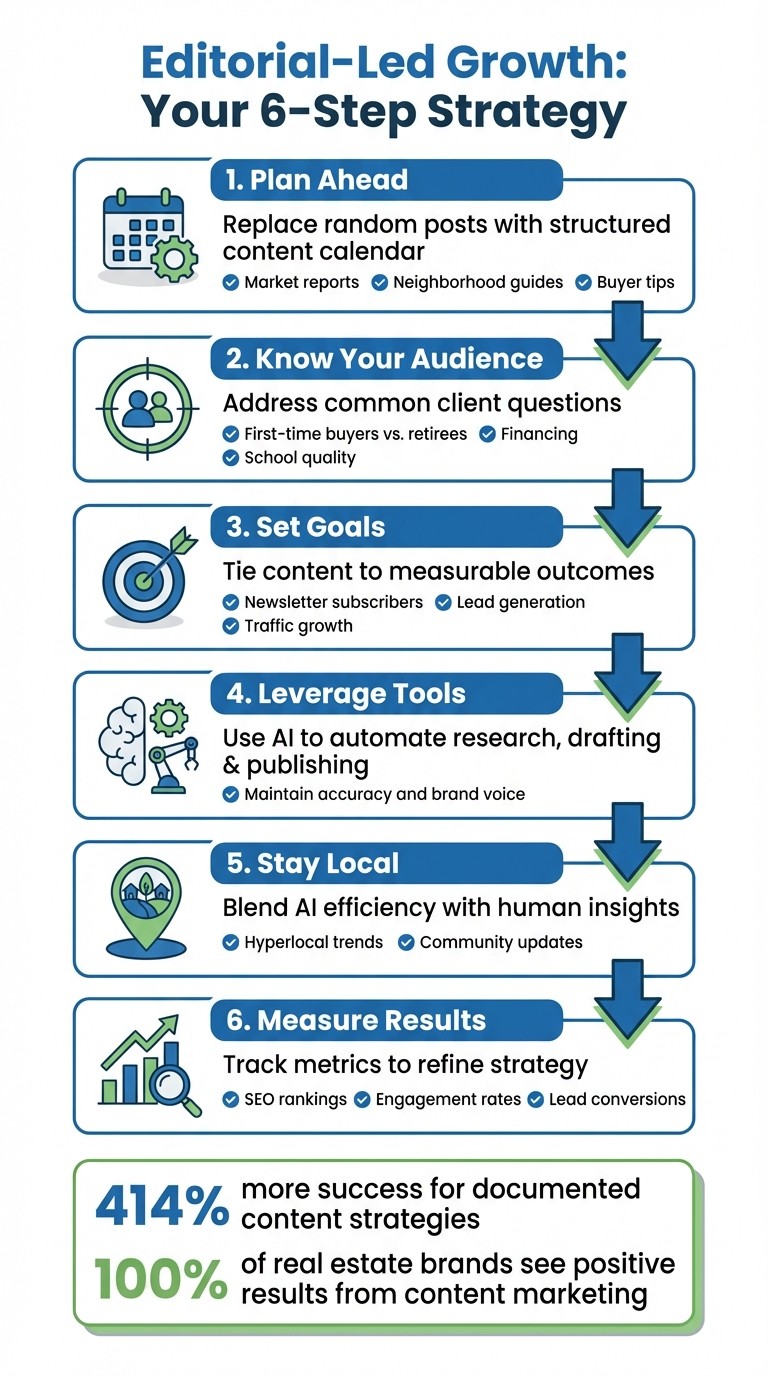
6-Step Editorial-Led Growth Strategy for Real Estate Agents
9 Real Estate Content Marketing Secrets To Gain You Traffic
Create Your Real Estate Content Strategy
A well-thought-out content strategy is your roadmap for deciding what to publish, when to publish it, and who it’s for - all while keeping your business goals front and center.
Find Your Target Audience
Start by truly understanding the people you serve. Pay attention to the questions your clients ask repeatedly, like “How much do I need for a down payment?” or “What are the schools like in this neighborhood?” These inquiries are goldmines for content ideas [7].
Take it a step further by immersing yourself in the community. Attend local school board meetings, town halls, or planning committee gatherings to learn what matters most to residents. Whether it’s infrastructure updates, school quality, or neighborhood safety, these insights can shape your content topics [7].
"Real Estate is a belly-to-belly business. In other words, it's a community-based effort. It places value on the personal. That means you really do have to be a local expert."
Create content personas tailored to the various groups you serve. For instance, a first-time buyer in their 30s might prioritize information about financing and navigating the buying process, while someone downsizing for retirement will likely focus on timing the market and finding the perfect smaller home [7][2]. Tools like Answer The Public can help uncover the specific questions people in your area are searching for online [4].
Once you’ve nailed down your audience’s needs, shift your attention to market trends and what your competitors are doing to refine your strategy further.
Study Market Trends and Competitors
Take a close look at what other agents and brokerages in your area are publishing. Pay attention to the types of content that spark engagement - whether it’s comments, shares, or views - and note the topics and formats they use [4][6]. Identify areas they may be neglecting, like affordable housing or up-and-coming neighborhoods, to carve out your own niche.
For credibility, back up your content with data from trusted sources like the National Association of REALTORS (NAR) or local real estate associations [7]. Since real estate content often falls under "Your Money or Your Life" (YMYL) standards, ensuring accuracy and trustworthiness is crucial for both search engines and your audience [3][7].
Video content is currently leading the pack at 48% popularity, followed by success stories at 38% and short-form articles at 36% [7]. Beyond just content, consider becoming a voice for community concerns like affordable housing or local infrastructure. As Chris Linsell explains, "If you're a thoughtful advocate for housing in your community, you will get business" [7].
This market insight sets the stage for defining clear content goals.
Set Content Goals
Every piece of content should be tied to a measurable business outcome. Instead of vague objectives like “increase visibility,” aim for specific targets: add 500 newsletter subscribers, double traffic to your listings, or generate 20 qualified leads each month [5]. Use the SMART framework to ensure your goals are Specific, Measurable, Attainable, Realistic, and Timely [5].
Decide whether your primary focus is lead generation, building brand awareness, establishing thought leadership, or earning trust. Track meaningful metrics like agent appointment rates or the volume of qualified leads for brokerages [3][5]. Professionals who document their content strategies report 414% more success than those who don’t, and 8 out of 10 clients see better response rates when following a structured content plan [8][1].
Build an Editorial Calendar
Once you've identified your audience and defined your goals, the next step is to create a content calendar. This tool helps you stay consistent, meet deadlines, and plan your publishing schedule effectively.
Plan Monthly Content Themes
Break your content into recurring themes to keep it engaging and relevant. For example, dedicate weeks to topics like market trends, seasonal advice, hyperlocal stories, and client testimonials. This approach ensures a steady mix of content while making the production process more manageable for your team.
Set aside one day each month for batch-creating your content - whether that's videos, blog posts, or newsletters. This method eliminates the stress of daily production. Booking a videographer for a single session can cover an entire month's worth of video content in one go.
Align Content with Seasonal Trends
Real estate follows predictable patterns, and your calendar should reflect these cycles. For instance, homes sell 18.5 days faster and for 5.9% more during the first two weeks of May, making spring a prime time for sellers [10]. Start releasing "Spring Market Forecast" content in March to capture buyers before the May rush. Use January for "New Year, New Home" campaigns, September for "Back-to-School" neighborhood guides, and November for tax-deduction tips.
Incorporate holidays, community events, and school calendars into your schedule. A post about top school districts in May - when families are planning summer moves - will perform far better than the same content in December. Planning 3–4 months ahead ensures your content is timely and aligns with peak search interest [10].
By tying your content to seasonal trends, you'll maximize its relevance and reach.
Fill Competitor Content Gaps
Take a close look at what other agents in your area are publishing and identify the topics they’re not addressing. For example, they might focus on luxury listings but overlook affordable housing or first-time buyer programs. They may provide general market updates but skip hyperlocal insights like new restaurants, park improvements, or infrastructure projects. These gaps are your chance to stand out [9][2].
Use tools like Answer The Public to uncover specific questions your audience is asking, then check if competitors have addressed them [4]. Keep a running list of ideas and systematically create content that fills these gaps [2]. With 46% of Google searches focused on local information [10], dominating niche topics - such as school district boundaries or neighborhood-specific market trends - can significantly boost your site traffic.
This organized approach lays the groundwork for using AI tools to streamline and elevate your content production.
Use AI Tools like Averi for Content Automation
Executing your editorial calendar with precision is essential for steady growth in the real estate industry. Once your calendar is set, the real challenge lies in maintaining a consistent flow of high-quality content. This is where tools like Averi step in, taking over the tedious aspects of content creation - research, drafting, and publishing - so you can focus on strategic priorities. Here's how Averi enhances every stage of your content automation process.
Automate Research and Drafting
Real estate content thrives on timely and accurate information. Market trends can shift weekly, and outdated content risks costing clients significant amounts of money [7]. Averi simplifies the research process by sourcing data from reliable platforms like the National Association of REALTORS (NAR), Inman, and City-Data.com. It then crafts SEO-optimized drafts with hyperlinked citations for easy verification [7].
With Averi, you can batch-create an entire month’s worth of content in a single session. By approving topics and reviewing AI-generated drafts, you eliminate the stress of daily content production while ensuring the accuracy your audience demands [7].
Maintain a Consistent Brand Voice
A common concern with AI-generated content is losing the distinct voice that defines your brand. Averi addresses this by learning your tone, style, and messaging framework through its AGM-2 training. Once you establish your "messaging house" - a clear outline of your mission, value propositions, and key proof points - the platform applies these principles to every piece of content [3].
This centralized approach ensures consistency across agents and offices, particularly for compliance-sensitive topics like fair housing or financing claims. By pre-approving language, you can guarantee that all content aligns with legal and MLS standards [3]. With your brand voice secured, you can shift your attention to streamlining the publishing process.
Streamline Publishing Workflows
Averi seamlessly integrates with popular CMS platforms such as WordPress, Webflow, and Framer, eliminating manual tasks. Once a draft is approved, it can be published automatically, complete with features like internal links, meta descriptions, and FAQ sections [2]. Each piece is stored in your content library, making future updates and drafts more efficient.
The platform’s Synapse orchestration system simplifies team collaboration by assigning tasks, tracking revisions, and notifying team members when approvals are needed. Instead of juggling multiple tools and communications, your entire workflow is centralized in one system. This streamlined process allows content to move from concept to publication in just hours, rather than days.
Combine AI with Human Review
AI can churn out content in record time, but real estate requires more than just speed. Markets shift quickly, buyers crave hyperlocal insights, and compliance errors can be costly. By blending AI-driven automation with human expertise, you can achieve both efficiency and accuracy. The best approach uses AI for tasks like research, structuring, and drafting, while humans step in to refine the content, ensuring it’s accurate, locally relevant, and aligned with your brand.
Edit Content as a Team
AI drafts are a great starting point, but human review is critical to catch errors that could mislead buyers or undermine your credibility. Real estate content falls under the "Your Money or Your Life" (YMYL) category for search engines, where accuracy is non-negotiable[7]. A single outdated statistic or incorrect figure can erode trust. Assign team members to fact-check, adjust tone, and verify compliance through a streamlined review process that allows for same-day feedback[3].
Marketers who document their content strategies and workflows report a 414% increase in success rates. Establish clear review stages using an AI content creation framework that includes ideation, AI drafting, human review, and final approval to create a reliable content pipeline[8].
Adapt Content for Local Markets
National trends might grab headlines, but they don’t always resonate with buyers looking for homes in specific neighborhoods. While AI can compile useful data like monthly market stats, interest rates, and inventory updates, it can’t explain why a particular area is popular with young families or why homes in one school district are selling faster. That’s where local agents add indispensable value[3].
Adopt a hybrid co-creation model: let AI handle the data-heavy groundwork, then have agents contribute personalized insights. For example, agents can record short videos or draft summaries that interpret the numbers for their local audience. Brokerages that use structured content playbooks report that 8 out of 10 clients experience higher response rates when they combine AI efficiency with localized human input[1]. This method naturally supports a multi-channel publishing strategy.
Publish Across Multiple Channels
Once content has been reviewed and refined, distribute it across platforms like email, your CMS, and social media. A centralized approach simplifies the process, ensuring updates, neighborhood highlights, and property promotions reach your audience wherever they’re active[2].
Measure and Improve Content Performance
Publishing content is just the start; the real challenge lies in understanding its impact and refining your strategy based on performance data. For real estate professionals, tracking the right metrics can lead to noticeable improvements in lead quality and conversion rates. With 97% of homebuyers starting their property search online [10], the effectiveness of your content directly influences your success.
Track Performance Metrics
To understand how your content is performing, focus on two main areas: visibility and engagement. Visibility metrics include impressions, reach, local SEO rankings, and brand search growth, while engagement metrics cover website sessions, click-through rates (CTR), email open rates, video completions, and social clicks. A particularly important metric for real estate is the appointment set rate, which measures the percentage of leads converting into scheduled meetings [3].
Local SEO metrics are especially critical. Keep an eye on Google Business Profile views, direction requests, and call volumes. Since 46% of all Google searches involve users looking for local information [10], these insights are vital for gauging your market presence. Tools like CallRail can help you assign unique phone numbers to blog posts, making it easier to see which topics - such as neighborhood guides or market reports - generate direct inquiries [10].
Metric Category | Metrics | Impact |
|---|---|---|
Visibility | Impressions, Reach, SEO rankings, Brand search growth | Measures how many people discover your content |
Engagement | Website sessions, CTR, Email open rates, Video completions, Social clicks | Indicates how well your content connects with your audience |
Conversion | Lead volume, Cost per lead, Appointment set rate | Tracks the actual business impact and ROI |
Local Impact | Google Business Profile views, Direction requests, Calls | Evaluates performance at the neighborhood level |
Once you have these metrics in place, let AI tools help you turn raw data into actionable insights.
Get AI-Powered Recommendations
AI tools like Averi go beyond simply displaying charts - they analyze performance data and provide tailored recommendations. These tools can identify which topics resonate most with your audience, send alerts when a blog post is nearing a ranking milestone, and suggest updates or new angles based on emerging trends [10].
You can also enhance your editorial calendar by adding fields for performance metrics like page views, clicks, and conversions. This makes it easier to spot high-performing content worth repurposing or updating [2]. Additionally, Google Search Console can uncover unexpected long-tail keywords driving traffic, revealing opportunities you might not have considered.
Adjust Content Based on Data
Set aside time during the first week of each month to review traffic, engagement, and lead generation metrics from the previous month [10]. Use this data to fine-tune your editorial calendar. Double down on topics that drive appointments, improve underperforming content with stronger headlines or updated stats, and remove or redirect pages that no longer serve your audience.
These insights can also guide your future content planning, ensuring each cycle builds on past successes. Conduct quarterly SEO audits to keep your content aligned with changing search algorithms. Check for consistent citations across directories and ensure internal links don’t lead to outdated property listings [10]. Operational metrics, such as the "template adoption rate" and the time it takes to move from content creation to publishing, can reveal how efficiently your team is executing your strategy [3].
Set SMART goals - like "Convert 50 website leads into customers" or "Increase newsletter subscriptions by 500" - to keep your strategy focused and measurable [5].
"Keeping a record of the content as it is created gives you a head start in tracking the performance of each piece and regularly sharing the results with your team and upper management." – Jodi Harris, Director of Content Strategy, Content Marketing Institute [2]
Conclusion
Achieving growth in real estate through editorial content isn’t about choosing between the efficiency of AI and the insight of human expertise - it’s about blending the two to create consistent, meaningful results. A well-planned content calendar helps maintain focus, tools like Averi handle repetitive tasks like research and drafting, and human oversight ensures every piece resonates with local knowledge and builds trust.
This strategy delivers tangible outcomes: research shows that 100% of real estate brands see positive results from content marketing[7], and 86% of home buyers and sellers rely on real estate professionals[5]. Your content often serves as the first handshake with potential clients, setting the stage for turning leads into appointments. By publishing consistently - leveraging AI for scalability and human input for local relevance - you can establish the credibility needed to turn website visitors into scheduled meetings.
To make this work, start with a clear plan. Define your content pillars, set SMART goals like “Increase newsletter subscriptions by 500”[5], and batch-produce content each month. Use AI to streamline tasks like keyword research and drafting, then layer in the local stories and market insights that only you can provide. Monitor what content drives appointments, focus on topics that perform well, and refine your strategy monthly based on real-world data.
"Real Estate is a belly-to-belly business. In other words, it's a community-based effort. It places value on the personal." – Chris Linsell, Senior Staff Writer and Real Estate Coach at The Close[7]
This perspective underscores the winning formula for long-term success: treat content as a foundational part of your growth strategy. Build a system, use AI to handle routine tasks, and prioritize authentic, personal connections that close deals.
FAQs
How can I use AI tools like Averi to grow my real estate business with content?
AI tools like Averi are transforming how real estate professionals create tailored, market-specific content. By blending automation with human insight, Averi helps craft engaging property listings, detailed market reports, and targeted email campaigns designed for specific buyer or seller groups. This combination doesn't just save time - it delivers results. For instance, studies reveal that AI-enhanced email campaigns can generate up to $36 for every $1 spent.
To make Averi work for your business, start by planning an editorial calendar that outlines key content types, such as property listings, neighborhood insights, and market trends. Next, segment your audience based on criteria like location, budget, or buying stage, and let Averi draft customized content for each group. After generating these drafts, refine them to ensure they reflect your brand's tone and meet any compliance standards. Once finalized, use your CRM or email tools to automate distribution and monitor performance metrics like click-through rates and lead generation. This data will help fine-tune your future campaigns.
By pairing AI’s speed and precision with your expertise, you can create a scalable content strategy that not only boosts engagement but also builds trust and drives long-term growth in your real estate business.
What’s the best way to create a content calendar for real estate marketing?
Creating a content calendar for real estate should go beyond simply scheduling posts - it’s about crafting a thoughtful strategy. Begin by setting clear objectives such as attracting leads, boosting website visits, or increasing brand visibility. Tie these goals to specific audience groups or buyer personas for a more focused approach. Next, identify important dates like seasonal buying trends, local community events, school schedules, and real estate industry holidays to ensure your content syncs with natural market dynamics.
Integrate SEO-focused topics by leveraging tools like Google Keyword Planner to uncover relevant search terms. Diversify your content with a mix of blog posts, videos, market updates, and property listings to keep your audience engaged. Use tools like Google Sheets or Notion to centralize your calendar, assign responsibilities, set deadlines, and manage approvals. Aim to plan 3–4 months ahead, but leave room for last-minute updates or trending topics. Regularly review your calendar’s performance and adjust your strategy as needed.
When targeting a U.S. audience, make sure your content reflects localized details: use U.S. dollar signs ($), dates in MM/DD/YYYY format, and imperial measurements like feet and miles. Include references to relevant local features, such as school districts or neighborhood highlights, to make your content relatable and appealing.
How can I track the success of my editorial-led growth strategy in real estate?
To gauge how well your editorial-led growth strategy is working, pay attention to key performance indicators (KPIs) that matter most. These include organic traffic growth, lead generation and conversion rates, and content engagement metrics such as click-through rates, time spent on the page, and social shares. It’s also important to keep an eye on SEO progress, like how your keywords are ranking, while making sure your editorial calendar stays in line with compliance and brand standards.
Using tracking tools and analytics platforms is essential for regularly reviewing these metrics. This data gives you the insight needed to fine-tune your approach based on how your audience is responding and evolving over time.
Related Blog Posts

Zach Chmael
CMO, Averi
"We built Averi around the exact workflow we've used to scale our web traffic over 6000% in the last 6 months."
Your content should be working harder.
Averi's content engine builds Google entity authority, drives AI citations, and scales your visibility so you can get more customers.