How to Scale Your Marketing Without Hiring a Full Team for B2B SaaS

Averi Academy
Averi Team
8 minutes

In This Article
Scale B2B SaaS marketing without hiring a full team using AI workflows, a lean tech stack, focused channels, automation, and ROI-driven measurement.
Updated:
Trusted by 1,000+ teams
Startups use Averi to build
content engines that rank.
Scaling marketing for a B2B SaaS company can be challenging when resources are tight. Instead of building a full team, you can achieve growth by leveraging AI-driven workflows and a lean tech stack. Here's how:
Define Priorities: Focus on 2–3 key growth channels and funnel stages that align with your business model (e.g., demo requests, PQLs, or SQLs).
Use AI Workflows: Automate repetitive tasks like content creation, lead processing, and ABM campaigns to save time and reduce costs.
Build a Lean Tech Stack: Consolidate essential tools into a few platforms like Averi for AI workspaces, HubSpot for lifecycle management, and Google Analytics for tracking.
Measure Results: Track metrics like cost per lead, content production time, and campaign ROI to refine and scale your efforts.
The SaaS Growth Strategy I’d Use to Drive Scalable Revenue
Build a Focused Marketing Strategy
Before diving into AI or automation tools, take a step back and define your marketing objectives. One of the most common pitfalls for small B2B SaaS teams is adopting tools without a clear strategy, which often leads to inefficiencies in their go-to-market (GTM) approach [1].
Identify Your Primary Growth Channels and Funnel Stages
Start by understanding your current growth model. Are you product-led (users sign up and convert independently), sales-led (sales reps drive deals), or a mix of both? Each approach requires distinct marketing priorities.
Next, pinpoint the 2–3 funnel stages that are most critical for your business right now. For early-stage SaaS companies, this might mean focusing on demo requests and product-qualified leads (PQLs). For growth-stage companies, the emphasis could shift to sales-qualified leads (SQLs) and expansion annual recurring revenue (ARR). Jean English, former CMO at Juniper Networks, exemplified this in 2025 when her team implemented a personalized, AI-driven GTM strategy targeting high-intent accounts, resulting in a fivefold increase in meetings [1].
Your primary channels should align with these priorities. For example, if you're targeting enterprise buyers, strategies like account-based marketing (ABM) and thought leadership content might take center stage. On the other hand, if product-led growth is your focus, SEO content and inbound lead processing become essential [1]. The key is to engage buyers where they are most active.
After defining your channels and funnel stages, allocate your resources to match these priorities.
Set Budget Limits and Allocate Resources
With your priorities clear, it’s time to align your budget and resources to achieve maximum impact. Begin by defining your constraints - whether that’s budget, team size, or available time. If you’re a small team led by a founder or just a couple of marketers, you won’t have the capacity to run ten programs at once. Instead, focus on systematic execution over spreading yourself too thin.
Ashley Levesque, VP of Marketing at Banzai, reflected on this in 2025 when she said:
I didn't even know AI workflows were something that I was lacking until someone said, 'Did you know you could do all of this with Copy.ai?' [1]
The takeaway isn’t about the specific tool - it’s about recognizing the value of focusing your limited resources on systematic, effective execution.
Stick to 2–3 scalable programs at most, and allocate your budget strategically. By concentrating your efforts, you can significantly improve efficiency [1]. Set clear spending limits for each program and track both time and money with equal care.
Design AI-Powered Marketing Workflows
Once your strategy is in place, the next step is creating AI-driven workflows that simplify execution while maintaining high standards. These workflows are not about replacing human creativity or judgment - they’re about automating repetitive tasks, giving you more time to focus on impactful decisions.
Build a Reusable Workflow Template
Think of workflows as structured, repeatable processes that save you from starting from scratch every time. Instead of juggling multiple tools for brainstorming, drafting, and coordinating, aim for a system that integrates strategy, execution, and optimization seamlessly.
Begin by identifying your most frequent marketing activities - whether it’s creating blog posts, launching email campaigns, managing social media content, or developing ABM (account-based marketing) assets. Break each activity into clear steps, such as creating briefs, generating drafts, reviewing content, and publishing. Then, explore AI-enabled platforms that can automate these steps into templates you can use repeatedly.
The real advantage lies in designing workflows that minimize manual handoffs and reduce reliance on external agencies. For example, tools like Averi AI bring all elements - strategy, content creation, and collaboration - into one platform. This eliminates the need to switch between tools or risk losing context, making the entire process from concept to publication more efficient.
Use AI Workspaces to Store and Reuse Marketing Context
Consistency is key in marketing, and AI workspaces ensure that your campaigns stay on-brand and on-message.
Typically, starting a new project or briefing a freelancer means repeating the same information about your brand voice, customer profiles, and product positioning. This repetition not only wastes time but also increases the risk of inconsistency. AI workspaces solve this by serving as a centralized repository - sometimes called an "Infobase" - where you store essential materials like ideal customer profiles (ICPs), brand guidelines, product details, and past campaigns.
With this information readily accessible, AI tools can automatically reference it for new projects, ensuring every piece of content aligns with your established tone and messaging. This approach is especially helpful as your team grows, allowing new members or external collaborators to hit the ground running without lengthy onboarding.
What’s more, as you store feedback, refine guidelines, and complete campaigns, the AI learns and improves. Over time, this means faster turnarounds and better results. By the time you’re working on your tenth campaign, you’ll see a noticeable boost in efficiency - all while maintaining the quality and consistency your audience expects.
Assemble a Lean Marketing Tech Stack
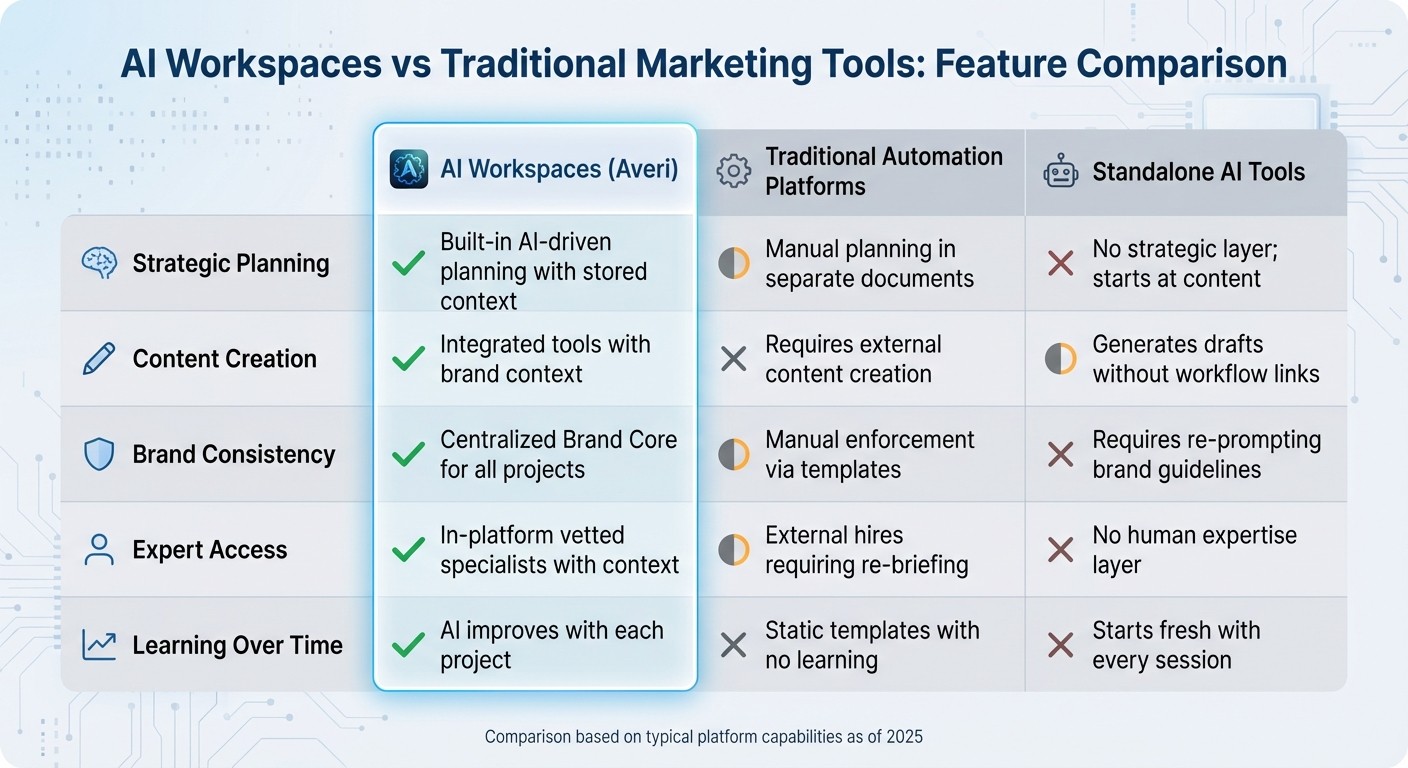
AI Workspaces vs Traditional Marketing Tools Comparison for B2B SaaS
To enhance your automated workflows, focus on building a streamlined marketing tech stack that consolidates essential functions into a few integrated platforms. This approach minimizes unnecessary complexity, helping your team work faster and more efficiently.
AI Workspaces vs. Other Marketing Tools
Integrated AI workspaces are redefining how marketing teams operate by replacing the need for multiple disconnected tools. While traditional platforms like HubSpot or Marketo excel at managing email campaigns and lead nurturing, they often require external content creation and manual imports. Similarly, standalone AI tools like Jasper or Copy.ai can generate quick drafts but leave the heavy lifting of strategy, brand consistency, and execution to you.
AI workspaces, such as Averi, take a different approach. They combine strategic planning, content creation, brand management, and expert collaboration into a single, seamless workflow. This eliminates the constant switching between tools - a common bottleneck for marketing teams.
Here’s a closer look at how these options stack up:
Capability | AI Workspaces (Averi) | Traditional Automation Platforms | Standalone AI Tools |
|---|---|---|---|
Strategic Planning | Built-in AI-driven planning with stored context | Manual planning in separate documents | No strategic layer; starts at content |
Content Creation | Integrated tools with brand context | Requires external content creation | Generates drafts without workflow links |
Brand Consistency | Centralized Brand Core for all projects | Manual enforcement via templates | Requires re-prompting brand guidelines |
Expert Access | In-platform vetted specialists with context | External hires requiring re-briefing | No human expertise layer |
Learning Over Time | AI improves with each project | Static templates with no learning | Starts fresh with every session |
Integrated platforms like Averi simplify workflows and reduce costs, making them a smart choice for modern marketing teams. With this in mind, here’s a recommendation for a lean, efficient tech stack tailored for B2B SaaS marketing.
Recommended Tools for B2B SaaS Marketing
To maximize efficiency, choose tools that work seamlessly together. A lean B2B SaaS tech stack might include:
AI Workspace: Averi ($45/month) for strategy, content creation, and collaboration.
Lifecycle Platform: HubSpot (free tier available) or ActiveCampaign (starting at $29/month) for managing campaigns and customer journeys.
CRM: Options like HubSpot CRM (free), Salesforce, or Pipedrive for deal tracking and sales processes.
Analytics Tool: Google Analytics (free) or Mixpanel for tracking product performance and user behavior.
This four-tool stack can replace the need for multiple specialized hires, reducing operational complexity and lowering personnel costs. Look for platforms with robust integration capabilities (2,000+ connectors) to ensure smooth connections without requiring custom development [1].
As Ashley Levesque, VP of Marketing at Banzai, shared:
I didn't even know AI workflows were something that I was lacking until someone said, 'Did you know you could do all of this with Copy.ai?' [1]
Automate Marketing Execution
With your tech stack set up, the next step is to create workflows that can operate with minimal manual input. The idea is to standardize your marketing processes so they function seamlessly - whether you're launching a content campaign, nurturing leads, or executing account-based strategies. These automated workflows act as the bridge between planning and execution, reinforcing a streamlined and efficient marketing approach.
Set Up Standard Campaign Workflows
Start by listing your most common marketing workflows - like content creation, demand generation, and lifecycle management - and pinpoint the steps that can be automated. AI platforms can transform these tasks into repeatable templates that blend strategy, content creation, and execution into one cohesive process.
Demand Generation: Automate tasks like lead enrichment, research, and engagement. AI can process inbound leads in seconds, significantly reducing response time and improving conversions without the need for manual data entry or research [1].
Account-Based Marketing (ABM): Use AI to gather insights on target accounts, industries, and personas, then generate personalized assets at scale. In 2025, Jean English, former Chief Marketing Officer at Juniper Networks, reported achieving five times more meetings using a personalized, AI-driven go-to-market strategy [1].
Content Marketing: AI platforms can produce drafts in seconds, eliminating the need for lengthy agency processes. For instance, Roman Olney, Head of Global Digital Experience at Lenovo, shared that automating workflows saved the company $16 million in 2025 by replacing weeks-long, high-cost agency work [1].
"Copy.ai has been phenomenal in transforming the way we develop marketing content. By automating workflows that would typically take weeks and cost thousands of dollars through agencies, they've saved us $16 million dollars this year alone."
Roman Olney, Head of Global Digital Experience, Lenovo [1]
Connect Automation Platforms
To amplify the benefits of your lean tech stack, integrate tools that streamline processes across the board. Platforms with thousands of connectors - linking AI workspaces, CRMs, email services, and analytics tools - can eliminate the need for custom development [1]. This ensures smooth data flow; for example, when a lead submits a form, it’s automatically enriched, scored, and added to the right nurture sequence.
Trigger-based workflows can handle common scenarios like new lead assignments, deal stage updates, or content downloads. For instance, downloading a whitepaper could trigger an email sequence, alert the sales team, and update your CRM. To maintain compliance and quality, set up automated approval checkpoints that avoid bottlenecks.
Manual vs. AI-Automated Workflows
Switching to AI-automated workflows is a game-changer for lean teams. The efficiency gains are undeniable, as shown in this comparison:
Workflow | Manual | AI-Automated | Time Saved | Cost Reduction (USD) |
|---|---|---|---|---|
Content Creation | Weeks via agencies | Seconds | Weeks to seconds | $16M annually (Lenovo, 2025) [1] |
Lead Processing | Manual enrichment | Automatic | Hours to seconds | Significant [1] |
ABM Assets | Manual per account | AI at scale | Days to minutes | Thousands per campaign [1] |
Translation | Agency cost | Real-time AI | Major time savings | Fraction of agency cost [1] |
The transition from manual to automated workflows doesn’t just save time - it redefines what a lean team can accomplish. Tasks that previously required multiple specialists can now be managed by one person equipped with the right AI tools. This shift empowers teams to focus on strategy and innovation rather than getting bogged down in repetitive tasks.
Measure Results and Scale
Once your automated workflows are in motion, the next step is to measure their effectiveness. Tracking performance allows you to identify what’s working and refine your approach as you grow.
Monitor Cost Efficiency and ROI
Start by focusing on key metrics that showcase the real impact of your AI-driven systems. Look at figures like cost per qualified lead, cost per customer, and overall marketing output. These numbers will reveal whether your streamlined processes are outperforming traditional methods.
For example, in 2025, Roman Olney, Head of Global Digital Experience at Lenovo, highlighted how automating content workflows saved the company a staggering $16 million by cutting out lengthy, high-cost agency work [1]. Beyond cost savings, track workflow efficiency by measuring reductions in content production time, lead processing time, and campaign launch cycles. Additionally, assess the pipeline generated per representative to determine if your team is achieving more without increasing resources. These insights will help you allocate resources strategically as you scale.
Tailor Scaling Strategies to Your Company’s Stage
As your company evolves, your approach to scaling should align with your growth stage. Data-driven insights can guide these adjustments:
Early-stage startups can rely on AI to handle much of the execution, freeing up a small team to focus on strategy and building the brand.
Growth-stage companies can use the efficiency gains from automation to expand into new markets or add channels without increasing headcount.
Enterprise organizations can reinvest automation savings into more complex initiatives, such as global localization efforts or hyper-personalized account-based marketing, all while keeping overhead under control.
This method allows businesses at any stage to grow effectively, maintaining a lean and efficient system while driving sustainable progress.
Conclusion
Elevate your B2B SaaS marketing efforts by embracing AI-powered tools, automated workflows, and a well-thought-out strategy. Shifting to a unified workspace - rather than relying on scattered, disconnected solutions - can lead to quicker results, reduced costs, and improved performance, all while maintaining a lean operation.
The benefits of AI-driven workflows are clear: they bring measurable cost savings and boost efficiency. This shift highlights how automation can redefine your marketing approach, enabling you to achieve more with less.
FAQs
How can small B2B SaaS teams use AI workflows to boost marketing efficiency?
AI workflows empower small B2B SaaS teams to save time and expand their marketing efforts by automating repetitive tasks such as content creation, lead enrichment, and personalized outreach. This automation minimizes manual work, ensures consistency, and accelerates outcomes, allowing teams to concentrate on strategic priorities without compromising on execution quality.
With the help of AI tools, lean teams can accomplish more with limited resources, simplifying operations and staying nimble in fast-paced, competitive markets.
What are the advantages of using a streamlined tech stack for B2B SaaS marketing?
Simplifying your tech stack can be a game-changer for B2B SaaS companies. By prioritizing integrated, AI-driven tools and automation over juggling numerous standalone solutions, businesses can cut costs, streamline workflows, and deliver results more quickly.
This strategy minimizes operational headaches, eliminates redundant software, and ensures marketing efforts are both efficient and easily scalable - perfect for teams aiming to grow without unnecessary complications.
How do AI workspaces help maintain brand consistency in marketing campaigns?
AI workspaces play a key role in keeping your brand identity intact. By centralizing brand guidelines, they ensure that every piece of content reflects your established voice and style. These tools take the guesswork out of content creation by automating reviews, quickly identifying any inconsistencies or deviations before they become an issue. They also simplify workflows, making it easier to maintain consistent messaging across all campaigns. With built-in quality checks, AI workspaces allow you to expand your marketing efforts confidently, all while preserving the essence of your brand.
Related Blog Posts

Zach Chmael
CMO, Averi
"We built Averi around the exact workflow we've used to scale our web traffic over 6000% in the last 6 months."
Your content should be working harder.
Averi's content engine builds Google entity authority, drives AI citations, and scales your visibility so you can get more customers.