How to Scale Your Marketing Without Hiring a Full Team for Healthcare & Wellness

Averi Academy
Averi Team
8 minutes

In This Article
Automate HIPAA-compliant marketing tasks with AI to save time, cut costs, and scale healthcare or wellness practices without hiring a full in-house team.
Updated:
Trusted by 1,000+ teams
Startups use Averi to build
content engines that rank.
You don’t need a full team to grow your healthcare or wellness marketing. By automating repetitive tasks like appointment reminders, social media posts, and email campaigns, you can save time, reduce costs, and focus on patient care. AI tools are transforming how small practices manage marketing, offering solutions that boost efficiency by up to 70% and save 2.5 hours daily.
Here’s how to get started:
Identify bottlenecks: Audit your marketing tasks to find time-consuming, repetitive work.
Automate smartly: Start with tools for email campaigns, social media scheduling, or analytics tracking that comply with HIPAA regulations.
Leverage AI: Use platforms like Averi AI or Birdeye to create content, schedule campaigns, and manage patient engagement seamlessly.
Test and improve: Begin with one workflow, track results, and expand automation gradually.
AI doesn’t replace human expertise - it handles the tedious work so you can focus on growing your practice and strengthening relationships with patients.
Boost Your Practice with Automation and AI: 7 Healthcare Tools for Efficiency & Better Outcomes
Finding Marketing Bottlenecks and Automation Opportunities
Before diving into automation, it’s crucial to understand where your time is actually going. Many healthcare and wellness practices spend countless hours on tasks that could easily be automated - but this often becomes clear only after mapping out workflows.
On average, businesses rely on 91 marketing tools but only utilize 33% of their capabilities[2]. Smaller practices face similar inefficiencies, juggling separate apps for email, scheduling, social media, and analytics. This fragmentation doesn’t just waste time - it disrupts focus. Research shows it takes 9.5 minutes to regain deep concentration after switching between tools[2]. By mapping your current workflows, you’ll uncover tasks that are perfect candidates for automation.
Mapping Your Current Marketing Workflow
Start by auditing your weekly marketing activities. Include tasks like patient follow-ups, appointment reminders, social media updates, email campaigns, blog content creation, and performance tracking. For each task, jot down how much time it takes and whether it requires clinical expertise or is repetitive in nature.
Pay attention to tasks that consume 20–30% of your team’s time but don’t demand strategic thinking. For example, scheduling emails, posting on social media, or generating performance reports are often repetitive and time-consuming. If you notice significant time spent transferring data or manually tracking metrics, you’ve likely found a bottleneck. Once identified, prioritize automating these routine tasks to free up time for more strategic and patient-focused work.
Selecting Tasks to Automate
Focus on automating repetitive tasks while keeping strategic functions under human oversight. Tasks like email campaigns, social media scheduling, lead nurturing, and analytics tracking are ideal candidates for automation[3][4][5].
After mapping your workflow, identify high-volume, low-value tasks that could benefit from automation. It’s essential to choose tools that comply with HIPAA and other healthcare regulations. Platforms like Keragon, Insightly, and Birdeye are specifically built for healthcare settings. These tools provide features like encrypted messaging, audit logs, and secure data handling[3][4][5]. For instance, Birdeye’s Messaging AI automates patient follow-ups and appointment reminders while staying compliant, significantly reducing manual work and improving engagement[5].
Start small by automating a single high-volume task, such as appointment reminders or weekly social media posts. Measure the results - track time saved, engagement improvements, and whether your team can shift focus to higher-value activities. The goal isn’t to replace human oversight but to eliminate repetitive tasks that divert attention from patient care and strategic growth.
Building an AI-Powered Marketing Strategy
Once you've identified the bottlenecks in your marketing efforts, it's time to let AI take the wheel and streamline your strategy. Today’s AI tools can handle everything from planning your content calendar to executing full campaigns. The trick is choosing platforms that seamlessly integrate strategy and delivery, rather than opting for tools that just add to your workload.
More than 60% of companies using generative AI report productivity gains of 60–70% [1]. For healthcare and wellness businesses, this means you can create patient education materials, email campaigns, and social media content without needing a large marketing team. However, the success of these tools depends entirely on how you implement them. Let’s dive into how AI can transform your content planning and campaign execution, making the process smoother and more effective.
Using AI for Content Strategy and Planning
Start by feeding your AI platform with existing materials - your website, patient resources, and previously published content. Tools like Averi AI can analyze this information to understand your branding, services, and tone. From there, these platforms identify your ideal audience, highlight content gaps, and even analyze competitors to suggest opportunities.
The result? A ready-to-go content queue tailored to your practice. No more scrambling each week to brainstorm ideas. Instead, you’ll have a list of publish-ready topics, such as patient education guides, wellness tips, treatment explainers, or seasonal health advice. Marketers save an average of 3 hours per piece of content and 2.5 hours per day overall by using AI tools [1]. For a small healthcare practice, this can mean the difference between posting once a month and maintaining a consistent weekly schedule.
Batching content creation can further simplify your workflow. Imagine generating an entire month’s worth of social media posts or email newsletters in one sitting. Once created, you can schedule them in advance, ensuring a steady stream of engagement without the daily grind.
Setting Up Automated Campaign Workflows
With a solid content plan in place, you can automate your entire campaign process, cutting out tedious manual tasks. Forget the old way of drafting in Google Docs, copying to your CMS, formatting, adding images, and manually publishing. AI workspaces can handle the entire process from start to finish.
Here’s how it works: Approve a topic, let the AI draft content in your brand voice, and refine it directly in a collaborative editor. Once finalized, the platform can publish it directly to your preferred CMS, whether that’s WordPress, Webflow, or Framer. SEO elements, like meta descriptions and keywords, are generated automatically, saving even more time.
The advantage of AI workspaces over standalone tools lies in their ability to maintain context. Platforms like Averi AI remember your brand voice, past content, and audience profiles, ensuring consistency across all your campaigns. This eliminates the coordination headaches often found in more traditional setups.
By 2025, 22% of healthcare organizations are projected to adopt domain-specific AI tools - a sevenfold increase from the previous year [8]. These platforms are designed to comply with HIPAA regulations, ensuring that patient data remains secure and never leaks into external AI models. Use de-identified or aggregated data for audience segmentation, and let AI handle tasks like bid optimization and content creation. However, steer clear of using AI for sensitive areas like medical decision-making or targeting specific conditions.
Comparing AI Workspaces, Marketplaces, and Point Tools
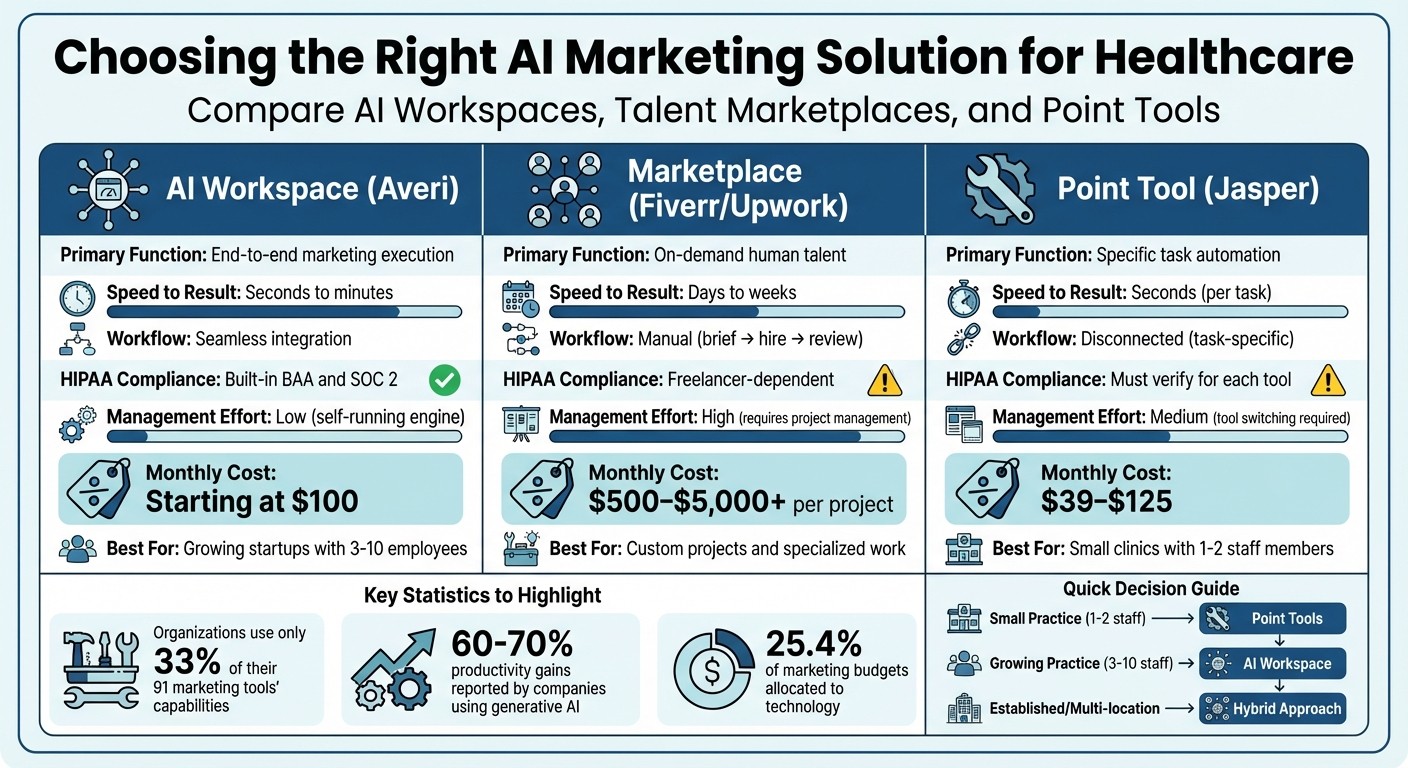
AI Marketing Tools Comparison for Healthcare: Workspaces vs Marketplaces vs Point Tools
Scaling healthcare marketing often comes down to selecting the right approach: AI workspaces, talent marketplaces, or task-specific point tools. Each option serves a distinct purpose, and understanding their strengths and limitations can help you allocate resources wisely.
AI workspaces like Averi function as centralized hubs, streamlining the entire marketing process from strategy to execution. These platforms allow you to approve topics, generate content in your brand voice, and publish - all in one place. With features designed for HIPAA compliance and access to vetted experts for review, they’re particularly suited for healthcare businesses that need consistent, compliant content without juggling multiple vendors.
Talent marketplaces such as Fiverr or Upwork connect businesses with freelancers for custom projects. While they’re great for tasks like designing brochures or creating landing pages, managing these projects requires briefing, revisions, and coordination. The quality of work varies by freelancer, and ensuring HIPAA compliance becomes your responsibility with each hire.
Point tools like Jasper or Copy.ai are task-focused solutions, perfect for generating social media captions, drafting email subject lines, or creating blog outlines. They’re affordable and efficient for specific jobs but operate independently, requiring manual effort to maintain brand consistency and integrate outputs. For small clinics exploring automation, these tools offer quick results for straightforward, high-volume tasks like appointment reminders or social media posts.
Feature, Cost, and Use Case Comparison
The true cost of these tools often extends beyond their subscription fees. Organizations allocate about 25.4% of their marketing budgets to technology but use only a third of its capabilities [2]. This inefficiency arises from disconnected tools that create data silos and require extensive manual coordination.
Feature | AI Workspace (Averi) | Marketplace (Fiverr/Upwork) | Point Tool (Jasper) |
|---|---|---|---|
Primary Function | End-to-end marketing execution | On-demand human talent | Specific task automation |
Speed to Result | Seconds to minutes | Days to weeks | Seconds (per task) |
Workflow | Seamless integration | Manual (brief → hire → review) | Disconnected (task-specific) |
HIPAA Compliance | Built-in BAA and SOC 2 | Freelancer-dependent | Must verify for each tool |
Management Effort | Low (self-running engine) | High (requires project management) | Medium (tool switching required) |
Monthly Cost | Starting at $100 | $500–$5,000+ per project | $39–$125 |
These differences are evident in real-world applications. For example, Boston Scientific leveraged Marketo in 2024 to manage over 700 global campaigns annually. This approach delivered a 14x return on digital marketing investment and significantly boosted marketing-qualified leads through better segmentation [9]. This case highlights how centralized solutions can simplify workflows and amplify results.
For smaller practices, tools like NexHealth have proven effective. Concierge Health used NexHealth's automated reminders to achieve a 95% appointment confirmation rate and an 85% patient adoption rate for digital check-ins [9]. This demonstrates how point tools can quickly address specific, high-volume needs.
Choosing the Right Solution for Your Business
The ideal solution depends on your business size and needs.
Small clinics with 1-2 staff members benefit from point tools that automate repetitive tasks like appointment reminders or basic social media scheduling. These tools save time without requiring technical expertise or a large budget.
Growing startups with 3-10 employees often need more than just automation. AI workspaces provide the efficiency of a full marketing team, combining strategy, content creation, SEO, and publishing in a single system. This is crucial as 62% of patients now expect healthcare providers to send personalized digital communications[9].
Established practices or multi-location businesses may find that a hybrid approach works best. Using an AI workspace for ongoing campaigns while hiring marketplace talent for specialized projects, like video production or website redesigns, offers both consistency and flexibility.
Ultimately, the choice boils down to balancing control and convenience. If you have the time to manage freelancers and need custom work, marketplaces are a good fit. For automating specific tasks efficiently, point tools are ideal. But if you’re looking for a comprehensive, low-maintenance marketing solution that ensures compliance and brand consistency, an AI workspace eliminates the coordination challenges that often slow down healthcare marketing.
Improving Your AI Marketing System Over Time
AI marketing systems are not static - they grow and improve with each campaign cycle. Ricardo Mazzi, Founder of Mazzi Studios, puts it succinctly:
AI is reshaping healthcare marketing. Instead of relying on outdated metrics like page views and click-through rates, marketers now use AI tools to predict patient behavior, refine content strategies, and optimize budgets [11].
This shift from simply reacting to data to actively shaping outcomes sets apart basic automation from a fully functional marketing engine. It’s an ongoing process that aligns seamlessly with the automation strategies previously discussed, driving better overall marketing results.
Using Analytics to Adjust Your Strategy
Traditional analytics focus on past performance, but AI analytics take it a step further by guiding your next actions. Real-time A/B testing powered by AI evaluates headlines, creative elements, and bids, reallocating budgets to the channels delivering the best return [11][7]. Instead of waiting weeks for campaign results, you get immediate feedback that informs your next steps.
Natural Language Processing (NLP) adds another layer of insight by analyzing patient reviews, search queries, and chatbot interactions. This helps uncover patterns and unmet needs that might otherwise go unnoticed [11][3]. For example, if reviews reveal patient confusion about insurance coverage, it signals an opportunity to create content addressing those concerns. One healthcare provider used predictive analytics to launch personalized educational email campaigns, leading to a 27% increase in preventive screening bookings within three months [11]. Another practice leveraged search behavior analysis to design hyper-targeted campaigns, boosting engagement rates by 40% [11].
Key metrics to monitor include engagement rates (such as open and click-through rates), appointment outcomes (confirmation rates, no-shows, rebookings), and patient sentiment indicators like review quality and unsubscribe rates [10]. For instance, a spike in opt-outs may indicate that your messaging frequency or relevance needs adjustment [10]. A/B testing can help refine AI-generated subject lines, send times, and content styles, ensuring your system continuously improves [10].
With analytics fine-tuning your strategy in real time, a well-designed system takes care of execution, keeping growth on track.
Building a Self-Running Marketing Engine
A self-sustaining marketing engine operates on three levels: strategic decisions like brand positioning and final approvals remain in your control; AI assists with tasks like content ideation, drafting, and data analysis; and fully automated processes - such as scheduling, performance tracking, and routine optimizations - run independently [1]. This division allows you to focus on high-impact decisions while AI handles repetitive tasks.
Platforms like Averi streamline this process by automating weekly cycles of content creation, publishing, and performance monitoring. These systems track market trends and competitor activity to identify opportunities for impactful content [1]. Once you approve the concepts, the AI takes over, handling research, drafting, SEO optimization, and direct publishing to your CMS. Each piece of content is stored in a Library, enabling the AI to learn and improve future drafts [1]. Performance data then completes the cycle, offering actionable insights on what’s ranking, what’s trending, and what requires updates.
These automated workflows align with the dynamic strategies previously covered, ensuring healthcare and wellness marketers maintain consistent, proactive campaigns. Over 60% of companies report productivity gains of 60% to 70% [1]. By batching tasks - like creating a month’s worth of social media posts or email campaigns in one session - you can maintain consistency while freeing up time to prioritize patient care and business growth.
Conclusion
Expanding marketing efforts in healthcare and wellness no longer requires the overhead of a full in-house team. By starting small - perhaps with a single automated workflow like patient reminders, social media scheduling, or email campaigns - you can gradually integrate AI while staying HIPAA-compliant. This measured approach helps reduce risk and builds confidence, paving the way for more advanced processes while keeping patient-focused outcomes at the forefront.
Platforms such as Birdeye and Marketo Engage have shown how healthcare providers can streamline operations. These tools have helped optimize ad spending, personalize campaigns to improve patient retention, and eliminate repetitive tasks - all without the need to hire additional staff [5][12].
Once you’ve seen success with initial automation, you can expand into areas like referral programs, satisfaction surveys, or wellness program enrollments. Use analytics dashboards to monitor key metrics such as speed-to-lead, conversion rates, and ROI. Regularly auditing your CRM data and conducting compliance checks - monthly for data accuracy and quarterly for regulations - ensures your system remains effective and aligned with industry standards.
AI-powered marketing doesn’t replace human expertise; it enhances it. By automating routine tasks, your team can focus on strategic initiatives and patient care. With 70–80% of health-related searches still starting online and increasingly relying on AI-driven answer engines [6], adopting a self-sustaining marketing system positions your practice for long-term growth.
Start with one workflow, track its results, and scale what works. This step-by-step approach lays the groundwork for a marketing engine that delivers consistent, scalable outcomes, allowing your practice to thrive in the evolving digital landscape.
FAQs
How can small healthcare practices use AI marketing tools while staying HIPAA-compliant?
Small healthcare practices can effectively leverage AI marketing tools while staying HIPAA compliant by taking a thoughtful, structured approach.
Start with the right AI platform. Opt for tools specifically designed for healthcare that explicitly support HIPAA compliance. Look for platforms that offer a Business Associate Agreement (BAA) to ensure the protection of Protected Health Information (PHI). To minimize risks, avoid feeding raw PHI into prompts. Instead, work with de-identified or aggregated data, and ensure sensitive information is stored in encrypted, access-controlled systems.
Ensure secure integration. Link the AI tool to HIPAA-compliant systems, such as secure CRMs or patient portals. Implement role-based access controls so only authorized team members can manage campaigns. Regular audits are also essential to track data flows and confirm adherence to compliance standards.
Collaborate with experts. Partner with marketing professionals who have experience navigating healthcare regulations. Their expertise can help ensure campaigns respect privacy rules and avoid accidental breaches of sensitive information.
By combining secure tools, rigorous data practices, and knowledgeable support, small healthcare practices can confidently scale their marketing efforts while safeguarding patient confidentiality.
What’s the best way to identify which marketing tasks to automate?
To figure out which marketing tasks are best suited for automation, begin by mapping out your current process. Break it down step by step - from how you generate leads to how you handle follow-ups and reporting. This overview makes it easier to pinpoint manual tasks that slow things down or are repeated often. For example, actions like replying to inquiries or sending routine reminders are ideal for automation.
Next, give priority to tasks that are either time-sensitive or tied to strict compliance requirements. For instance, quickly responding to leads or managing workflows governed by regulations like HIPAA in the healthcare sector can benefit greatly from automation. These changes not only save time but also help reduce potential risks. Lastly, target tasks that are easy to automate and can provide immediate benefits, such as setting up automatic replies for new leads. By starting with small, manageable steps and keeping track of your progress, you’ll set the stage for expanding automation smoothly in the future.
What’s the difference between AI workspaces and point tools when it comes to marketing efficiency?
AI workspaces, such as Averi’s AI + human execution hub, simplify marketing campaigns by integrating content creation with built-in workflows, approvals, and delivery systems. This all-in-one approach not only speeds up the process but also ensures consistency and helps cut down on operational expenses.
On the other hand, tools like Jasper or Copy.ai are designed for specific tasks, such as generating copy. While they can accelerate the content creation phase, they leave crucial steps - like scheduling, approvals, and tracking campaign performance - in the hands of the user. This can create delays and add complexity to the workflow. AI workspaces address these challenges by streamlining the entire process, making them a smarter choice for efficiently managing and scaling marketing efforts.
Related Blog Posts

Zach Chmael
CMO, Averi
"We built Averi around the exact workflow we've used to scale our web traffic over 6000% in the last 6 months."
Your content should be working harder.
Averi's content engine builds Google entity authority, drives AI citations, and scales your visibility so you can get more customers.