How to Scale Your Marketing Without Hiring a Full Team for Startups

Averi Academy
Averi Team
8 minutes

In This Article
Automate content, publishing, and analytics with AI to scale startup marketing, cut costs, and keep strategic control without hiring a full team.
Updated:
Trusted by 1,000+ teams
Startups use Averi to build
content engines that rank.
Startups can scale marketing effectively without hiring a full team by leveraging AI tools to automate repetitive tasks, streamline workflows, and optimize campaigns. This approach reduces costs, saves time, and enables small teams to achieve results comparable to larger ones. Here's how startups can make the most of AI-driven marketing:
Automate Routine Tasks: Use AI tools to handle social media scheduling, content drafting, SEO research, and publishing directly to platforms, cutting manual workloads by up to 90%.
Combine AI and Human Oversight: Let AI manage initial drafts and data analysis while reserving final approvals and marketing strategy for your team.
Track and Optimize Performance: AI-powered analytics tools consolidate data, monitor metrics, and suggest improvements, helping you refine campaigns efficiently.
Choose the Right AI Marketing Platforms: Depending on your stage, opt for AI workspaces (e.g., Averi AI) for end-to-end solutions, marketplaces for specific tasks, or single-purpose tools for quick wins.
Complete Guide to Automated Marketing for Startups & Affiliates
1. Use AI Tools to Automate Your Marketing
AI-driven tools are reshaping how marketers work, taking over repetitive tasks so teams can focus on the bigger picture. Instead of spending hours scheduling social posts, formatting blog content, or compiling reports, AI handles these time-consuming activities. For example, tools like Averi AI can analyze your website to understand your products, positioning, and brand voice, cutting manual effort by as much as 80% [3]. This allows marketers to dedicate more time to strategic planning and creative decision-making.
The first step is identifying tasks that are ideal for automation. Start with routine, high-volume activities often referred to as "Tier 3" tasks. These include social media scheduling, performance reporting, basic design work, and SEO keyword research. Automating these rule-based processes frees up time to focus on more impactful work, such as refining your messaging, analyzing customer insights, and determining which channels deserve priority.
1.1 Automate Content Planning and Creation
Building a content calendar traditionally takes weeks, but AI tools can reduce this process to hours. For instance, Averi AI analyzes your website to craft strategies tailored to your ideal customer profiles (ICPs). It identifies gaps in competitor content and generates a detailed content marketing plan, complete with a calendar aligned to your brand voice and business goals. One SaaS startup used this method to develop 12 months of blog topics in under an hour, saving 40–60 hours of planning each month [3]. This efficiency allows startups to scale their content efforts without needing to expand their teams.
AI tools also simplify the planning process by continuously monitoring trends, competitor activity, and high-potential topics. Platforms like ActiveCampaign offer over 900 pre-built workflow templates that make setting up content pipelines a breeze, even for non-technical users [6]. Instead of scrambling for ideas each week, you’ll have a curated list of pre-researched topics - complete with titles, keywords, and content outlines - ready for review. Whether you need listicles, how-to guides, or editorial pieces, AI ensures your content strategy stays on track.
1.2 Speed Up Content Drafting and Editing
AI can handle the bulk of content creation, drafting up to 70% of a piece by pulling from your brand’s stored information. This includes research, outlining, and initial copywriting, leaving the final 30% for human refinement. Tools like Jasper use your brand voice to produce polished drafts, cutting editing time from hours to minutes [3]. For startups managing a high volume of content, platforms such as Copy.ai can generate personalized copy at scale for millions of users [3][4]. One company paired this with Grammarly for final edits, producing 50 social posts weekly with 90% less manual effort [3][4]. On average, marketers save three hours per piece of content using these tools [1].
Once the drafting and editing processes are streamlined, the next logical step is improving how content is published.
1.3 Publish Content Directly to Your CMS
Publishing content manually can take hours, but AI tools make this process nearly instant. Zapier, for instance, connects with over 8,000 apps and enables workflows where AI-created content is directly uploaded to platforms like HubSpot or WordPress, reducing publish time from 30 minutes to just seconds [5].
Averi AI goes even further by publishing directly to Webflow, Framer, or WordPress, eliminating the need for copy-pasting and tedious formatting. Each piece of content is automatically saved to a library, which helps the AI improve future drafts. Features like internal linking suggestions and auto-generated meta descriptions ensure your content is optimized, while your brand voice becomes more refined with every post. Setting it up is simple: link your AI tool to your CMS, configure triggers for approved content, and let the system handle formatting and scheduling. This seamless publishing process allows startups to focus on strategy and growth instead of logistics.
2. Build Workflows That Combine AI and Human Review
Blend the efficiency of AI with the precision of human oversight by adopting a structured, three-tier approach. Here’s how it works: Tier 3 tasks - like scheduling posts, basic reporting, and data entry - are best handled entirely by AI. Tier 2 tasks, such as content drafting, research, and data analysis, thrive when AI provides the initial groundwork and humans step in for refinement. Lastly, Tier 1 tasks, including strategic planning, brand positioning, and final approvals, should always remain under your team’s control[1].
Using unified AI workspaces can significantly streamline processes by eliminating the need to switch between multiple tools. This not only saves time but also reduces the likelihood of errors[2]. To make this combination of AI and human input seamless, it’s crucial to establish a clear approval workflow.
2.1 Set Up a Simple Approval Process
Start by defining clear roles for your team using Role-Based Access Control (RBAC). Assign specific responsibilities - like drafting, approval, and publishing - to individual team members. Platforms such as Vellum AI and Stack AI offer features like audit logs and environment separation, which help keep workflows organized and prevent unauthorized actions[9].
To further enhance quality control, integrate error filters that catch issues before they reach human reviewers. For instance, tools like Gumloop can flag AI-generated errors, such as hallucinations or mismatched data[7]. If the AI produces a statistic that doesn’t align with your source material, the system halts the process and alerts your team. This ensures reviewers can focus on refining the content’s tone and messaging rather than hunting for technical mistakes.
"Gumloop has been critical in helping all teams at Instacart - including those without technical skills - adopt AI and automate their workflows."
– Fidji Simo, CEO, Instacart[7]
Another time-saving strategy is batch reviewing. By using AI to generate an entire month’s worth of social media posts or ad variations in one session, your team can dedicate specific blocks of time to review and scheduling. This minimizes constant interruptions, allowing your team to focus on higher-level strategic goals[1].
Collaboration tools further enhance this process by streamlining refinements and ensuring consistency across all outputs.
2.2 Use AI-Assisted Editing for Team Collaboration
Real-time collaboration platforms make teamwork smoother by eliminating endless email chains and version control headaches. Tools like Averi AI provide shared editing spaces where team members can leave comments, tag colleagues, and edit content together in real time. These platforms also let you highlight sections for AI to rewrite, expand, or adjust tone. Additionally, they generate internal linking suggestions and meta descriptions automatically, freeing your team to focus on perfecting the messaging instead of getting bogged down by technical SEO.
A practical approach to dividing tasks is the 70/30 rule: let AI handle the initial drafting, and reserve the final refinements for human input. This method allows AI to do the heavy lifting while ensuring your team maintains control over the voice, style, and polish of the final product.
Platforms like Jasper AI make this process even smoother with features like Brand IQ, which enforces brand guidelines across drafts[8]. By ensuring alignment with your style guide from the outset, these tools reduce the need for multiple revisions and help teams move quickly from concept to publication.
3. Track Performance and Improve Your Campaigns
After automating content creation and streamlining workflows with AI, the next step is tracking performance to refine your strategy. Once your content goes live, AI-powered analytics tools bring together data from platforms like Google Analytics, social media, email dashboards, and ad managers into a single, unified dashboard. This consolidated view simplifies the process of identifying key metrics that matter at different stages of your campaign [2].
To measure the full impact of your efforts, focus on three types of metrics: leading indicators (such as traffic, engagement, and list growth), intermediate metrics (like MQLs and SQLs), and lagging measures (including revenue, customer acquisition cost, and lifetime value-to-CAC ratios). While only 36% of marketers currently measure ROI with precision [10], AI tools make this process far more accessible, especially for startups without large teams.
Platforms like ActiveCampaign and HubSpot go a step further with conversational analysis, providing instant answers to questions like, “Why did our email open rates drop last month?” These tools can save up to 2.5 hours a day in manual analysis [1]. For startups operating on a tight budget, affordable options like Mailchimp (starting at $9.99/month) offer AI-assisted email analytics, while Mixpanel provides a free tier for real-time funnel analysis and behavioral tracking.
3.1 Monitor Metrics with AI Analytics
AI analytics platforms track essential metrics such as impressions (total content views), clicks (user interactions leading to visits), keyword rankings, conversion rates, and engagement rates like time on page and bounce rates. Tools like Mixpanel and ActiveCampaign enable real-time funnel analysis, A/B testing, and customizable dashboards that integrate with major ad platforms and CMS tools.
Here’s how to get started:
Integrate your analytics tool with your CMS or website.
Define key performance indicators (KPIs) using custom dashboards.
Set up real-time tracking for metrics like clicks and keyword rankings.
Use AI alerts to catch anomalies and review weekly reports.
Platforms like Averi AI take this further by automatically tracking impressions, clicks, and keyword rankings while offering actionable recommendations. For instance, they can identify trending topics, flag content on the verge of climbing search rankings, and highlight high-potential keywords for your next content strategy. These insights provide a foundation for AI-driven adjustments that fine-tune your campaigns.
3.2 Get Recommendations for Optimization
Beyond monitoring, AI tools analyze your data to suggest targeted improvements for underperforming content. For example, HubSpot's AI agents can recommend tweaks to boost low click-through rates, while Mixpanel’s Spark highlights conversion funnel drop-offs and suggests A/B tests to address them. ActiveCampaign uses machine learning for predictive optimizations, such as determining the best times to send emails, while Mailchimp’s Intuit Assist offers practical advice like revising subject lines to improve open rates.
AI doesn’t stop at reporting - it also forecasts outcomes, such as the likelihood of conversions or how well your content will resonate with your audience. This allows you to reallocate budgets more effectively, shifting resources from underperforming keywords to high-potential topics before wasting valuable time or money [1]. Tools like Albert.ai even automate A/B testing and adjust ad bids based on ROI for paid campaigns.
"AI doesn't just tell you what happened - it predicts what's likely to happen next." - Averi Academy [1]
The best results come from combining AI insights with human judgment. While AI excels at monitoring and flagging issues - like low impressions or engagement - it’s up to you to add context and make strategic decisions. For instance, ActiveCampaign’s reports can feed into workflows where founders or marketers review and approve AI-generated recommendations. This hybrid approach ensures decisions are not only data-driven but also aligned with your brand’s voice and goals, giving you clarity without drowning in spreadsheets or losing control of your strategy.
4. Compare AI Workspaces, Marketplaces, and Point Tools
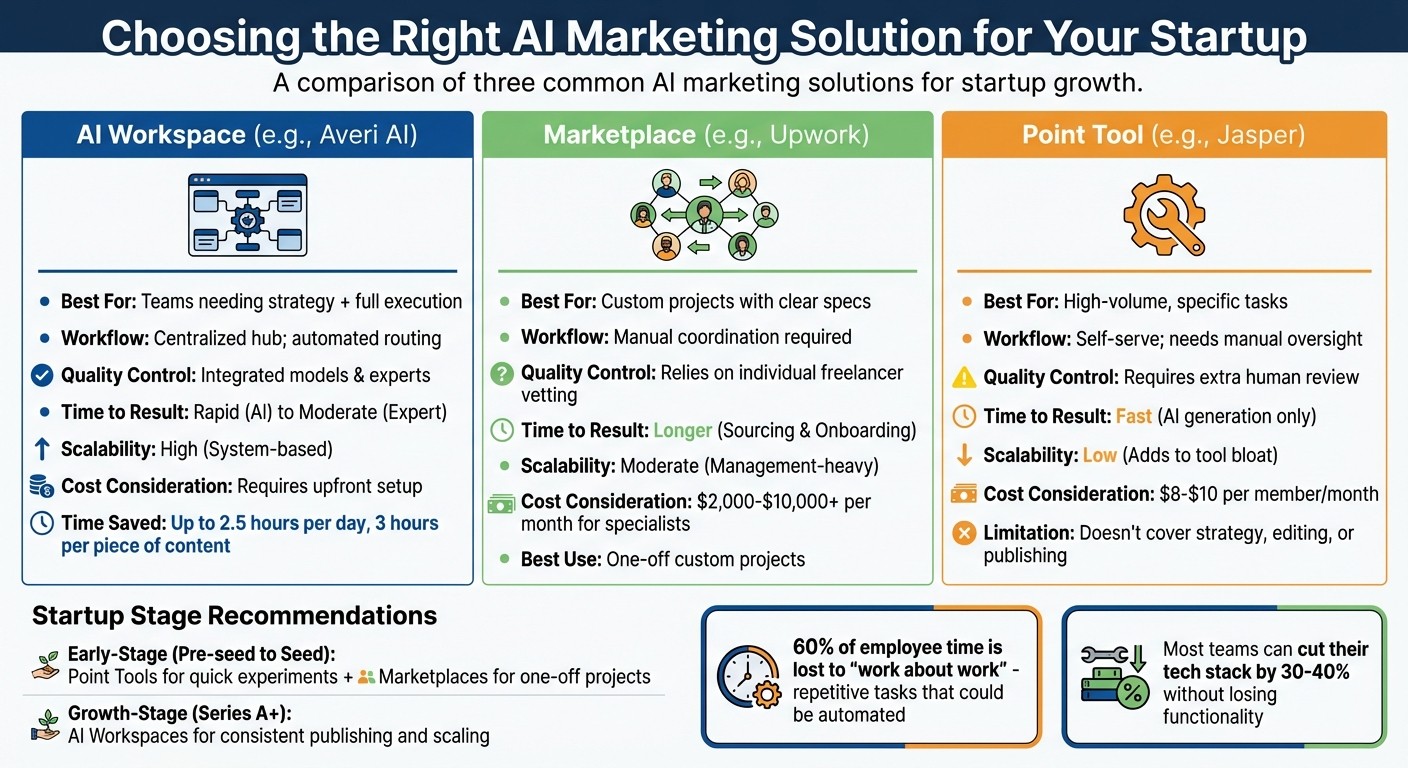
AI Marketing Tools Comparison for Startups: Workspaces vs Marketplaces vs Point Tools
Once you've automated your content creation and set up performance tracking, the next step is deciding which tools align best with your needs. Startups today typically choose between three main options: AI workspaces like Averi AI, freelancer marketplaces such as Upwork or Fiverr, and single-purpose AI tools like Jasper or Copy.ai. Each serves a distinct purpose, and knowing the strengths and limitations of each can make a big difference.
AI workspaces offer an all-in-one solution, combining strategy, execution, and publishing in a single platform. They streamline task management, integrate brand context into every piece of content, and include built-in quality controls with expert oversight. Freelancer marketplaces, on the other hand, connect startups with contractors for tailored projects but require manual coordination and onboarding efforts. Meanwhile, point tools are designed for specific tasks - like creating blog posts or ad copy - but require human involvement for quality assurance and don’t handle the entire workflow from strategy to publishing. Understanding these differences will help you choose the right tool to complement your automated processes and performance insights.
One key challenge with using multiple tools is the cost of switching between platforms. Research shows that each interruption costs 9.5 minutes of focus [2]. For startups, this fragmentation can be especially draining. A more efficient approach is to select a single solution capable of managing multiple steps in your workflow, minimizing the need for juggling multiple platforms.
4.1 Pros and Cons of Each Option
Here’s a breakdown of how these three options compare across critical factors for startups:
Factor | AI Workspace (e.g., Averi AI) | Marketplace (e.g., Upwork) | Point Tool (e.g., Jasper) |
|---|---|---|---|
Best For | Teams needing strategy + full execution | Custom projects with clear specs | High-volume, specific tasks |
Workflow | Centralized hub; automated routing | Manual coordination required | Self-serve; needs manual oversight |
Quality Control | Integrated models & experts | Relies on individual freelancer vetting | Requires extra human review |
Time to Result | Rapid (AI) to Moderate (Expert) | Longer (Sourcing & Onboarding) | Fast (AI generation only) |
Scalability | High (System-based) | Moderate (Management-heavy) | Low (Adds to tool bloat) |
This comparison highlights that while AI workspaces provide a comprehensive system, marketplaces and point tools are better suited for specific, targeted needs.
AI workspaces excel when you need an end-to-end system that handles everything from research and drafting to publishing and analytics. They can save up to 2.5 hours per day and 3 hours per piece of content [1]. However, they require upfront setup and work best when you’re committed to consistent publishing. Marketplaces offer flexibility and access to specialized talent, but hiring experts - like SEO or content specialists - can cost anywhere from $2,000 to $10,000 or more per month [10], and managing freelancers takes time. Point tools like Notion AI, which start at $8–$10 per member per month [4], are affordable and quick for specific tasks, but they don’t cover strategy, editing, or publishing, meaning you’ll still need to coordinate those steps manually.
"The $500K budget, in other words, is largely a tax on organizational complexity rather than marketing capability." - Averi Academy [10]
The takeaway? 60% of employee time is lost to "work about work" - repetitive tasks and coordination that could be automated [10]. The type of tool you choose directly affects how much time you spend on actual marketing versus managing processes.
4.2 Which Option Fits Your Startup Stage
The right choice depends on your startup’s stage. Early-stage founders (pre-seed to seed) often need to validate messaging and experiment with AI content strategies quickly, without committing to large budgets. Point tools are a good fit here for generating drafts and exploring different approaches, as long as you’re prepared to handle editing and publishing yourself. For one-off tasks - like creating a landing page or writing a product announcement - marketplaces can provide high-quality, custom work without requiring long-term commitments.
For growth-stage startups (Series A and beyond), AI workspaces are the most effective choice. At this stage, you’re likely publishing regularly, tracking performance across multiple channels, and scaling your efforts. AI workspaces streamline the entire process - from strategy and execution to publishing and analytics - while maintaining quality through built-in brand context and expert reviews. This is where the compounding benefits come into play: every piece of content helps refine the system’s understanding of your brand.
Most teams can cut their tech stack by 30–40% without losing functionality [2]. Start by auditing your current tools and consolidating around a primary platform that can handle multiple tasks. The goal is to eliminate redundant tools and invest in systems that grow with your business, rather than just solving isolated problems. Making the right choice now will set your startup up for efficient, scalable, and high-quality marketing as you expand.
5. Conclusion
Growing your marketing efforts without a large team is entirely doable. AI can handle much of the heavy lifting - tasks like research, drafting, scheduling, and analytics - allowing you to concentrate on the bigger picture: aligning with your brand, making strategic choices, and refining creative elements. This gives you more time to focus on building your product and connecting with customers.
For pre-seed and seed-stage startups, affordable tools such as Brevo (starting at $12/month) or ActiveCampaign (from $15/month) can automate email campaigns and workflows [6]. As your business scales, platforms like Averi AI offer unified workspaces that simplify everything from strategy to publishing. Many teams find they can cut their tech stack by 30–40% while still maintaining the same level of functionality [2].
While AI boosts efficiency, your involvement ensures that your brand’s voice and strategic goals remain intact. This hybrid approach is why over 60% of companies using generative AI report productivity gains of 60–70% [1]. For example, tools like Mailchimp's Intuit Assist can draft emails for you, but they still require human review to ensure accuracy and maintain quality [11]. By blending automation with oversight, you can achieve results comparable to a full marketing team at a fraction of the cost.
Start small by automating a single high-impact task - like creating blog outlines or scheduling social media posts - and gradually expand from there [1]. Use AI analytics to identify areas for improvement, then fine-tune your strategy with human input. Each piece of content you produce helps your system learn more about your brand, making future outputs smarter and faster. With the right mix of automation and personal oversight, you can deliver high-quality marketing results while staying lean and focused on growing your startup.
FAQs
How can small marketing teams use AI to save time and reduce costs?
AI tools are transforming how small marketing teams operate by taking over time-consuming tasks such as content creation, campaign management, and data analysis. These tools enable teams to generate polished drafts in mere seconds, experiment with ideas more quickly, and manage workloads that would typically require a much larger staff - all while keeping expenses in check.
For startups, this means more time to concentrate on strategy and creative work without being overwhelmed by manual tasks. Many users have noted substantial time savings and streamlined workflows, allowing teams to expand their marketing efforts without the need to build out a full in-house team.
What are the main differences between AI workspaces, talent marketplaces, and point tools for marketing?
AI workspaces, talent marketplaces, and point tools each play distinct roles in scaling marketing efforts, particularly for startups navigating limited resources and big ambitions.
AI workspaces, such as Averi, bring together AI-driven tools and human expertise to simplify workflows and ensure top-notch execution. They offer a collaborative, all-in-one environment where tasks are streamlined from start to finish. On the other hand, talent marketplaces like Fiverr or Upwork connect businesses with freelance professionals, giving you access to a wide range of skills. However, these platforms often require more active management to coordinate projects and ensure quality. Lastly, point tools, such as Jasper or Copy.ai, are designed to tackle specific tasks like content creation or data analysis. While they are highly efficient for niche needs, they often lack the ability to integrate seamlessly with broader systems.
The decision between these options comes down to your priorities. AI workspaces excel at providing a cohesive solution with built-in collaboration, talent marketplaces offer flexibility for hiring specialized expertise, and point tools shine in their ability to handle focused tasks efficiently. Your choice should align with your team’s size, budget, and overall marketing objectives.
How can AI analytics help startups improve their marketing campaigns?
AI-powered analytics equip startups with the ability to harness data-driven insights, transforming how they approach marketing campaigns. By processing real-time data from ads, email campaigns, social media, and website interactions, AI pinpoints what content resonates most, identifies the most engaged audience segments, and determines optimal budget distribution - all within moments.
Through automated testing, AI can create and assess hundreds of ad variations, reallocating budgets to high-performing ads while cutting back on underperformers. These insights integrate directly into existing workflows, enabling startups to make immediate adjustments - whether it’s tweaking ad copy, modifying bids, or fine-tuning strategies. This efficient approach not only saves time but also maximizes return on investment, empowering small teams to deliver results on par with larger organizations that have more resources at their disposal.
Related Blog Posts
How to Scale Your Marketing Without Hiring a Full Team for Tech Startups
How to Scale Your Marketing Without Hiring a Full Team for Food & Beverage Businesses
How to Scale Your Marketing Without Hiring a Full Team for B2B SaaS
How to Scale Your Marketing Without Hiring a Full Team for Media & Entertainment

Zach Chmael
CMO, Averi
"We built Averi around the exact workflow we've used to scale our web traffic over 6000% in the last 6 months."
Your content should be working harder.
Averi's content engine builds Google entity authority, drives AI citations, and scales your visibility so you can get more customers.