Predictive Task Allocation vs. Manual Workflow Management

Averi Academy
Averi Team
8 minutes

In This Article
Compare AI-driven predictive task allocation with manual workflow management—benefits, limits, and when to use each, plus hybrid strategies for teams.
Updated:
Trusted by 1,000+ teams
Startups use Averi to build
content engines that rank.
Predictive task allocation and manual workflow management are two distinct approaches to organizing and assigning tasks within teams. Manual workflows rely on managers' judgment and static tools, while predictive systems use AI to dynamically assign tasks based on skills, workload, and performance data. Here's a quick breakdown:
Manual Workflow Management: Best for small teams or projects requiring human judgment. However, it struggles with scaling, fragmented processes, and inefficiencies, consuming up to 65% of time on coordination.
Predictive Task Allocation: Ideal for high-volume, complex tasks. AI automates assignments, anticipates bottlenecks, and reduces project turnaround times by 20–30%. It requires historical data and setup but saves time on repetitive tasks.
Quick Comparison
Feature | Manual Workflow | Predictive Task Allocation |
|---|---|---|
Task Assignment | Manager-driven, manual updates | AI-driven, dynamic adjustments |
Efficiency | Time-intensive, prone to errors | Faster task routing, fewer errors |
Scalability | Limited to smaller teams/projects | Handles large-scale, multi-channel work |
Setup Requirements | Minimal | Requires data and system integration |
Best Use Case | Small teams, low-volume tasks | High-volume, repetitive tasks |
The right choice depends on your team's size, workload, and goals. A hybrid approach often works best - manual for nuanced tasks, predictive for repetitive ones.
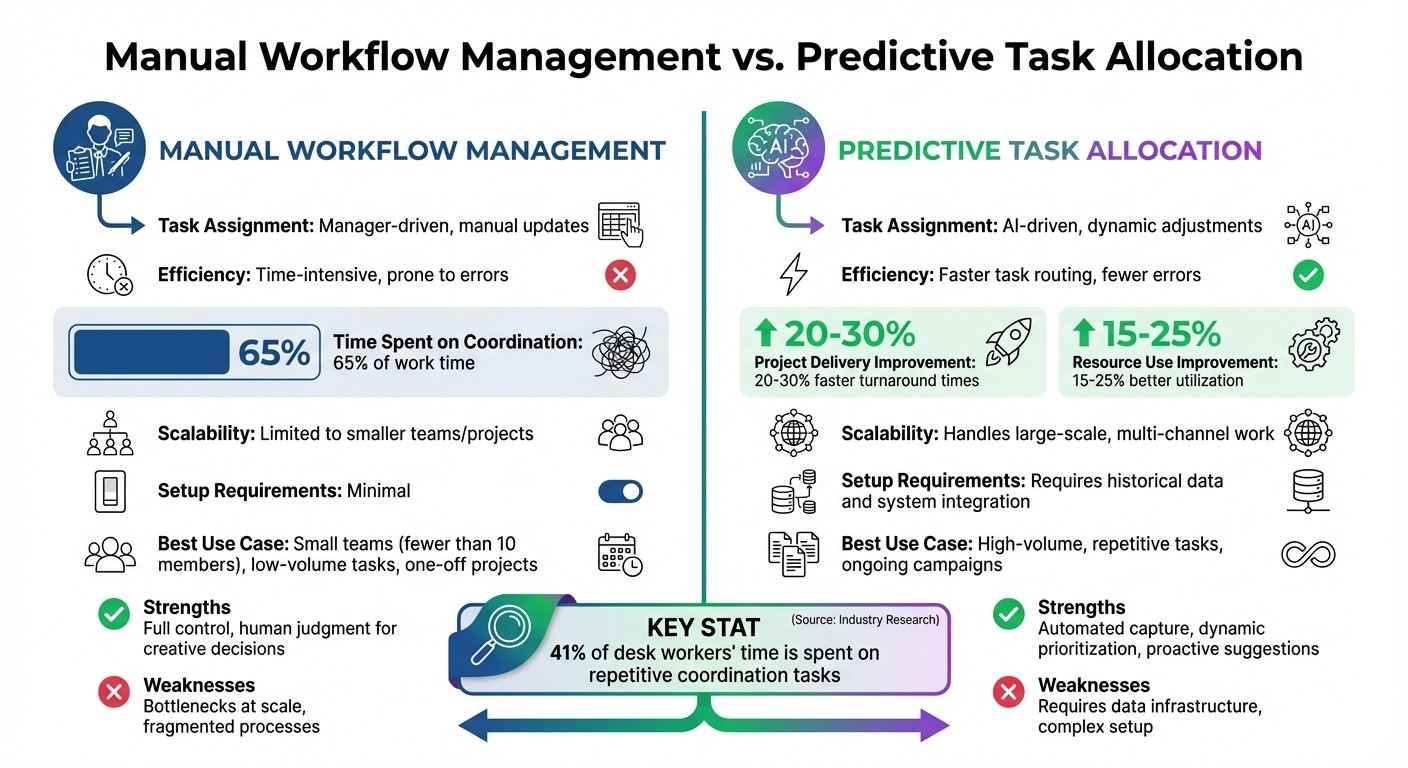
Manual Workflow vs Predictive Task Allocation: Key Differences and Benefits
Manual Workflow Management in Marketing Teams
Where Manual Workflows Work Well
Manual workflows shine in scenarios where human judgment and creativity are non-negotiable - think brainstorming sessions, strategic planning, or final decision-making. For small teams of three to five members or pilot projects testing out new campaign ideas, tools like shared Google Docs or Slack help streamline coordination. These simple solutions provide hands-on control and allow for real-time tweaks without the overhead of complex software systems [4][5]. While this approach works well in these specific contexts, the benefits tend to diminish as tasks multiply and processes grow more intricate.
Where Manual Workflows Fall Short
The cracks in manual workflows start to appear when the workload increases. Research shows that marketing teams often spend around 65% of their time on planning and coordination, leaving less time for actual creative work [9].
Take Silver Spring Foods as an example. In March 2023, their Chief Information Officer, Noah Wallace, shared how their manual shipping process involved pulling documents from multiple systems, printing them, and assembling them by hand. This labor-intensive process led to missed orders and shipments going out of sequence, jeopardizing their credibility and risking significant fines from major retailers [8]. Similarly, Graceland Fruit faced inefficiencies with their manual reporting system, where generating a single report took two minutes. After upgrading, this time was slashed to just 1.7 seconds [8].
As teams scale, manual workflows often create bottlenecks instead of improving efficiency, leading to a marketing workflow death spiral [6][7]. Fragmented processes - spread across emails, Slack messages, and personal task lists - make it difficult for leaders to maintain visibility over who owns what and whether deadlines are being met [6]. Saikat Ray, an analyst at Gartner, highlights this issue:
"Many enterprises struggle with fragmented process automation and, as a result, find themselves applying technologies in isolation rather than integrating them into a unified architecture. This leads to low reuse of resources, poor integration, limited scalability and high maintenance costs" [6].
These challenges underscore the limitations of manual workflows, particularly when teams or tasks grow in complexity.
When to Use Manual Workflow Management
Understanding the strengths and weaknesses of manual workflows helps teams decide when they’re still a viable option. Manual processes are best suited for small teams (fewer than 10 members) managing low-volume campaigns or one-off projects, like hosting a single event or running a short-term partnership. In these cases, the overhead of implementing predictive systems or automation isn’t worth it. Teams lacking robust data pipelines or system integrations may also find manual workflows practical. Starting with a manual approach can be a smart way to test and refine processes before committing to automation [4][5][6].
Predictive Task Allocation: How AI Changes Workflow Management
What Predictive Task Allocation Can Do
Traditional workflows often falter when it comes to juggling fragmented tasks, but predictive task allocation offers a smarter way to manage operations. By leveraging real-time data, AI systems operate within a "capture, curate, execute" loop that keeps tasks organized and responsive [1]. These systems monitor inputs from meetings, Slack conversations, and CRM updates to automatically generate tasks, eliminating the need for manual entries. As priorities shift - whether due to deadlines, team capacity, or project dependencies - the AI adjusts task rankings dynamically, moving beyond static labels like "High", "Medium", or "Low" [1].
This isn't just about automating routine tasks. Advanced systems deploy Manager Agents that break down larger goals into detailed task graphs while coordinating efforts between human and AI contributors [3][10]. These agents allocate tasks based on team members' specific skills and track records, helping to balance workloads, avoid burnout, and even identify skill gaps before they become bottlenecks [2]. The results speak for themselves: project delivery times can shrink by 20–30%, and resource use can improve by 15–25% [2]. Teams spend less time on administrative oversight and more time on meaningful, strategic work.
These capabilities highlight the operational and strategic adjustments needed to make AI-driven task allocation a reality.
What You Need to Implement Predictive Task Allocation
Building the right foundation for predictive task allocation isn't overly complex. You'll need scalable cloud-based tools, secure API connections, and a centralized "single source of truth" to prevent data silos [11]. The system should seamlessly integrate with your existing platforms - such as CRMs, project management tools, and communication apps - so the AI has access to the data it needs to function effectively.
Equally important is preparing your team. Consider the example of Zota, a global payments marketplace that implemented an AI agent in 2025. This agent handled 180,000 annual inquiries for 500,000 merchants, enabling their 140-person team to perform as though they were 800 strong - all without increasing headcount [11]. Vanessa Tabbert, VP of AMER SDR at Salesforce, captures the essence of this transformation:
My job isn't just to lead a team anymore. It's to lead a system where humans and agents work in sync to sell smarter, faster, and better than ever before [11].
Once the right tools and team mindset are in place, the next step is identifying the ideal scenarios for applying predictive allocation.
When to Use Predictive Task Allocation
Predictive task allocation shines in high-volume, multi-channel environments where manual coordination often falters. For example, marketing teams managing ongoing campaigns - like content calendars, paid ads, and email sequences - can immediately benefit. The system handles the repetitive work of scheduling and prioritizing tasks [1][2].
Success hinges on having enough historical data for the AI to identify patterns. If your team has been using project management tools for at least three months and has reliable records of task completion times, resource use, and project outcomes, you're ready to get started. A good strategy is to test the system with a single workflow - such as sales follow-ups or content approvals - for two weeks. This allows you to measure how accurately tasks are prioritized before rolling it out more broadly [1][2].
It’s worth noting that predictive allocation isn’t a substitute for human judgment in strategy or creativity. Instead, it’s a way to eliminate the 41% of time desk workers spend on repetitive coordination tasks [11], allowing them to focus on work that drives real progress for the business.
Manual Workflow Management vs. Predictive Task Allocation
How They Compare on Key Factors
Manual workflows depend heavily on human input, while predictive systems take a more automated approach, capturing tasks from meetings, Slack messages, and emails, and dynamically adjusting priorities based on deadlines and workload [1].
When it comes to speed and throughput, the difference is clear. Manual management gives teams full control over task execution, but this comes with a hefty price: time-consuming coordination. Every status update, priority shift, or resource reallocation requires human effort. Predictive systems, on the other hand, handle these adjustments automatically, streamlining task routing and reducing administrative drag. However, they do require a solid data infrastructure to function effectively [1].
Accuracy is another area where the two approaches differ. Manual workflows shine when human oversight is needed for creative decisions or nuanced judgment calls. But they are also more prone to errors like forgotten updates or misaligned priorities. Predictive systems, driven by data, provide consistent results and minimize such errors. That said, AI models can sometimes reflect biases, which requires careful monitoring [1].
When considering scalability, the strengths and weaknesses of each system become more apparent. Manual workflows are ideal for small teams or manageable task volumes. But as task loads grow or campaigns span multiple channels, manual coordination can slow things down. Predictive systems excel in handling large-scale operations without adding administrative burden, though they do come with a more complex and costly initial setup. As Vaishali Badgujar from Avoma aptly notes:
The win isn't automation for its own sake; it's fewer dropped balls with less manual care-and-feeding [1].
This comparison highlights the distinct roles each method can play, depending on the scale and complexity of your team's needs.
Pros and Cons Side by Side
Factor | Manual Workflow Strength | Manual Workflow Weakness | Predictive Allocation Strength | Predictive Allocation Weakness |
|---|---|---|---|---|
Task Creation | Full control over what gets tracked | Requires manual entry and updates | Automated capture from conversations and documents | May miss tasks if inputs are incomplete |
Prioritization | Human judgment for strategic decisions | Static labels can become outdated | Dynamic re-ranking based on real-time context | Needs sufficient historical data |
Response Time | Instant, reactive decisions | Relies on human availability | Proactive, AI-driven suggestions | May overlook subtle creative nuances |
Scalability | Low initial investment | Limited by human administrative capacity | Handles high-volume, multi-channel operations | Greater setup complexity and costs |
Adaptability | Easy to adjust for unique situations | Requires manual re-planning when things change | Automatically updates as plans evolve | Can falter if data inputs are inconsistent |
These strengths and weaknesses suggest that a hybrid approach may be the most effective for many teams.
Using Both Approaches Together
Many teams find success by blending these methods - leveraging predictive systems for routine tasks while relying on manual oversight for more strategic or creative work. A practical solution is a human-in-the-loop system, where AI suggests task allocations and humans make the final call on critical or creative deliverables [1][12].
To implement this, start by automating repetitive workflows like content calendars, sales follow-ups, or email sequences. Using an AI content engine can help bridge the gap between planning and multi-channel execution. These tasks are well-suited for predictive systems. Meanwhile, reserve manual management for areas requiring strategic thinking, a consistent brand voice, or complex stakeholder negotiations. Research supports this balance, showing that AI excels in handling low-risk, low-complexity tasks autonomously, while for high-stakes or complex projects, an AI system that challenges human assumptions can enhance decision-making [12].
How to Choose the Right Workflow for Your Team
What to Consider When Deciding
Selecting the best workflow for your team is all about finding the right balance between efficiency and creativity. The choice largely depends on factors like team size, the volume of tasks, and how much administrative effort you can handle. For small teams with straightforward workflows, manual systems often make more sense, as the time required to set up AI might not justify the benefits [1]. If your team is compact and tasks are manageable, sticking to manual coordination can often be quicker and more effective.
For larger teams or those experiencing rapid growth, predictive allocation becomes increasingly valuable [2][13]. If you’re dealing with high task volumes, missed deadlines, or spending too much time maintaining tools, automation can be a game-changer [1].
However, predictive systems thrive on historical data and consistent inputs. If your team doesn’t systematically track tasks or operates with fragmented workflows, you’ll need to establish a solid foundation first. Also, think about the nature of your tasks: those requiring empathy, nuanced judgment, or creative thinking are best managed manually, while repetitive or data-heavy tasks are ideal for automation [10]. This evaluation will help you determine the system that aligns with your team’s current workload and future goals.
Making the Right Choice for Your Situation
Many teams find success with a hybrid approach - leveraging predictive allocation for high-volume, repetitive tasks like campaign approvals or lead follow-ups, while keeping manual oversight for strategic and creative work [1][2]. Once you’ve identified specific pain points, consider running a pilot program to test and refine your approach.
Start small by focusing on marketing workflow fixes that address delays or inefficiencies. Run a two-week pilot to track improvements in task completion rates and time savings before expanding the system further [1][2]. If your challenges include excessive administrative tasks, poor prioritization, or uneven workloads, predictive allocation is worth exploring [1].
Platforms like Averi AI offer a practical example of this hybrid model. Averi’s Synapse architecture and AGM-2 foundation model automate routine workflows while integrating experienced marketing specialists for tasks that demand human insight. This setup delivers the speed and efficiency of AI without compromising the quality that comes from human judgment. It’s a solution that addresses the need for automation while preserving the strategic control essential for creative and high-stakes decisions.
8 AI Marketing Workflows That Will Drive INSANE Growth
FAQs
Should my team use manual workflow management or predictive task allocation?
When deciding between manual workflow management and predictive task allocation, the right choice depends on your team's priorities, the nature of your projects, and the resources at hand.
Manual workflows work best in steady, well-defined environments. If your tasks require meticulous oversight or must comply with strict regulations, this approach offers simplicity and control. It's particularly suitable for teams with limited technical tools or those managing smaller-scale projects.
In contrast, predictive task allocation shines in fast-moving, unpredictable settings, such as e-commerce campaigns or real-time content updates. By leveraging AI, this method evaluates numerous factors, adjusts priorities on the fly, and minimizes the time spent on manual scheduling. Teams with access to accurate, real-time data and the ability to implement AI tools will find this approach a strong ally in enhancing efficiency.
Key factors to weigh:
Flexibility: Manual workflows are consistent and stable, while predictive systems adapt to changing conditions.
Data availability: Predictive systems need reliable, up-to-date data; manual processes can function with minimal input.
Team size: Smaller teams often lean toward manual workflows, whereas larger or tech-savvy teams can benefit from AI-driven predictive allocation.
For teams prioritizing agility and speed, predictive task allocation offers a cutting-edge solution. On the other hand, manual workflows remain a dependable option for those seeking control and simplicity.
What are the key steps to successfully implement predictive task allocation?
To set up predictive task allocation effectively, start by pinpointing the key details of each task - such as its urgency, deadlines, overall business impact, and any dependencies. These elements serve as the building blocks for AI-driven decision-making.
The next step is integrating an AI allocation tool, like Averi AI, with your existing systems. This could include marketing platforms, CRMs, or project management tools. Connecting these systems ensures a seamless flow of real-time data, which is essential for accurate prioritization.
Once integrated, configure the AI to analyze the data it collects and provide priority scores or task recommendations. It's important to establish a feedback loop where your team can review the AI's suggestions, make necessary adjustments, and feed the results back into the system. This ongoing process helps improve the system's accuracy and reliability over time.
Finally, set clear success metrics to gauge the system’s performance. Metrics like time saved or task completion rates can help you measure and refine the process. By following these steps, you can build a flexible, data-driven workflow tailored to your team’s unique needs.
Can combining manual workflows with AI-powered task allocation improve team performance?
Combining manual workflows with AI-driven task allocation can greatly improve your team's productivity and decision-making. Predictive tools like Averi AI use real-time data to prioritize tasks, streamline administrative work, and quickly adapt to shifting circumstances. This enables your team to concentrate on impactful projects while cutting down time spent on routine organizational tasks.
Meanwhile, human oversight plays a crucial role in ensuring strategic decisions align with your goals, maintaining brand consistency, and addressing ethical concerns. By delegating repetitive processes - such as task scoring and capacity tracking - to AI, while reserving strategic adjustments for human review, your team can achieve faster outcomes without sacrificing the assurance of human judgment. This approach offers a practical solution for modern marketing teams seeking both efficiency and accuracy.
Related Blog Posts

Zach Chmael
CMO, Averi
"We built Averi around the exact workflow we've used to scale our web traffic over 6000% in the last 6 months."
Your content should be working harder.
Averi's content engine builds Google entity authority, drives AI citations, and scales your visibility so you can get more customers.