

In This Article
How Series A startups tie content to revenue: define ICPs, prioritize formats, automate production, and track metrics to build a scalable content engine.
Updated:
Trusted by 1,000+ teams
Startups use Averi to build
content engines that rank.
Series A startups often struggle to balance limited resources with the need for a strong content strategy. Yet, businesses that publish weekly content achieve 3.5x more conversions and generate 67% more leads. The key is aligning content with business goals like revenue growth and investor engagement while building efficient workflows. Here's how startups can create a scalable content system:
Tie Content to Revenue Goals: Start with targets like ARR and work backward to define content needs (e.g., case studies, newsletters).
Define Your Audience: Focus on specific Ideal Customer Profiles (ICPs) using customer data and search behavior insights.
Prioritize Content Types: Use formats like how-to guides, case studies, and product demos to target different sales funnel stages with a full-funnel strategy.
Leverage Automation: Tools like Averi AI streamline research, drafting, and publishing, letting small teams produce more content efficiently.
Track and Iterate: Regularly audit performance metrics like traffic, conversion rates, and CAC to refine your strategy.
Scaling content isn't about doing more but doing it smarter. By combining automation with clear goals and audience insights, Series A startups can build a content engine that drives growth.
How to create a content strategy for a small business (template included)
Connecting Content Goals to Business Objectives
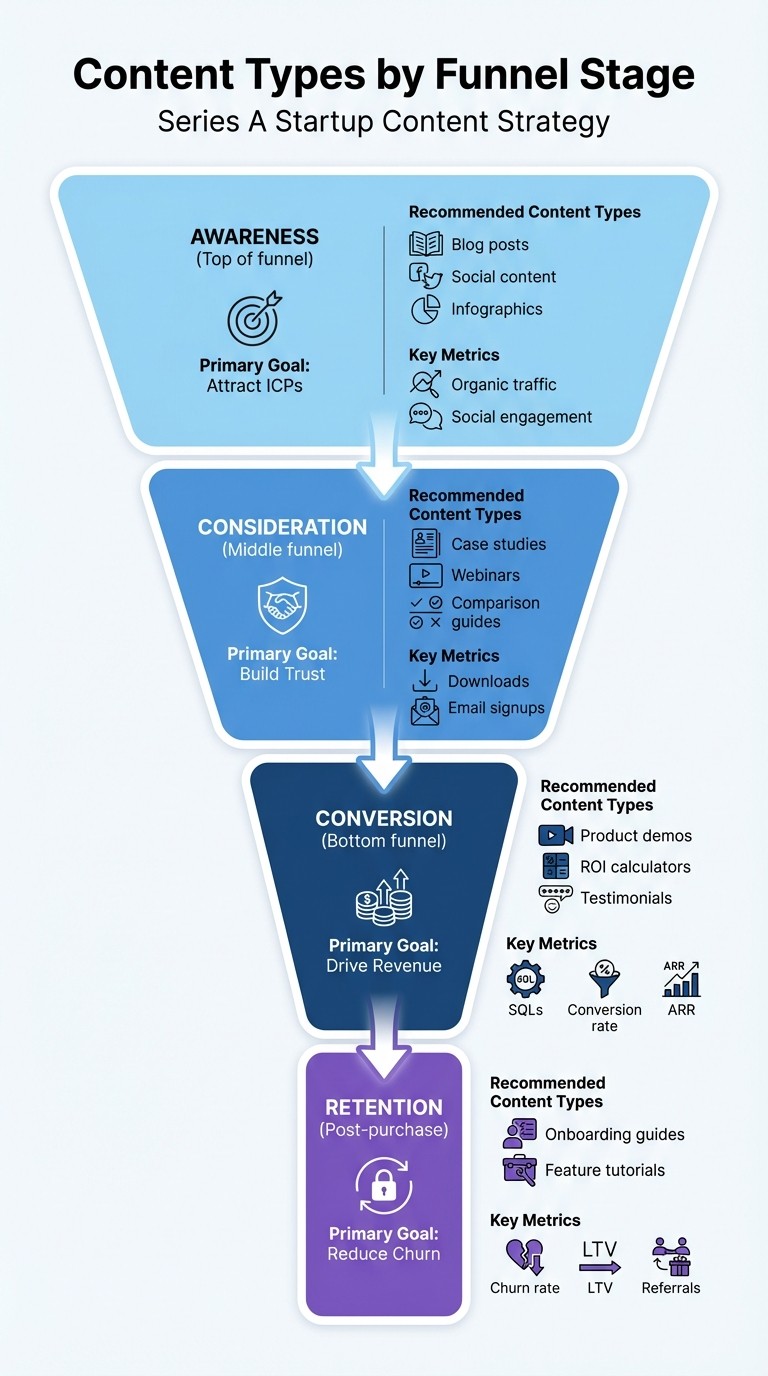
Content Types by Sales Funnel Stage for Series A Startups
Many Series A startups fall into the trap of churning out content without tying it to key business objectives like revenue or investor milestones. The result? A busy-looking content library that doesn’t actually move the needle on critical metrics like ARR, pipeline growth, or brand positioning.
Start with your revenue target and work backward to design your content strategy. For example, if your goal is to hit $1M in ARR this quarter, calculate how many sales-qualified opportunities (SQOs) you’ll need - say, 50 - and then figure out what content is required to generate those opportunities. This might mean creating four high-converting case studies, two industry benchmark reports, or a weekly newsletter that nurtures leads through the funnel. By reverse-engineering your content plan, every piece serves a specific purpose and contributes to measurable outcomes [1].
"Content isn't a 'nice-to-have' marketing line item; it's the engine that drives awareness, credibility, and inbound opportunities while you sleep." - The Logonaut [1]
Before hitting publish, solidify your positioning. Take Averi as an example. Between March and May 2025, their two-person team built a content engine from scratch, starting with a full day dedicated to defining five brand pillars such as "AI + Human" and "Execution Over Ideas." They anchored every piece of content to these pillars, including their contrarian newsletter titled "Don't Feed the Algorithm." This focused strategy resulted in publishing over 100 pieces in just 60 days, leading to a 340% jump in organic traffic, 3,400 newsletter subscribers in eight weeks with a 47% open rate, and a 190% rise in demo requests [2].
Your content should align with every stage of the sales funnel. Awareness content (like blog posts or social media updates) attracts potential customers searching for solutions. Consideration content (like case studies or comparison guides) builds trust among decision-makers. Conversion content (like product demos or ROI calculators) helps close deals, while retention content (like onboarding guides or feature tutorials) reduces churn and boosts lifetime value. Tailor your content formats, metrics, and distribution channels to these stages, ensuring every piece supports your business goals - not just the latest trends on LinkedIn. To make this work, you first need to define your audience.
Identifying Your Ideal Customer Profiles (ICPs)
A successful content strategy starts with a clear understanding of your audience. Many Series A startups make the mistake of targeting "everyone" or relying on vague personas like "tech-savvy founders" or "marketing managers." Instead, focus on 2-3 well-defined buyer personas grounded in actual product-market fit data.
Begin with your current customers. Analyze website traffic, CRM records, and sales call notes to spot patterns: What job titles are converting? Which industries are closing deals fastest? What pain points keep coming up? For instance, if mid-market SaaS companies are signing on while enterprise clients aren’t, your content should reflect that specificity. Competitor analysis can also sharpen your targeting - examine who’s engaging with similar offerings and what types of content resonate in those circles.
Once you’ve outlined your ICPs, validate your assumptions using search behavior. Tools like Google Search Console or SEMrush can reveal what your audience is actually searching for. If your ICP is a VP of Marketing at a Series A startup, they’re likely Googling phrases like "content strategy for startups" or "how to scale content with a small team" rather than generic terms like "content marketing tips." Build your content calendar around the specific questions and challenges your ICPs face, and you’ll attract qualified leads - not just traffic. With your audience clearly defined, the next step is selecting the right content formats.
Choosing the Right Content Types for Series A
Not all content formats are created equal, and at Series A, you’re juggling three priorities: generating leads, engaging investors, and educating prospects. Trying to tackle every format at once can dilute your efforts, so focus on what delivers the most impact.
For lead generation, prioritize assets that have long-term value. How-to guides, "X vs. Y" comparison posts, and original research (like industry surveys or benchmark reports) can drive consistent traffic and conversions over time. These formats perform well in search engines, address high-intent questions, and position your brand as an authority. Aim for a 70/30 split between evergreen and timely content to balance SEO benefits with current relevance.
For engaging investors and positioning your product, founder-led content is key. LinkedIn users are three times more likely to engage with posts that feature a CEO or founder, and investors want to see thought leadership that demonstrates a deep understanding of the market. Case studies, product demos, and testimonials are particularly effective here, showcasing traction in ways that generic blog posts can’t. A founder’s unique perspective - especially through bold or contrarian takes - can cut through the noise far better than polished corporate messaging.
Here’s a quick breakdown of content types by funnel stage:
Funnel Stage | Primary Goal | Recommended Content Types | Key Metrics |
|---|---|---|---|
Awareness | Attract ICPs | Blog posts, social content, infographics | Organic traffic, social engagement |
Consideration | Build Trust | Case studies, webinars, comparison guides | Downloads, email signups |
Conversion | Drive Revenue | Product demos, ROI calculators, testimonials | SQLs, conversion rate, ARR |
Retention | Reduce Churn | Onboarding guides, feature tutorials | Churn rate, LTV, referrals |
Creating a Content Strategy That Scales
For most Series A startups, the biggest challenge isn’t coming up with content ideas - it’s building the systems to produce content reliably. Scaling content isn’t about hiring more people; it’s about creating workflows that consistently turn ideas into published pieces. The aim is to build a rhythm where content creation becomes predictable, trackable, and sustainable as your business expands.
To start, separate strategy from execution. Strategy should be established upfront and revisited periodically, not reimagined every week. Execution, on the other hand, should follow a steady cycle. Take Averi’s approach as an example: their two-person team defined five core brand pillars at the outset and focused on execution. They followed a strict weekly schedule - planning on Monday, AI-assisted drafting on Tuesday and Wednesday, human review on Thursday, and publishing on Friday. This system allowed them to produce over 100 pieces of content in just 60 days [2].
Your content mix should balance long-term and short-term goals: 70% of your efforts should go toward evergreen content - like how-to guides or comparison posts - and 30% should focus on timely, trend-based pieces, such as industry news or product updates [2]. Evergreen content builds consistent traffic over time, while timely pieces keep your brand relevant and engaged in current conversations.
Automation plays a key role in scaling. Leverage AI for tasks like identifying the top 20 questions your ideal customer profile (ICP) asks, analyzing competitor content gaps, and generating keyword-optimized outlines [2]. However, human input is still critical for aligning content with your brand voice, refining strategy, and ensuring quality. As the Averi team emphasizes:
"AI should amplify human creativity, not replace it. Strategy without execution is just expensive PowerPoint" [2].
Think of the workflow as a relay race: AI drafts the initial content, humans refine and enhance it, and the system tracks performance to identify what works. This approach ensures a streamlined process for scalable content production.
Using Averi AI to Automate Strategy Setup
Building a content strategy from scratch can be a time-consuming process, often requiring weeks of research, competitor analysis, and internal discussions. Averi simplifies this process into a 10-minute setup by automating much of the heavy lifting. Once you connect your website, Averi analyzes your product, positioning, and brand voice. It then suggests ideal customer profiles, identifies competitor content gaps, and generates a complete content plan tailored to your goals. While you still review and refine the strategy, the foundational work that often slows teams down is already done.
Averi doesn’t stop at the initial setup. It continuously tracks industry trends, analyzes keywords, and identifies high-priority topics aligned with your ICPs. For example, if a competitor publishes a new guide or a keyword starts trending in your niche, Averi flags it and suggests a counter-angle or complementary piece. This automated feedback loop keeps your content pipeline full and ensures you’re always working on high-value ideas instead of scrambling for inspiration.
What makes this system scalable is its persistent brand memory. Every piece of content you publish feeds back into Averi’s understanding of your voice, style, and priorities. Over time, the AI’s drafts become more aligned with your brand, requiring less human editing. The table below outlines how AI and human tasks complement each other across the content lifecycle:
Workflow Phase | AI Task | Human Task |
|---|---|---|
Ideation | Keyword research & trend analysis | Strategic alignment & prioritization |
Creation | First draft & outline generation | Add insights & refine |
Optimization | SEO & multi-platform adaptation | Quality assurance & factual review |
Analysis | Strategic adjustments & learning |
Setting Up Ongoing Content Research
A steady stream of content ideas comes from understanding your audience’s real questions. Use AI tools to identify the top 20 questions your ICP asks about your industry [2]. For instance, if your target audience is a VP of Marketing at a Series A startup, they might ask, "How can I scale content with a small team?" or "What’s the ROI of content marketing for startups?" These questions should guide your content queue, ensuring every piece addresses a genuine need or knowledge gap.
Competitor monitoring is equally important. Set up alerts or use tools to track when competitors publish new content, especially on high-value topics like product comparisons or industry reports. If a competitor releases a guide on "Best Content Tools for Startups", take it as an opportunity to create a more comprehensive or unique take. The goal isn’t to copy but to find gaps in their coverage and fill them with your perspective. This approach keeps your content relevant and positions your brand as a leader in the conversation.
Keyword research should also be a continuous effort. Dedicate time each week to review search trends, identify low-competition keywords, and add them to your content queue. Tools like Google Search Console or SEMrush can help you find existing pages that rank on page two or three - perfect candidates for updates or expansions to push them to page one. By treating research as a weekly habit, you’ll ensure your pipeline never runs dry.
Managing Your Content Queue
A well-organized content queue is essential for a smooth and scalable content operation. Your queue should clearly outline priorities, deadlines, and approval workflows so everyone knows what’s being worked on, who’s responsible, and when it’s due. Start by categorizing content by type (e.g., how-to guides, case studies, comparisons) and by funnel stage (awareness, consideration, conversion). This structure helps you maintain a balanced output and avoid overloading one format or stage.
Establish a weekly production rhythm to keep things moving. A proven schedule might look like this: Monday for planning and topic finalization, Tuesday and Wednesday for AI-assisted drafting, Thursday for human review and edits, and Friday for publishing and performance analysis [2]. This rhythm creates predictability, ensuring content doesn’t get stuck in the "almost done" phase. It also builds momentum; consistently publishing every week boosts both SEO performance and team confidence.
Be selective with your content ideas. Not every topic is worth pursuing, and spreading your efforts too thin will dilute your results. Use a scoring system to rank ideas based on factors such as search volume, alignment with business goals, and ease of execution. Focus on the highest-priority topics and don’t hesitate to drop ideas that don’t meet the mark. Revisit your queue monthly to remove outdated ideas and add new opportunities based on performance data and market trends.
Producing Content with AI and Human Review
Once your content queue is up and running, the next challenge is creating a production process that’s both efficient and scalable. Many Series A teams stumble here - not because they lack ideas, but because they struggle to move content from draft to publication without delays. The key is to establish a system where AI manages repetitive tasks, leaving humans to focus on what matters most: shaping the voice, ensuring accuracy, and aligning with the overall strategy.
Picture it like a relay race with seamless handoffs. AI handles research and initial drafts, humans refine and approve, and the system takes care of publishing and learning. A great example of this approach is Wyndly, a telehealth platform. In 2025, they used AI to automate content research based on expert-led videos and applied AI tools for SEO and brand voice checks. This allowed them to boost their output from 40 to 200 articles per month, driving a 20x increase in organic traffic - from 10,000 to 200,000 monthly clicks - and achieving a 28% growth in organic customer acquisition [3].
To make this work, roles must be clearly defined: AI takes care of structure, research, and technical optimization, while humans bring in insights, verify accuracy, and maintain brand consistency. As Rand Fishkin, Founder of SparkToro, aptly states:
"AI-generated content is the new floor. Anyone can make it... If your content isn't better than what AI can produce, it's not worth making" [3].
Your workflow should aim to meet - and surpass - that standard.
The Complete Workflow: Approval to Publishing
The process begins with topic approval. With a prioritized content queue in place, choosing the next topic to produce becomes straightforward. Once a topic is greenlit, AI steps in to handle the heavy lifting: conducting thorough research with linked sources, generating a well-structured SEO outline, and drafting the first version based on your brand’s context. This alone can cut drafting time by about 60% [2].
Next comes the human touch. Use a collaborative editing tool that enables team members to comment, tag each other, and make real-time edits. Highlight sections and ask the AI to rewrite, expand, or adjust the tone as needed. This stage is where you inject personal stories, unique insights, and ensure the content aligns with your brand’s identity. The AI takes care of the framework; you focus on the depth and substance. This collaborative approach ensures the final piece not only reads well but also reflects your brand’s voice and values.
To avoid delays, automate the publishing process. Tools like Averi can seamlessly push content to platforms like Webflow, WordPress, or Framer - eliminating the need for manual copy-pasting or formatting adjustments. Each published piece is then stored in a content library, which feeds back into the AI’s learning process. Over time, this creates a compounding effect: every piece of content makes the AI smarter and more aligned with your brand’s style, continuously improving the entire system.
Maintaining Brand Voice and Quality
A streamlined production process is only half the battle; maintaining a consistent brand voice is just as critical. Start with clear documentation. Before producing even a single piece, define your brand voice in detail: tone (e.g., "confident but approachable"), personality ("like a knowledgeable friend"), and language style ("straightforward and conversational") [2]. Input these parameters into your AI tools to ensure every draft starts from the same foundation.
Build an example library to train the AI on your brand’s style. Include your best-performing blog posts, email campaigns, LinkedIn updates, and even internal communications like Slack messages [2]. The more examples you provide, the better the AI will replicate your tone and style. Keep this library up to date - add content that performs well and remove anything outdated or no longer relevant.
Implement a two-level review process to ensure quality. The first level is AI-driven, covering grammar, SEO compliance, and plagiarism checks. The second level is human-led, focusing on factual accuracy, brand alignment, and emotional resonance. The table below highlights how AI and human roles complement each other across key tasks:
Task Category | AI Role | Human Role |
|---|---|---|
Ideation | Keyword research, trend analysis | Defining strategy, setting the point of view |
Drafting | Outlines, first-draft generation | Adding personal stories, unique insights |
Optimization | SEO, grammar, technical checks | Ensuring brand voice, emotional connection |
Review | Fact-checking, plagiarism scans | Final approval, legal/compliance review |
Automating Publishing and Content Storage
Automating the publishing process eliminates the tedious steps that often slow teams down. Instead of manually copying drafts into your CMS, formatting headers, inserting images, and fixing links, tools like Averi handle everything. They publish directly to platforms like Webflow, Framer, or WordPress, ensuring each piece goes live with proper formatting, metadata, and internal links intact.
Equally important is how you store your content. Every published piece should be saved in a centralized library that the AI can reference for future drafts. This creates a feedback loop: the more you publish, the better the AI understands your brand’s nuances, reducing the amount of editing required over time. Case studies have shown that this approach significantly increases organic traffic and audience engagement.
This library isn’t just for AI - it’s a valuable resource for your team. New hires can use it to quickly grasp your brand’s voice and style. Marketing leaders can analyze patterns in high-performing content to refine strategy. Over time, this library evolves into a living record of your brand’s journey and a training tool for both AI and humans alike.
Tracking Performance and Improving Over Time
Publishing content is just the first step; the real work begins when you analyze its performance and refine your strategy. Many Series A teams fall into the trap of creating content consistently but neglect to review the data. This oversight means missing valuable opportunities to adjust their approach and boost ROI. The key is to establish a feedback loop where insights from performance metrics directly influence future content creation, keeping your strategy aligned with actual outcomes. Focus on the numbers that drive growth to stay ahead.
Key Metrics for Series A Startups
To measure success effectively, track metrics that directly impact growth. Organic traffic is a strong indicator of how well your content ranks in search results and reflects the success of your SEO efforts. Conversion rates, particularly those tracking the journey from Marketing Qualified Leads (MQLs) to Sales Qualified Leads (SQLs), reveal whether your content is engaging the right audience and moving them through the funnel. Investors also pay close attention to Customer Acquisition Cost (CAC) and Lifetime Value (LTV) - a healthy LTV:CAC ratio is typically 3:1 [4][5][7].
Additionally, monitor engagement metrics like time spent on site and repeat visits to gauge how well your content resonates. Net Promoter Score (NPS) is another critical measure of customer satisfaction - scores above 50 are considered excellent [4][6].
As Anu Hariharan, Frank Chen, and Jeff Jordan from Andreessen Horowitz emphasize:
"Metrics aren't just for pitching but for discussing in subsequent board meetings, quarterly updates, and management meetings. In other words: Drive with them, don't just 'report' them" [6].
These metrics should inform your decisions, not just exist as static dashboard figures.
Using Data to Guide Content Decisions
Metrics are more than numbers - they reveal where your content strategy needs attention. Start by conducting content audits on a quarterly basis. During these reviews, evaluate each piece of content for SEO visibility, relevance, freshness, and its ability to drive conversions [8]. Look for gaps in topics, supporting evidence, and formats [8]. Tools like Averi can simplify this process by identifying underperforming content that needs updating and highlighting new high-potential topics.
Once you’ve identified opportunities, prioritize updates using an impact vs. effort matrix. This approach helps you weigh the potential SEO or revenue benefits against the required resources, such as writing, design, or development time [8]. Simple updates like refreshing meta descriptions, updating statistics, and improving internal links can often lead to noticeable results. Averi’s case studies demonstrate how regular audits can deliver measurable improvements [2].
Building a Feedback Loop
The best teams treat content strategy as an evolving system, not a static plan. Create a 30/60/90-day roadmap to structure your efforts: spend the first 30 days piloting content audits, the next 30 implementing quick wins, and the final 30 scaling improvements [8]. Schedule quarterly strategy reviews to evaluate your performance against KPIs and adjust your roadmap based on what’s delivering results. Use UTM parameters to automate tracking, ensuring you can attribute success to specific content pieces [9].
Don’t rely solely on numbers - integrate qualitative insights. Regularly meet with your sales and support teams to uncover frequently asked questions and customer pain points. These provide excellent ideas for new content [9][10]. As Sarah Moon, a content strategist, explains:
"Content strategy is a long game... it compounds like a nice reliable index fund, growing over time" [10].
Conclusion
Crafting a content strategy at the Series A stage isn’t about doing everything - it’s about doing the right things. The key is to align your content efforts with core business goals like generating pipeline and driving revenue, rather than chasing vanity metrics. Focus on establishing 3–5 content pillars that reflect your expertise and meet your audience’s needs. Then, concentrate your distribution efforts on just 2–3 channels that deliver the most impact [11][12].
Once you’ve defined your content pillars, the next step is to make smart use of content strategy software. Automation can be a game-changer for small teams. Tools like Averi AI simplify tasks like research, SEO, topic planning, and CMS publishing, enabling a single marketer to produce up to eight high-quality pieces each month [12]. As Dennis Hammer wisely notes:
"A content strategy framework brings structure to the process so you're not starting from scratch every week" [11].
The aim is to balance speed of execution with consistent quality.
But tools alone aren’t enough - data-driven iteration is what sets successful strategies apart. Conduct quarterly audits to refresh high-performing content, phase out what’s underperforming, and uncover new opportunities. Monitor key metrics regularly and let the data guide your decisions [11][12]. This iterative process strengthens your overall strategy and execution. It’s worth noting that while 90% of B2B marketers are invested in content marketing, only 37% have a documented strategy [13]. That gap represents a major opportunity.
Think of content as a strategic foundation that grows alongside your product. By tying it directly to business objectives, every piece you create contributes to measurable growth. A strategy only works if it’s put into action - start building today so you can begin creating tomorrow [12].
FAQs
How can Series A startups create a content strategy that drives revenue growth?
Startups in their Series A phase can build a revenue-driven content strategy by first defining clear business objectives, such as annual recurring revenue (ARR) or average contract value (ACV). Every piece of content should align with the buyer's journey - covering acquisition, expansion, and retention - to ensure it addresses a specific need or goal.
To gauge effectiveness, monitor key metrics like lead generation, pipeline contribution, and conversion rates, and refine the strategy based on results. Tools like Averi AI can be invaluable in streamlining workflows, automating routine tasks, and fine-tuning content to achieve stronger outcomes, even when operating with limited resources.
How can automation help small teams scale their content efforts?
Automation, driven by AI-powered tools, has become a game-changer for small teams, enabling them to produce content at a scale previously reserved for larger organizations. By taking over repetitive tasks such as topic research, drafting, SEO tagging, and scheduling across multiple platforms, these tools free up valuable time. This shift allows marketers to concentrate on what truly matters - strategic thinking and creative execution - while accelerating the journey from idea to publication.
When integrated into existing workflows like approval systems, CMS platforms, and CRM tools, automation not only ensures a consistent brand voice but also minimizes manual errors. This seamless integration empowers startups to produce a steady stream of blogs, emails, social media posts, and videos without the need to significantly expand their team or budget.
By letting automation handle the routine tasks, small teams can focus their energy on impactful efforts like refining their messaging, diving into performance analytics, and fine-tuning their strategies. In essence, it transforms limited resources into a highly efficient and productive content machine.
How can startups define and target their Ideal Customer Profiles (ICPs) effectively?
An Ideal Customer Profile (ICP) is a precise, data-backed description of the businesses most likely to benefit from what you offer. For startups, it’s a way to focus energy on customers who are more likely to purchase, stick around, and grow alongside them. A well-defined ICP doesn’t just save time - it streamlines your efforts toward high-value prospects, making every interaction count.
To create an ICP, start by collecting firmographic details such as company size, annual revenue, and industry type. Then, layer in behavioral insights like purchasing habits and the technologies they rely on. Dive deeper by interviewing your early customers to uncover shared challenges and motivations. Use this information to establish clear criteria - for example, targeting companies with $5–$30 million in ARR and a sales enablement budget exceeding $100,000. Test your profile with small-scale outreach to ensure it aligns with your broader growth objectives.
Once your ICP is set, focus on accounts that offer the greatest revenue potential or align strategically with your business. Craft messaging that directly addresses their specific pain points and desired outcomes, and engage them on platforms where they’re most active, such as LinkedIn or at industry gatherings. Tools like Averi AI can help you scale outreach efforts while keeping communications personal. Keep a close eye on metrics like conversion rates, customer acquisition cost (CAC), and lifetime value (LTV) to refine and improve your ICP over time.
Related Blog Posts

Zach Chmael
CMO, Averi
"We built Averi around the exact workflow we've used to scale our web traffic over 6000% in the last 6 months."
Your content should be working harder.
Averi's content engine builds Google entity authority, drives AI citations, and scales your visibility so you can get more customers.