Startup SEO Engine: How to Build Compounding Traffic With a 1-Person Team

Averi Academy
Averi Team
8 minutes

In This Article
A concise 5-step system for solo marketers to use AI and automation to find keywords, create optimized content, automate SEO tasks, and grow organic traffic.
Updated:
Trusted by 1,000+ teams
Startups use Averi to build
content engines that rank.
SEO doesn’t have to be overwhelming, even for a team of one. By combining AI tools with a structured approach, you can create a scalable SEO system that drives long-term results without overloading yourself. Here's the 5-step plan to grow your organic traffic by 200–400% while cutting costs by 60–80%:
Find high-impact keywords quickly: Use AI tools like ChatGPT, Ahrefs, or Semrush to identify low-competition keywords and build topic clusters.
Automate content creation: Leverage AI platforms like Jasper and SurferSEO to draft articles, create outlines, and optimize for search intent.
Optimize on-page SEO: Automate repetitive tasks like meta tag creation, keyword density checks, and schema markup with tools like RankMath or SurferSEO.
Track performance and audit content: Set up dashboards with Google Search Console and Analytics to monitor rankings and flag underperforming pages.
Streamline workflows with AI platforms: Use systems like Averi AI to centralize tasks, automate audits, and focus on high-value activities.
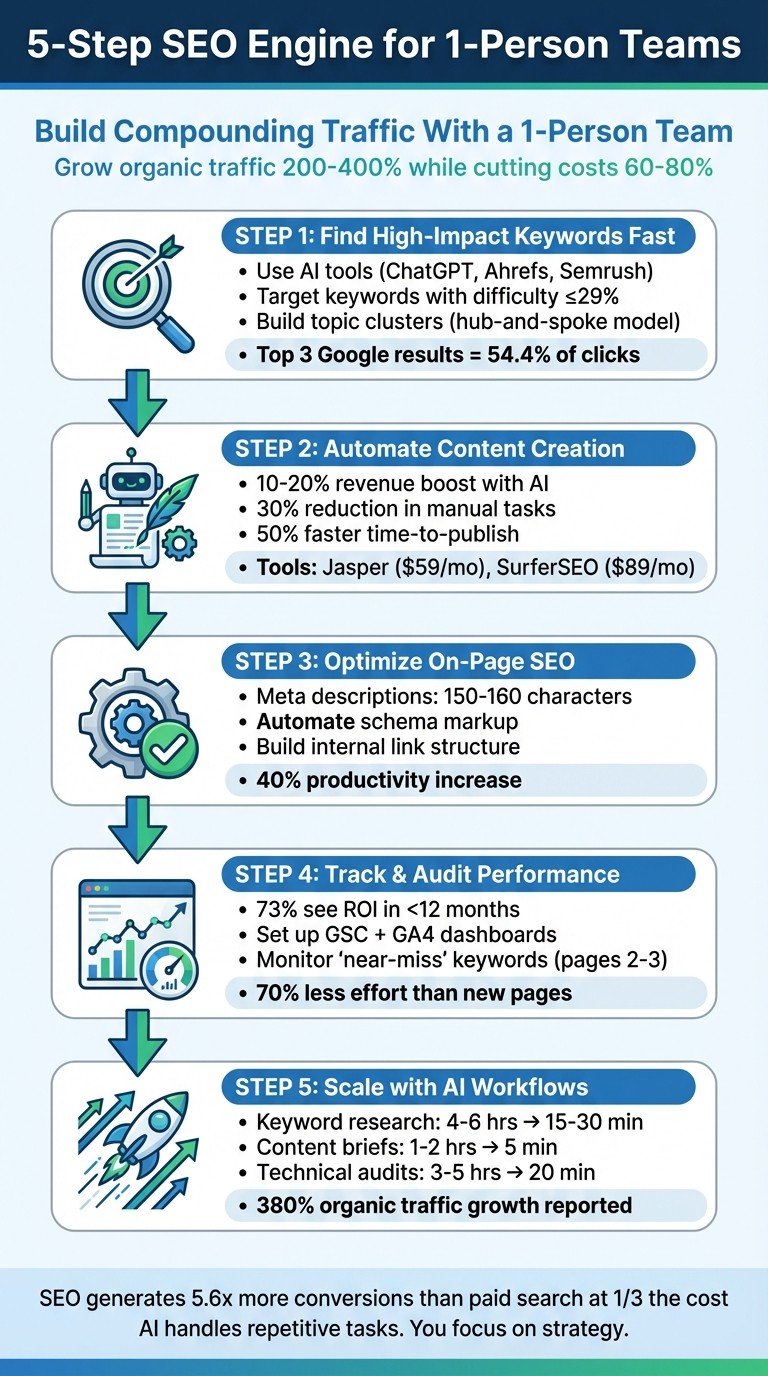
5-Step SEO System for Solo Marketers to Build Compounding Traffic
How To Automate Your Own SEO Workflows w/ Andy O_neil
Step 1: Find High-Impact Keywords Fast
Gone are the days of spending hours sifting through spreadsheets for keyword research. With AI-powered tools, the process has become faster and more efficient, allowing solo marketers to pinpoint high-impact opportunities in just minutes. These tools analyze search intent, group related terms, and uncover opportunities that might otherwise go unnoticed.
The best results come from blending AI's creative ideation with data-driven validation. Start by using ChatGPT to generate unique seed ideas and uncover long-tail questions that traditional tools might miss. For instance, you could prompt it to "act as a frustrated startup founder searching for SEO solutions" to reveal authentic language patterns. Once you’ve gathered these ideas, import them into SEO platforms like Semrush (starting at $129/month) or Ahrefs (starting at $99/month) to assess search volume and keyword difficulty.
"The key to standing out lies in having a unique perspective or thesis that drives your content strategy." - Ryan Stewart, Founder, The Blueprint Training [1]
When selecting keywords, focus on search intent rather than just raw volume. With the top three Google results capturing 54.4% of all clicks, targeting the right terms is far more effective than chasing high-volume keywords. Look for opportunities with a difficulty score of 29% or lower - these "low-hanging fruit" keywords are ideal for startups with limited domain authority and can yield results within 3–6 months [2][4].
Using AI Tools for Keyword Research
To streamline the process, break keyword research into four steps: brainstorm with AI, validate with SEO tools, auto-cluster related terms, and conduct manual SERP analysis. Tools like SurferSEO (starting at $89/month) can simplify clustering by grouping keywords based on shared ranking pages, enabling you to target multiple related terms in a single article.
While AI models like ChatGPT are excellent for generating ideas, they lack the precision needed for metrics. Always validate AI-generated ideas using dedicated SEO tools before moving forward with content creation.
Building Topic Clusters to Strengthen Authority
Instead of focusing on individual keywords, shift to building authority across an entire topic. This involves creating a hub-and-spoke model: a central pillar page supported by detailed subtopic pages. This approach not only boosts your site's credibility but also aligns with how Google's algorithms - like BERT and RankBrain - evaluate content comprehensiveness.
AI-powered clustering tools use natural language processing to identify semantic relationships between keywords, helping you build these topic clusters effectively. Score clusters on a 1–5 scale based on relevance, search volume, and difficulty to prioritize the ones most likely to drive revenue.
Before writing content, manually review the SERP using an incognito window to confirm the dominant format of top-ranking results - whether they’re blog posts, videos, or product pages. If the results lean heavily toward YouTube videos and you’re planning a blog post, you may need to rethink your format to match user intent. Once your cluster pages are live, add internal links from existing content using keyword variations as anchor text. This not only enhances your topical authority but also helps distribute ranking power across your site.
With this keyword strategy in place, you’ll be ready to tackle automated content creation in the next step.
Step 2: Automate Content Creation with AI
After identifying your target keywords, the next step is turning them into published content quickly and effectively. AI tools can take on essential tasks like creating detailed outlines or even drafting full articles, leaving you free to focus on the strategic elements that make your content distinct. The trick is finding the right balance - using AI to speed things up while relying on human judgment for the crucial finishing touches.
Companies leveraging generative AI report a 10–20% boost in revenue and a 30% reduction in manual content tasks, cutting the time needed to publish by half [6]. The difference between generic AI-generated content and material that ranks well lies in how you structure the process - from starting with a strong brief to finishing with a thoughtful human review.
Generate Content Briefs with AI
Before diving into writing, start with a well-structured content brief that guides both AI and human contributors. Begin by analyzing the top three results for your target keyword in an incognito browser window. Look for the "Three Cs":
Content Type: Is it a blog post, video, or product page?
Content Format: Does it take the shape of a listicle, a how-to guide, or a case study?
Content Angle: Is it aimed at beginners, driven by data, or focused on tool comparisons? [2]
AI tools can help automate this process. Platforms like Jasper (starting at $59/month annually) and Surfer SEO (starting at $89/month) analyze competitor content to create outlines complete with H2/H3 headings, target entities, and FAQs pulled from "People Also Ask" boxes [10][5]. For instance, you can prompt ChatGPT with:
"Analyze the top 5 results for [keyword]. Create a content outline that includes: 1) Main headings from top-ranking pages, 2) Frequently mentioned semantic entities, 3) Questions from 'People Also Ask,' and 4) Internal link opportunities to existing content."
To add a personal touch, record a short video sharing your insights or a case study. Tools like Podsqueeze can transcribe the video into text, which you can then expand into a unique and engaging article [1]. This approach ensures your content reflects real expertise rather than simply rehashing existing material.
Draft and Refine Content with AI Tools
Once your brief is ready, let AI handle the first draft. ChatGPT Plus ($20/month) is excellent for brainstorming creative ideas and testing different angles, while Jasper AI ensures a consistent brand voice across your marketing materials [10][5]. When crafting your prompts, be specific about your target audience, tone, and keywords, and request examples or data points to avoid bland or overly generic output [1].
"While AI delivers scale, your distinct insights ensure content that truly stands apart." - Ryan Stewart, Founder, WEBRIS [1]
After drafting, use tools like Surfer SEO to compare your content with top-ranking articles. This helps identify missing keywords, semantic entities, or subtopics that could improve your article's relevance [5]. Companies that integrate AI drafting with human oversight report an 88% reduction in content development costs and an 800% increase in website traffic [10].
Human input remains crucial at three key stages: maintaining brand voice, fact-checking data and claims, and adding industry-specific insights or case studies that AI can't replicate. For example, in February 2025, Ryan Stewart successfully ranked for the competitive term "lawyer SEO" using a fully AI-driven workflow. He converted video transcripts into blog posts and optimized them with short, impactful paragraphs and AI-assisted guest posts [1]. The secret was keeping strategic decisions in human hands while letting AI handle repetitive tasks.
Before hitting publish, AI can also streamline tasks like generating meta titles, descriptions, alt-text, and schema markup (JSON-LD). This can save 15–20 minutes per article while ensuring consistency across your site [6][11]. With your drafts polished and optimized, the next step is automating on-page SEO tasks.
Step 3: Optimize and Automate On-Page SEO
Once your content is drafted, the next step is ensuring search engines can rank it effectively. On-page SEO - covering meta tags, headers, internal links, and schema markup - used to require hours of manual effort. Today, AI tools can handle much of the repetitive work, allowing you to focus on strategy. Businesses using AI-powered automation have seen a 30% reduction in manual content tasks and cut their publishing timelines in half [6].
The goal is to set up systems that handle routine tasks while preserving quality. Tools like SurferSEO (starting at $89/month) and RankMath can automate keyword density checks, suggest header improvements, and generate schema markup. This frees up your time to concentrate on more impactful elements, such as aligning content with search intent and strengthening internal link structures. Below, we break down how to refine key structural elements to improve your rankings.
Optimize Meta Tags and Headers
Meta titles and descriptions play a big role in click-through rates, so it’s crucial to get them right. Meta descriptions should be between 150–160 characters to ensure they display fully on search results pages [12][9]. AI tools like Jasper, ChatGPT, and Claude can create these automatically by analyzing your target keywords and blog titles, keeping them within the ideal character range [12][6].
For headers, follow a clear hierarchy: H1 for the title, H2 for main sections, and H3 for subsections. This not only helps search engines understand your content but also makes it easier for readers to navigate [1][6]. Tools like SurferSEO can analyze top-ranking pages and suggest H2/H3 structures that address related topics and common "People Also Ask" questions [5]. You can also use prompts with AI tools like ChatGPT, such as: "Create an outline with H2/H3s, target entities, and FAQs" to ensure your headers are comprehensive [6].
AI tools can even optimize meta titles and snippets at scale by generating and testing alternatives to improve click-through rates [7]. Once AI generates these options, review them for consistency with your brand’s tone before deploying. For better readability, especially on mobile, keep paragraphs between headers to no more than three sentences [1].
Build Internal Links for Better Traffic Flow
Internal linking is essential for distributing authority across your site and guiding readers to related content. A hub-and-spoke structure works best: create a central "Pillar Page" that links to all related "Spoke Pages", and ensure those spokes link back to the pillar and to each other. This setup reinforces your topical authority and helps search engines understand your site’s structure.
When publishing new content, link to it from at least two high-authority pages on your site to speed up discovery and indexation. For pages designed to drive conversions - such as pricing or product demos - prioritize links that direct high-intent users toward key actions. Aim to place spoke-to-pillar links within the first 200 words of your content to establish topical relevance early.
"The more machine-readable your outputs are (entities, topics, schema, internal link maps), the more compounding effects you'll see over time." - Single Grain [11]
To find internal linking opportunities manually, use the site search operator: site:yourdomain.com "target keyword" to locate pages mentioning relevant terms. For a more efficient approach, tools like SurferSEO and ClickFlow can scan your site to identify "orphaned" pages without internal links and suggest where links should be added. This transforms a tedious task into a quick review-and-approve process.
Automate Repetitive On-Page SEO Tasks
Automation allows you to replace one-time tasks with ongoing systems. AI SEO agents can handle data ingestion, competitor analysis, and scheduled updates with minimal manual input [7]. For example, you can set up automated crawl health reports to flag broken links or redirect chains daily, giving you a prioritized list of fixes without needing to run manual audits [6].
Tools like RankMath and SurferSEO simplify schema markup for FAQs, products, and articles [6][7]. This is especially important for appearing in AI-powered search overviews and answer engines.
For solo marketers, the workflow looks like this: let AI handle data gathering, diagnostics, and repetitive tasks, while you focus on final approvals and strategic decisions [7]. Teams using this approach have reported a 40% increase in productivity within the first year [11]. By setting up these systems early, you can let automation handle the heavy lifting, leaving you free to make high-impact decisions.
SEO Task | What AI Automates | Human-Controlled Gate |
|---|---|---|
Meta Tags | Generates titles/descriptions based on keywords | Review for brand tone and accuracy |
Header Structure | Suggests H2/H3s based on SERP and PAA data | Validate logical flow and expertise |
Internal Links | Recommends context-aware link targets | Approve placements |
Schema Markup | Creates JSON-LD based on page structure | Validate code before publishing |
Once your on-page SEO is optimized and automated, the next step is tracking performance and auditing your content to ensure your SEO strategy continues to deliver results over time.
Step 4: Track Performance and Audit Content
Once you’ve automated on-page SEO, the next step is to monitor performance closely to catch problems before they hurt your traffic. 73% of executives using AI in marketing reported seeing positive ROI in under 12 months [11]. This success often stems from moving away from manual checks and adopting continuous monitoring systems. For solo marketers, this means linking your data sources to automated dashboards that can quickly flag potential issues.
The aim is to shift from reacting to problems after they arise to maintaining a proactive approach. Instead of noticing a ranking drop weeks too late, you’ll get alerts as soon as a high-value page falls below position 5 or experiences a traffic drop of over 25% within 90 days [9]. This kind of proactive tracking seamlessly integrates with real-time dashboards, ensuring your SEO efforts remain agile and effective.
Set Up Dashboards for Real-Time Tracking
Begin by connecting Google Search Console (GSC) and Google Analytics 4 (GA4) to a central platform. This could be a Business Intelligence (BI) tool or even a Google Sheets dashboard powered by APIs [11]. By consolidating your data, you’ll have a single source of truth for monitoring rankings, traffic, and conversions, saving you from jumping between tools. You can even link GSC queries and landing pages to your CRM to track which keywords are driving qualified leads [11].
Using AI SEO agents, you can automate the process of pulling data from GSC and analytics. These tools cluster pages based on performance changes and flag declining content in real time [7]. For instance, you can set up alerts for when a critical page falls below position 5 or sees a traffic decrease of more than 25% within 90 days [9]. Tools like Ahrefs Webmaster Tools (AWT) can send you regular email summaries of over 100 SEO issues, such as Core Web Vitals and indexation errors, eliminating the need for manual crawls [2].
To stay ahead of competitors, connect Semrush's API to Google Sheets via Zapier. This setup provides a weekly list of competitor keywords, cutting down on manual research time [5]. Focus on tracking three key metrics weekly: crawl errors, mobile usability status, and site speed scores [8]. This streamlined approach keeps your dashboard actionable without overwhelming you with unnecessary data.
Once your tracking systems are in place, the next step is to automate content audits for ongoing improvements.
Automate Content Audits
Automating content audits ensures your website stays optimized without requiring constant manual effort. Use Google Search Console to spot "near-miss" keywords - those ranking on pages 2 or 3. These keywords are much easier to move to page 1, requiring 70% less effort than launching entirely new pages [8]. Tools like SurferSEO and Screaming Frog can scan your site for underperforming pages, broken links, and duplicate content [3][8].
"The most successful resource-constrained businesses use 'SEO time banking' - dedicating consistent, small time blocks... rather than sporadic all-nighters." - RankWiser [8]
AI tools can continuously analyze your site’s search footprint, flagging URLs with sudden drops in impressions for manual review [7]. Platforms like Semrush allow for page-level analysis, comparing your content to competitors and generating a checklist for updates [5]. To prioritize effectively, rank content clusters on a scale of 1–5 based on Relevance (alignment with business goals), Volume (search demand), and Difficulty (ranking potential) [5].
Real-world examples highlight the impact of automated audits. In 2025, a fitness studio reclaimed the #1 ranking for "yoga classes [city]" by resolving HTTPS mixed content errors identified in Google Search Console. This quick, two-hour fix led to an additional $1,200 in monthly revenue [8]. Similarly, a local HVAC company boosted organic traffic by 28% in three weeks after adjusting mobile touch targets to make phone numbers easier to tap [8]. These cases demonstrate how automated audits can uncover impactful fixes that might otherwise go unnoticed.
Audit Priority | Tool | Key Metric to Monitor |
|---|---|---|
Technical Health | Google Search Console | Crawl errors, Mobile usability, HTTPS status [8] |
Content Performance | Google Analytics 4 | Traffic decay (>25% drop), Conversion rate [9] |
On-Page Optimization | Surfer / Page Optimizer Pro | Content score vs. Top 10 competitors [5] |
Site Infrastructure | Screaming Frog |
With both tracking and audits automated, you can scale your SEO efforts further by leveraging AI-powered platforms, allowing you to focus more on strategy and less on manual tasks.
Step 5: Scale SEO Workflows with Averi AI
Once tracking and audits are automated, the next step is to consolidate all your SEO tasks into a single, streamlined workspace. Averi AI serves as a comprehensive SEO operating system, managing everything from data collection and analysis to execution and publication. By integrating these processes, you eliminate the inefficiencies of juggling multiple tools, creating a seamless workflow built on the foundation of automated tracking and audits.
Averi AI employs a human-in-the-loop approach, where the platform handles data-heavy tasks like pattern recognition and analytics, while you focus on strategic decisions and maintaining your brand's unique voice. Companies using this model have reported cutting manual content tasks by 30% and reducing time-to-publish by 50% [6].
Route SEO Tasks with Synapse
At the heart of Averi AI is Synapse, its cognitive routing engine. Synapse ensures every SEO task is assigned to the most appropriate system - whether it’s an advanced AI model, cutting-edge LLMs like GPT-4, or a human expert [13]. The platform organizes workflows into four specialized areas:
Strategic Cortex: Handles competitive analysis and audience research.
Creative Cortex: Focuses on producing content that aligns with your brand.
Performance Cortex: Optimizes content based on data insights.
Human Cortex: Reserved for tasks requiring nuanced decision-making and judgment.
Synapse simplifies task delegation by matching the complexity of the work to the right resource. For example, AI takes care of technical audits like meta tag checks or keyword clustering, while humans focus on strategic tasks such as refining brand voice or fact-checking. It also taps into a network of over 2,500 vetted U.S.-based marketing specialists, who boast an average match feedback score of 4.97/5 [13].
"Averi doesn't just give us insights, it helps us act on them. That's the gap every other platform misses." - David, Thorn [14]
Compare Manual vs. AI-Driven SEO Workflows
The efficiency gains from Averi’s AI-driven methods are clear when compared to traditional manual workflows. For instance, manual keyword research can take 4–6 hours of sifting through spreadsheets, while Averi’s clustering system completes the same task in just 15–30 minutes [5][14]. Similarly, creating a content brief drops from 1–2 hours of competitor analysis to only 5 minutes with Averi’s automated tools [11][14].
Task | Manual Time | AI Time with Averi | Tools Used |
|---|---|---|---|
Keyword Research & Clustering | 4–6 Hours | 15–30 Minutes | Averi AI + Search Console |
Content Brief Generation | 1–2 Hours | 5 Minutes | Averi AI + Brand Core |
Technical SEO Audit Triage | 3–5 Hours | 20 Minutes | Averi AI + Crawler APIs |
Content Drafting & Optimization | 5–8 Hours | 45–60 Minutes | Averi /create Mode + Experts |
Mapping Internal Links | 2–3 Hours | 10 Minutes | Averi AI + Site Map Data |
The results speak for themselves. One user reported a staggering 380% growth in organic traffic after adopting Averi’s SEO workflows. Another noted that technical marketing tasks were completed 3 to 5 times faster compared to manual methods [14]. Additionally, Averi’s Brand Core feature ensures that all AI-generated content perfectly aligns with your brand’s voice and guidelines. By integrating with Google Search Console and Analytics, the platform continuously tracks performance and automatically generates structured briefs for your most impactful opportunities [7].
Conclusion
Running a one-person SEO operation doesn’t mean working harder - it means working smarter. By using AI-driven tools alongside strategic human decision-making, solo marketers can thrive in competitive niches that once required entire teams. The five-step framework presented here - identifying impactful keywords through semantic clustering, leveraging AI-generated content briefs, fine-tuning on-page elements, monitoring progress with real-time dashboards, and streamlining workflows with intelligent automation - provides the foundation for an SEO system that delivers results over time.
The numbers back this up: generative AI has been shown to increase revenue by 10–20% and achieve positive ROI in less than a year [6][11]. Unlike paid ads, which stop delivering the moment you stop spending, SEO offers lasting benefits. A strong strategy can generate 5.6 times more conversions than paid search while costing just a third as much [8]. Startups adopting systematic SEO sprints have seen organic traffic grow by 200–400% [3].
"The landscape of SEO is rapidly evolving, and the days of needing large teams to compete for high-value keywords are coming to an end." - Ryan Stewart, Founder, WEBRIS [1]
AI isn’t here to replace your role - it’s here to enhance it. By automating repetitive tasks like keyword clustering, technical audits, and meta tag creation, you can focus on strategy and maintaining your brand’s unique voice. This hybrid approach, which underpins the five-step framework, allows businesses to reduce content-related costs by 30% and cut publishing times in half [6]. With just 90-minute weekly blocks and clear standard operating procedures, you can build an SEO system that drives consistent, compounding results without overwhelming yourself.
Ready to take the next step? Sign up for Averi's AI Marketing Workspace today and receive a personalized marketing plan tailored to your goals.
FAQs
How can a solo marketer use AI to build an effective SEO strategy?
A solo marketer can build an effective SEO strategy by combining AI tools with a focus on delivering original, high-quality insights. Think of elements like unique case studies, niche-specific observations, or proprietary data that set your content apart. Relying solely on AI-generated material won’t cut it - your originality is what will make your efforts stand out.
Once you’ve nailed down a strong base of ideas, AI can help you streamline the process. For instance, you can transcribe notes or video content into text and then use platforms like ChatGPT or Jasper to draft outlines and articles. From there, take it further by incorporating AI-powered keyword tools to pinpoint high-intent keywords, refine headings, and polish metadata. This combination ensures your content is not only valuable to readers but also optimized for search engines.
To keep the momentum going, automate publishing and performance tracking with AI platforms that consolidate data on rankings, traffic, and conversions. These tools make it easy to monitor results and tweak strategies without needing technical expertise. With many AI tools available for under $500 per month, a solo marketer can efficiently grow traffic while staying focused on critical business outcomes like conversions and revenue.
What are the key benefits of using topic clusters for SEO?
Using topic clusters for SEO brings a range of benefits that can elevate your website's performance. For starters, they can boost your search engine rankings by showcasing your depth of knowledge on a particular subject, which strengthens your site's authority. Additionally, they create a streamlined, interconnected site structure that not only enhances the experience for your visitors but also simplifies the process for search engines like Google to crawl and index your pages. This structured approach makes your content more accessible and organized.
Another major advantage is the potential to draw in more organic traffic. By targeting a variety of related keywords through well-linked content, your website becomes more visible to a broader audience. This strategy doesn't just attract new visitors - it keeps them engaged longer, helping to build trust and credibility over time. By focusing on core topics and connecting relevant content, you're setting up a framework that benefits both your readers and your search engine visibility.
How can Averi AI help a solo marketer build an effective SEO strategy?
Averi AI takes the complexity out of SEO for solo marketers by merging the power of AI tools with practical human insights. It’s designed to help you run impactful campaigns more effectively, offering features like automated keyword research, AI-driven content creation, and simplified workflows that save time and boost outcomes.
By using Averi AI, you can dedicate your energy to crafting quality content while the platform takes care of repetitive tasks such as performance tracking and search engine optimization. This approach empowers individuals to manage and steadily grow traffic that builds momentum over time.
Related Blog Posts

Zach Chmael
CMO, Averi
"We built Averi around the exact workflow we've used to scale our web traffic over 6000% in the last 6 months."
Your content should be working harder.
Averi's content engine builds Google entity authority, drives AI citations, and scales your visibility so you can get more customers.