

In This Article
Technical founders can use product data, automation, and AI to build repeatable content systems that save time and scale marketing without a big team.
Updated:
Trusted by 1,000+ teams
Startups use Averi to build
content engines that rank.
Technical founders often struggle with content marketing due to limited time, creative challenges, and the need to scale without large teams. However, they can apply their engineering mindset to build structured, efficient, and data-driven systems for content creation. This approach focuses on measurable results, automation, and leveraging AI marketing tools to save time and improve output.
Key Takeaways:
Time Constraints: Founders spend 60–80% of their time on engineering tasks, leaving little room for content marketing.
Creative Challenges: Translating technical expertise into engaging storytelling can feel unnatural.
Scaling Issues: Without a dedicated team, maintaining consistency across multiple formats is difficult. To solve this, founders can implement an AI content engine to streamline multi-channel publishing.
Solutions: Use product data to refine customer profiles, automate repetitive tasks with AI tools, and analyze ROI with precision.
Main Problems Technical Founders Face with Content Marketing
Limited Time and Conflicting Priorities
For technical founders, time is a scarce resource. Between 60–80% of their hours are consumed by engineering tasks - developing MVPs, debugging issues, iterating on features, and managing customer support. In many early-stage startups, the founder is the entire tech team, leaving little room for anything else. Content marketing often gets relegated to late nights or weekends, making consistent efforts like publishing weekly blog posts nearly impossible without outside help. This lack of time not only reduces the quantity of content but also impacts its quality and creativity.
Handling Creative Work with an Engineering Mindset
Even when time is available, the transition from engineering to creative writing can feel like shifting gears in a completely different vehicle. Engineers thrive on solving problems with logic and data, but content marketing demands storytelling and emotional resonance. While technical founders can expertly explain how a feature works, weaving a narrative around why it matters to the audience often feels awkward or forced. The result is content that's packed with technical detail but struggles to connect with readers on a human level, leaving it informative but lacking in engagement.
Scaling Content Without a Large Marketing Team
The challenges don't stop at creativity or time management. scaling content production with marketing automation tools is another uphill battle. Founders often find themselves juggling every aspect of the process - from brainstorming ideas to distribution - without the bandwidth to maintain consistency. Studies show that 70–80% of founders cite time as their biggest obstacle, and only 20–30% manage to maintain regular content schedules without external support. This inconsistency limits their ability to produce content in multiple formats, which is critical for engaging diverse audiences. As a result, organic traffic stagnates, and opportunities to build lasting audience trust slip away. These constraints push many founders to explore AI content strategies and automated solutions to bridge the gap.
428: Marketing for Founders Who Hate Marketing
Using Data Skills to Build Better Content Strategies
Technical founders often excel at thinking in terms of systems, metrics, and patterns - skills that can transform content marketing into a measurable, repeatable process. By analyzing user behavior and market data, you can move beyond guesswork to craft strategies that resonate. Let’s delve into refining customer profiles, uncovering untapped content opportunities, and creating consistent themes.
Building Ideal Customer Profiles from Product Data
To create content that truly connects, focus on what users do rather than just who they are. Behavioral segmentation can reveal key insights: which features users interact with most, the search queries driving them to your site, how far they scroll through documentation, or the resources they download before making a decision.
Your existing tools likely already hold the answers. CRM platforms can map the buyer's journey, highlighting which content moves users from awareness to action. Product logs and customer data platforms (CDPs) provide insights into feature usage, perfect for crafting how-to guides or support content. Even support tickets can be goldmines, pointing to recurring challenges that could inspire high-impact blog posts. Research shows that 78% of organizations see improved lead conversion through data-driven marketing, and behavioral insights can boost sales growth by up to 85% [5].
Start by auditing your data sources. Review your CMS, CRM, and product analytics to identify gaps in customer behavior tracking. Once you’ve addressed blind spots, integrate your CDP with your CMS to deliver tailored content based on real-time activity. Analyze drop-off points in the customer journey and create content to address friction areas. Use this data to validate your audience assumptions, and be ready to shift gears if certain segments aren’t performing as expected.
Finding Content Opportunities Through Competitor Research
Competitor analysis isn’t about imitation - it’s about identifying gaps and finding ways to stand out. Tools like Ahrefs and SEMrush can help you export competitor keyword lists, analyze their traffic-driving topics, and pinpoint areas they’ve overlooked. By clustering these keywords using AI, you can uncover opportunities where competitors fall short using AI-assisted content ideation.
Ask yourself, “What frustrates you about the current state of the industry?” [2]. That frustration often leads to unique ideas that can set your content apart. For instance, if your competitors churn out shallow listicles, you could focus on in-depth technical breakdowns. Or, if they stick to feature-heavy content, you might spotlight the why behind those features. These insights can help you build a content strategy centered on themes that consistently differentiate your brand.
Data Source | Insight Provided | Content Application |
|---|---|---|
CRM Platforms | Buyer’s journey mapping | Identifying content that drives purchase decisions [5] |
Product Logs/CDP | Feature usage and behavior | Crafting personalized how-to guides and support content [4] |
Support Tickets | Common customer pain points | Developing solution-focused blogs and FAQs [5] |
Search/Keywords | Audience interests and trends | Spotting content gaps and trending topics [5] |
Behavioral Analytics | Scroll depth and click rates | Improving content layout and call-to-action placement [6] |
Creating Repeatable Content Themes
Instead of relying on sporadic posts, anchor your strategy around 3–5 core brand pillars that align with both your business objectives and audience needs. These pillars act as a guiding framework, ensuring every piece of content reinforces your brand’s positioning. For example, if your product emphasizes "AI + Human" collaboration, this theme can echo across how-to guides, case studies, and thought leadership articles.
Develop a Minimum Viable Content Engine (MVCE) to streamline production. Focus on creating one major pillar piece each month, supported by 2–3 smaller, derivative assets weekly. This setup allows you to maintain consistent, high-quality output with just 5–7 hours of effort per week. Use topic clustering to group related keywords and map them to your brand pillars. Each major piece can then be repurposed into social media snippets, email campaigns, or carousel posts with the help of AI.
Adopt a "Head Chef" approach to content creation: let AI handle the initial draft - about 80% of the work - and refine the remaining 20% with your unique insights and precise fact-checking. Record a quick voice memo sharing your perspective on a topic, and use AI to transcribe and structure it into a full draft. Over time, this process builds a rich content library, with each new piece benefiting from the context and brand memory embedded in your system. By integrating these themes into scalable workflows, you can maintain an efficient and impactful content strategy.
Building Content Systems That Scale with AI and Automation
Technical founders often rely on scalable systems to transform content marketing into an AI-powered strategy into a consistent, repeatable process. By automating repetitive tasks - like research, drafting, publishing, and tracking - you can save time and focus on the strategic decisions that demand your attention. These systems work by letting AI handle the bulk of the groundwork, freeing you to concentrate on the aspects that truly matter: your unique insights, fact-checking, and maintaining your brand’s voice. Instead of replacing humans, the aim is to enhance efficiency, allowing you to channel your energy into creative and strategic efforts.
Automating Content Planning and Topic Research
Tasks like keyword research and competitor analysis can eat up hours of your week. Tools like Averi AI simplify this process by integrating directly with platforms like Google Analytics and Search Console. Once connected, the system automates topic research, generating over 50 content ideas complete with traffic predictions based on search volume and competition gaps. With a single setup of target keywords, AI can auto-schedule topics into your content management system (CMS). Automated alerts keep you informed about shifting trends, so you can adjust strategies without constant manual effort. By adopting this approach, technical founders often save 70–80% of their planning time, doubling their content output while focusing on strategy rather than spreadsheets.
Combining AI Drafting with Human Review
AI can handle the heavy lifting of content creation by generating 80% of a draft, leaving you to spend just a few minutes refining it for technical accuracy and brand alignment. Think of it as a "Head Chef" model: AI prepares the base, and you add the final touches - fact-checking, personal stories, and tone adjustments. Start by training the AI with 20–50 of your previous articles to help it learn your style. Then, use custom prompts tailored to your brand guidelines to produce drafts that already feel aligned with your voice. For instance, a SaaS founder using this workflow drafts 10 posts weekly with AI, reviews each for precision, and achieves a 90% time savings while preserving authenticity. Research shows that 86% of marketers edit AI-generated content before publishing, and those who combine AI with human review see 40% higher engagement compared to fully automated or manual approaches [7].
Automating Publishing and Performance Tracking
After finalizing content, automated publishing tools ensure it reaches your audience without delays. By integrating your content system with your CMS using tools like Zapier or native plugins, you can automate multi-channel distribution - publishing blog posts to WordPress, sharing snippets on LinkedIn, and sending summaries via email - all on a pre-set schedule. This setup allows solo founders to maintain a daily publishing rhythm without the hassle of manual uploads.
On the analytics side, integrated dashboards pull performance data from sources like Google Analytics, tracking metrics such as organic traffic, conversion rates, time-on-page, and backlink growth. Set benchmarks - for example, aiming for 20% monthly traffic growth - and use automated alerts to flag underperforming content. The real advantage lies in the feedback loop: AI identifies which topics perform best and recommends what to create next. One fintech founder reported producing 4x more content monthly by automating topic research, drafting, and publishing with Averi AI. By keeping human oversight for compliance, they achieved a 150% traffic increase and a 25% growth in leads within just three months.
Workflow Phase | AI/Automation Task | Human Task |
|---|---|---|
Strategy | Keyword clustering, trend analysis, competitor research | Defining themes, setting perspective, topic selection |
Creation | Draft generation, metaphor suggestions, outlining | Fact-checking, adding personal touches, final edits |
Distribution | Auto-generate social snippets, format for CMS, schedule posts | Engaging with readers, responding to comments |
Tracking | Data aggregation, SEO ranking alerts | Adjusting strategy based on ROI and lead quality |
Measuring Results and Improving ROI
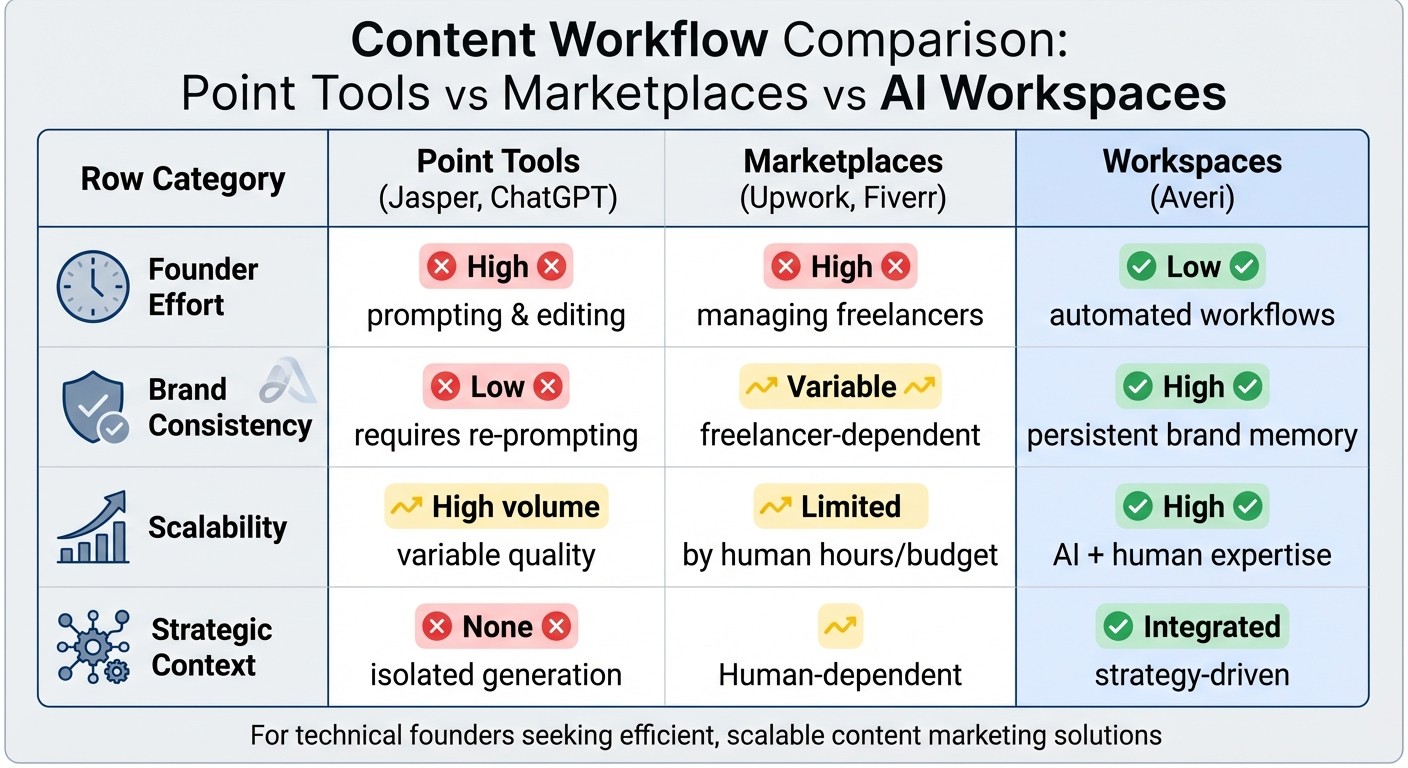
AI-Powered Content Workflows vs Traditional Methods for Technical Founders
Building on the automated workflows mentioned earlier, measuring outcomes is essential to ensure your AI-driven strategies deliver real results. For technical founders, the focus naturally leans toward data-backed outcomes. In content marketing, success is rooted in measurable achievements. Start by defining KPIs that align with your business goals - whether it’s lead generation, conversion rates, organic traffic, or search rankings. For email campaigns, track metrics like open rates, click-through rates, and unsubscribe rates to maintain the health of your subscriber list [10]. Additionally, consider tracking your brand’s visibility in AI-generated responses from tools like ChatGPT, Claude, and Perplexity. With 90% of businesses now using AI in marketing execution, this metric provides valuable insights into your brand’s reach [8][9].
Setting Key Performance Indicators (KPIs)
Select KPIs that directly impact revenue. Metrics like customer retention and lead scoring, based on behavioral data such as site visits or email engagement, can help you identify and prioritize high-value prospects [10]. Establish benchmarks that reflect your business context - for example, steady growth in organic traffic or higher conversion rates - to ensure your content strategy aligns with your objectives. For instance, ActiveCampaign users have reported a 30% increase in email open rates and a 17% boost in engagement by leveraging predictive AI features [8]. Defining these revenue-focused KPIs sets the stage for using analytics to refine your efforts.
Using Analytics to Improve Content Over Time
Once KPIs are in place, analytics become a powerful tool for improvement. Data is only valuable when it drives action. Integrate platforms like Google Analytics and Search Console into your content system to automatically gather performance insights. If a piece of content underperforms, dig into metrics like time-on-page and bounce rates to gauge reader engagement. For posts that rank lower in search results, analyze top-performing competitors to identify areas for improvement. AI-powered platforms like Averi can further enhance your strategy by analyzing traffic-driving topics and suggesting new content ideas based on trending keywords and competitor activity. This transforms analytics into a roadmap for strategic growth.
Manual Workflows vs. AI-Powered Automation
Traditional content workflows often involve juggling freelance writers and spending significant time managing production. AI-powered content workspaces offer a different approach, reducing founder involvement to tasks like content approval while maintaining a consistent brand voice through persistent context. These systems also enable scaling without the need for additional team members. While tools like Jasper require extensive prompting and editing and freelancer platforms like Upwork are constrained by budget and availability, AI-driven platforms like Averi provide a more integrated solution [8][9].
Feature | Point Tools (Jasper, ChatGPT) | Marketplaces (Upwork, Fiverr) | Workspaces (Averi) |
|---|---|---|---|
Founder Effort | High (prompting & editing) | High (managing freelancers) | Low (automated workflows) |
Brand Consistency | Low (requires re-prompting) | Variable (freelancer-dependent) | High (persistent brand memory) |
Scalability | High volume, variable quality | Limited by human hours/budget | High (AI + human expertise) |
Strategic Context | None (isolated generation) | Human-dependent | Integrated (strategy-driven) |
Conclusion
Technical founders have a unique advantage when it comes to content marketing: their engineering mindset. By approaching content creation with the same structured thinking used in product development, you can turn what might seem like a creative puzzle into a measurable, repeatable process. Focus on clear goals, track performance, iterate quickly, and streamline workflows with the right tools.
A good starting point is using your product data to define ideal customer profiles and pinpoint content opportunities through competitor analysis. Develop consistent content themes that address real user needs, and rely on automation to handle time-consuming tasks like planning, drafting, publishing, and tracking. For example, DigitalOcean’s community-writing program spent about $1,000 per article to produce over 5,000 tutorials, which now attract around 10 million visits per month [3]. This case shows how strategic automation can transform content into a scalable, high-impact asset.
AI workspaces are especially helpful for reducing your hands-on involvement while maintaining strategic alignment. Unlike tools like ChatGPT that require frequent prompting and editing or freelancer marketplaces that often lead to inconsistent quality, AI workspaces such as Averi streamline the process. These platforms keep your brand voice intact and integrate strategy seamlessly, so you can concentrate on your product while your content operates in the background.
Set specific, measurable goals - like increasing website traffic by 30% within six months by publishing bi-weekly [1]. Monitor key metrics such as organic traffic, lead generation, conversion rates, and user engagement. Use analytics to refine your strategy, identifying which topics to expand on, what content needs updates, and where gaps exist. As of 2025, founder-led content strategies are proving to be more effective than costly ad campaigns or inconsistent outreach, building long-term visibility that compounds over time [11].
FAQs
How can technical founders balance engineering work with effective content marketing?
Technical founders can manage content marketing effectively by treating it as a structured process rather than an occasional task. Setting aside a consistent weekly time block - around 5 to 7 hours - can make a big difference in creating, refining, and scheduling meaningful content. Using AI tools can simplify this process, such as converting a 30-minute voice memo into multiple draft versions. By integrating this time block into sprint planning, content creation becomes a regular, manageable task.
AI platforms are particularly useful for handling repetitive tasks like drafting outlines, generating initial content, and adapting material for different formats. This allows founders to save their energy for refining the brand voice and making strategic decisions. A streamlined workflow - starting with a brief, followed by an AI draft, editing, approval, and scheduling - keeps the process efficient and reduces unnecessary decision-making. Incorporating these tasks into existing project management tools ensures progress is tracked without detracting from engineering priorities.
To make the system scalable and effective, establish clear guidelines for tone, approval processes, and workflows. Track key metrics like website traffic and conversions to fine-tune your strategy over time. This approach allows technical founders to increase content output while staying focused on their core engineering responsibilities.
How can technical founders turn their expertise into effective content marketing?
Technical founders have a unique edge when it comes to content creation, thanks to their analytical mindset and knack for problem-solving. By breaking down intricate concepts into straightforward, problem-solution stories, they can effectively connect with both technical and non-technical audiences. Backing these narratives with solid data or real-world case studies adds credibility and depth, making the content more engaging and relatable.
To make the process more efficient, leveraging AI-powered tools can be a game-changer. These tools can handle tasks like brainstorming ideas, drafting content, and repurposing it across various formats - whether it’s a blog post, a social media update, or a newsletter. This not only saves time but also helps maintain a consistent tone and message. Setting up workflows with templates and clear brand guidelines further streamlines production, ensuring every piece meets quality standards.
Setting clear, measurable goals for each piece of content - such as boosting website traffic or generating leads - can provide direction and focus. Analytics then play a key role in evaluating performance and refining strategies. By approaching content creation as a scalable system, technical founders can consistently craft impactful, data-driven stories that align with their expertise and business objectives.
How can AI tools help technical founders streamline and scale their content marketing?
AI tools have revolutionized how technical founders approach content marketing, turning what used to be a time-intensive process into something far more efficient and manageable. Instead of dedicating endless hours to brainstorming and crafting content, founders can now provide a basic outline or idea to an AI platform, which swiftly generates blog posts, social media updates, and email drafts. This streamlined approach cuts content creation time down to just 5–7 hours per week, all while maintaining a steady flow of output.
But these tools don’t stop at content creation. They also handle tasks like building content calendars, identifying topic opportunities based on keyword gaps, and breaking down long-form content into smaller, shareable formats. Many platforms integrate seamlessly with systems like CMS, CRM, and ad platforms, automating approvals, scheduling, and performance tracking. This allows founders to shift their focus to strategy and ensuring quality, while the AI takes care of repetitive tasks. The result? Content marketing becomes a dependable growth engine instead of a time-draining hurdle.
Related Blog Posts

Zach Chmael
CMO, Averi
"We built Averi around the exact workflow we've used to scale our web traffic over 6000% in the last 6 months."
Your content should be working harder.
Averi's content engine builds Google entity authority, drives AI citations, and scales your visibility so you can get more customers.