How to Maintain Brand Consistency in AI-Generated Marketing Content
83% of marketers report creating content faster with AI, but only 25.6% say it outperforms human content. The gap? Most teams are using AI like a cheap ghostwriter instead of an intelligent tool that can actually learn and maintain your brand.

Averi Academy

In This Article
83% of marketers report creating content faster with AI, but only 25.6% say it outperforms human content. The gap? Most teams are using AI like a cheap ghostwriter instead of an intelligent tool that can actually learn and maintain your brand.
Updated
Trusted by 1,000+ teams
Startups use Averi to build
content engines that rank.
TL;DR
🎯 Brand consistency with AI is possible—but only if you build systems for it, not hope for it
❌ Why AI destroys brand voice: You're asking it to mind-read, treating all AI the same, confusing "professional" with "on-brand," working in silos, and have no learning loop
💰 Real cost of inconsistency: 10-33% revenue loss from damaged brand equity, confused positioning, sales enablement failure, audience skepticism, and team inefficiency
📋 The framework: Document voice thoroughly (not just "friendly"), train AI on YOUR content, structure prompts with brand context, implement human review gates, enforce with systems, build feedback loops that improve over time
⚡ Time savings: AI first draft (2-5 min) + human brand refinement (15-30 min) = 50-70% faster than writing from scratch while maintaining quality
🔧 Tool reality: Generic AI requires manual brand management every time; purpose-built platforms like Averi learn your brand automatically and improve from your edits
📈 The compound effect: Month 1 requires 30min editing per piece; Month 6 requires 10min; Month 12 content is 90% publication-ready—but only if AI learns from feedback
🚀 The choice: Spend 50% of time fixing voice issues with generic AI, or 5% with AI that actually learned your brand
Stop fighting AI to maintain brand voice. Build systems where brand consistency is automatic, not aspirational.
Your brand voice is an asset. Protect it while scaling with AI.
"We built Averi around the exact workflow we've used to scale our web traffic over 6000% in the last 6 months."

Your content should be working harder.
Averi's content engine builds Google entity authority, drives AI citations, and scales your visibility so you can get more customers.
How to Maintain Brand Consistency in AI-Generated Marketing Content
Your CMO just read three pieces of content from your team.
One sounds like a startup bro on LinkedIn. One reads like a corporate press release from 1997. One has the personality of a Terms of Service document.
They were all written by AI. None of them sound like your brand.
Welcome to the fastest way to destroy years of brand building: letting AI write without guard rails.
52% of consumers reduce engagement when they suspect content is AI-generated. Only 30% of companies actively enforce their brand guidelines — and AI makes that gap worse.
You're left with a growing volume of content that's technically competent but sounds like it could belong to any company in your category.
85% of marketers now use AI for content creation.
Most feed a prompt into ChatGPT, paste the output into their CMS, and hope the audience doesn't notice. The audience notices.
46% of social media users are uncomfortable with brands using AI-generated content. The discomfort isn't with AI itself — it's with generic AI content that lacks the voice, specificity, and perspective that made them follow the brand in the first place.
This guide covers why AI content defaults to generic, what actually fixes it (not "add your brand guidelines to the prompt" — that doesn't work), and how to build a system where AI output sounds like your brand from the first draft, not after 45 minutes of editing.
Why AI Destroys Brand Consistency (And It's Your Fault)
Let's start by being honest about what's actually happening when AI content sounds off-brand:
Problem 1: You're Asking AI to Mind-Read
The typical approach:
"Write a blog post about our product"
"Create social media posts for our launch"
"Draft an email announcing our new feature"
What you didn't tell the AI:
How your brand talks about this category
What metaphors and frameworks you use
Your opinion on industry trends
How you balance technical depth with accessibility
Your specific terminology and language patterns
What makes you different from competitors
The result: AI gives you "professional B2B tone" because it has no idea what YOUR tone is.
Research from the Content Marketing Institute shows that 64% of the most successful content marketers have documented brand voice guidelines—but only 23% are actively using those guidelines to train their AI tools.
Translation: You have the playbook. You're just not giving it to the AI.
Problem 2: You're Treating All AI the Same
Generic AI tools (ChatGPT, Claude, etc.) are trained on the entire internet.
That means they know:
How millions of companies talk
Generic "professional" business writing
Common industry jargon and phrases
Standard blog post structures
But they don't know:
How YOUR company talks
YOUR specific brand voice
YOUR unique frameworks and terminology
YOUR positioning and differentiation
YOUR audience's language and pain points
Every time you start a new conversation with generic AI, it forgets everything from the last conversation. You're constantly re-explaining your brand, re-correcting the same mistakes, and getting inconsistent output.
Problem 3: You're Confusing "Professional" With "On-Brand"
Generic AI optimizes for "sounds professional"—which usually means:
Corporate jargon and buzzwords
Passive voice and formal language
Generic value propositions
Safe, forgettable phrasing
Example AI output: "Our innovative platform leverages cutting-edge technology to deliver transformative solutions that empower organizations to optimize their workflows and achieve operational excellence."
Translation: This could be from literally any B2B company. There's nothing distinctive, memorable, or authentic about it.
84% of consumers say they need to trust a brand before buying from them, but trust requires distinctiveness. Generic voice = no differentiation = no trust.
Problem 4: Your Team Is Working in Silos
The scenario:
Sarah uses ChatGPT for blog posts
Mike uses Jasper for social media
Jennifer uses Copy.ai for email campaigns
Tom uses Claude for ad copy
The result:
Four different AI tools with four different interpretations of your brand
No consistency across channels or team members
No shared learning about what works
Every person re-explaining brand voice to their tool
Impossible to maintain quality at scale
Gartner research shows that 88% of marketers plan to consolidate their tool stack in 2025—specifically because fragmentation destroys consistency.
Problem 5: You Have No Learning Loop
What happens with generic AI:
AI generates content
You edit to fix brand voice issues
You publish
AI learns nothing from your edits
Next time, AI makes the same mistakes
Repeat forever
The missing piece: A system that learns from what you approve, what you edit, and what actually performs—so AI gets better at your brand over time, not worse.
The Real Cost of Inconsistent Brand Voice
This isn't just about "sounding professional." Inconsistent brand voice has measurable business impact:
Impact 1: Eroded Brand Equity
Brand consistency across all channels increases revenue by 10-33%.
Inverse impact: Inconsistency actively damages the brand equity you've built. When content sounds different across channels, customers don't know what your brand stands for.
Example: A SaaS company with strong "no-BS, straight-talk" brand started using generic AI. Their content became full of corporate jargon. Customer feedback: "You used to tell it like it is. Now you sound like everyone else."
Result: Brand preference scores dropped 18% over six months.
Impact 2: Confused Positioning
Your brand says: "We simplify complex enterprise software."
Your AI-generated content says: "Our comprehensive suite of enterprise-grade solutions leverages innovative technologies to deliver transformative outcomes across multiple deployment scenarios."
What customers hear: Mixed messages that undermine your positioning.
77% of B2B buyers say clear, consistent messaging influences their purchase decision. Inconsistency creates doubt.
Impact 3: Sales Enablement Failure
The scenario: Sales team gets generic AI-generated content that doesn't sound like your brand.
What happens:
They don't use it (because it doesn't match their pitch)
Or worse, they DO use it (and confuse prospects with mixed messaging)
They have to create their own materials (wasting time)
Prospects see disconnect between marketing and sales
73% of B2B buyers say consistent cross-channel messaging is very important, but generic AI makes consistency impossible.
Impact 4: Audience Skepticism
68% of consumers trust AI-generated content less than human-created content—and they can tell when something's AI-generated.
The trust equation:
Distinctive voice + consistent tone = authentic brand = trust
Generic voice + inconsistent tone = obviously AI = skepticism
In B2B especially, trust is everything. Long sales cycles, committee decisions, significant investments—all require sustained trust that generic AI content undermines.
Impact 5: Team Frustration and Inefficiency
What we hear from marketing teams:
"We spend more time editing AI content to match our voice than it would take to write from scratch."
"Everyone on the team interprets 'our brand voice' differently when prompting AI."
"We keep making the same edits over and over because the AI doesn't learn."
The productivity promise of AI evaporates when every output requires substantial editing to fix voice issues.
Brand Voice AI Tools: What's Available in April 2026
The tools for maintaining brand voice in AI content have split into three categories. Each solves a different part of the problem.
Category 1: Brand Voice Training Layers (bolt-on)
Jasper Brand Voice ($49–$59/month): Analyzes your existing content and creates a voice profile that applies to all outputs. Strong for short-form copy (social, ads, email). Requires Surfer SEO integration ($89+/month separately) for search optimization. No CMS publishing. No content strategy. Voice layer only.
Writer Style Guides (enterprise pricing, $180+/user/month): Enforces brand rules across all AI outputs with compliance audit trails. Built for regulated industries (healthcare, finance, legal). SOC 2, HIPAA, GDPR compliant. Overkill for startup teams. Per-user pricing makes it expensive above 3 people.
Limitation of bolt-on tools: They solve voice but not workflow. You still need separate tools for keyword research, content strategy, SEO optimization, CMS publishing, and analytics. Brand voice is one problem. The 5 other problems remain disconnected.
Category 2: Voice-Aware Content Platforms (integrated writing)
Writesonic ($49–$249/month): Brand Voice training plus GEO/AI search visibility tracking. Strong for teams prioritizing AI citation alongside brand consistency. GEO features locked behind the $249/month tier.
Copy.ai ($49/month): Brand Voice plus GTM workflow automation. Extends beyond content into sales enablement. Less focused on long-form blog content.
Category 3: Content Engines With Built-In Brand Context (end-to-end)
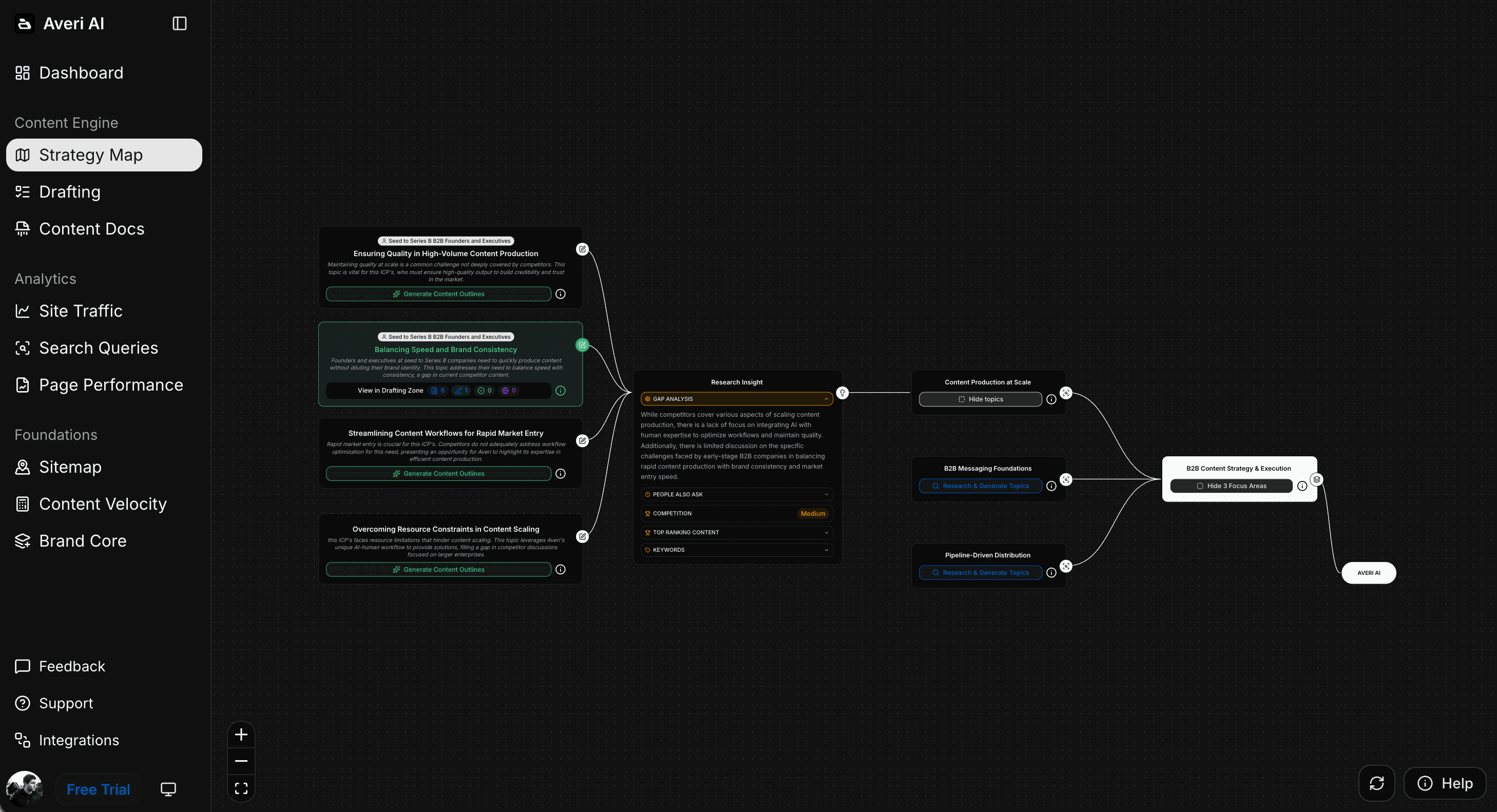
Averi Brand Core ($99/month Solo Plan): This is the approach we built because Categories 1 and 2 didn't solve the actual problem.
Brand Core works differently from voice training layers.
Instead of analyzing your writing samples, it scrapes your entire website to learn your business: products, positioning, ICP, competitive differentiators, and voice patterns.
That context persists across every piece of content the engine produces — strategy recommendations, topic queue, AI-assisted drafts, FAQ sections, meta descriptions, LinkedIn posts.
The difference: Jasper learns how you write. Brand Core learns who you are, what you sell, and who you're selling to.
The voice is one dimension of brand context. The product knowledge, competitive positioning, and ICP understanding are the other five dimensions that make AI content sound like it came from someone who actually works at your company.
Every piece created through the engine gets scored at 55% SEO + 45% GEO before publishing. The scoring catches promotional tone — one of the primary signals that content is AI-generated and the factor most correlated with citation failure.
Consistent brand presentation increases revenue 10–20%. The ROI case for brand consistency tools isn't about preventing bad content. It's about the revenue gap between generic and distinctive.
The Brand Consistency Framework for AI Content
Here's how to actually maintain brand consistency while using AI to scale content:
Step 1: Document Your Brand Voice (Really Document It)
Not this: "Our brand voice is professional but friendly."
This: Comprehensive brand voice guidelines that include:
Voice characteristics with examples:
Tone: How do you sound? (Authoritative, conversational, irreverent, technical, warm?)
Language level: Complexity of vocabulary and sentence structure
Perspective: First person "we" vs. third person? Active vs. passive voice?
Personality traits: What 3-5 adjectives describe your brand voice?
Specific do's and don'ts:
Words and phrases you always use
Words and phrases you never use
Jargon you embrace vs. avoid
How you refer to customers, products, competitors
Metaphors and analogies you favor
Examples of good vs. bad:
3-5 paragraphs that perfectly capture your voice
3-5 paragraphs that feel off-brand (and why)
Side-by-side comparisons
Context-specific guidance:
How voice shifts for different audiences (technical vs. business buyers)
How voice shifts for different channels (LinkedIn vs. email vs. docs)
How voice shifts for different content types (educational vs. promotional)
Content Marketing Institute research shows that organizations with documented content strategies are 313% more likely to report success.
Time investment: 2-4 hours to document thoroughly. This becomes your AI training foundation.
Step 2: Train AI on Your Actual Brand
The right approach: Feed AI your best existing content so it learns patterns.
What to provide:
Your best content samples (10-20 pieces):
Blog posts that nail your voice
Email campaigns that performed well
Social media posts with strong engagement
Product pages that convert
Case studies customers love
Your brand voice guide:
The documented guidelines from Step 1
Specific do's and don'ts
Examples of good and bad
Your strategic context:
How you position in market
Key differentiators from competitors
Core messages and themes
Audience pain points and language
Your performance data:
What content resonates (engagement, conversions)
What messages work in sales conversations
What language customers use when they describe your value
How this works with different tools:
Generic AI (ChatGPT, Claude):
You must provide this context in every conversation
Use custom instructions to set baseline
Still requires manual re-explanation
No persistent learning
AI with memory (ChatGPT with memory, Claude Projects):
Remembers within a project/conversation
Still loses context between projects
Requires careful organization
Limited by context window
Purpose-built platforms (Averi):
Analyzes your content library to learn patterns
Maintains persistent brand intelligence
Learns from your edits and approvals
Improves over time based on what works
Designed specifically for brand consistency at scale
Step 3: Structure Prompts for Brand Consistency
Bad prompt: "Write a blog post about our new feature."
Good prompt:
The difference: Specific direction produces on-brand output. Vague prompts produce generic output.
Step 4: Implement Human Review Gates
The workflow:
AI generates → Human reviews → Edit for voice → Approve
Not: AI generates → Publish
What human review catches:
Subtle voice mismatches ("sounds professional but not US")
Missing brand-specific frameworks or terminology
Generic claims that need specific proof points
Opportunities to add perspective only you have
Technical accuracy and fact-checking
Time allocation:
AI first draft: 2-5 minutes
Human review and edit: 15-30 minutes (vs. 60-90 minutes writing from scratch)
Net time savings: 50-70% while maintaining brand quality.
The review checklist:
✅ Voice alignment: Does this sound like our brand?
✅ Message consistency: Does this align with our positioning?
✅ Terminology: Are we using our specific language?
✅ Differentiation: Does this show what makes us unique?
✅ Audience fit: Will our specific audience respond to this?
✅ Proof points: Do we have specific examples/data?
✅ Accuracy: Are all claims factual and supportable?
Step 5: Create Brand Consistency Enforcement Systems
Beyond just reviewing individual pieces, build systems that enforce consistency:
1. Style guide integration:
Automated checks against brand guidelines
Flag violations before human review
Consistent formatting and structure
2. Terminology libraries:
Approved ways to describe products/features
Competitor comparison language
Industry terminology standards
3. Approval workflows:
Clear ownership of brand voice
Escalation for uncertain cases
Documentation of decisions
4. Performance tracking:
Which AI-generated content performs best
Which voice/tone/style drives engagement
What resonates with audience
5. Continuous training:
Feed successful content back to AI
Update guidelines based on what works
Regular brand voice calibration with team
Platforms like Averi build these enforcement systems directly into the workflow—not as separate tools you have to manage, but as integrated guardrails that ensure consistency automatically.
Step 6: Build Feedback Loops That Improve Brand Consistency
The learning cycle:
AI generates content → Human edits for voice → Track what edits you're making → Feed patterns back to AI → AI gets better at your brand → Less editing required over time
What to track:
Common edit patterns:
Words/phrases you consistently change
Tone adjustments you repeatedly make
Structure changes you always implement
Examples you add every time
Performance data:
Which AI-generated content engages audience
What voice/tone drives conversions
Which messages work in sales conversations
Team feedback:
Which AI outputs require minimal editing
Where AI consistently misses brand voice
What would make AI more useful
How to implement:
With generic AI: Manual documentation of patterns (spreadsheet of common fixes)
With purpose-built platforms: Automated learning from your edits and performance data
The compound effect: Research shows that organizations with systematic learning loops see 40% better performance over time because improvements compound.
Month 1: AI requires 30 min editing per piece Month 6: AI requires 10 min editing per piece (because it's learned your brand) Month 12: AI generates content that's 90% publication-ready
This only works if your AI actually learns from feedback—which generic tools don't.
Advanced Strategies for Brand Consistency at Scale
Once you have the basics in place, these advanced strategies ensure consistency as you scale:
Strategy 1: Multi-Layer Brand Voice (Context-Aware)
The reality: Your brand voice isn't identical in every situation.
Technical documentation: More precise, less personality Social media: More personality, less formal Executive content: More authoritative, strategic Product marketing: More feature-focused, proof-driven Educational content: More explanatory, accessible
The solution: Train AI on context-specific voice variations
Example frameworks:
LinkedIn thought leadership voice:
Direct, opinionated, backed by experience
Use "I/we" perspective
Share specific learnings and mistakes
Challenge conventional wisdom
Technical documentation voice:
Precise, comprehensive, structured
Use exact terminology
Focus on "how" not "why"
Include code examples and diagrams
Email newsletter voice:
Conversational, personal, value-first
Use "you" language
Share insights before promotion
End with clear next action
The key: AI should know when to use which voice variant based on content type and audience.
Strategy 2: Competitive Differentiation Language
Beyond just "sounding like your brand," ensure AI reinforces how you're different:
Document your positioning:
What makes you different from competitors
How you talk about the category
Your unique frameworks and methodologies
Your perspective on industry trends
Example:
Generic AI: "Our platform helps teams collaborate more effectively."
Brand-differentiated: "While most collaboration tools add complexity with endless features, we eliminate the noise—giving teams exactly what they need and nothing they don't."
The differentiation comes through in:
What you emphasize (simplicity vs. features)
What you critique (tool bloat)
How you frame the problem (not about adding more, about removing excess)
Strategy 3: Brand Voice Calibration Sessions
Quarterly exercise (2 hours):
Step 1: Have AI generate 10 pieces of content on various topics Step 2: Team reviews and scores each for brand alignment (1-5) Step 3: Identify patterns in what's off Step 4: Update AI training and guidelines Step 5: Regenerate and compare
This ensures:
Team alignment on what "sounds like us" means
Continuous refinement of brand voice
AI training stays current as brand evolves
Strategy 4: Channel-Specific Brand Consistency
Different channels have different norms—but your brand should still be recognizable:
The framework:
Channel | Voice Adaptation | Non-Negotiables |
|---|---|---|
Professional, thought-leader, opinionated | Core message, terminology, differentiation | |
Concise, timely, conversational | POV, brand personality | |
Personal, value-first, action-oriented | Voice, frameworks, language | |
Docs | Comprehensive, precise, structured | Terminology, technical accuracy |
Ads | Benefit-focused, urgent, clear | Core value prop, differentiation |
AI should understand: Adapt format and style for channel while maintaining core brand identity.
Strategy 5: Global and Localized Brand Consistency
For companies with international markets:
The challenge: Maintain brand identity across languages and cultures
The approach:
Core brand principles that transcend language
Cultural adaptation guidelines
Translation review by native speakers
Local market voice variations documented
AI's role:
Generate localized content with brand guardrails
Ensure core messages translate consistently
Adapt examples/references for local relevance
Maintain tone even in translation
Tools and Technology for Brand Consistency
Not all AI tools are equal when it comes to brand consistency:
Tier 1: Generic AI (Requires Manual Consistency Work)
ChatGPT, Claude, Gemini
Brand consistency: Requires detailed prompts every time
Memory: Limited or project-specific
Learning: Doesn't learn from your edits
Best for: Small teams, simple needs, willing to manually manage brand voice
Cost: $20-50/month per user
Tier 2: Content-Specific AI (Better Templates, Still Generic)
Jasper, Copy.ai, Writesonic
Brand consistency: Template-based with some customization
Memory: Saves brand profiles but limited depth
Learning: Minimal learning from performance
Best for: High-volume content with basic brand needs
Cost: $50-500/month depending on usage
Tier 3: Purpose-Built Marketing Platforms (True Brand Intelligence)
Brand consistency: Learns from your content library, maintains voice automatically
Memory: Persistent brand intelligence across all content
Learning: Improves from your edits and performance data
Integration: Connects brand voice to campaigns and strategy
Best for: Teams serious about brand consistency at scale
HubSpot, Marketo (with AI features)
Brand consistency: Basic AI features within marketing automation
Memory: Connected to CRM but limited brand learning
Learning: Focused on lead scoring/email optimization, not content voice
Best for: Enterprise teams already using these platforms
The differentiation: Purpose-built platforms treat brand consistency as a core feature, not an afterthought.
Averi's approach specifically:
Analyzes your existing content to learn voice patterns
Maintains persistent brand intelligence across all projects
Learns from every edit you make to improve
Connects voice to strategy ensuring consistency serves business goals
Provides expert review when AI + automation isn't enough
Real Examples: Brand Consistency Done Right (and Wrong)
Example 1: The Consistency Failure
Company: Mid-market SaaS, strong brand voice (direct, no-BS, focused on simplicity)
What happened:
Adopted ChatGPT across team
No shared guidelines or training
Each person prompting differently
Result after 3 months:
Blog posts sounded corporate and generic
Social media lost personality
Email campaigns confused customers
Sales team stopped using marketing content
Brand perception scores dropped
The fix:
Documented brand voice comprehensively
Switched to platform with brand learning
Implemented review workflow
6 months later: consistency restored, performance improved
Example 2: The Consistency Success
Company: B2B platform, technical audience, known for deep expertise
Their approach:
Spent 4 hours documenting brand voice with examples
Used Averi to learn from 50 best pieces of content
Created prompt templates for common content types
Implemented 15-min review process
Tracked edits to improve AI over time
Result:
3x content output (same team size)
90% brand consistency scores
Minimal editing required by month 6
Sales team actively using content
Audience engagement increased
The difference: They treated brand consistency as a system, not an afterthought.
The Bottom Line
You can maintain brand consistency with AI-generated content—but only if you:
1. Document your brand voice comprehensively
Not just "we're professional and friendly"
Specific do's, don'ts, examples, and context
2. Train AI on your actual brand
Feed it your best content
Provide strategic context
Use platforms that actually learn
3. Implement human review gates
AI generates, humans refine
50-70% time savings while maintaining quality
Review checklist for consistency
4. Build systems that enforce consistency
Style guides, terminology libraries, approval workflows
Automated checks before human review
Performance tracking and optimization
5. Create feedback loops that improve over time
Track common edits
Feed learnings back to AI
Compound improvements month over month
The reality: Generic AI tools make maintaining brand consistency hard because they weren't built for it.
Purpose-built platforms like Averi make it easy because brand consistency is a core feature, not something you manually enforce.
The choice: Spend 50% of your time editing AI content to fix voice issues, or spend 5% because your AI actually learned your brand.
Ready to scale content without breaking your brand?
See how Averi maintains brand consistency automatically →
FAQs
Q: How long does it take to train AI on our brand voice?
A: Initial setup: 2-4 hours to document brand voice + upload 10-20 exemplary content pieces. With platforms like Averi that learn from your content library, the AI understands your brand within days. It continues improving over time as it learns from your edits and performance data. Generic AI requires re-explanation in every conversation with no persistent learning.
Q: Can AI really capture subtle brand voice nuances?
A: Yes—but only if properly trained. Generic AI gives you "professional B2B voice" because it doesn't know YOUR nuances. AI trained on your specific content can learn patterns like: how you balance technical depth with accessibility, which metaphors you favor, how you structure arguments, what words you always/never use. The more examples you provide, the better it captures subtlety. Platforms designed for brand learning do this automatically; generic tools require manual management.
Q: What if our brand voice is still evolving?
A: That's fine—AI should evolve with you. The key is documenting what you know now, even if it's not perfect. As your brand voice refines, update AI training with new examples. Platforms with learning loops adapt naturally. Consider quarterly brand voice calibration sessions where you review AI outputs and refine guidelines. Better to start with "good enough" documentation than wait for perfection.
Q: How do we maintain consistency across a large team?
A: This is where shared platforms beat individual AI subscriptions. Instead of 20 people each using ChatGPT with their own interpretation of brand voice, use centralized platform where: (1) Brand intelligence is shared, (2) Everyone generates consistent content, (3) Team learns collectively, (4) Approval workflows enforce quality, (5) Performance data informs everyone. Averi is specifically designed for this team use case—ensuring consistency even with 50+ marketers creating content.
Q: What's the minimum team size where brand consistency tools make sense?
A: If you have 3+ people creating content, brand consistency systems pay off immediately. Below that, you can manage manually with good documentation and generic AI. At 10+ people, automated brand consistency becomes essential—impossible to maintain quality through manual review alone. The larger the team and higher the content volume, the more ROI from purpose-built tools.
Q: How does Averi specifically maintain brand consistency better than other tools?
A: Averi's Brand Core is built into the content engine at $99/month (Solo Plan). During onboarding, Brand Core scrapes your website to learn your business, products, positioning, voice, and ICP — no manual briefing required. That context persists across every piece: strategy recommendations, AI-assisted drafts, content scoring, and CMS publishing. Unlike bolt-on voice training (Jasper, Writer) that learns how you write, Brand Core learns who you are, what you sell, and who you're selling to. The context compounds — every piece published adds to the Library that informs future content. 14-day free trial, no credit card.
Q: What if AI-generated content performs better than our current brand voice?
A: This happens and it's valuable data. If AI (trained on best practices across millions of examples) suggests voice/tone that outperforms your current approach, consider it. Test variations, measure performance, evolve your brand voice accordingly. Brand voice shouldn't be static—it should optimize based on what resonates with audience. The difference: intentional evolution based on data vs. random inconsistency from poor AI implementation.
Q: How do we handle brand voice for different audiences or product lines?
A: Document voice variations by context: technical docs vs. marketing content, SMB vs. enterprise audiences, Product A vs. Product B positioning. AI should know which variant to use based on content type and audience. Averi handles this through campaign and audience segmentation—ensuring appropriate voice for each context while maintaining overall brand consistency. Better than rigid "one voice for everything" approach.