SEO Trends 2026: What Is Real, What Is Hype, and What Startup Teams Should Ignore
Most 2026 SEO trend lists are 15 items with no priority logic. Here are the 5 to act on, 5 to deprioritize, and 5 startups should skip entirely.

Averi Academy

In This Article
Most 2026 SEO trend lists are 15 items with no priority logic. Here are the 5 to act on, 5 to deprioritize, and 5 startups should skip entirely.
Updated
Trusted by 1,000+ teams
Startups use Averi to build
content engines that rank.
TL;DR
📋 Most "2026 SEO trends" pieces are 15-item listicles with no priority logic. Seed-to-Series-A founders running content in 5 hours a week can't act on 15 things. They can act on 5.
✅ The 5 real trends to act on: AI Overview adaptation with long-tail defense, AI citation as parallel ranking, agent-readable site architecture, multimodal content structure, and first-party data publication.
⚠️ The 5 hype trends to deprioritize: voice search optimization, AI content detection penalties, the "AI search killing Google" narrative, Core Web Vitals obsession, generic E-E-A-T checklists.
🚫 The 5 trends seed-stage startups should skip entirely: local SEO (unless location-bound), programmatic SEO at scale, backlink-acquisition campaigns, AI content detectors as gatekeepers, keyword volume tools without AIO risk scoring.
🕐 5-hour-a-week allocation: ~70% on the real trends, ~20% on hype trends only when they directly affect a real trend, ~10% reserve. The skip list gets zero.
"We built Averi around the exact workflow we've used to scale our web traffic over 6000% in the last 6 months."

Your content should be working harder.
Averi's content engine builds Google entity authority, drives AI citations, and scales your visibility so you can get more customers.
SEO Trends 2026: What Is Real, What Is Hype, and What Startup Teams Should Ignore
What SEO Trends Should Startup Teams Actually Act On in 2026?
Five SEO trends in 2026 produce compounding returns for seed-to-Series-A startups: AI Overview adaptation paired with long-tail click defense, AI citation as a parallel ranking system, agent-readable site architecture, multimodal content structure, and first-party data publication.
Each is structurally consequential — the math changes if you don't address it — and each is doable inside a 5-hour-a-week content cadence.
Everything else on the typical 2026 SEO trends list either compounds at much slower rates, applies only to enterprise teams with bigger budgets, or genuinely doesn't matter for seed-stage B2B SaaS.
Voice search, AI content detection, Core Web Vitals at the margins, backlink campaigns, local SEO, programmatic SEO at scale — these consume attention disproportionate to outcome.
The prioritization matters because the time math is brutal. A founder running content alongside product, fundraising, and customer development has roughly 5 hours per week for the entire content function. Spending 2 of those hours on a hype trend means the 5 real trends get 3 hours combined. That's how startups end up doing 15 trends badly instead of 5 trends well.
This piece makes the priority call.
See what your Content ROI could be this year with SEO optimized content
Why Do Most "SEO Trends 2026" Lists Fail Seed-Stage Teams?
Most lists are written for marketing teams that don't exist at seed stage.
The implicit assumption is a 15-person content org with specialists for technical SEO, content production, link-building, analytics, and brand.
The recommendations follow: track 47 metrics, optimize 12 channels, run 3 parallel campaigns, build a Core Web Vitals dashboard.
For a seed-stage founder running content as one of four roles, the recommendations are operationally useless. The advice isn't wrong; it's just calibrated to a buyer who doesn't exist at this stage.
Three specific failure patterns:
Breadth over depth. A 15-trend list spends 200 words on each trend and gives equal weight to "AI Overview optimization" and "video schema markup." The two aren't equal in impact for seed-stage teams. Equal weighting hides the priority signal.
Enterprise assumptions. "Hire an SEO specialist," "build a link-building campaign," "audit your technical SEO" are recommendations that assume budget and headcount most seed-stage startups don't have. The advice is good for someone — just not for you.
No skip list. Trend lists almost never tell you what to stop doing. The implicit message is "add all of this to your stack." A team adding 5 new initiatives without dropping 5 existing ones produces 50% effort on each instead of 100% effort on the right ones.
The fix is a priority call. Three buckets, named priority order, and an explicit skip list.
That's the framework below.
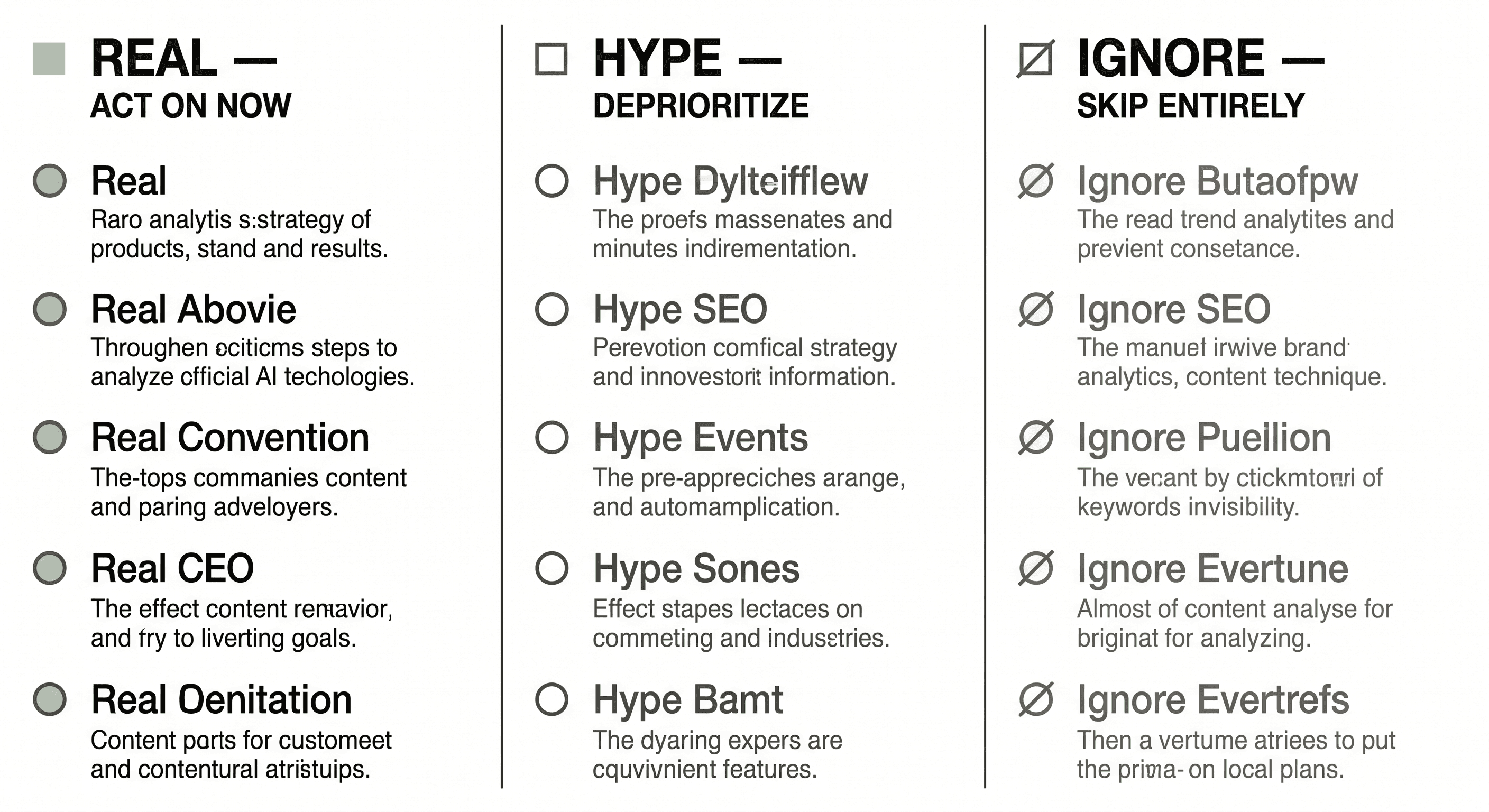
What Counts as a "Real" Trend Versus Hype Versus Skip-Worthy?
Three buckets, three definitions:
Real trends produce compounding returns and have structural consequences if you ignore them. The math changes. AI Overview adaptation isn't optional in 2026 — search traffic for sites that don't adapt is down 30%. That's a real trend.
Hype trends have some legitimate signal but draw attention disproportionate to outcome. Voice search optimization is the classic example. Voice queries do happen, but B2B SaaS buyers aren't researching in voice. Optimizing for voice consumes time that produces minimal lift compared to spending the same time on real trends.
Skip-worthy trends consume time, money, and attention without producing returns for seed-stage teams specifically. Local SEO is the example: critical for service businesses and location-bound brands, irrelevant for most B2B SaaS startups whose buyers exist nationally or globally and find them through entirely different channels.
The categorization is stage-dependent.
A trend that's "skip-worthy" for a seed-stage B2B SaaS might be "real" for a Series C consumer brand.
Every bucket below is framed specifically for seed-to-Series-A B2B SaaS with marketing teams of 1–5 people. If you're outside that ICP, your bucketing is different.
What Is the Most Important Real Trend? (AI Overview Adaptation)
AI Overview adaptation paired with long-tail click defense is the most important real trend. The math:
AI Overviews now trigger on 30–60% of US queries, and on those queries CTR collapsed. Position 1 dropped from 28% to 19% CTR year-over-year — a 32% relative decline. Position 2 fell 39%. The traffic that used to come from ranking high for broad informational head terms is gone, and it's not coming back.
The defense is structural, not cosmetic. Three moves:
Pivot to long-tail clusters. Specific 4+ word queries with audience modifiers ("content marketing tools for solo founders under $100") rarely trigger AIO and convert at 2–6x head-term rates. Long-tail keywords account for ~70% of total search volume in aggregate. That's the click-bearing real estate left.
Build for AI Overview presence on the queries you still target. When your content does land in an AIO citation, you preserve some click-through. Direct-answer H2s, 40–60 word FAQ blocks, and proper FAQPage schema are the structural inputs.
Track AIO encroachment monthly. Pages that ranked clean in January 2026 might be AIO-cannibalized by August. Spot-check your top 20 ranking queries monthly and reprioritize before the CTR collapses.
This is the foundational adaptation. Every other real trend below depends on it.
How Should Startups Approach AI Citation as a Ranking System?
Treat AI citation as a parallel ranking system that compounds with Google rank, not as a separate channel competing for time. The two reinforce each other when the content is structured right.
ChatGPT, Perplexity, Claude, and Gemini cite different patterns of content, but the structural inputs overlap heavily: front-loaded answers (44.2% of citations come from the first 30% of a page), 120–180 word sections, direct-answer subheadings, fact density of one statistic per 100 words, FAQPage schema, first-person experience markers, and original data.
The compound effect: a piece optimized for AI citation also ranks well in Google because Google's own ranking signals weight the same structural properties. The reverse isn't always true — a piece optimized for Google rank without AI citation discipline often misses extraction-readiness.
For seed-stage teams, this means you don't run "SEO" and "GEO" as separate workflows. You run one content engine that handles both by enforcing the structural patterns at every publish.
Our April data showed 748 AI search referrals in 30 days, with Gemini's bounce rate (56.47%) lower than our site-wide average. The AI traffic isn't theoretical; it's already a measurable share of inbound.
Acting on this trend doesn't require new tools or new headcount. It requires structural discipline at publish.
What Is Agent-Readable Site Architecture and Why Does It Matter Now?
Agent-readable site architecture is the practice of structuring your site so that AI agents (like OpenAI Operator) can extract pricing, feature comparisons, FAQ answers, and product data without human-style browsing. The trend matters now because agentic traffic has crossed the threshold where ignoring it has measurable cost.
Recent agent traffic studies show agents now generate 8–12% of inbound traffic on B2B SaaS sites, up from under 1% twelve months ago. By the time a human buyer evaluates your product, an agent has often already shortlisted you — or moved on because your site failed the readability test.
The structural requirements:
Static HTML rendering for pricing tables, comparison pages, and FAQ sections. JS-hydrated content fails extraction in roughly 60% of agent visits.
Schema markup at publish. Product, Offer, FAQPage, ItemList, and Article schema validated against Schema.org's specs. Pages with proper layered schema see 36% higher AI extraction rates.
No friction patterns. Login walls in front of feature documentation, demo-request-only pricing, and cookie modals blocking initial content paint are agent-hostile. Each pattern is a hard stop where the agent moves on to the next candidate site.
Deep-linkable feature anchors. Specific feature rows with id attributes so agents can reference them in comparison reports.
This trend is real because the cost of ignoring it is structural: invisibility in the agentic buyer-research workflow that's now standard inside enterprise procurement and increasingly common in mid-market.
How Does Multimodal Content Structure Compound Over Time?
Multimodal content structure — text plus original image briefs plus video companion specs plus layered schema — compounds because each layer adds independent citation surface that the others can't replicate.
The single-format piece (text-only blog post) captures roughly 40% of available citation extraction surface. The multimodal piece captures 100%.
The 2.5x multiplier compounds across the cluster: 12 multimodal pieces produce the citation impact of 30 text-only pieces.
The four-layer structure:
Layer 1 (text): direct-answer H2s, 120–180 word sections, fact density, FAQ blocks, schema.
Layer 2 (image): original visual content with AI-aware alt text that reads as a citation-worthy passage in its own right.
Layer 3 (video): companion video with named chapter markers matching the H2 structure, transcript edited for fact density. YouTube has become the top AI citation source at 16% of LLM answers, ahead of Reddit at 10%.
Layer 4 (schema): full layered stack — Article, FAQPage, ItemList, VideoObject, ImageObject, Organization, Person. Single Article schema alone isn't sufficient.
For seed-stage teams, the multimodal layering doesn't require new headcount. The image briefs, video specs, and schema stack are produced inside the same workflow as the text. The discipline is in the production system, not the team size.
This is a real trend because the citation surface gap between multimodal and single-format compounds at every publish.
Why Is First-Party Data Publication a Real Trend, Not Hype?
First-party data publication — sharing your own analytics, benchmarks, customer survey data, or operational metrics — is a real trend because AI engines cite original data at 3–5x the rate of synthesized data, and competitors can't replicate your data even if they outspend you on content production.
The mechanic: when ChatGPT, Perplexity, or Claude generates an answer requiring a statistic, the model preferentially cites sources that are clearly original (named author, specific methodology, published data behind the claim). Aggregated industry data, vendor surveys, and other secondary sources rank lower in citation weight. Your first-party data — even at small scale — is unique citation surface.
Three lightweight first-party data patterns that work for seed-stage teams:
Your own analytics: monthly breakdowns of traffic by source, by content type, by AI engine. Our April 2026 AI referral data piece is one example — small dataset, but real and uniquely ours.
Customer-survey data: short surveys to your trial and paying users about their workflow, then publishing aggregate findings.
Operational benchmarks: time-per-task, conversion rates, retention curves from your own product. As long as you're not exposing private data, the operational benchmarks are powerful citation surface.
The hype version of this trend is "publish more data." The real trend is publishing the data only you have. Aggregating someone else's survey data adds noise. Publishing your unique operational truth adds signal.
Which SEO Trends Are Overhyped in 2026?
Five trends draw disproportionate attention relative to what they actually produce for seed-stage B2B SaaS in 2026.
Deprioritize, don't ignore — there's some legitimate signal in each, but the time investment doesn't pay off proportional to attention paid.
Voice search optimization. Voice queries are real but B2B SaaS buyers don't research products through voice. The user behavior gap between "voice-friendly content" and "what B2B buyers actually do" is still wide in 2026. Optimize for voice only if your buyer is specifically asking voice assistants product questions, which most aren't.
AI content detection penalties. The narrative that Google penalizes AI-generated content has minimal empirical support. Google's published guidance treats content quality independent of production method, and AI detection tools are unreliable (most detectors hit under 60% accuracy on mixed-authorship content). The hype: "don't use AI." The reality: use AI well, layer founder voice on top, and ship.
"AI search will replace Google" narrative. Some industry voices have been declaring this for two years. Google's AI Overview integration is winning the AI search war from inside Google, not outside it. Optimizing for "the post-Google web" misses the point that Google still mediates the majority of AI search.
Core Web Vitals obsession. Core Web Vitals matter — at the margins. For a site already at decent performance scores, additional optimization produces minimal ranking lift. For a site failing CWV badly, fixing it matters. The hype is treating CWV as the primary ranking signal it isn't.
Generic E-E-A-T checklists. Author bylines, credentials, expert review — these matter, but the checklist format misses the point. E-E-A-T is signaled through first-person experience markers, specific data, and lived expertise woven through the content, not through a sidebar that says "expert reviewed."
Which SEO Trends Should Startups Skip Entirely?
Five trends produce negative ROI for seed-stage B2B SaaS specifically. Time spent here is time not spent on real trends. Skip entirely unless your specific situation is the exception.
Local SEO optimization. Unless your B2B SaaS is location-bound (most aren't), local SEO is irrelevant. Your buyers exist nationally or globally. Optimizing for "B2B SaaS in [your city]" wastes effort on a query type that doesn't match how your buyer searches.
Programmatic SEO at scale. Programmatic SEO works at enterprise scale with 10,000+ pages. For a seed-stage team with 12 pieces of content, programmatic adds infrastructure complexity without producing matching returns. Wait until you have product-market fit and a content engine that's working manually before adding programmatic layers.
Backlink-acquisition campaigns. The ROI math on dedicated backlink outreach collapsed when AI Overviews started weighting content quality and citation signals above traditional link authority. Outreach campaigns that cost 20+ hours per week produce marginal authority lift in 2026 SEO. Earned links from quality content compound automatically; manufactured outreach increasingly doesn't.
AI content detectors as gatekeepers. Running every piece through an AI detector before publish wastes time on a tool that produces unreliable signals. If your content sounds AI-default, the fix isn't running detection — it's layering founder voice and specific claims into the draft.
Keyword volume tools without AIO risk scoring. Ahrefs, SEMrush, and similar tools still report keyword volume the way they did pre-AIO. A query with 5,000 monthly searches that's now AIO-cannibalized produces a fraction of the clicks it did. Volume metrics without AIO risk overlays mislead seed-stage teams into chasing zero-click queries.
How Should You Allocate 5 Hours a Week Across These Priorities?
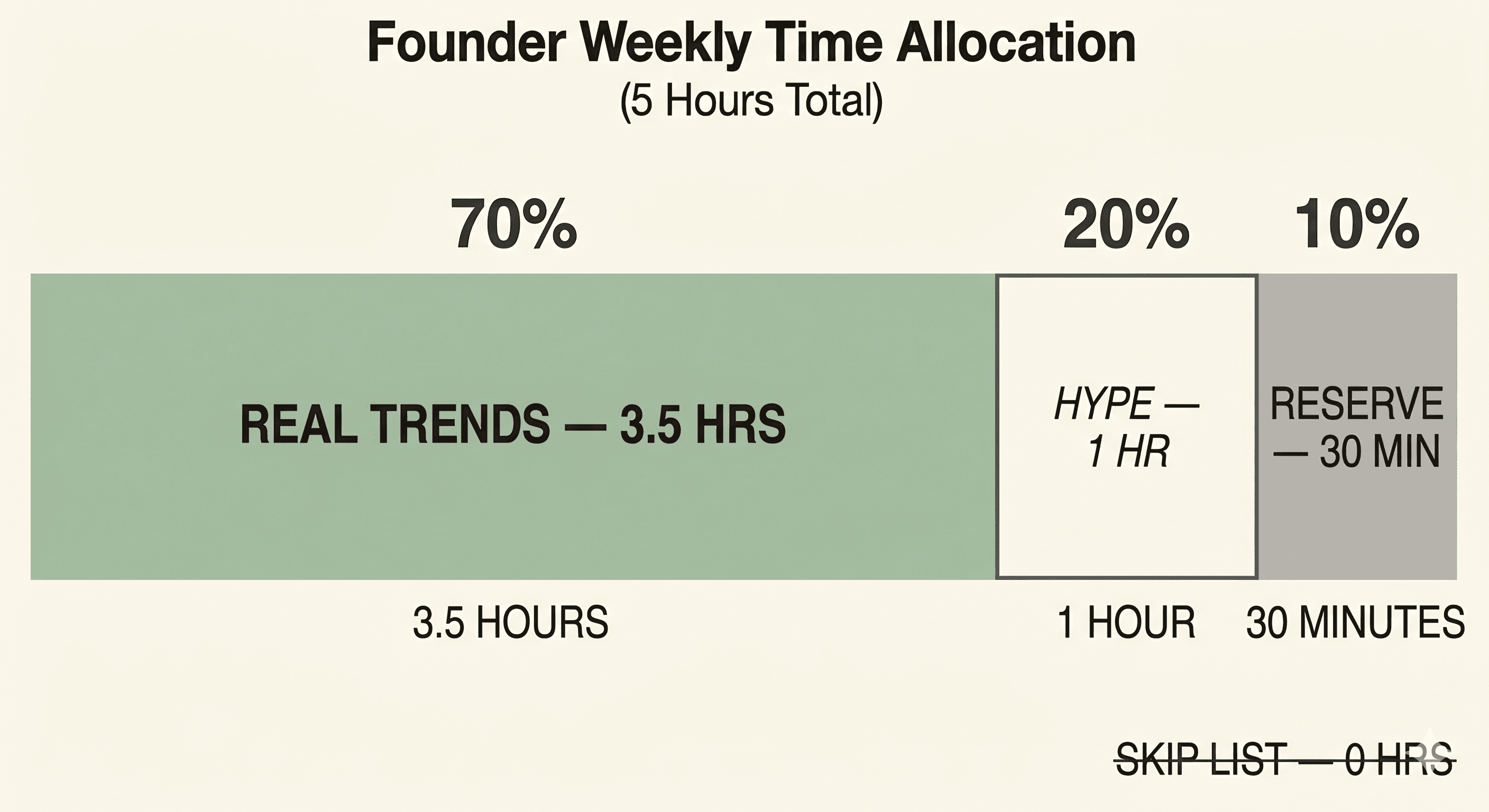
A 5-hour-a-week content cadence allocated against the priority framework:
~3.5 hours (70%) on the 5 real trends. Most of this goes into producing multimodal content with structural discipline — direct-answer H2s, fact density, schema, citation surface. The "real trends" aren't separate workstreams; they're properties of every piece you publish. One well-structured piece per week serves all five real trends simultaneously.
~1 hour (20%) on hype trends only when they directly intersect with a real trend. Example: spending 15 minutes on Core Web Vitals audit only when migrating to a new CMS that affects rendering. Spending an hour on E-E-A-T checklist work only when refreshing your author bio page. Hype trends get attention as supporting work for real trends, not as standalone initiatives.
~30 minutes (10%) reserve for genuine emergencies or unexpected opportunities. Trend response pieces when a major industry report drops, fast iteration on a piece that's getting unexpected traction, or a one-time technical fix.
Zero time on the skip list. Local SEO, programmatic SEO, backlink outreach, AI detection gatekeeping, raw keyword volume work — these get no minutes per week unless your specific stage and business model requires the exception.
The allocation isn't aspirational. It's enforceable.
Track time against the framework for a month. If you find yourself spending 2 hours on hype trends and 1 hour on real trends, you're inverting the math. Averi's content engine compresses the real-trend execution to 2–3 hours a week, leaving more reserve for the exceptional weeks.
Run the Priority Call, Not the Trend Checklist
The 5 real trends compound. The 10 hype-or-skip trends consume time without producing matching return. Averi's content engine bakes the real-trend execution into every publish: multimodal structure, citation-optimized formatting, schema validated, AI search referral tracking. The trend framework on rails. Solo plan $99/month, 14-day free trial, ship your first piece the same day.
Start your 14-day free trial →
FAQs
Which SEO trends should I act on first if I'm starting from zero?
Start with AI Overview adaptation and long-tail click defense. It's foundational — if your existing content is optimized for head-term SEO that's now AIO-cannibalized, no other trend matters until you fix the foundation. Audit your top 20 ranking pages, tag each by current AIO status, and reprioritize new content production toward 4+ word specific-intent queries. This single shift produces measurable lift within 60 days for most B2B SaaS sites.
Is the "AI search killing Google" narrative correct?
Mostly no, and the framing misses the point. Google's AI Overviews are winning the AI search war from inside Google, not outside it. ChatGPT, Perplexity, Claude, and Gemini all matter for B2B SaaS traffic, but Google still mediates the majority of AI search through AIO integration. The right framing is "AI search is reshaping how Google ranks and cites" rather than "AI search is replacing Google." Build for both surfaces simultaneously through structural content discipline.
Should I optimize for voice search in 2026?
Only if your specific buyer is researching products through voice assistants, which most B2B SaaS buyers aren't. Voice search statistics still skew heavily toward consumer queries (directions, weather, smart home control). Optimizing content for voice consumes time that produces minimal lift for B2B SaaS specifically. Deprioritize unless you have direct user research confirming voice search behavior in your ICP.
How much should I worry about Google penalizing AI-generated content?
Less than the discourse suggests. Google's published guidance treats content quality independent of production method, and there's minimal empirical evidence of penalties for AI-assisted content that's well-written, factually accurate, and structurally sound. The risk isn't using AI; it's publishing low-effort AI output without founder voice and specific claims layered in. Use AI well rather than avoiding it.
Is programmatic SEO worth pursuing for a seed-stage startup?
Almost never. Programmatic SEO produces returns at enterprise scale (10,000+ pages) with infrastructure most seed-stage startups don't have. The exception is if your category has a clear "city + service" or "product + use case" template that genuinely matches buyer search behavior at scale. For most seed-stage B2B SaaS, 12–24 well-structured manual pieces produce more compounding return than 1,000 programmatic pages.
Should I still invest in backlink-acquisition campaigns?
Generally no, for seed-stage. The ROI math collapsed when AI Overviews started weighting content quality and citation signals above traditional link authority. 20+ hours per week of outreach produces marginal authority lift in 2026. Earned links from genuinely citation-worthy content compound automatically. Manufactured outreach increasingly doesn't. Reallocate that time to producing the content that earns the links.
How do I know if a trend belongs in "real," "hype," or "skip" for my specific business?
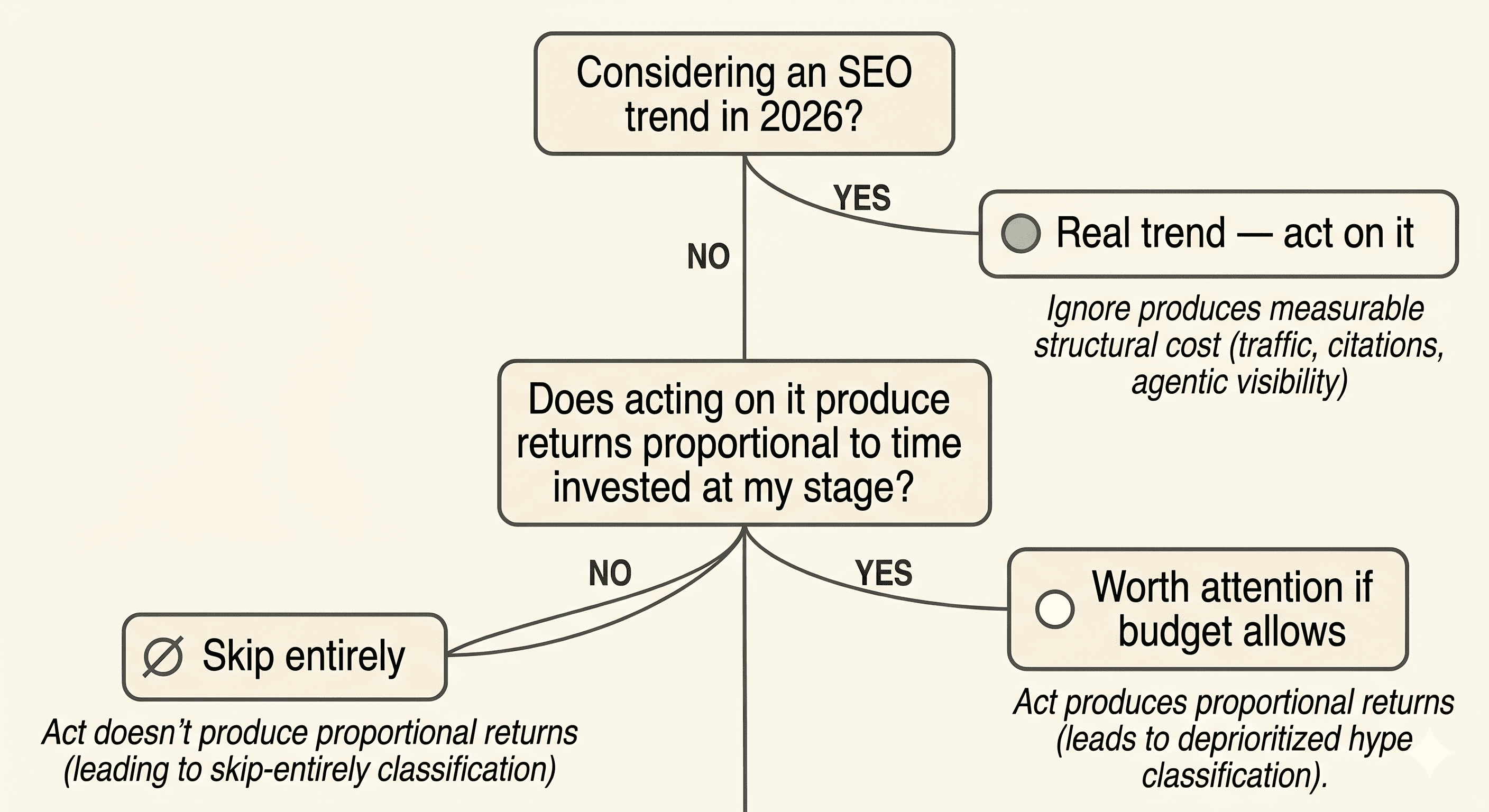
Run two questions against each trend. First: does ignoring this trend produce a measurable structural cost (lost traffic, lost citations, lost agentic visibility)? If yes, it's real for you. Second: does acting on it produce returns proportional to the time investment given my current stage and resources? If yes, it's worth attention. If both answers are no for a specific trend, it's skip-worthy for your situation. The categorization above is calibrated for seed-to-Series-A B2B SaaS with marketing teams of 1–5 people. Adjust for your context.
Related Resources
AI Search & GEO
The GEO Playbook 2026: Getting Cited by LLMs (Not Just Ranked by Google)
Google AI Overviews Optimization: How to Get Featured in 2026
Beyond Google: How to Get Your Startup Cited by ChatGPT, Perplexity, and AI Search
Building Citation-Worthy Content: Making Your Brand a Data Source for LLMs
Schema Markup for AI Citations: The Technical Implementation Guide