You Don't Need to Hire a Content Engineer. You Need to Buy One. (For $99/mo.)

6 minutes

TL;DR
💰 Mid-level content engineers cost $180–$220K fully loaded Year 1 when you add salary, payroll loading, tools, training, and recruiting — VelvetJobs reports content engineer base at $165K, 6figr's range runs to $259K
⏱ Six months of ramp before output — a content engineer's first quarter is system-building, not publishing; the second quarter is when content starts shipping
📊 AirOps's $1M cohort proof comes from companies like Webflow, Wiz, Vanta, Ramp, Ironclad, Netflix — companies with revenue, marketing teams, and headcount budget. Different ICP than seed-to-Series-A founders.
🛠 What a content engineer builds in 90 days is roughly identical to what Averi ships on day one: Strategy Map, Content Queue, Content Scoring, CMS publishing, analytics
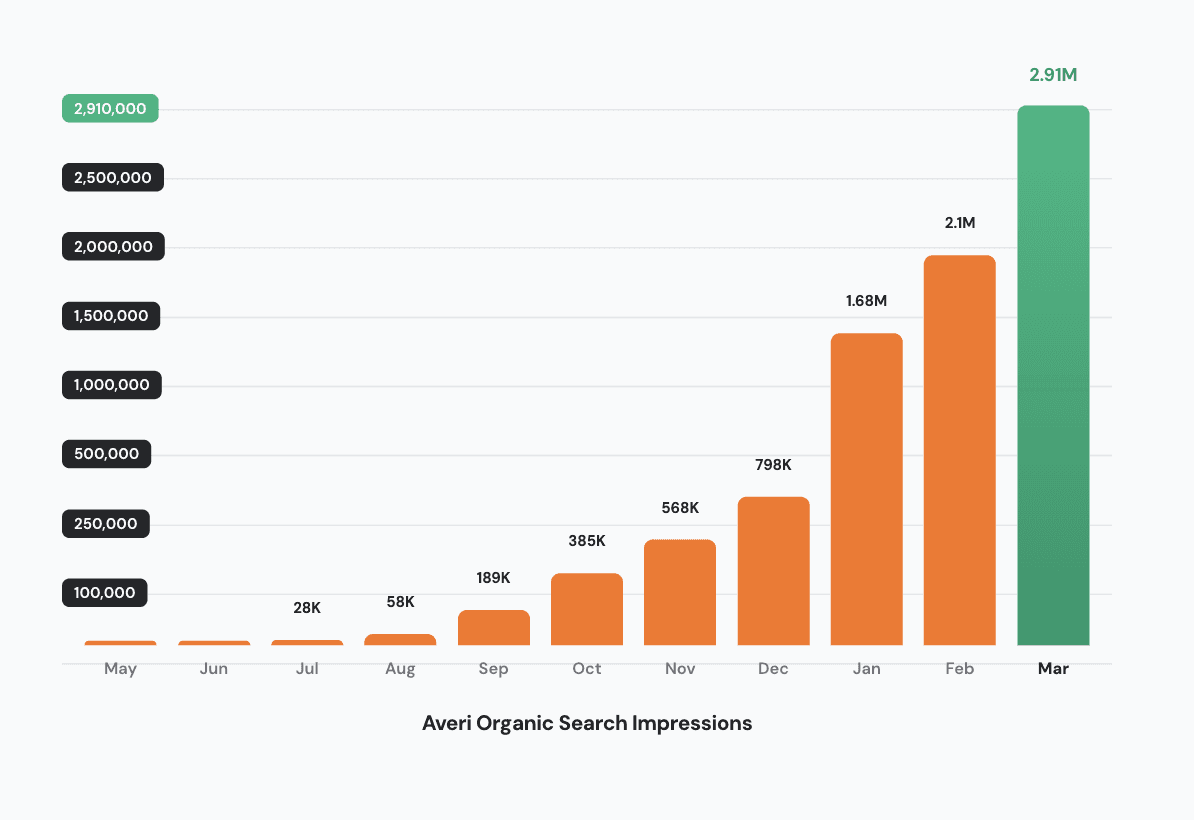
📈 Averi's own marketing engine runs entirely on the platform — 6,000%+ organic traffic growth, 1.68M+ monthly impressions, one-person marketing team. The proof is the same one a $200K hire would aim to produce
✅ Hire a content engineer when you're $5M+ ARR, have a marketing team, and need a builder. Buy a content engine when you're a founder running marketing solo and need outputs this quarter.

Zach Chmael
CMO, Averi
"We built Averi around the exact workflow we've used to scale our web traffic over 6000% in the last 6 months."
Your content should be working harder.
Averi's content engine builds Google entity authority, drives AI citations, and scales your visibility so you can get more customers.
You Don't Need to Hire a Content Engineer. You Need to Buy One. (For $99/mo.)
The content engineer role is having its moment.
AirOps just published "10x Content Engineer One Year Later" showing $1M in pipeline from their training cohort.
Job listings at Meta, Ramp, Vercel, and Wiz now use the title formally. The category has been named, and the dominant framing is hire one.
Here's the founder counter-position the category needs: a senior content hire costs $120–$220K fully loaded, and that's before tooling stack, training cohort fees, and the 6-month ramp before they've built anything.
For a seed-to-Series-A founder, that's the wrong end of the buy-vs-build decision.
You don't need the role. You need the system the role would build.
This piece is the buy-vs-hire math, the 90-day output comparison, and the honest answer to "do I need a content engineer at this stage."
Want to see your current Marketing Maturity?
Why the content engineer role exists (and who named it)
Credit where credit is due. The content engineer category was named largely by AirOps and iPullRank, sharpened across 2024–2025 by a real shift in what content marketing required.
The diagnosis is sound: AI changed the bottleneck. Production speed stopped being constrained by writing and started being constrained by system design.
Teams that figured out how to automate research, briefing, drafting, scoring, and refresh shipped 10x faster than teams still publishing one piece at a time.
AirOps's framing: "Content marketers and SEO teams needed to stop being production units and start being system builders."
That's right. The job-to-be-done at the modern content function is system design, not document drafting.
The cohort outcomes prove the model works: Webflow grew AI-attributed signups from 2% to nearly 10% in under a year, Chime tripled citations in under 4 weeks, and Carta achieved a 75% citation rate increase — all without adding additional headcount, all by training existing employees on system-building.
The category-defining content engineer responsibilities, as published across the AirOps, Jasper, and Surfer pieces:
Build automated workflows for keyword research, content briefs, and first drafts
Design programmatic SEO templates that scale across hundreds of pages
Set up content refresh pipelines that catch decay before traffic drops
Build internal linking maps that update automatically with new content
Optimize content for AI search citations (GEO/AEO)
Maintain brand voice consistency across AI-generated output at scale
Track AI citation patterns and competitor share-of-voice
That's a real job description.
It's also a job description that describes a system more than it describes a person.
Which is the central question this piece exists to answer: at the seed-to-Series-A stage, do you need to hire someone to build that system, or do you need to buy a system that's already built?
For more on the role's origin and category context, see our piece on the rise of the content engineer and our take on why 2026 is the year you might actually become a content engineer.
What a content engineer actually does in their first 90 days
This is the part that matters. Strip away the LinkedIn job postings and look at what someone in this role actually ships in their first quarter. Based on the cohort case studies AirOps publishes and the public job descriptions at Meta, Ramp, and Vercel, here's the honest 90-day output.
Days 1–30: Foundation
Audit the existing content library (typically 100–500 URLs)
Map current content against ICP, buyer journey stages, and topic clusters
Set up a workflow tool stack (typically AirOps + Ahrefs + a CMS connector + Clay or similar)
Build the brand voice / style guide system the AI will use for drafting
Identify the top 10 highest-priority content gaps
What's published: Nothing. This is foundation work.
Days 31–60: First systems
Build the first 2–3 automated workflows (typically: a content brief generator, an AI draft pipeline, an internal link auditor)
Set up the content scoring rubric (SEO + GEO composite)
Configure the first competitor monitoring dashboard
Build the content refresh prioritization pipeline
Ship 3–5 pieces of content as workflow proof
What's published: A handful of pieces, mostly as workflow validation rather than strategic output.
Days 61–90: Scaling production
Tune the workflows based on output quality
Add agentic-browser-readiness checks to the publishing pipeline (schema, FAQ structure, fact density)
Set up the analytics dashboard tying content to pipeline
Onboard the rest of the marketing team to use the system
Begin refreshing the existing library at a defined cadence
What's published: Maybe 10–15 pieces total in the first 90 days, with the system finally producing predictable output by week 12.
That's the honest version.
Three months, $50K+ in salary alone, and roughly a dozen pieces of content.
The compound value comes later — in months 4–12, the system the engineer built starts producing 30–50 pieces per quarter at consistent quality.
That's where the AirOps "$1M pipeline" stories come from.
They're real, and they're real for the companies that can afford 90 days of foundation cost. Teams using content engineering report cutting production costs by 50%, doubling publishing speed, and refreshing content with 40% more impact — but those gains compound only after the system is built.
For the broader workflow this maps to, see our content engine workflow guide — same six phases, same structural layers, built into a platform instead of assembled from parts.
Want to see your potential Content ROI you could achieve with the right system?
The real fully-loaded cost of hiring one
The Year 1 cost of a content engineer is rarely the salary line on the offer letter. Here's the actual budget impact.
Cost category | Range (US, 2026) | Source |
|---|---|---|
Base salary (mid-level) | $140,000–$165,000 | |
Benefits + payroll tax loading (~30%) | $42,000–$50,000 | Standard US loading rate |
Tooling stack (AirOps + Ahrefs + Clay + CMS) | $12,000–$30,000 | Published platform pricing |
AirOps University / cohort training | $3,000–$8,000 | |
Recruiting cost (20–25% of base) | $30,000–$40,000 | Standard recruiter fee |
Onboarding ramp opportunity cost | ~$30,000 | 60 days × $500/day in deferred output |
Year 1 total | $257,000–$323,000 |
Even at the conservative end, you're looking at roughly $250K in Year 1 to put a content engineer in seat and have them produce a system. If your ICP is enterprise (50+ marketing employees, $25M+ ARR), this math works. Your CMO is already running multi-million-dollar campaigns. A $250K hire is a rounding error, and the system that hire builds compounds across a team that can use it.
If your ICP is the seed-to-Series-A founder running marketing solo, $250K is roughly your entire first-year marketing budget. Series A startups typically allocate 10–15% of ARR to marketing, which at $2–5M ARR puts the entire annual marketing spend in the $200–750K range. You're choosing between hiring someone to build the system OR doing every other piece of marketing — paid acquisition, demand gen, partnerships, events, content, brand. Picking the system-builder leaves nothing for the system to promote.
For more on the broader budget framing, our 2026 marketing budget reality check walks through how to allocate when AI changes every line item.
See how much you'd save by utilizing Averi as your Content Engineer
What you actually get when you buy the system instead
Here's what Averi Solo ($99/mo) gives you on day one — the parallel comparison to a content engineer's 90-day output.
Day 1 (after a 30-minute setup)
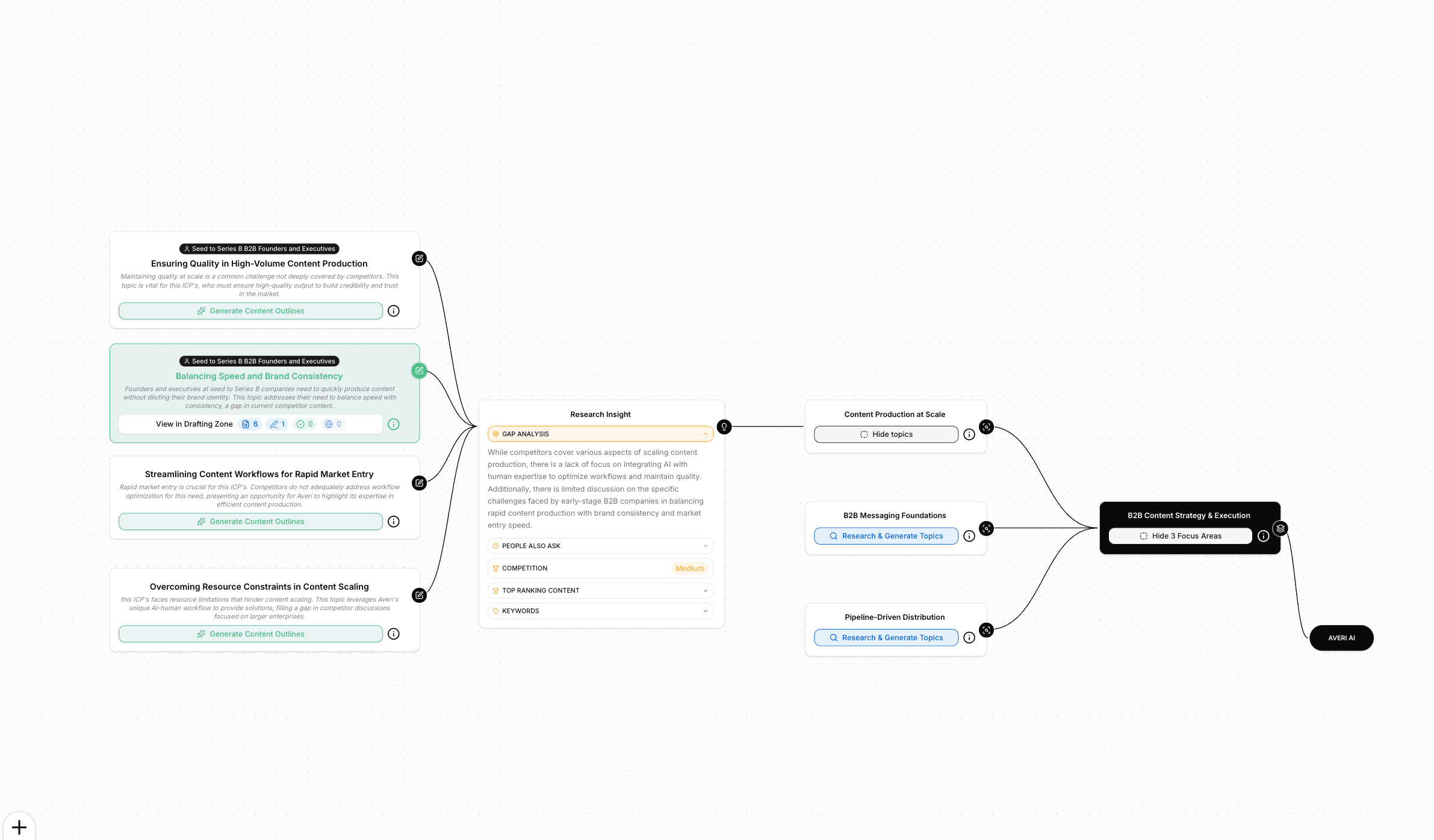
Strategy Map: Averi scrapes your site and generates your ICPs, competitor analysis, and content goals automatically. This is the work an engineer would do in week 1.
Brand Core: Brand voice and style guide built from your site content and confirmed by you in 10 minutes. The work an engineer would do in week 2.
Content Queue: Topic ideas, target keywords, and outlines pre-attached, refreshed weekly. The work an engineer would do in weeks 3–4.
Week 1
Content drafting: AI drafts based on your Brand Core, your Strategy Map, and the queued topic. The work an engineer's pipeline would produce in weeks 6–8.
Content Scoring: Composite SEO + GEO score (0–100) on every draft before publish. The scoring rubric an engineer would build in weeks 4–6.
CMS publishing: Direct publish to Webflow, Framer, or WordPress with proper schema markup by default. The publishing pipeline an engineer would set up in weeks 8–10.
Week 2
Analytics dashboard: Search Console + AI citation tracking unified in one view. The dashboard an engineer would assemble in weeks 10–12.
Calendar view + autopublish: Content scheduling and execution. Standard publishing infrastructure.
The gap between "what a content engineer ships in 90 days" and "what Averi ships on day one" is roughly 90 days of foundation work.
That gap is the entire value proposition.
You're paying $99/mo to skip the buildup phase and start with the system already running.
The catch worth naming: Averi gives you the engine. It does not give you the strategic context only you have about your business, your buyers, and your market.
A content engineer would acquire that context over their first 30 days through interviews, document review, and customer research.
As a founder, you already have it — that's the unfair advantage of running marketing yourself.
You skip the context acquisition phase entirely.
For the deeper system breakdown, see our guide to building an AI content engine that grows your startup and our piece on the 48-hour AI content engine.
When hiring is actually the right call
Same as the HubSpot piece — I'm not going to argue that hiring a content engineer is wrong for everyone, because it isn't. Here's the honest framework for when the hire makes sense.
Hire a content engineer when ALL of these are true:
You're at $5M+ ARR with a marketing team of 3+ people
You have a content library of 100+ existing pages that need active management
You're running paid acquisition at meaningful scale and need the organic side to balance the budget
Your CMO has signed off on a 6-month payback timeline
You have specific technical requirements (programmatic SEO at scale, custom integrations, multi-brand publishing) that platform tools can't accommodate
The $250K+ Year 1 investment doesn't crowd out other marketing spend
If most of those are true, the hire compounds. The system the engineer builds becomes infrastructure the rest of the marketing team uses, and the AirOps cohort case studies (Webflow, Wiz, Vanta, Ramp, Ironclad) show the model working.
With AI Overviews now appearing on 50%+ of US searches and AI search visitors converting at 4.4x the rate of traditional organic, the content engineering layer is real infrastructure for an enterprise marketing team to invest in.
Buy a content engine when ALL of these are true:
You're seed to Series A with 5–25 employees
You're the marketing team (or one hire deep)
Your content library is small (under 50 pages) or starting from scratch
You need outputs this quarter, not next quarter
$250K is your entire annual marketing budget, not a line item within it
You'd rather spend that budget on actually executing than on building the capability to execute
If most of those are true, you don't need the role. You need the system the role would build, and you need it now.
What we did at Averi (the proof point)
We never hired a content engineer. We are the content engineer for Averi, running entirely on the platform we built.
One person on the marketing team (that's me. hi).
The Strategy Map, the Content Queue, the Scoring System, the autopublish pipeline — all of it runs through the same workflow any Averi customer uses.
The output, after roughly a year of running this way:
6,000%+ organic traffic growth in 10 months
2.9M+ Monthly Google impressions
25k+ monthly site visitors on a one-person marketing team
Zero paid advertising spend
That's the same outcome a $250K hire would aim to produce — without the $250K, without the 6 months of ramp, and without taking the marketing function offline while someone gets hired and onboarded.
The system shipped the results because the system was the point. The role was the wrapper.
If a content engineer's job is to build a content engine, and you can buy a content engine for $99/mo, the buy-vs-hire question for founders mostly answers itself.
What to do this week
If you're a founder evaluating "do I hire a content engineer or do I buy a content engine," the decision is faster than the comparison suggests:
Ask which problem you're actually solving. If your content function is broken because nobody's running the system, hire someone. If your content function doesn't exist yet because you don't have a system, buy one.
Run the buy-vs-hire math at YOUR stage. Not at the enterprise stage the case studies use. A $250K hire at Series A is a category mistake; the same hire at Series C is a competitive advantage. Stage matters.
Test the buy alternative first. Averi Solo is $99/mo with a 14-day free trial. The downside risk is one month of trial cost. The upside is finding out whether the system replaces the hire entirely.
If you decide you need the hire, do it after you've used the system. Founders who've run a content engine for 6 months write better job descriptions and onboard new hires faster, because they know exactly what the system does and what gaps remain.
Don't let the role's existence be the argument for the hire. Categories get named because they describe a real shift. They don't get named because every company at every stage needs to add the role to the org chart.
If you want to test the alternative — the same content engine workflow that produces the AirOps cohort outcomes, but built for founders running marketing solo — start a free 14-day Averi trial. 30 minutes to set up. Outputs in week one.
FAQs
What is a content engineer and what do they do?
A content engineer is a hybrid role combining content strategy, workflow automation, and AI tooling expertise. They build the systems that scale content production — automated research pipelines, AI draft workflows, content scoring rubrics, refresh pipelines, and AI search optimization layers. The role was named in 2024–2025 as AI shifted the production bottleneck from writing to system design.
How much does a content engineer cost in 2026?
Fully loaded, a mid-level content engineer in the US costs $180,000–$220,000 in Year 1. That includes a base salary of $140K–$165K, ~30% benefits and payroll tax loading, tooling stack ($12K–$30K), training cohort fees ($3K–$8K), recruiting cost (20–25% of base), and ramp-period opportunity cost. Senior hires at high-growth companies push past $250K fully loaded.
Can a startup founder do a content engineer's job themselves?
Yes, if they have the right tooling. A content engineer's job is system design, not writing. Founders running marketing solo already have the strategic context an engineer would spend 30 days acquiring (ICP, buyer journey, competitive set) — the gap is the system itself. With a content engine platform, the system is bought rather than built, and the founder becomes the one operator who already understands the business.
What's the difference between a content engineer and a content engine?
A content engineer is a person who builds the system. A content engine is the system itself. AirOps positions the engineer as the role that uses tools like AirOps to build the engine. Averi positions the engine as the platform that delivers the same output without requiring the engineer hire — useful for founders, marketing teams of one, and lean B2B SaaS startups under $5M ARR.
When should I hire a content engineer vs buy a content engine?
Hire when you're at $5M+ ARR, have a marketing team of 3+, manage a content library of 100+ pages, and have $250K+ in annual hiring budget that won't crowd out other marketing spend. Buy when you're seed-to-Series-A, running marketing solo, and need outputs this quarter rather than next quarter. The decision turns on stage and team size, not on whether the role is real.
How does Averi compare to hiring through an AirOps cohort?
AirOps trains existing employees to become content engineers through their cohort program. The cohort produces real results for companies like Webflow, Wiz, and Ramp — but those companies have existing marketing teams to upskill. Averi delivers the same end output (content engine running, scored content shipping, AI citation optimization) without requiring an existing employee to train. For founders without a marketing team yet, Averi replaces the hire entirely.
What does Averi's own marketing engine look like?
Averi runs its own marketing entirely on the platform with a one-person marketing team. The output: 6,000%+ organic traffic growth in 10 months, 2.85M+ Google impressions, 1.68M+ monthly organic impressions, zero paid advertising spend. The Strategy Map, Content Queue, Scoring System, and autopublish pipeline all run through the same workflow any Averi customer uses. The platform is its own best case study for the buy-vs-hire decision.
Related Resources
Content Engineer & Category Context
The Rise of the Content Engineer: Marketing's Most In-Demand Role
2026 Is the Year You Probably Should Become a Content Engineer
How to Build a Content Engine That Doesn't Burn Out Your Team
Content Engine Workflow & Implementation
Founder Marketing Economics
Marketing at 12 Months Runway: The Survival Playbook for Series A Pressure
Seed Stage Marketing Budget: Where to Spend Your First $5K/Month
Strategic Context
Buy the engine. Skip the hire. Averi Solo gives you the same system a content engineer would spend 90 days building, running on day one. $99/mo, no contract, 14-day free trial. Start your free trial →