We Rank #1 for Our Brand Name. It Took 6 Months and It's Still Not Enough.
5 minutes

TL;DR
📊 Our real Search Console data: "averi ai" = 331 clicks, 61.4% CTR, position 1.4. "ai content marketing platform" = 7 clicks, 2.1% CTR, position 14. The gap is the whole story.
🔢 85% of our search clicks are branded (people who already know us). 15% are non-branded (actual SEO performance). Established companies run 25–35% branded, 65–75% non-branded.
🏔️ Non-branded search is hard for startups: weak domain authority, thin content libraries, competing against entrenched players, on a field where 60% of searches produce zero clicks
🎯 What works: long-tail keywords over head terms, topic clusters over isolated posts, AI citation optimization alongside traditional SEO, honest timelines (7–9 months to break-even)
📈 Averi grew organic traffic 6,000% in 10 months. But the first 4 months were flat. You have to survive the flat part.
🔄 The goal: shift 85/15 to 60/40 to 35/65 over 18–24 months. Every non-branded blog post that ranks adds a permanent discovery channel.
🔧 Averi is the content engine we built because we needed it. Same system, same strategy, now available to startups running the same playbook.
Zach Chmael
CMO, Averi
"We built Averi around the exact workflow we've used to scale our web traffic over 6000% in the last 6 months."
Your content should be working harder.
Averi's content engine builds Google entity authority, drives AI citations, and scales your visibility so you can get more customers.
We Rank #1 for Our Brand Name. It Took 6 Months and It's Still Not Enough.
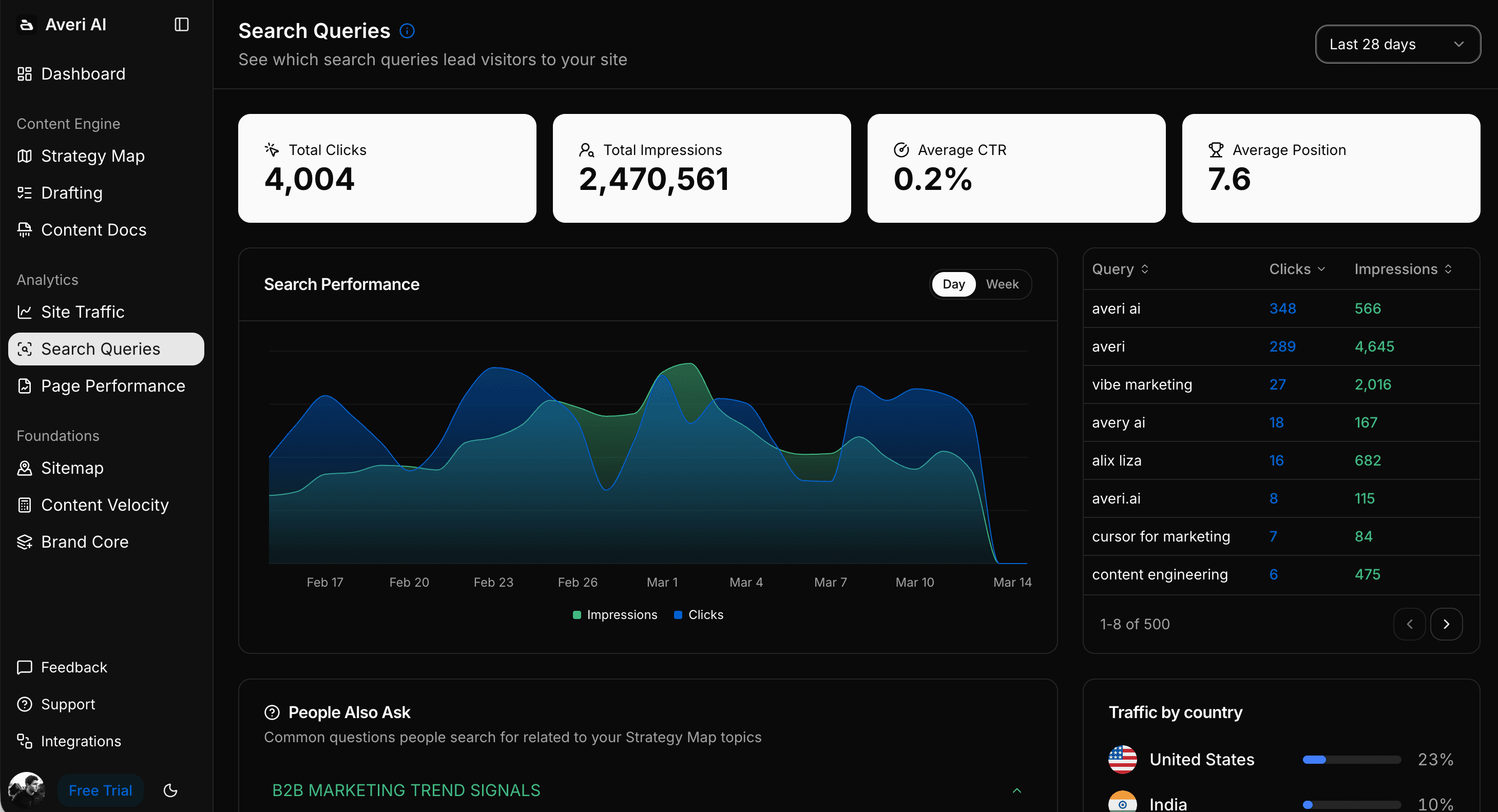
Here are the numbers from our Google Search Console right now:
"averi ai" — 331 clicks/month. 61.4% CTR. Average position 1.4.
"averi" — 266 clicks/month. 5.8% CTR. Average position 2.3.
"avery ai" (the misspelling) — 30 clicks/month.
Combined branded search: roughly 630 clicks per month. We rank #1 or close to it for every variation of our name. If you type our brand into Google, you find us.
That took about six months of consistent work to lock down.
Sounds great. I'd love to tell you we popped champagne.
Here's the other number: "ai content marketing platform" — 7 clicks. 326 impressions. 2.1% CTR. Position 14.
That's a category term. That's a person who doesn't know we exist, searching for exactly what we sell.
Three hundred and twenty-six people saw our listing in search results last month. Seven clicked. Because we're buried on page 2, and nobody scrolls to page 2.
Our branded search CTR is 61%. Our non-branded CTR is 2.1%.
The gap between those two numbers is the entire story of early-stage startup SEO.
The Vanity of Ranking #1
Let me be direct about what ranking #1 for your brand name actually means… people who already know about you can find your website.
That's it. That's what it means.
It doesn't mean your SEO is working. It doesn't mean you're winning in search. It means that the small number of people who heard about Averi through a LinkedIn post, a podcast mention, word of mouth, or a newsletter referral can successfully navigate to our website through Google.
We could have achieved the same thing with a business card.
Most websites get up to 95% of their traffic from branded searches. At early-stage startups, that number can be even higher because there's so little non-branded traffic to balance it out.
When I look at our total search traffic and see it growing, the honest truth is that most of that growth comes from more people hearing about us through non-search channels and then Googling our name.
The search engine is getting credit for work that our newsletter, our content marketing, and our social presence actually did.
Approximately 44% of all Google searches involve branded terms. For established companies, branded queries make up 25–35% of organic traffic, with non-branded driving 65–75%.
For early-stage startups like us?
The ratio is inverted. We're closer to 85% branded, 15% non-branded. That 15% is the part that actually represents SEO doing its job.
What Branded vs. Non-Branded Actually Tells You
If you're a founder staring at your Search Console dashboard feeling good about your click numbers, do this exercise.
It takes two minutes and it will change how you think about your SEO.
Go to Google Search Console → Performance → Queries.
Filter for queries containing your brand name (and common misspellings). Note the clicks.
Now filter for queries NOT containing your brand name. Note those clicks.
The first number is your brand awareness converted into search behavior. People heard about you somewhere else and used Google as a navigation tool.
The second number is your actual SEO performance. People who never heard of you typed a question or need into Google, and your content showed up.
For us, the ratio is roughly 85/15.
Eighty-five percent of our search clicks come from people who already knew about Averi. Fifteen percent come from strangers finding us through the topics we write about.
That 15% is the number that matters.
That's the number we're trying to grow. Because that 15% represents a subscriber, a trial signup, or a customer we would never have reached through any other channel.

Why Non-Branded Search Is So Hard for Early-Stage Startups
The honest answer: because you're competing against companies that have been publishing for years.
The average page in Google's top 10 is over 2 years old. When we target a keyword like "ai content marketing platform," we're competing against established players with domain authorities 3–5x ours, content libraries 10–50x ours, and backlink profiles we can't match for years.
The #1 organic result gets 39.8% of clicks. Position 2 gets 18.7%. Position 3 gets 10.2%.
By position 10, you're collecting scraps.
By position 14 (where we sit for that category term), you're invisible. The top three positions capture 68.7% of all clicks. The rest fight over 31.3%.
Add to that: 60% of Google searches now generate zero clicks as AI Overviews absorb the answer. AI Overviews appear in 25.8% of all US searches and trigger on informational queries 39.4% of the time.
Those are exactly the kinds of queries early-stage startups target because they're the ones that attract new audiences.
So the starting conditions for a seed-to-Series-A startup trying to rank for category terms are: weak domain authority, thin content library, minimal backlinks, competing against entrenched players, on a playing field where clicks are declining industry-wide.
Sounds discouraging.
I don't think it is. But it requires looking at the problem differently.
The Strategy That's Actually Working (Slowly)
We're not going to rank for "ai content marketing platform" this quarter.
Maybe not next quarter either.
That keyword has established competitors with massive link profiles and years of content supporting their rankings.
But here's what we can do, and what's producing results right now.
Target the Long Tail, Not the Head
Instead of chasing the 5 category-defining keywords with thousands of monthly searches and impossible competition, we publish content targeting specific, lower-competition queries that our audience actually searches.
"content marketing strategy for early-stage saas startups" — not "content marketing strategy."
"how to build an ai content engine that grows your startup" — not "ai content engine."
"seo for startups how to rank higher without a big budget" — not "seo for startups."
Each of these has lower volume. But lower competition means we can rank on page 1 within months instead of years.
And the traffic quality is higher because the search intent is more specific.
Someone searching "seo for startups how to rank higher without a big budget" is closer to our ICP than someone searching "seo."
Nearly 74% of all keywords have 10 or fewer searches per month. The long tail is where most search volume lives. It's also where startups can compete.
Build Topic Clusters, Not Isolated Posts
A single blog post targeting "content marketing for startups" won't outrank HubSpot.
But a cluster of 8–10 interconnected posts covering content marketing for startups from every angle starts to build topical authority that Google respects.
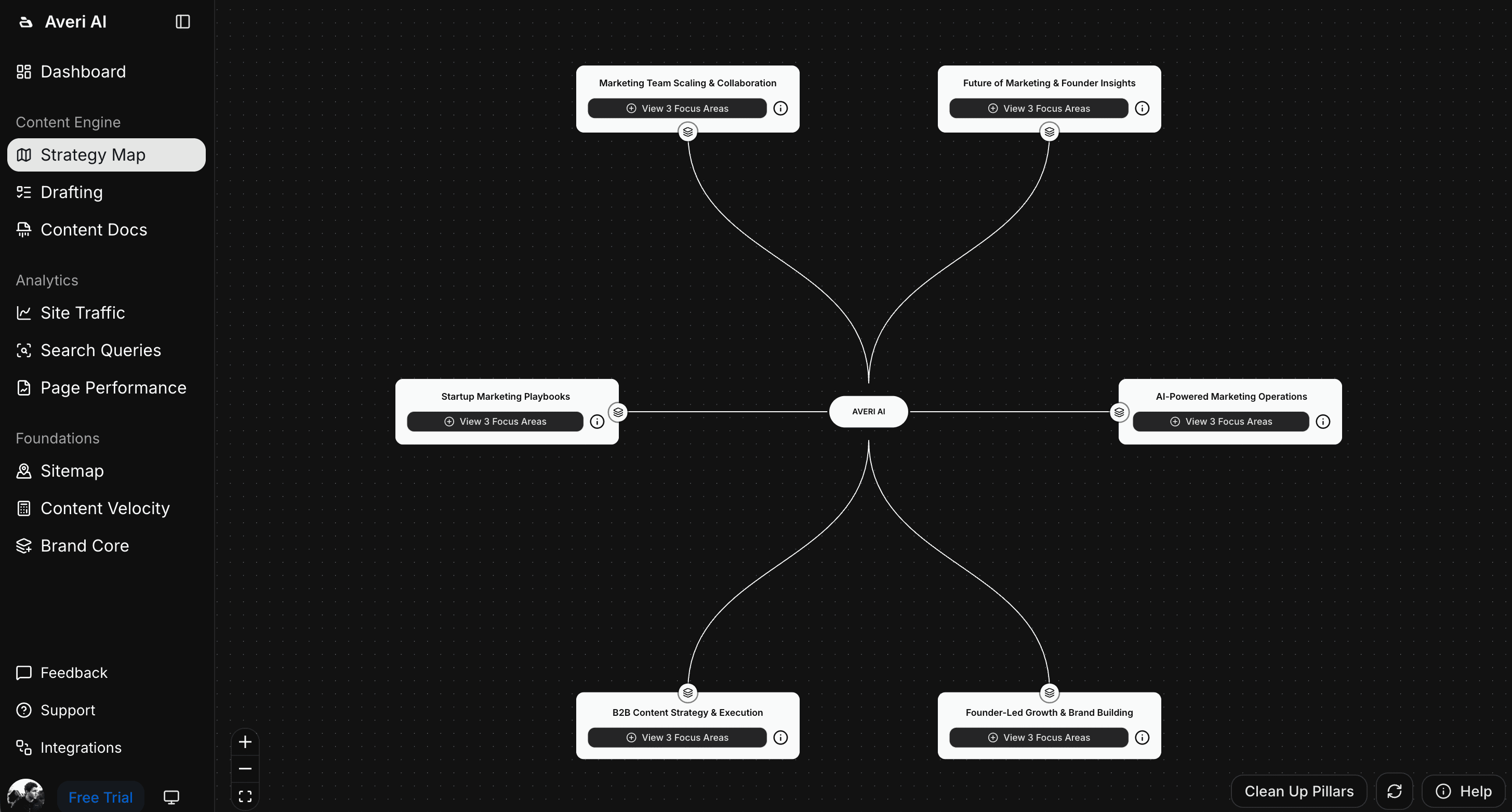
We've built clusters around content marketing for startups, SEO for B2B SaaS, GEO and AI citations, founder-led marketing, and several others.
Each cluster has a pillar post and 4–8 supporting articles. They link to each other. They reference each other. Google sees a web of related authority, not a scattershot of random articles.
The math works because each supporting post has its own keyword target.
Some rank quickly. Some take months.
But the cluster as a whole performs better than any individual post would alone, because the internal linking passes authority between pages and the topical coverage signals expertise.
Optimize for AI Citations Alongside Google
Here's the thing about the zero-click problem: if 60% of searches don't produce a click, the value of being cited in the answer goes up. Getting mentioned in an AI Overview, a ChatGPT response, or a Perplexity answer is visibility even when the searcher doesn't click through.
Sites cited within AI Overviews can see CTR increases of up to 35%. Brands mentioned in AI responses experience 91% higher paid CTR from the halo effect. Being the source that AI systems cite builds brand awareness that converts later, even if it doesn't produce a click today.
We structure every piece for AI citation readiness: clear question-and-answer headers, standalone 40–60 word answer blocks, hyperlinked authoritative statistics, and FAQ sections with extractable answers. Our content scoring system weights GEO factors at 45% alongside traditional SEO at 55%.
This is the informational footprint strategy.
Every piece of content we publish adds to our presence across discovery surfaces.
Some of those surfaces produce clicks. Some produce citations. Some just produce familiarity.
All of them contribute to the moment when someone decides to search for "averi ai" because they saw us mentioned somewhere else first.
Be Honest About Timelines
SEO delivers 748% ROI for B2B companies. But the break-even period is 7–9 months, and meaningful compounding takes 12–18 months.
For a startup managing 12 months of runway, that's a long horizon.
The temptation is to look at month 3 data, see that your non-branded traffic is 7 clicks on a category term, and conclude SEO doesn't work for startups.
I get it. I've felt it.
The data at month 3 looks like failure. It looks like failure at month 5 too.
It stops looking like failure around month 8, when the compound effect kicks in and the posts you published in month 1 start climbing to positions where they actually get clicks.
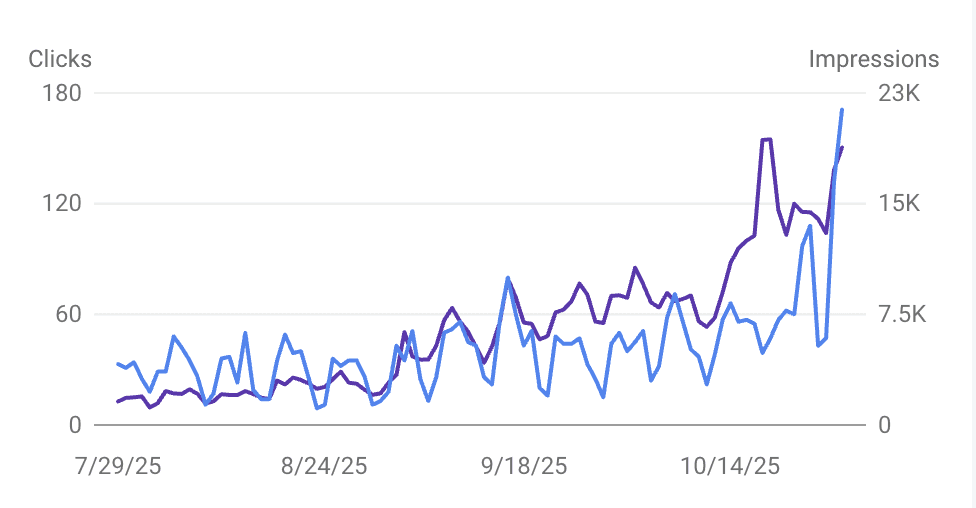
Averi grew organic traffic 6,000% in 10 months. But the first 4 months of that curve were flat.
You have to survive the flat part.
What 85% Branded / 15% Non-Branded Actually Means for Your Strategy
If your numbers look like ours (and if you're an early-stage startup, they probably do), here's what the ratio is telling you:
Your non-search channels are working.
Branded search is a reflection of awareness generated elsewhere. When someone types your company name into Google, something, a LinkedIn post, a podcast appearance, a newsletter mention, a referral from a friend, put your name in their head. Branded search growing means your overall marketing is working. It just means Google is getting the credit.
Your content marketing is still in early innings.
Non-branded clicks at 15% of total means your content library hasn't reached the tipping point where it generates significant organic discovery. That's normal for the first 6–12 months.
The goal is to watch that ratio shift: 85/15 becomes 75/25 becomes 60/40. Established companies run 25–35% branded, 65–75% non-branded.
That's the target. Getting there takes 18–24 months of consistent publishing.
The highest-impact move is more non-branded content.
Not more brand awareness campaigns. Not more social posts. More blog content targeting the keywords your potential customers search when they don't know you exist.
That's what shifts the ratio.
Every blog post that ranks for a non-branded term adds a permanent source of traffic from people who would never have found you otherwise.
Content marketing generates $3 for every $1 invested. Organic SEO generates leads at $31 per lead versus $181 for PPC. Compound blog posts generate 38% of all blog traffic from just 10% of total posts.
The math favors non-branded content production at every turn. The only cost is patience.
Why We're Showing You This
Most SaaS companies publish "How We Grew Traffic 10x" pieces after the growth happened.
The data is clean. The narrative is tidy. The awkward middle part where nothing seems to work gets compressed into one sentence.
We're showing you the middle part. Right now. While we're still in it.
Our branded search is strong. Our non-branded search is a grind.
We rank #1 for our name and page 2 for most category terms.
That's the reality for early-stage startups doing SEO in 2026 and anyone telling you otherwise is either lying or selling you something.
But we also grew organic traffic 6,000% in 10 months. We have 1.68 million monthly organic impressions.
The non-branded slice is growing every month. Some long-tail keywords are already on page 1. Topic clusters are building authority. The content scoring system we built for ourselves is the same one our users run for their own content.
The tool we sell is the tool we use.
The strategy we recommend is the strategy we're executing.
The honest truth about where it is right now, complete with the parts that aren't working yet, is more useful to you than a polished case study would be.
If you're a startup founder looking at your own Search Console data and seeing a similar ratio, you're not behind.
You're in the part of the curve where it feels like nothing is happening. Keep publishing. The compounding game rewards the ones who don't stop.
And if you want the content engine that handles the publishing, the keyword research, the SEO and GEO optimization, the topic clusters, and the analytics while you focus on building your product, that's what Averi does.
We built it because we needed it. Now you can use it too.
FAQs
What is the difference between branded and non-branded search traffic?
Branded search traffic comes from queries containing your company name or product name ("averi ai," "averi content engine"). Non-branded traffic comes from queries about topics, categories, or problems without mentioning you ("ai content marketing platform," "how to build a content engine"). Branded traffic indicates brand awareness generated through other channels. Non-branded traffic indicates your content ranking for terms people search when they don't know you exist. For startups, non-branded queries represent the true measure of SEO performance because branded clicks would have come to your site anyway.
What branded vs. non-branded ratio should startups expect?
Early-stage startups (seed to Series A) typically see 80–95% branded traffic with only 5–20% non-branded. Established companies run 25–35% branded with 65–75% non-branded. The goal is to shift the ratio over 18–24 months of consistent content publishing. Watching the non-branded percentage grow is a more meaningful SEO metric than watching total traffic grow, since total traffic increases can be driven entirely by brand awareness from non-search channels. If your non-branded share is climbing month over month, your content marketing engine is working.
Why is ranking #1 for your brand name not enough?
Ranking #1 for your brand name means people who already know you can find your website through Google. It doesn't generate new awareness or reach people unfamiliar with your company. Most websites get up to 95% of their traffic from branded searches, which creates a misleading picture of SEO success. The real growth comes from non-branded rankings where your content appears for category terms, problem-solution queries, and comparison searches. Those are the queries that connect you with potential customers who would never have found you otherwise.
How do startups improve non-branded search traffic?
Target long-tail keywords with lower competition rather than high-volume category terms. Build topic clusters of 4–8 interconnected posts that establish topical authority. Optimize for both Google and AI citation platforms. Be honest about timelines: 7–9 months to break-even, 12–18 months to meaningful compounding. Organic SEO generates leads at $31 per lead versus $181 for PPC, but the returns are backloaded. The startups that succeed at non-branded search are the ones that keep publishing through the first 4–6 months when the data looks discouraging.
How long does it take to shift the branded/non-branded ratio?
Expect 6–12 months before non-branded traffic becomes a meaningful percentage of total search traffic, and 18–24 months to reach the 35/65 branded/non-branded split that established companies achieve. The average page in Google's top 10 is over 2 years old. Content you publish now is building the non-branded traffic you'll see next year. Compound blog posts generate 38% of all blog traffic from just 10% of total posts. A small number of your articles will eventually drive a disproportionate share of non-branded discovery.
Should startups invest in non-branded SEO or brand marketing?
Both, but non-branded SEO is the higher-ROI investment for most early-stage startups. Brand marketing (PR, social, events) drives branded search by putting your name in people's heads. Non-branded content marketing drives organic discovery from people who don't know you yet. The two compound together: non-branded content builds awareness, which drives branded search, which improves your overall domain signals, which helps non-branded content rank higher. Content marketing generates $3 for every $1 invested. For startups watching burn rate, that ROI profile matters.
How does Averi help startups grow non-branded search traffic?
Averi is the AI content engine for startups built for exactly this problem. It generates content strategy with keyword-backed topic clusters, produces AI-assisted blog posts with dual SEO + GEO optimization, publishes directly to your CMS, and tracks performance through Google Analytics and Search Console integration. We built it because we needed it for our own non-branded search problem. The 6,000% organic traffic growth came from running the same system now available to users. Start a free 14-day trial. No credit card required.
Related Resources
SEO for Startups: How to Rank Higher Without a Big Budget in 2026
Beyond Google: How to Get Your Startup Cited by ChatGPT, Perplexity, and AI Search
Google AI Overviews Optimization: How to Get Featured in 2026
Marketing at 12 Months Runway: The Survival Playbook for Series A Pressure
AI-Powered SEO for B2B SaaS: Getting to Page 1 Without an Agency
Content Marketing on a Startup Budget: High-ROI Tactics for Lean Teams
The Future of B2B SaaS Marketing: GEO, AI Search, and LLM Optimization