The EU AI Act Hits August 2026. Here's the Content Governance Checklist for Startups Publishing With AI.

5 minutes

TL;DR
📅 EU AI Act Chapter III enforces around August 2, 2026. That's the date most high-risk AI system obligations apply and the broader compliance posture becomes visible to regulators. Roughly 90 days from publish.
🌍 The Act applies extraterritorially. Non-EU startups with any EU users or customers in their content funnel fall under its scope. The "we're not based in Europe" argument doesn't exempt you.
📋 Five content governance artifacts cover the practical risk surface: a human-review log, a content workflow model card, a source attribution standard, AI disclosure language, and an editorial sign-off trail.
⚖️ Penalties scale up to €35M or 7% of global annual turnover for the most serious violations (prohibited practices). Content marketing rarely triggers that ceiling, but Article 50 transparency obligations apply broadly.
⚙️ What this isn't: a substitute for legal counsel, a guarantee of compliance, or a position on whether your specific tools qualify as "high-risk AI systems." It's the operational baseline that makes the legal conversation easier.

Zach Chmael
CMO, Averi
"We built Averi around the exact workflow we've used to scale our web traffic over 6000% in the last 6 months."
Your content should be working harder.
Averi's content engine builds Google entity authority, drives AI citations, and scales your visibility so you can get more customers.
The EU AI Act Hits August 2026. Here's the Content Governance Checklist for Startups Publishing With AI.
Quick Note Before You Read
This piece is a practical content governance framework informed by the EU AI Act. It is not legal advice. The Act's specific obligations depend on your AI system type, your role (provider vs. deployer), your jurisdiction, and how regulators interpret several provisions still being clarified. If you have EU customers or users and you're publishing AI-assisted content, consult counsel for definitive compliance guidance. What we cover below helps you arrive at that conversation already organized.
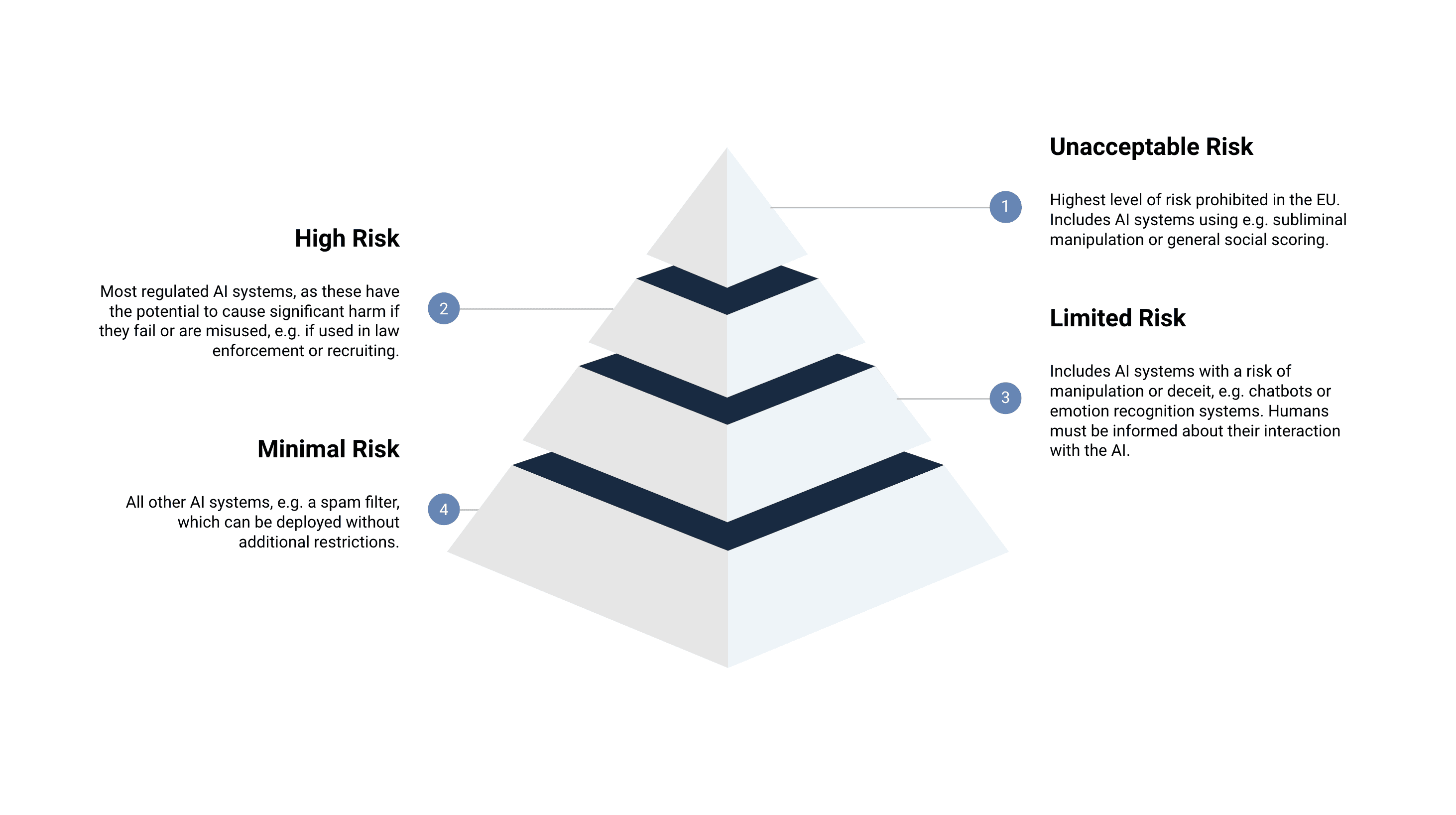
The Deadline: Roughly August 2, 2026
The EU AI Act became law on August 1, 2024. The Act phases in over several years, with different obligations applying at different dates. The phase that hits roughly August 2, 2026 covers most of the high-risk AI system obligations under Chapter III, along with the broader compliance posture that regulators will start auditing against.
For seed-stage startups publishing AI-assisted content, the August 2026 milestone matters less because of one specific obligation and more because it's the point at which a coherent compliance story becomes visible.
Regulators don't audit isolated articles. They look at how a company governs its AI use across content production, customer-facing surfaces, and decision-making workflows.
The practical question for most B2B SaaS startups isn't "are we violating the AI Act" (most aren't). It's "if a regulator or a large EU customer asks how we govern our AI content production, can we answer with documentation rather than improvisation?"
The five artifacts below build that documentation in a 90-day window, which is roughly the time remaining before the enforcement phase. None requires new headcount. All can be assembled inside an existing content workflow.
What the EU AI Act Actually Does to Content Marketing
The EU AI Act regulates AI systems and the providers and deployers of those systems. It does not directly regulate "content" as a separate category. This distinction matters because most "EU AI Act content compliance" coverage gets it wrong by treating the Act as a content censorship law. It isn't.
What the Act actually does for content marketing teams:
Transparency obligations under Article 50. Providers and deployers of certain AI systems must disclose AI involvement to users. For content marketing, this most commonly applies when AI-generated text, images, or video could be mistaken for human-authored content in contexts where the user reasonably expects authorship transparency. The disclosure language requirement is specific but flexible — labels, watermarks, or contextual notices all qualify depending on the case.
Risk classification obligations. Most content marketing tools and workflows fall outside the "high-risk AI system" definition, which is reserved for AI used in safety-critical, employment, education, law enforcement, and other named contexts. Standard content drafting tools generally don't trigger high-risk obligations, but the deployer-side compliance posture still matters.
General-purpose AI model obligations. If you use foundation models (GPT-4, Claude, Gemini, etc.) in your workflow, those models have their own provider-side obligations. As a deployer, you inherit some downstream documentation responsibilities.
Penalty structure. Up to €35M or 7% of global annual turnover for the most serious violations (prohibited AI practices). For most content marketing scenarios, the relevant penalty tier is lower — administrative fines under €15M or 3% of turnover for various other infractions, with SME-specific provisions reducing exposure for smaller companies.
The Act is broader than content but the content slice of it is narrower than the discourse suggests.
Who Needs to Care (and Who Doesn't)
The Act applies to any AI provider or deployer whose system is placed on the EU market or whose output is used in the EU, regardless of where the provider is located.
For content marketing, that means almost every B2B SaaS startup with even a small EU audience is in scope for transparency obligations.
You're in scope if:
You have any EU-based customers, users, prospects, or readers
Your content is published in EU languages or distributed to EU markets
Your AI-assisted content reaches EU users in any way (organic traffic, paid distribution, newsletter sends to EU subscribers, etc.)
You're out of scope only if:
You have demonstrably zero EU touchpoints (uncommon for B2B SaaS in 2026)
You produce no AI-assisted content at all (also increasingly uncommon)
Your AI use is purely internal with no external content output
For practical purposes: if you're publishing content using AI in 2026, the Act's transparency obligations apply to you. The risk gradient depends on the specifics, but the baseline obligations are broad.
This is the part most "AI Act content compliance" pieces get right: the scope is wide. The part they get wrong is assuming the obligations are equally heavy across the scope. Most content marketing scenarios fall into the lower-obligation tiers. Document the right artifacts and the compliance posture becomes manageable.

The 5 Content Governance Artifacts You Need
Five artifacts cover the practical risk surface for AI-assisted content marketing under the Act's framework.
Each is doable inside an existing workflow. Each protects you against Article 50 transparency obligations, broader regulatory readiness, and the trust-building case with EU customers who will increasingly ask about your AI governance posture.
The five artifacts:
A human-review log — documentation of which content pieces had human review, when, and by whom.
A content workflow model card — a one-page description of how your AI-assisted content production works.
A source attribution standard — how you handle citations, statistics, and external claims in AI-assisted content.
AI disclosure language — the specific wording you use to disclose AI assistance where required.
An editorial sign-off trail — a record of who approved each piece for publication and when.
None of these requires legal expertise to build. All five can be assembled from existing tools (your CMS, Google Docs, Notion, your content engine) without new infrastructure. The discipline is in making them consistent, auditable, and reviewable on request.
The sections below cover each artifact in practical detail.
Artifact #1: The Human-Review Log
The human-review log is documentation that each piece of AI-assisted content was reviewed by a human before publication. The Act's transparency obligations and the broader case-law trajectory both emphasize human oversight of AI output. A clean review log is the simplest way to evidence that oversight.
What the log needs to capture, per piece:
Content identifier: title or URL slug
AI tools used: which models or systems contributed to drafting
Human reviewer: who reviewed before publish
Review date: when review was completed
Material changes: brief note on what the human reviewer changed (or "no material changes" if approved as-drafted)
The log can live in a spreadsheet, a Notion database, your CMS metadata, or inside your content engine's audit layer. The format matters less than the consistency.
What the log does not need to be: a detailed line-by-line edit history, a sworn statement, or a notarized document. Regulators looking at compliance posture want to see that human oversight exists and is documented. They don't want forensic records.
A useful retention period: 24 months after publication for most pieces. Longer if your content involves higher-risk topics (medical, legal, financial advice). The 24-month window covers most regulatory inquiry timelines.
Artifact #2: The Content Workflow Model Card
A model card is a structured one-page description of how your AI-assisted content workflow operates. The concept comes from machine-learning practice (model cards describe an AI model's training data, intended uses, limitations); applied to content marketing, it describes your production system.
The card answers:
Which AI tools you use for content production (foundation models, drafting tools, image generators, etc.)
What role each tool plays in the workflow (research, drafting, editing, optimization, publishing)
What human oversight applies at each stage
What types of content your workflow produces (and what categories it doesn't — e.g., "we don't produce medical, legal, or financial advice")
What disclosure practices apply to the content produced
Known limitations and risks of your workflow
The card is roughly 500–800 words. It's a public-facing or semi-public artifact — many B2B SaaS startups publish it as a page on their site (often at /ai-governance or similar). EU customers, regulators, and increasingly sophisticated B2B buyers will ask for it.
The model card serves three purposes simultaneously: regulatory readiness, customer trust (especially with EU enterprise buyers), and internal discipline (writing the card forces you to think clearly about your workflow). Averi's content engine workflow produces the operational backbone the model card describes.
Don't overthink the format. A clean, honest, one-page description beats a 12-page compliance document for both regulators and customers.
Artifact #3: The Source Attribution Standard
A source attribution standard is your documented policy for how AI-assisted content handles citations, statistics, and external claims.
The standard protects against two specific risks: factually incorrect AI output presented as fact, and uncited use of others' content.
The standard should specify:
Required attribution for external claims. Every statistical claim cites the source. Every claim attributed to a specific company, person, or study includes the link. AI-generated content that summarizes external sources cites those sources explicitly.
Verification requirements. Statistics from AI drafts get verified against the original source before publication. AI-generated summaries of studies get checked against the study abstract. Quotations attributed to named people get verified or removed.
Treatment of common knowledge vs. citable claims. Common-knowledge statements don't require citations ("water boils at 100°C"). Specific or contested claims do ("78% of B2B buyers prefer X" requires a source).
Handling of hallucinations. When the AI drafts a statistic or claim that can't be verified, the standard practice is removal, not unsourced inclusion. AI hallucination is the highest-frequency factual risk in AI-assisted content; the standard explicitly addresses it.
This standard is a 1-2 page internal document, applied at the editorial review stage. The structural discipline of citation-optimized content overlaps heavily with the attribution standard — pieces that earn AI engine citations also tend to be the pieces that meet attribution requirements cleanly.
Artifact #4: AI Disclosure Language
AI disclosure language is the specific wording you use to disclose AI assistance where required. The Act's Article 50 transparency obligations expect disclosure in cases where AI-generated content could reasonably be mistaken for human-only authorship, in contexts where authorship transparency matters.
What the disclosure should specify (in plain language):
That AI tools were used in producing the content
The general nature of human involvement (review, editing, fact-checking)
Where to find more information if the reader wants context
Practical disclosure examples:
Light-touch disclosure (for most blog content where human authorship oversight is clear): "This article was drafted with AI assistance and reviewed by [Author Name] before publication. See our AI governance page for more on how we work."
Fuller disclosure (for content where AI involvement is heavier or the topic is more sensitive): a paragraph explaining the workflow, the human review applied, and any known limitations of the AI-generated sections.
Visible signaling (for AI-generated images or graphics): a small visible indicator (icon, label, or caption) noting AI generation.
Where the disclosure lives: typically at the bottom of the piece, near the author byline, or in a sidebar. Some startups use a dedicated tag like "AI-assisted" in their CMS metadata that surfaces consistently.
The disclosure language doesn't need to be apologetic or legalistic. Plain-English transparency works better than dense compliance language — both for the reader and for the regulator reading your content for governance signals.
Artifact #5: The Editorial Sign-Off Trail
The sign-off trail is documentation that a named human approved each piece for publication.
This artifact overlaps with the human-review log but serves a slightly different purpose: the review log shows human oversight existed; the sign-off trail shows accountable approval.
The trail captures, per piece:
Final approver: the named human who authorized publication
Approval date: when sign-off occurred
Approval scope: did the approver authorize the full piece, including all factual claims, or did they approve subject to specific revisions
Any waivers or exceptions: noted explicitly (e.g., "approved with the statistic in Section 3 to be verified before final publication")
For seed-stage startups with small teams, the sign-off trail is often the founder or CMO approving each piece. That's fine.
The point isn't to build approval hierarchies that don't match your reality; it's to document who took responsibility for each publication.
The trail can live in the same system as the review log (often it's the same spreadsheet with an "approved by" column). The discipline is making sure no piece publishes without a named approver entry.
This artifact also serves an important non-regulatory purpose: it makes editorial accountability visible inside the team. When a piece has an issue (factual, tonal, strategic), the trail clarifies who made the call. Pieces with unclear ownership tend to be the pieces that have problems.
How to Build All Five in 90 Days
The 90-day build plan, calibrated for a seed-stage team with limited time:
Weeks 1–2: Audit and template. Inventory your current AI-assisted content production. List the tools, the workflow stages, the human oversight points, and the existing approval patterns. The inventory becomes the input for the model card.
Weeks 3–4: Build the model card and source attribution standard. The model card is roughly a half-day of writing once you have the inventory. The source attribution standard is another half-day. Both can be drafted by one person and reviewed by the team.
Weeks 5–6: Set up the human-review log and sign-off trail. Both can live in a single shared spreadsheet, Notion database, or CMS metadata system. The setup is mechanical; the discipline is filling it in consistently for every piece going forward.
Weeks 7–8: Draft and refine disclosure language. Test the disclosure in 2–3 pieces. Get feedback from a customer or two if you have EU customers willing to weigh in. Refine the language. Commit to a consistent pattern.
Weeks 9–12: Operationalize. Apply the five artifacts to every new piece. Backfill the log and trail for the last 90 days of content if reasonable. Publish the model card and disclosure approach as a page on your site (e.g., /ai-governance). Notify EU customers if their contracts include AI use disclosure expectations.
By the end of the 90-day window, the five artifacts are operational and you have demonstrable governance posture. The August 2026 enforcement milestone arrives with you organized rather than scrambling.
What This Doesn't Replace
The five artifacts are operational governance practices. They are not a substitute for:
Legal counsel. Specific compliance obligations depend on your jurisdiction, your specific AI use cases, your customer types, and several Act provisions that are still being clarified through regulatory guidance and case law. A 30-minute consultation with an EU-experienced tech lawyer is worth more than any checklist (including this one) when it comes to definitive compliance opinions.
Industry-specific obligations. If you operate in healthcare, finance, education, employment, or other regulated sectors, your AI use likely intersects with sector-specific regulations beyond the AI Act. Healthtech startups, for example, also have to think about MDR, GDPR's health data provisions, and national-level health regulations.
Customer contractual obligations. Large EU enterprise customers will often have AI use clauses in their contracts that go beyond the Act's minimums. The five artifacts give you the foundation to satisfy most contractual asks, but specific contract review is its own work.
GDPR compliance. The EU AI Act layers on top of GDPR, which has been in force since 2018. AI Act compliance doesn't replace GDPR; both apply to AI-assisted content involving personal data.
Other jurisdictions. The UK, the US (varying by state), Canada, and several Asian jurisdictions have their own AI governance frameworks at varying stages of development. The five artifacts are a reasonable foundation that adapts to most of these regimes, but each has specifics worth understanding.
The honest framing: these five artifacts get you to "operationally organized for AI governance." Specific compliance certainty requires specific legal advice.
How Averi's Roadmap Closes the Governance Gap
The five artifacts above are operational practices your team builds and maintains today, regardless of which content tool you use. None of them require Averi specifically — a disciplined founder with a spreadsheet, a Notion database, and a clear workflow can assemble all five.
What Averi is committing to: building the governance layer into the workflow over the next 12–18 months, so the five artifacts (and whatever artifacts the next wave of AI regulations require) get produced as a byproduct of using the platform rather than as a separate compliance project on your plate.
The commitment is specific:
Audit logging for AI-assisted content production, capturing tools used, human review checkpoints, and material changes per piece. On the roadmap, with the foundation already in development.
Source citation enforcement at the drafting layer, flagging unverified statistical claims before publish. Tied closely to the multimodal citation framework we already enforce editorially; the next step is automating the check.
Named editorial sign-off as a publishing requirement, with the approval record persisting in the workflow history. Lighter lift than the others and earlier on the roadmap.
Configurable disclosure language that appends consistently to published content per your governance policy. Straightforward to ship once the publishing layer's metadata model expands.
Ongoing regulatory monitoring so you don't have to track every update to the EU AI Act, the UK AI framework, US state-level AI laws, or anything coming next. As obligations evolve, we update the platform. You don't have to read the regulatory news.
What this looks like in practice for an Averi customer over the next year: today, you build the five artifacts manually with our help (the content engine workflow already structures most of the inputs). Over the next 12–18 months, more of that work moves inside the platform. When the August 2026 milestone arrives, manual artifacts are sufficient if you've followed the 90-day plan above. By the time the next major AI governance milestone hits — and there will be one, probably from another jurisdiction — the platform handles more of it automatically.
The honest version: governance is operational work today. The commitment is making it less of your work over time, and keeping you compliant as the rules evolve without putting the regulatory-monitoring burden on your team.
Ready to Build the Governance Backbone Alongside Your Content Engine?
The five artifacts are doable manually. The 90-day plan above gets you organized for August 2026 regardless of which tools you use. What Averi commits to is bringing more of that governance work inside the platform over the next 12–18 months — and keeping you compliant as new obligations land in the EU, UK, US, and elsewhere. You build the foundation now. We build the automation that maintains it. Solo plan $99/month, 14-day free trial.
Start your 14-day free trial →
FAQs
Does the EU AI Act apply to my US-based B2B SaaS startup?
If you have any EU customers, users, prospects, or readers, yes. The Act applies extraterritorially to AI providers and deployers whose systems or outputs reach the EU market, regardless of where the company is based. For B2B SaaS startups in 2026, having zero EU touchpoints is uncommon. The practical answer for most teams is "yes, but the obligations are lighter than the discourse suggests if you're not in a high-risk category." Consult counsel for specific scope.
What's the difference between Article 50 transparency obligations and full Chapter III compliance?
Article 50 specifically covers transparency obligations for providers and deployers of certain AI systems — disclosure that AI was involved, especially when output could be mistaken for human work. Chapter III covers the broader high-risk AI system regime: classification, risk management, technical documentation, transparency, human oversight, accuracy, and post-market monitoring. Most content marketing falls under Article 50 transparency obligations rather than full Chapter III high-risk requirements, but the specific classification depends on your use case.
Do I need to disclose AI involvement in every blog post?
Probably yes, in some form, if you're operating in EU markets and your content reaches EU readers. The disclosure can be light-touch (a one-line note at the bottom of the post) for most B2B content where human review is clear, and heavier for cases where AI involvement is more significant. The Act doesn't prescribe specific disclosure formats, but the practice that's emerging in 2026 is consistent footer-level disclosure with a link to a fuller AI governance page.
Are content marketing tools like Averi considered "high-risk AI systems" under the Act?
Generally no. The high-risk category is reserved for AI used in safety-critical, employment, education, law enforcement, biometric, and other named contexts (Annex III of the Act). Standard content drafting and marketing tools fall outside that scope. That said, "high-risk" classification is one issue among many — the broader Article 50 transparency obligations and general AI Act deployer obligations still apply. Consult counsel if your use case touches any of the named high-risk areas.
What happens if a startup ignores the AI Act entirely?
For seed-stage startups with small EU exposure, the immediate enforcement risk is low. Regulators are focused on larger systemic actors initially, and SME-specific provisions reduce penalty exposure. However: large EU customers will increasingly ask about AI governance posture as part of vendor due diligence, so the operational consequence of having no governance documentation often arrives through customer conversations rather than regulatory enforcement. The five artifacts protect against both surfaces.
How long should I retain the human-review log and sign-off trail?
The Act doesn't specify a single retention period for content marketing artifacts (unlike GDPR, which has clearer guidance). A reasonable default is 24 months after publication for most pieces, with longer retention (3-5 years) for higher-risk topics or content where you reasonably anticipate ongoing regulatory or customer inquiry. Some EU enterprise customers will specify retention periods in their vendor contracts; defer to the longer of the contractual and operational requirements.
Will the EU AI Act change how Averi or similar content tools work?
The Act primarily creates obligations for AI providers (foundation model developers) and deployers (companies using those tools). Averi sits between the two and is committing to building governance into the workflow as the regulatory landscape evolves — audit logging, source attribution enforcement, named sign-off, and configurable disclosure language are all on the roadmap. The benefit for customers: as obligations change across the EU, UK, US states, and other jurisdictions, we update the platform so the compliance posture stays current without your team chasing regulatory news.
Related Resources
AI Governance & Compliance
The AI Marketing Governance Framework Enterprise Teams Actually Use
AI-Generated Content Uncovered: Ethical, Effective, and Scalable Implementation
The Authenticity Premium: Why Human-in-the-Loop Content Outperforms Pure AI by 4x
How to Create Thought Leadership Content That Doesn't Sound AI-Generated
Content Engine & Workflow
B2B SaaS Foundations
Building Citation-Worthy Content: Making Your Brand a Data Source for LLMs
The Future of B2B SaaS Marketing: GEO, AI Search, and LLM Optimization
Content Marketing on a Startup Budget: High-ROI Tactics for Lean Teams
Ready to Build Governance Into Your Content Engine?
The five artifacts are doable manually. They're easier when the workflow produces them by default. Averi's content engine bakes the audit log, source attribution enforcement, named sign-off, and disclosure language into the publishing flow. The August 2026 milestone arrives with the operational backbone already in place. Solo plan $99/month, 14-day free trial, 90 days to get organized.