The Click Collapse Playbook: How Seed-Stage Startups Can Thrive When 60% of Searches End Without a Click
9 minutes

TL;DR: The Click Collapse Playbook
The Crisis:
📉 60% of Google searches end without a click (83% when AI Overviews appear)
📉 HubSpot lost 80% of traffic—from 24M to 6M monthly visits
📉 Zero-click rates projected to hit 70%+ by mid-2026
📉 Traditional SEO focused on traffic volume is dying
Why Startups Win:
✅ No content debt weighing you down
✅ No legacy pages outside your expertise getting penalized
✅ Speed to pivot in days, not quarters
✅ Natural focus on deep expertise (what Google now rewards)
The New Rules:
🔄 Citations beat clicks (visibility without traffic is now valuable)
🔄 Depth beats breadth (20 expert pieces > 200 generic ones)
🔄 Structure determines citability (40% higher citation rates for well-structured content)
🔄 Velocity matters more than volume (respond to changes in days, not months)
The 7 Tactics:
Build authority zones, not topic lists
Lead with proprietary data
Structure every piece for AI extraction
Optimize for the AI discovery layer
Move faster than incumbents can react
Build for conversions, not traffic
Use AI to produce citation-worthy content 3x faster
The Averi Advantage:
🚀 Authority zone architecture built into onboarding
🚀 Citation-optimized structure by default
🚀 Research-first drafting with sources included
🚀 Proactive intelligence surfacing opportunities
🚀 45-90 minutes per piece vs. 4-8 hours manual
The Bottom Line: The click collapse punishes breadth and rewards depth. That's exactly backwards from the old game—and exactly right for focused startups with genuine expertise.
While incumbents scramble to protect declining traffic, you're capturing territory. The winners won't be the biggest content teams. They'll be the fastest, most focused, and most authentic.
That's your advantage. Use it.

Zach Chmael
CMO, Averi
"We built Averi around the exact workflow we've used to scale our web traffic over 6000% in the last 6 months."
Your content should be working harder.
Averi's content engine builds Google entity authority, drives AI citations, and scales your visibility so you can get more customers.
The Click Collapse Playbook: How Seed-Stage Startups Can Thrive When 60% of Searches End Without a Click
HubSpot lost 80% of their organic traffic in 10 months.
The company that literally wrote the book on inbound marketing, with 81 domain authority, 120+ million backlinks, and one of the best SEO teams in the world… watched their monthly organic visits plummet from 24 million to 6 million.
If that doesn't get your attention, this will: 60% of all Google searches now end without a single click to any website. When AI Overviews appear, that number jumps to 83%. Industry projections suggest we're heading toward 70%+ zero-click rates by mid-2026.
The old playbook is dead. And here's the thing nobody's talking about: this is actually good news for seed-stage startups.
While enterprise content teams scramble to protect declining traffic portfolios, founders with 12-month runways and zero legacy content have a structural advantage.
You're not defending territory, you're capturing it. You're not weighed down by thousands of pages of "shrug emoji" content that Google is actively penalizing. You're starting fresh in a new game with new rules.
This playbook shows you exactly how to win.

Why Big Content Libraries Are Now a Liability
The HubSpot Lesson
HubSpot's traffic collapse wasn't random bad luck. It was a predictable consequence of a strategy that no longer works.
Their approach—target high-volume keywords regardless of relevance, publish at scale, capture top-of-funnel traffic—was the gold standard for a decade.
Pages about "famous quotes," "shrug emoji," "resignation letter examples," and "cover letter templates" drove millions of visits despite having nothing to do with CRM software.
Then Google changed the rules.
The March 2024 algorithm update prioritized content closely tied to a website's core expertise. The December 2024 update accelerated this. And AI Overviews, which now appear on 50% of US searches, started answering informational queries directly, eliminating the need to click through at all.
HubSpot's CEO acknowledged the shift on their earnings call: organic search traffic is "declining globally" and "AI overviews are giving answers, and fewer people are clicking through to websites."
The lesson isn't that SEO is dead. It's that the wrong kind of SEO is dead.
Why Incumbents Are Stuck
Large companies with massive content libraries face a brutal problem: their existing content is now actively hurting them.
Google's E-E-A-T framework (Experience, Expertise, Authoritativeness, Trustworthiness) penalizes sites that publish outside their core expertise. Those thousands of loosely-related blog posts that drove traffic for years? They're now signals that your site lacks focus and authority.
Cleaning up this content debt is a massive undertaking:
Audit tens of thousands of pages
Decide what to keep, redirect, or delete
Risk breaking internal links and losing whatever traffic remains
Rebuild authority around a narrower topic focus
This takes 12-24 months for enterprise content teams. That's 12-24 months of continued decline while competitors capture the new landscape.
Your Unfair Advantage
As a seed-stage startup, you have none of these problems.
No content debt: You're not weighed down by irrelevant pages signaling lack of expertise. Every piece you publish can be strategically aligned with your core positioning.
No legacy dependencies: You're not trying to protect traffic to pages that no longer convert. You can optimize purely for what works now.
Speed to pivot: When the algorithm shifts (and it will), you can adjust in days. Enterprise teams take quarters.
Focus by necessity: With limited resources, you naturally create content closely tied to your expertise, exactly what Google and AI systems now reward.
The click collapse punishes breadth and rewards depth. That's exactly backwards from how most startups think about competing with established players. It means the playing field just got more level.
The New Rules: What Actually Drives Results in 2026
Rule 1: Citations Beat Clicks
Here's the shift that changes everything: visibility without traffic is now valuable.
When your brand gets cited in an AI Overview, ChatGPT response, or Perplexity answer, you build awareness and authority even if users never click through. Research shows that prospects who encounter brands inside AI answers move faster to pricing and product decisions—they skip the research phase because the AI already validated you.
HubSpot understood this.
Despite losing 80% of traffic, they maintain 35% share of voice in AI-generated answers for their category. They're cited in nearly every AI response about CRM and marketing software. The traffic collapsed, but the brand visibility didn't.
For startups, this is liberating. You don't need to compete for clicks against companies with decade-long domain authority advantages. You need to produce content that AI systems cite as authoritative, and that's a completely different competition.
Rule 2: Depth Beats Breadth
The old model: publish 100 articles across diverse topics, capture broad traffic, funnel to conversions.
The new model: publish 20 articles with genuine expertise on closely-related topics, get cited as the authority, convert at higher rates.
Only 21.5% of content marketers using AI report underperforming strategies, compared to 36.2% of those who don't use AI. But the AI advantage isn't about volume—it's about using AI to produce higher-quality, more authoritative content faster.
Google's algorithm updates increasingly reward:
Content that demonstrates real expertise (first-hand experience, proprietary data)
Tight topical focus (everything relates to your core business)
Clear E-E-A-T signals (author credentials, original research, practical application)
This is a game startups can win.
You have expertise in your domain. You have proprietary insight into the problems you're solving. You don't need to fake it with generic top-of-funnel content.
Rule 3: Structure Determines Citability
AI systems don't read content the way humans do. They extract specific, attributable claims from well-structured text.
Content with clear formatting (headings, bullets, tables) is 28-40% more likely to be cited than unstructured content. Pages with consistent heading hierarchy are 40% more likely to appear in AI-generated answers.
This means structure is no longer just about readability. It's about whether your content can be machine-extracted and attributed.
The citation-optimized structure:
Question-based H2s that match how users prompt AI systems
40-60 word "answer capsules" immediately after each heading
Specific statistics with clear attribution
FAQ sections formatted for direct extraction
Schema markup that provides explicit machine-readable context
Startups producing 10 highly structured, citation-optimized pieces will outperform incumbents with 1,000 generic blog posts.
Rule 4: Velocity Matters More Than Volume
Here's the counterintuitive math: marketers who use AI spend less than one hour writing a long-form article. Those who don't spend 2-3 hours minimum.
This isn't about producing more content, it's about producing better content faster. When the landscape shifts (and it shifts constantly), the companies that can adapt their content strategy in days rather than months win.
AI Overviews expanded 102% in just two months (January to March 2025). The topics triggering AI answers shifted from 91% informational to 57% informational, with commercial and transactional queries growing rapidly. Navigational queries with AI Overviews jumped from under 1% to over 10%.
Every month brings new rules. The winners are the teams that can read the data and pivot immediately, not the teams with quarterly content calendars locked in six months ago.

The Click Collapse Playbook: 7 Tactics for Seed-Stage Survival
Tactic 1: Build Authority Zones, Not Topic Lists
Stop thinking about keywords. Start thinking about territories.
The old approach: Research 200 keywords, prioritize by volume and difficulty, create content for each.
The new approach: Identify 3-5 "authority zones" where your expertise is genuine and deep. Create clusters of interconnected content that establish you as the definitive source on those specific topics.
How to identify your authority zones:
What problems does your product actually solve?
What questions do your customers ask before buying?
What do you know from building this company that others don't?
Where does your team have demonstrable expertise?
Your authority zones should be narrow enough to establish genuine expertise, but large enough to capture meaningful search intent.
Example: A seed-stage HR tech company shouldn't try to compete on "HR software." They should own "onboarding automation for remote teams" or "compliance management for startups scaling internationally."
Tactic 2: Lead with Proprietary Data
AI systems desperately need specific, quotable data points. Content featuring original statistics sees 30-40% higher visibility in AI responses because it provides something unique—information that can't be found anywhere else.
As a startup, you have data that no one else has:
Product usage patterns
Customer behavior insights
Implementation timelines
Success metrics from your users
Market observations from your sales conversations
Package this data intentionally:
Data Type | Citation Angle | Example |
|---|---|---|
Aggregate metrics | Industry benchmarks | "Across 200+ implementations, average time to value is 47 days" |
Usage patterns | Adoption trends | "73% of users activate this feature within 30 days" |
Customer outcomes | Success validation | "Top performers share these 3 characteristics" |
Market observations | Trend identification | "Based on 500+ sales conversations, the top concern shifted from X to Y" |
You don't need massive sample sizes to be citable. You need clear methodology, specific numbers, and confident framing.

Tactic 3: Structure Every Piece for AI Extraction
Every piece of content should be built for dual discovery: traditional search AND AI citation.
The checklist:
☐ Question-based headers: "What is X?" and "How do I Y?" match user prompts directly
☐ Answer capsules: 40-60 word direct answers immediately after each H2
☐ Specific statistics: Numbers with attribution, not vague claims
☐ Chunked paragraphs: 3-5 sentences max, one extractable idea per paragraph
☐ FAQ section: Formatted for schema markup and direct AI extraction
☐ Schema markup: FAQPage, HowTo, Article with author credentials
☐ Internal links: Connect to related content in your authority zones
Before (not citable):
"Content marketing has become increasingly important for startups. Many founders find it challenging to produce enough content while running their businesses, though approaches vary significantly."
After (citable answer capsule):
"Content marketing delivers 3x more leads than traditional marketing at 62% lower cost, yet 58% of startup founders cite lack of resources as their primary content challenge. The solution isn't producing more content—it's building systems that produce high-quality content efficiently."
The second version has specific statistics, confident claims, and an extractable structure that AI systems can quote directly.
Tactic 4: Optimize for the AI Discovery Layer
The "AI Discovery Layer" is where your brand gets encountered before users ever reach your website. This includes:
Google AI Overviews
ChatGPT recommendations
Perplexity answers
Claude responses
Voice search results
Optimization tactics:
Build entity authority: Your brand information must be consistent across platforms. AI systems cross-reference LinkedIn, Crunchbase, your website, and other sources to build confidence in your entity.
Get cited in AI-friendly sources: Reddit threads are among the most-cited content in AI responses. Authentic participation in relevant subreddits—genuine expertise sharing, not promotion—builds citation equity.
Create definition-worthy content: When someone asks "What is [concept in your space]?" AI needs concise, authoritative definitions. Own the definitions for key terms in your authority zones.
Target questions without authoritative answers: AI systems struggle with novel queries where no clear source exists. Find these gaps in your space and fill them.

Tactic 5: Move Faster Than Incumbents Can React
Your speed advantage is real. Use it.
Weekly monitoring cycle:
Which of your target queries now trigger AI Overviews?
What sources are being cited in your space?
What new query patterns are emerging?
Where are competitors getting visibility you're not?
Rapid response capability:
Can you produce a citation-optimized piece in 48 hours?
Can you update existing content with fresh data in hours?
Can you pivot your content queue based on this week's learnings?
Enterprise content teams plan quarterly and execute monthly. You should plan weekly and execute daily.
The tactical advantage: When AI Overviews started appearing for navigational queries (a 10x increase in 10 months), nimble teams that pivoted immediately captured positions that slower competitors are still trying to understand.
Tactic 6: Build for Conversions, Not Traffic
Here's the math that matters: with 60%+ of searches ending without clicks, the traffic you do get is more valuable than ever.
Users who click through despite AI Overviews providing answers are high-intent. They're looking for something the AI couldn't provide—depth, specificity, differentiation, or the ability to take action.
Conversion-first content strategy:
Content Type | Purpose | Success Metric |
|---|---|---|
Authority content | Get cited, build awareness | AI citation presence, share of voice |
Comparison content | Capture high-intent visitors | Conversion rate, pipeline influence |
Bottom-funnel content | Convert ready buyers | Demo requests, signups |
Product content | Enable purchase decisions | Time on page, feature adoption |
Don't chase traffic numbers. Chase the traffic that converts.
The 60/40 split: Allocate 60% of content effort toward citation-worthy authority content (awareness and trust building) and 40% toward conversion-focused content (capturing the clicks that actually matter).
Tactic 7: Use AI to Produce Citation-Worthy Content 3x Faster
Here's where speed becomes a sustainable advantage.
Manual content production at startup scale is impossible. You can't compete with enterprise content teams on volume, and you shouldn't try. But you can compete on velocity—how quickly you can go from insight to published, citation-optimized content.
The efficiency gap:
Without AI: 2-3 hours per long-form article
With AI: Under 1 hour per long-form article
With AI + systems: 45-90 minutes of your time per piece
That's not about producing more. It's about producing faster, which means:
Responding to algorithm changes before competitors notice
Capturing emerging topics before they're saturated
Iterating based on performance data in days, not months
Sustaining consistent publishing without burning out
What AI should handle:
Research compilation (statistics, studies, sources)
First draft generation with brand context
SEO + GEO optimization
Schema markup generation
Cross-platform formatting
What you should handle:
Authority zone selection
Proprietary data and insights
Voice and expertise refinement
Strategic positioning
Quality judgment
The startups winning in the click collapse aren't working harder, they're working with systems that multiply their expertise.
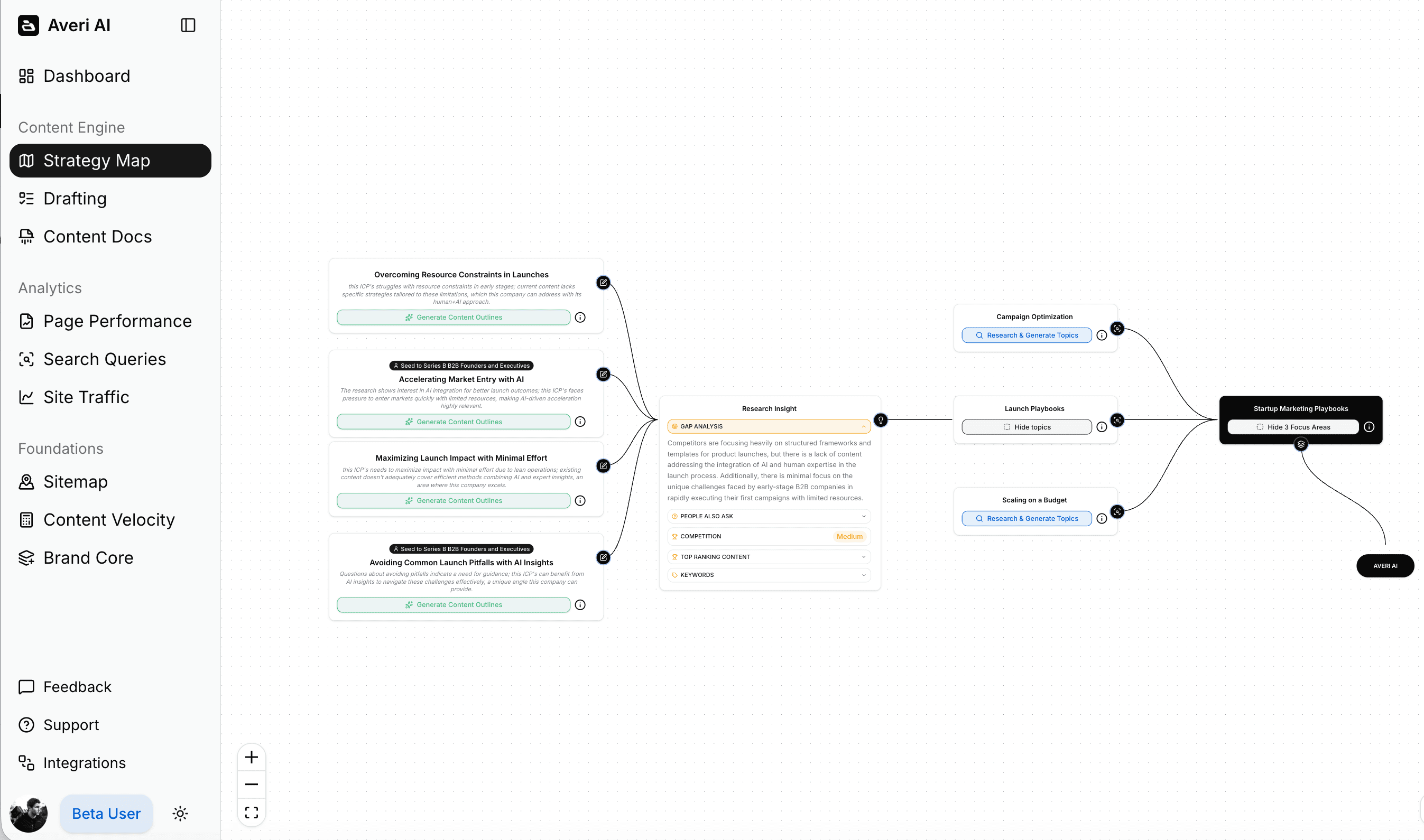
The Averi Content Engine: Built for the Zero-Click Era
Everything in this playbook (authority zones, citation optimization, proprietary data packaging, rapid iteration) requires a system. Not a tool, not an assistant, not scattered point solutions. A system.
Averi is designed specifically for this environment.
How It Addresses the Click Collapse
Authority zone architecture: When you onboard, Averi doesn't just learn your brand—it maps your authority zones. Based on your positioning, competitors, and market opportunity, the system identifies the specific territories where you can establish citation authority.
Citation-optimized by default: Every piece created through the Content Engine is automatically structured for AI extraction:
Answer capsules placed after each major heading
Question-based H2s matching user prompts
FAQ sections formatted for direct extraction
Schema markup generated automatically
Research-first drafting: The system compiles statistics, studies, and sources with proper attribution before drafting. Your content arrives pre-loaded with the citation-worthy elements AI systems value.
Proactive intelligence: Averi monitors your performance, industry trends, and competitor activity, then proactively queues content recommendations. You're not guessing what to create; you're approving opportunities the system has already identified.
The speed advantage: Averi's workflow produces citation-ready content in a fraction of the time manual approaches require. When the algorithm shifts, you pivot in days.
The Math
Metric | Manual Approach | Averi Content Engine |
|---|---|---|
Time per piece | 4-8 hours | 45-90 minutes |
Setup time | 4-8 weeks | 48 hours |
Structure optimization | Manual checklist | Automatic |
Research compilation | Your responsibility | Built-in |
Algorithm response time | Weeks-months | Days |
The click collapse rewards teams that can produce high-quality, citation-optimized content faster than their competitors. That's exactly what the Content Engine delivers.
The 90-Day Click Collapse Sprint
Days 1-30: Foundation
Week 1: Audit and Position
Map your 3-5 authority zones
Audit any existing content for alignment
Research which queries in your space trigger AI Overviews
Identify competitors getting cited and why
Week 2: System Setup
Set up your content engine (Averi or equivalent)
Configure brand context and positioning
Build your initial content queue focused on authority zones
Establish entity consistency across platforms
Week 3-4: Initial Content Sprint
Publish 4-6 citation-optimized pieces in your primary authority zone
Each piece includes proprietary data or unique perspective
All structured for AI extraction
Monitor initial citation signals
Days 31-60: Expansion
Week 5-6: Authority Building
Expand content across remaining authority zones
Create definition-worthy content for key terms
Build internal linking architecture
Begin tracking AI citation presence
Week 7-8: Optimization
Review performance data and adjust priorities
Identify which content is getting cited vs. which isn't
Refresh underperformers with stronger structure
Double down on working topics
Days 61-90: Scale
Week 9-10: Velocity
Increase publishing cadence using refined workflow
Respond to emerging opportunities identified by monitoring
Build comparison and bottom-funnel content
Week 11-12: System Maturation
Implement feedback loops (performance → recommendations)
Establish ongoing monitoring rhythm
Document what's working for continued iteration
Plan Q2 based on Q1 learnings
Success Metrics
Citation Metrics:
AI citation presence for target queries (manual audit monthly)
Share of voice vs. competitors in AI responses
Sources cited in AI Overviews for your authority zones
Traditional Metrics (Still Matter):
Organic traffic to conversion-focused content
Conversion rate from organic visitors
Time on page for authority content
Business Metrics:
Leads attributed to content
Pipeline influence from content touches
Sales conversation quality (are prospects better informed?)
The Bottom Line: Why This Moment Favors Startups
The click collapse terrifies incumbent content teams because they have everything to lose. Years of accumulated content, established traffic patterns, existing workflows—all suddenly devalued.
You have nothing to lose and everything to gain.
The old rules favored scale: More content, more backlinks, more domain authority. Established players had insurmountable advantages.
The new rules favor focus: Genuine expertise, citation-worthy structure, speed to adapt. These are advantages startups naturally possess.
HubSpot lost 80% of their traffic not because SEO died, but because the game changed. The winners in the new game aren't the biggest—they're the fastest, the most focused, and the most authentic.
That's you.
The question isn't whether the click collapse is coming for your market. It already has. The question is whether you'll be positioned to capture the opportunity, or watch it go to whoever moves first.
Start building your citation authority →
FAQs
What percentage of Google searches end without a click?
Currently, 58-60% of all Google searches end without a click to any website. When AI Overviews appear, zero-click rates jump to approximately 83%. Industry projections suggest zero-click rates will reach 70%+ by mid-2026 as AI Overviews continue expanding across more query types.
Does zero-click search mean SEO is dead?
No—it means traditional SEO focused on traffic volume is being replaced by citation-focused SEO. Brands that get cited in AI Overviews and LLM responses build awareness and authority even without clicks. The goal shifts from "rank higher, get more clicks" to "become the source AI systems cite by default." Companies optimizing for citations rather than rankings are actually gaining visibility as competitors decline.
Why is the click collapse good for startups?
Startups benefit because the new rules reward depth over breadth, expertise over volume, and speed over scale. Established players are weighed down by massive content libraries that now hurt more than help—pages outside their core expertise that Google is actively devaluing. Startups can build focused, citation-optimized content from scratch without this legacy burden, and can pivot faster as the landscape continues shifting.
What happened to HubSpot's SEO traffic?
HubSpot's organic traffic dropped from approximately 24 million monthly visits in early 2023 to around 6 million by early 2025—roughly a 75-80% decline. The collapse resulted from Google algorithm updates penalizing content outside a site's core expertise, combined with AI Overviews answering informational queries directly. HubSpot's strategy of targeting high-volume keywords loosely related to their CRM product (resignation letters, famous quotes, cover letter examples) became a liability rather than an asset.
How do I get my content cited by AI systems?
AI citation requires: (1) Genuine expertise demonstrated through proprietary data and specific insights, (2) Clear structure with question-based headers and extractable answer capsules, (3) Consistent entity authority across platforms like LinkedIn, Crunchbase, and your website, (4) FAQ sections formatted for direct extraction, and (5) Schema markup providing machine-readable context. Content must be both authoritative AND easily extractable for AI systems to cite it confidently.
How long does it take to build citation authority?
Initial citation presence can be established within 60-90 days with focused effort. Building meaningful share of voice typically takes 4-6 months of consistent, citation-optimized publishing. The compounding effect—where AI systems increasingly recognize your brand as authoritative and cite you more frequently across related queries—accelerates over time. Early movers have significant advantages as AI systems learn to trust certain sources.
Key Definitions
Zero-Click Search: A search query where the user finds their answer directly on the search results page—through AI Overviews, featured snippets, knowledge panels, or other SERP features—without clicking through to any website.
GEO (Generative Engine Optimization): The practice of optimizing content to be cited and recommended by AI systems like ChatGPT, Perplexity, Google AI Overviews, and Claude—complementing traditional SEO with structure and formatting that AI can extract and attribute.
Content Engineering: The practice of designing, building, and optimizing systems that produce content at scale—applying systems thinking and AI integration to transform content marketing from manual effort into a repeatable, self-improving engine.
AI Discovery Layer: The ecosystem of AI-powered interfaces—including ChatGPT, Perplexity, Google AI Overviews, and voice assistants—where users increasingly discover, research, and form opinions about brands before ever visiting a website.
Authority Zone: A focused topic territory where a brand has genuine expertise and aims to be the definitive source—replacing the broad keyword strategy of traditional SEO with concentrated depth that signals E-E-A-T to both search engines and AI systems.
Citation Optimization: The practice of structuring content specifically to be extractable and attributable by AI systems—including answer capsules, question-based headers, specific statistics, and FAQ formatting that enables confident AI citation.
Related Resources
Understanding the Zero-Click Landscape
The HubSpot SEO Collapse: 5 Lessons Every B2B SaaS Founder Must Learn
Building Content That AI Agents Will Recommend: The 2026 Technical Guide
Optimizing for AI Citations
The Complete Guide to GEO: Getting Your Brand Cited by AI Search
Building Your "Data Source" Status: How to Become the Brand That LLMs Quote by Default
Platform-Specific GEO: How to Optimize for ChatGPT vs. Perplexity vs. Google AI Mode
Building Your Content Engine
How to Build a Content Engine That Runs Without You (2026 Workflow)
How to Build an AI Content Engine That Grows Your Startup in 2026
The Seed-Stage Content Marketing Playbook: Pipeline on a $3K/Month Budget