

In This Article
AI is now table stakes in marketing — choose the right workspace, marketplace, or point solution to scale, govern, and prove measurable ROI.
Updated:
Trusted by 1,000+ teams
Startups use Averi to build
content engines that rank.
AI is now a necessity in marketing, not a choice. By 2026, 91% of marketing teams have integrated AI tools into their daily workflows, up from 63% in 2025. These tools are driving faster campaign launches, cutting costs, and delivering ROI of 2x to 3x for most teams. On average, every every $1 spent on marketing automation now returns $5.44. spent on marketing automation tools now returns $5.44.
However, this rapid adoption comes with challenges. Governance, compliance, and leadership demands for measurable revenue impacts are reshaping how teams choose and use AI tools. Today’s marketers face three main options:
Workspaces: All-in-one platforms for managing strategy, content, and publishing.
Marketplaces: Platforms connecting businesses to freelance experts for specific tasks.
Point Solutions: Specialized tools for tasks like SEO or copywriting.
Each option has trade-offs in cost, scalability, and ease of use. The right choice depends on team size, budget, and goals. For startups, integrated workspaces simplify workflows. For enterprises, governance-focused platforms ensure compliance. As AI continues to evolve, success lies in selecting tools that align with your needs while enabling measurable results.
Our Top 5 AI Tools for Marketing in 2026 (AI Marketing Essentials)
3 Types of Marketing AI Tools
As of 2026, the marketing AI landscape can be grouped into three main categories, each tailored to different needs and workflows:
Workspaces: Comprehensive platforms that handle strategy, content creation, and publishing in one place.
Marketplaces: Platforms that connect you with freelance experts for specific, project-based tasks.
Point solutions: Tools designed for specific functions, like writing or SEO, often requiring manual integration.
Choosing the right type depends on your goals, work style, and how much coordination you're willing to manage. Let’s take a closer look at what each offers, along with their trade-offs and ideal use cases.
Workspaces: All-in-One Marketing Platforms
Workspaces, such as Averi and HubSpot Breeze, provide an integrated solution for managing your entire content pipeline. These platforms combine AI automation with human input, maintaining a consistent understanding of your brand voice, product messaging, customer profiles, and performance metrics. They continuously learn and adapt based on your publishing history, improving over time.
With workspaces, you can handle everything from strategy and topic research to drafting, collaborative editing, direct publishing, and performance tracking - all within a single platform. This makes them particularly appealing for startups and small-to-medium businesses (SMBs) that need a streamlined content engine without juggling multiple tools. However, they may lack the flexibility of a customized AI marketing stack.
Marketplaces: Freelance Talent on Demand
Marketplaces like Upwork and Fiverr connect businesses with freelance marketing specialists for project-based work. Whether you need a copywriter, social media strategist, or technical writer, these platforms offer access to a wide range of expertise. Freelance rates vary widely depending on the scope of the project and the freelancer’s experience.
While marketplaces offer flexibility, they also require significant effort to manage. You’ll need to vet candidates, provide detailed project briefs, review deliverables, and ensure quality control for each task. Additionally, switching between freelancers can result in a loss of continuity, as important context from previous projects often doesn’t carry over. This can make scaling a challenge.
Point Solutions: Focused AI Tools for Specific Tasks
Point solutions, such as Jasper, Copy.ai, and Surfer SEO, are designed to handle specific marketing tasks with precision. Whether you’re generating copy, optimizing for SEO, or creating topical authority plans, these tools excel at what they’re built for. Pricing typically ranges from $39 to $299 per month, depending on the features and usage limits.
These tools are ideal for repetitive, high-volume tasks like crafting product descriptions or email campaigns. However, their specialized nature means they operate independently, requiring manual effort to transfer data and ensure consistency across campaigns. Managing multiple point solutions can add complexity to your workflow, especially when integrating brand guidelines or coordinating with other tools.
What's New in Marketing AI for 2026
By 2026, AI isn't just a tool for marketing teams - it’s embedded into their daily operations. Building on earlier advancements, the focus has shifted to predictive analytics, AI-driven search strategies, and autonomous campaign execution. These innovations are redefining how marketing teams function, pushing the boundaries of efficiency and creativity.
Key developments include predicting lead conversions before outreach, crafting content tailored for AI-powered answer engines like ChatGPT and Perplexity, and deploying autonomous systems capable of running campaigns with minimal human involvement.
Predictive Analytics and Lead Scoring
AI has taken predictive analytics to new heights, enabling platforms to forecast customer behavior and rank leads based on their likelihood to convert. While most marketers use AI for content creation, only 31% have integrated it into lead scoring, making this a prime area for competitive advantage in 2026 [9]. Emails driven by predictive analytics generate 10 times the revenue of standard campaigns, while AI-powered personalization can boost revenue by as much as 41% [3]. Among marketers tracking AI’s return on investment, 60% report seeing at least a 2× to 3× increase [1].
To scale these systems, companies are creating specialized roles. For instance, 31% of organizations now employ "AI Architects", while 34% have "AI Transformation Leads" to oversee technical operations [1]. However, this progress comes with challenges. Legal and compliance issues have grown 3.4× year-over-year, and trust in AI outputs remains moderate, with an average score of 5.8 out of 10 [9].
The next big leap in AI’s impact lies in content strategies, especially as search behavior evolves.
Content Optimized for AI Search Engines
Search engines as we know them are undergoing a transformation. By 2026, 43% of marketing teams are optimizing their content specifically for AI-driven search tools like ChatGPT and Perplexity [1]. This shift has given rise to a new discipline called Answer Engine Optimization (AEO), where the goal isn’t just to rank on a search results page but to become the source cited in direct answers.
AI search engines operate differently from traditional ones. Instead of focusing on backlinks and keyword density, they prioritize entity-based SEO, which emphasizes understanding the relationships between concepts. Tools like MarketMuse and InLinks are helping brands build authority by creating detailed topical maps tailored for AI knowledge graphs [7].
"Citations are the new backlinks in AI search."
Waqas Arshad, CEO, The Rank Masters [7]
Platforms such as Averi, Jasper, and Semrush have adapted to support both traditional and AI-focused search strategies. For example, Semrush now tracks traffic and citations from AI search engines, while Jasper’s "Content Pipelines" streamline the process of achieving AI search visibility [1][5]. To keep up with these changes, 40% of marketing organizations plan to hire AI Search Specialists within the year [1].
This evolution in search optimization lays the groundwork for the next leap: autonomous AI agents.
AI Agents That Execute Tasks
The rise of autonomous AI agents marks a groundbreaking shift in 2026. These systems don’t just draft content - they manage entire campaigns, from research to publication, with minimal human oversight. AI agents now oversee the full content lifecycle, discovering opportunities, optimizing campaigns, and executing strategies in record time.
Currently, 65% of marketing teams have roles dedicated to managing AI marketing automation workflows. AI-assisted content creation has slashed production timelines by 80%, boosting overall productivity by 44% [1][3].
"The problem is that somewhere between 'generate draft' and 'publish,' we lost the craft... the competitive advantage isn't generation. It's orchestration."
Averi Academy [3]
Despite their efficiency, autonomous systems come with challenges. As these tools scale, organizations are encountering more hurdles related to governance, legal reviews, and brand compliance. This underscores the need for robust frameworks to ensure that automation aligns with brand values and maintains consistency in execution.
Workspaces vs. Marketplaces vs. Point Solutions
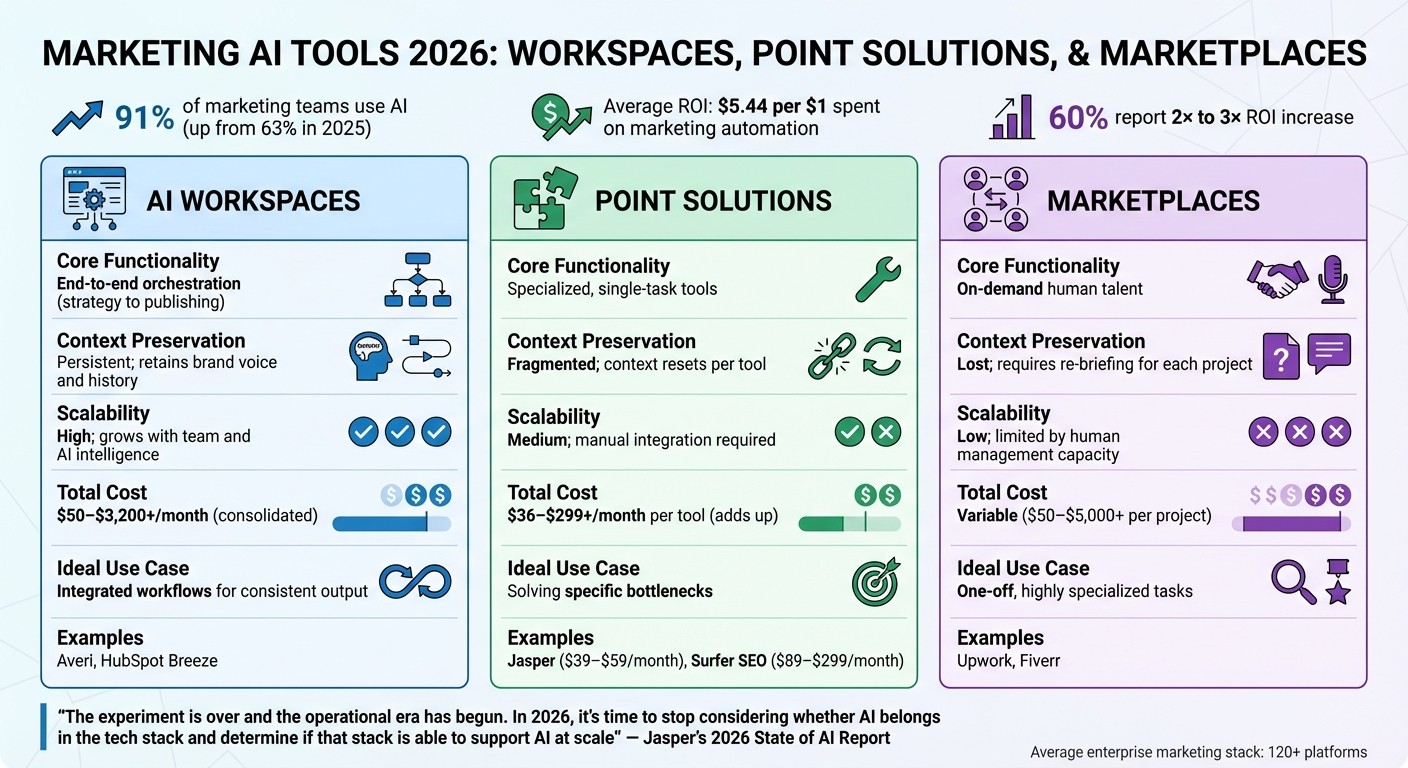
Marketing AI Tools Comparison 2026: Workspaces vs Marketplaces vs Point Solutions
By 2026, marketing teams will face a choice between three primary infrastructure models: workspaces, marketplaces, and point solutions. Each offers distinct advantages and challenges depending on team needs and goals. As highlighted in Jasper's 2026 State of AI Report:
"The experiment is over and the operational era has begun. In 2026, it's time to stop considering whether AI belongs in the tech stack and determine if that stack is able to support AI at scale" [4].
With 91% of marketing teams now leveraging AI - up significantly from 63% in 2025 - the focus has shifted from adoption to selecting the right infrastructure to support AI effectively [1][4]. Here's a breakdown of how these models compare in terms of features, costs, and ideal use cases.
Feature and Cost Comparison
The three models differ in how they manage context, scalability, and expenses. Workspaces like Averi and HubSpot offer end-to-end workflow orchestration, ensuring consistency in brand voice and scalability, with pricing from $50 to over $3,200 per month [5]. Point solutions, such as Jasper ($39–$59/month) and Surfer SEO ($89–$299/month), address specific tasks at a lower cost but often require manual integration [5]. Meanwhile, marketplaces like Fiverr and Upwork charge per project, providing access to specialized freelance talent without the commitment of full-time hires.
However, the total cost of ownership can be deceptive. While point solutions seem more affordable individually, teams often accumulate multiple subscriptions, leading to "tool sprawl." By 2026, the average enterprise marketing stack includes over 120 different platforms [2]. Workspaces, though more expensive upfront, consolidate functions, potentially reducing long-term costs.
Feature | AI Workspaces | Point Solutions | Marketplaces |
|---|---|---|---|
Core Functionality | End-to-end orchestration (strategy to publishing) | Specialized, single-task tools | On-demand human talent |
Context Preservation | Persistent; retains brand voice and history | Fragmented; context resets per tool | Lost; requires re-briefing for each project |
Scalability | High; grows with team and AI intelligence | Medium; manual integration required | Low; limited by human management capacity |
Total Cost | $50–$3,200+/month (consolidated) | $36–$299+/month per tool (adds up) | Variable ($50–$5,000+ per project) |
Ideal Use Case | Integrated workflows for consistent output | Solving specific bottlenecks | One-off, highly specialized tasks |
For teams tracking AI ROI, 60% report returns of 2× to 3× or more [1]. However, achieving these returns hinges on selecting infrastructure that aligns with workflow needs. For example, AI marketing automation can deliver an average ROI of $5.44 per dollar spent, but only when properly integrated [2].
Strengths and Weaknesses by Category
Each model has its own strengths and challenges, making the choice highly dependent on your team's specific goals and workload.
Workspaces are ideal for creating repeatable systems. They maintain context across projects, automate governance, and address the growing legal and compliance challenges that come with scaling AI - challenges that have increased 3.4× year-over-year [1]. However, they come with higher upfront costs and may include features that go unused if your needs are limited.
Point solutions excel at tackling isolated tasks, such as optimizing meta descriptions or generating social media captions. They're budget-friendly and quick to deploy. But as Do Tromp, Growth Marketing Manager at The Brief, explains:
"Traditional automation executes your instructions, while AI automation adapts based on what it learns" [2].
This adaptability is where point solutions fall short - they lack the cross-functional learning and integration that workspaces provide, leaving teams to manually bridge gaps between tools.
Marketplaces shine for specialized, one-off projects like custom illustrations, technical white papers, or niche expertise. While they offer flexibility, they also require significant effort to brief, manage, and ensure quality. Scalability becomes a challenge as managing multiple freelancers can quickly turn into a full-time task.
The right choice depends on your objectives. If you're solving a one-time problem, filling a specific gap, or building a scalable content engine, each model offers a different path forward. For teams producing content regularly, workspaces provide the persistent context and automation needed to transform content creation from a recurring task into a long-term asset.
How to Pick the Right Tool
Choosing the right marketing AI tool boils down to three key factors: the size of your team, your budget, and your specific goals. While each tool serves a unique purpose, the challenge lies in finding the one that aligns perfectly with your business needs.
As businesses progress from experimenting with AI to fully incorporating it into their operations, priorities shift. Scalable and repeatable content pipelines become essential for long-term success [1]. A solopreneur focused on speed will need a very different solution than a 50-person enterprise managing brand consistency across multiple regions.
Best Options for Startups and SMBs
For startups and small-to-medium businesses (SMBs), affordability and seamless integration are critical. Smaller teams working with limited budgets should look for all-in-one AI marketing tech stacks that handle the entire content creation process - from planning to publishing. Tools like Averi (priced at $100/month) or HubSpot Marketing Hub (starting around $800/month) are ideal, as they consolidate multiple functions into one system, eliminating the need for several subscriptions and reducing manual coordination [6].
Solopreneurs typically spend between $240 and $780 annually on integrated tools [6]. By fully integrating AI-assisted content production, they can save about $480 per blog post compared to traditional methods. However, fragmented solutions that require frequent context-setting can erode these savings over time, as they lack the ability to retain and build on a consistent brand memory.
For SMBs with teams of 3–5 people, investing in AI tools can yield significant time savings - often 10–15 hours per week. This translates to an annual value of approximately $26,000 to $52,000 for mid-sized teams [6]. The initial investment in an integrated platform typically pays off within 21 to 70 days, making it a more efficient choice than piecing together individual tools [6].
Best Options for Enterprises
Enterprises face unique challenges, such as managing governance, compliance, and multi-channel coordination. By 2026, legal and compliance reviews have become major barriers to scaling AI, with these challenges increasing 3.4× year-over-year [1]. Large organizations should focus on platforms like Salesforce Marketing Cloud (costing over $1,000/month) or HubSpot with features like native CRM integration, SOC 2/GDPR compliance, and advanced team permissions [2][6].
Enterprise-level tool budgets typically range from $15,000 to $50,000 annually, with break-even points occurring within 47 to 88 days [6]. Hidden costs often arise from integration efforts, as custom API development can cost an average of $6,375 (51 developer hours at $125/hour). In contrast, platforms with built-in connectors can reduce setup time from 40–60 hours to just 30–90 minutes [6]. These built-in integrations help eliminate data silos and reduce coordination delays, which are common pain points for large teams.
Enterprises often designate specialized roles, such as AI Transformation Leads or AI Search Specialists, to oversee AI workflows and governance. These roles are critical for avoiding wasted budgets, as overlapping tool functionalities and unused licenses can lead to a 34% loss in spending. Alarmingly, 41% of AI users with licenses remain inactive for over 90 days [6].
When to Use Multiple Tools
For mid-sized teams, a modular approach can be highly effective. This involves using a central workspace alongside specialized tools for specific tasks. For instance, pairing Averi for overall content management with Surfer SEO for on-page optimization (priced between $89 and $299/month) can address unique bottlenecks [5][7]. The key is ensuring that the workspace maintains context and brand consistency while the point solutions tackle niche challenges.
Regularly auditing your tech stack is essential to eliminate redundant tools and streamline integrations. The goal isn’t to minimize the number of tools but to ensure that each serves a distinct purpose and integrates seamlessly. This approach supports long-term growth by reducing manual handoffs and allowing tools to build on shared context.
As highlighted in Jasper's 2026 State of AI Report:
"The advantage comes from integrating it [AI] so teams can use it meaningfully and prove out measurable business impact" [1].
Whether you opt for a single platform or a modular stack, the cornerstone of success is integration. Tools should work together, share context, and continuously improve efficiency to drive meaningful results over time.
Conclusion
By 2026, marketing AI has firmly moved from being experimental to becoming a standard part of operations. A striking 91% of marketers now actively use AI, a sharp rise from 63% in 2025 [4]. The focus has shifted from whether to adopt AI tools to how well they are integrated into daily workflows. As highlighted in HubSpot’s 2026 State of Marketing Report:
"AI is now table stakes. In 2026, the gap isn't who is using AI - it's how well they're using it." [8]
The real edge lies in seamless integration. While half of marketing teams report faster go-to-market times, only 41% can confidently demonstrate ROI. This is because leadership increasingly prioritizes measurable outcomes like pipeline growth and revenue over AI productivity boosts [4]. Marketing automation offers an impressive average ROI of $5.44 for every dollar spent, but achieving this requires tools that work together without friction [2].
One of the most unexpected trends is the growing value of human-created content, often referred to as the "humanity premium." Even though 95% of marketers use AI for content creation, 83% of top-ranking content on Google remains human-written or human-edited [3,8]. Kieran Flanagan, SVP of Marketing, AI, & GTM at HubSpot, explains:
"Today, more content is generated by AI than by humans. But it's mostly average. Consumers seek human-created content, and will tune out brand and AI-generated content." [8]
Choosing the right AI tools depends on factors like team size, budget, and growth goals. Solopreneurs benefit from cost-effective point solutions, SMBs thrive with integrated workspaces that streamline collaboration, and enterprises need platforms that prioritize governance and CRM connectivity. The ultimate goal is to select tools that build on shared knowledge, enabling teams to maintain momentum without starting from scratch on every project.
In 2026, success isn’t about having the most AI tools - it’s about leveraging the right ones to protect your brand’s voice while driving meaningful, measurable results.
FAQs
How do I choose between a workspace, a marketplace, and point solutions?
Choosing the right option comes down to your specific needs, team size, and how much control you want over the process.
Workspaces like Averi provide an integrated platform where AI tools and human oversight come together for smooth collaboration.
Marketplaces such as Fiverr and Upwork give you flexible access to freelancers, though they may lack centralized control.
Point solutions like Jasper or Copy.ai are built for specific tasks. While they offer specialized features, they often require more setup.
Your decision should align with your goals and how complex your workflow is.
What’s the fastest way to prove AI-driven ROI to leadership?
Mid-sized teams can achieve tangible time and cost savings by integrating AI tools effectively. On average, these teams reclaim 10–15 hours per week, which, over a year, equates to financial savings of $26,000–$52,000. Even better, many teams report breaking even on their investment within just 60–90 days.
AI tools streamline tasks that often consume valuable time, such as automating campaign adjustments and generating content. This not only reduces manual effort but also enhances overall productivity, allowing teams to focus on strategies that drive revenue growth. By handling repetitive processes efficiently, AI becomes a key player in optimizing both time and resources.
How can I use AI while staying compliant and on-brand?
To integrate AI effectively while maintaining compliance and staying true to your brand, start by creating detailed brand guidelines specifically tailored for AI-generated content. These guidelines should ensure that the content remains consistent with your established tone and voice. Choose AI tools equipped with quality control mechanisms, review processes, and robust data management features to meet legal requirements, such as data privacy regulations. Finally, implement regular human oversight to review AI outputs. This step is crucial for protecting your brand's reputation and ensuring that the content aligns with your company’s standards.
Related Blog Posts

Zach Chmael
CMO, Averi
"We built Averi around the exact workflow we've used to scale our web traffic over 6000% in the last 6 months."
Your content should be working harder.
Averi's content engine builds Google entity authority, drives AI citations, and scales your visibility so you can get more customers.