

In This Article
Blend AI-driven SEO, user-generated content, and human storytelling to turn travel interest into direct bookings.
Updated:
Trusted by 1,000+ teams
Startups use Averi to build
content engines that rank.
The hospitality and travel industry faces stiff competition in a digital world where travelers interact with platforms like Instagram, TikTok, Google, and AI tools before booking. To stand out, businesses must use content marketing to create personalized, engaging stories that guide customers from dreaming about trips to making bookings. Here’s what you need to know:
Why Content Marketing Works: It builds trust, boosts visibility, and helps travelers choose your brand over competitors by addressing their needs at every stage - awareness, consideration, and decision.
Key Goals: Increase direct bookings, reduce reliance on third-party platforms, and retain customers through newsletters, travel tips, and personalized recommendations.
Effective Strategies:
Know Your Audience: Use traveler personas, social listening, and surveys to understand preferences.
Target High-Intent Keywords: Focus on long-tail, location-specific phrases like "best family resorts in Florida."
Plan for Seasons: Use an editorial calendar to publish content ahead of peak travel times.
Leverage User-Generated Content (UGC): Showcase guest photos and reviews to build trust.
Collaborate with Influencers: Partner with micro-influencers for relatable, niche storytelling.
Use AI Tools: Automate repetitive tasks like keyword research and content drafts to save time.
Metrics to Measure Success: Track direct booking rates, engagement (click-through rates, time on page), and visibility on AI-driven platforms like ChatGPT or Google AI Overviews.
The takeaway: Combine AI’s efficiency with human storytelling to connect with travelers, increase bookings, and stay competitive in a rapidly evolving digital landscape.
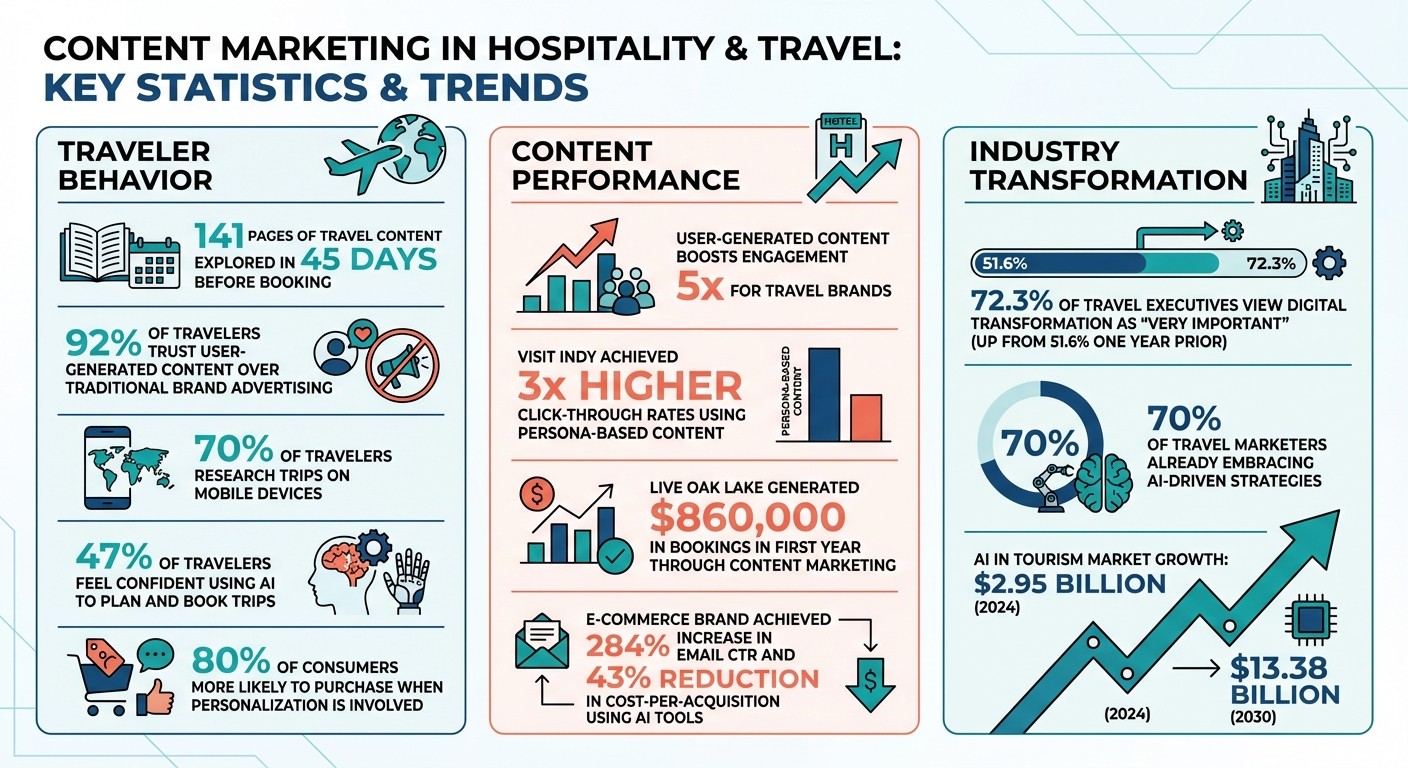
Content Marketing Statistics for Hospitality and Travel Industry 2024-2030
Harnessing content marketing in the travel industry
Building a Destination-Focused Content Strategy
A destination-focused content strategy connects traveler insights with actionable marketing practices. By aligning content with traveler needs, you can create meaningful engagement and drive results.
Identifying Traveler Personas and Preferences
Understanding your audience goes beyond basic demographics. It’s about identifying their motivations, challenges, and decision-making triggers. Begin by tapping into the knowledge of front-line staff at visitor centers or front desks. These team members often hear recurring questions and concerns, providing valuable insight into what travelers are looking for.
Next, leverage social listening and sentiment analysis. Use AI-driven tools to gather data from platforms like Reddit and TripAdvisor. Analyzing customer reviews can reveal emerging trends, such as the growing interest in wellness travel or solo adventures [5]. For more direct insights, send targeted email surveys to past guests, asking about their travel goals, concerns, and preferred research methods [4].
A great example of this approach comes from Visit Indy, which shifted from generic messaging to persona-based content. By focusing on specific traveler goals and objections, they achieved three times higher click-through rates on Facebook ads [4]. This success came from relying on real data to guide their content strategy.
Finding and Using High-Intent Keywords
Once you understand your audience, you can identify high-intent keywords - terms that indicate a traveler is ready to act, whether booking a trip, purchasing a tour, or requesting a quote [11]. These keywords often combine location with intent, such as "family-friendly resorts in Phoenix" or "hidden hiking trails near Big Bear" [9]. Long-tail keywords like these are less competitive and attract travelers closer to making a decision [7].
Discover these phrases by exploring travel forums like Reddit and TripAdvisor [9]. Features like Google's "People Also Ask" and Autocomplete can also uncover long-tail queries with high search volume and low competition [9]. Don’t ignore social platforms - Instagram, TikTok, and Pinterest are increasingly used as search tools, so optimize your content with destination-specific keywords in alt-tags and captions [9].
"Traffic and clicks don't pay the bills - conversions do. That's why optimizing for high intent keywords can have a direct, measurable impact on your revenue." - Alex Thompson, WhatConverts [11]
To maximize impact, map your keywords to the traveler’s journey: use informational keywords like "what to pack for 10 day safari Tanzania" for awareness, commercial investigation terms like "best boutique hotels in Paris under $250" for consideration, and transactional phrases like "buy skip the line tickets Colosseum" for decision-making [8]. Including the current year (2026) in titles and metadata signals that your content is current and relevant [8].
Once you’ve identified your keywords, structure your content release schedule to align with seasonal traveler behavior.
Creating an Editorial Calendar for Seasonal Trends
A well-planned editorial calendar anticipates traveler demand before it peaks. Using predictive analytics, you can forecast when interest in specific destinations, events, or seasons will rise [5] [3]. Publishing content weeks or months in advance helps you capture early planners and build organic visibility.
Organize your calendar into three tiers of content:
KeyContent: Cornerstone destination guides that provide in-depth information.
SupportContent: Blogs, FAQs, and other materials answering specific traveler questions.
MicroContent: Bite-sized posts for social media and email campaigns [1].
AI tools can help identify trending topics and frequently asked questions, allowing you to fill gaps in your schedule [5]. For instance, if AI detects growing interest in "longevity wellness retreats" or "carbon-negative resorts" - luxury trends expected to grow in 2026 [10] - you can adjust your strategy to target these audiences. Create themed content hubs, such as "family beach escapes" or "solo wellness retreats", to guide travelers from inspiration to booking [2].
Creating Content That Engages Travelers
Capturing the attention of travelers and converting their interest into bookings requires content that resonates. With the average traveler exploring 141 pages of travel content in the 45 days leading up to a booking [12], your content needs to deliver meaningful value at every stage of their journey.
Writing Blog Posts and Travel Guides
The best blog posts go beyond surface-level information to address specific traveler needs. Instead of broad destination overviews, focus on high-intent guides that align with how people search. For example, a guide like "Best snorkeling spots in Tulum for non-swimmers" is far more effective than a generic "Things to do in Tulum" post [6]. These targeted guides not only attract attention but also connect with travelers ready to make decisions.
Detailed neighborhood itineraries are another powerful tool. By including specific local spots, you help travelers imagine their stay, building trust and positioning your property as an insider's resource [12].
Success stories highlight the impact of this approach. Live Oak Lake, for instance, generated $860,000 in bookings in its first year by emphasizing design, lifestyle, and authentic guest experiences [12]. Similarly, 1 Hotels crafted content around their green initiatives, appealing to environmentally conscious travelers and fostering loyalty [12].
Guest reviews can also be transformed into compelling marketing copy. By distilling emotional testimonials into concise phrases, you can create powerful messages. For example, a review like "waking up to the sound of waves and having coffee on our private balcony was pure magic" can become the centerpiece of a landing page or ad. 92% of travelers trust user-generated content over traditional brand advertising [12].
From here, visual storytelling can take your content to the next level.
Using Visual Content: Videos and Interactive Tools
Short-form videos on platforms like TikTok and Instagram Reels are redefining discovery. Authentic, user-generated clips - such as room walkthroughs, staff-led guides, or behind-the-scenes moments - can showcase your property in a way static images cannot [12]. These videos help travelers feel the atmosphere and envision their experience before booking.
Loews Hotels saw significant engagement gains by swapping traditional photos for guest-generated images in their "Travel for Real" campaign [12]. This approach highlights the power of authenticity in visual content.
Interactive tools also play a key role in reducing decision-making friction. Virtual tours allow potential guests to explore your property remotely, fostering transparency and trust [13]. For event planners, tools like 3D diagrams and interactive floor plans (e.g., Cvent Event Diagramming) enable them to customize layouts without needing a site visit [14]. Downloadable resources, such as packing lists or event guides, can further address common questions before they arise [14].
"Your content can transform your hotel into more than just a place to stay; it becomes part of the journey." - Milestone Internet [13]
Repurposing content across platforms ensures maximum reach. A single blog post can evolve into Instagram Reels, TikTok videos, and email snippets with the help of AI-assisted content ideation tools [1]. This strategy allows you to meet travelers wherever they are, whether they're scrolling through social media or diving into a detailed guide.
Using Storytelling to Connect with Travelers
Storytelling is the heart of travel content. Travelers aren't just booking rooms - they're seeking experiences [2][6]. Your content should focus on the emotional rewards of staying with you, rather than just listing amenities or features.
Avoid overused phrases like "hidden gem" or "heart of the city", which can dilute your brand's voice [6]. Instead, use natural, conversational language that reflects how real people describe their experiences. Highlight recurring guest mentions such as "cozy fireplace" or "breakfast tacos" to add authenticity.
Personalized experiences and genuine storytelling have a significant impact on purchasing decisions [3]. Showcase what sets your property apart, whether it's the history of your building, staff members' personal connections to the area, or collaborations with local businesses [12]. These details turn a simple transaction into a memorable experience.
"Emotional connections and compelling storytelling are aspects of content marketing that still need the human touch." - Watauga Group [3]
While AI can assist with outlines and initial drafts, the emotional nuances - the warmth of a guest interaction or the magic of a sunset - require human creativity to truly resonate [1][3]. By combining AI-powered content strategy with your own unique voice, you can scale content production while maintaining its personal touch.
Using User-Generated Content and Influencers
Travelers tend to trust the opinions of other travelers far more than they trust brands. This makes user-generated content (UGC) and influencer collaborations a natural fit for engaging with your audience. In fact, nearly 92% of travelers rely on UGC, such as guest photos, reviews, and social media posts, as a key part of their decision-making process [12]. When paired with influencer partnerships, this type of content can extend your reach and build trust.
Collecting and Showcasing Guest Reviews and Photos
Encouraging guests to share their experiences starts with building a marketing strategy that makes it easy and fun. Create spaces at your property that are perfect for photos - think eye-catching lobby installations, stunning rooftop views, or cozy reading corners. Add a branded hashtag and display it prominently so guests know how to tag their social media posts [15][16][17].
You can also use post-stay emails to collect reviews and photos. Send a follow-up message within 24–48 hours after checkout, including direct links to review platforms like TripAdvisor or Google. Add a friendly invitation for guests to share their photos on social media. The easier you make it, the more likely guests are to participate [15][16][17].
Once you’ve gathered this content, use it to your advantage. Feature guest photos on your website’s homepage and booking pages to offer social proof when it matters most [2][12]. Highlight glowing reviews in email campaigns, and consider turning standout guest posts into paid social ads.
"User-generated content boosts engagement 5x for travel brands, and people trust travelers more than branded ads." - Averi [2]
Influencer partnerships can take this strategy even further, adding another layer of authenticity and reach.
Working with Micro-Influencers
Collaborating with micro-influencers - those with 10,000 to 100,000 followers - can amplify your brand’s story in a relatable way. Unlike celebrity endorsements, micro-influencers often feel like trusted friends to their audiences, which leads to stronger engagement [12]. Focus on finding influencers whose niche matches your offerings, whether it’s solo wellness retreats, family-friendly vacations, or eco-conscious travel.
A great example comes from Live Oak Lake, a micro-resort in Texas. By teaming up with regional micro-influencers in the design and lifestyle space, they drove $860,000 in bookings within their first year. This campaign also played a role in the property’s eventual $7 million sale [12]. The key to their success? Authentic storytelling that resonated with a specific audience.
Use influencer content to spark interest at the top of the funnel. Showcase aspirational imagery and videos that capture the imagination [3]. Then, repurpose this content across your platforms - turn blog posts into email highlights, use social captions inspired by influencer stories, or add FAQs based on influencer feedback. Encourage a variety of formats, like short-form videos, carousel posts, and interactive elements, to keep the narrative fresh.
To maintain a cohesive brand image, provide influencers with clear guidelines on tone, language, and style. While AI tools can help streamline tasks like drafting creative briefs or researching keywords, the emotional core of influencer content - like the magic of a sunset or the intimacy of a personalized experience - requires a human touch [3].
Automating and Personalizing Content with AI Tools
AI tools can handle repetitive content tasks, giving you more time to focus on running your hospitality business. This isn’t about sidelining creativity - it’s about creating systems that allow you to produce content consistently without the risk of burnout. It's worth noting that 72.3% of travel executives now view digital transformation as "very important" to their business, a significant rise from 51.6% just a year ago [2]. By integrating automation into your destination-focused strategy, you can ensure your content stays timely and relevant while freeing up resources for more creative storytelling to connect with travelers.
Generating SEO-Optimized Content with AI
AI simplifies the process of keyword research and content structuring for both traditional search engines and AI-driven tools. Platforms like Averi AI are particularly adept at identifying gaps in competitor content and generating ready-to-use topic ideas, complete with titles, keywords, and outlines. You maintain control by approving what gets created, while the AI drafts content with hyperlinked sources for easy verification.
For high-volume tasks like destination FAQs or seasonal promotions, detailed prompts are key. For example, instead of a generic request, try something like: "Write as a senior Airbnb SEO consultant targeting wellness travelers planning a spring retreat in Sedona." Specific instructions lead to better-targeted, conversion-focused content.
Once the AI produces a draft, you can refine it using collaborative editing tools. Highlight areas for improvement and instruct the AI to rewrite, expand, or adjust the tone. Tools like Averi even suggest internal links and generate meta descriptions, cutting down on repetitive tasks. From there, content can be published directly to platforms like WordPress, Webflow, or Framer, eliminating time-consuming manual uploads.
Personalizing Customer Experiences with AI
Personalization, once reserved for businesses with large budgets, is now accessible thanks to AI. By analyzing guest behavior, AI delivers tailored recommendations. For instance, sentiment analysis can categorize customer reviews and social media mentions as positive, negative, or neutral. This helps you decide whether to focus your next campaign on managing your reputation or amplifying positive testimonials.
Dynamic content delivery takes personalization to the next level. Your website and email campaigns can adapt in real time to traveler preferences - showing spa retreat options to wellness enthusiasts while highlighting corporate-friendly amenities for business travelers. With over 70% of travelers researching trips on mobile devices [2], it’s critical to ensure your personalized content performs well on mobile, with fast load times and clear calls-to-action.
Additionally, 47% of travelers now feel confident using AI to plan and book trips [12]. They expect tailored suggestions rather than generic options. AI can forecast peak travel seasons based on historical booking trends, enabling you to ramp up marketing efforts before demand slows. By refining customer targeting, AI not only personalizes the traveler experience but also streamlines how your content moves from idea to execution.
Simplifying Content Workflows
The real strength of AI lies in its ability to unify fragmented workflows. Tools like Averi AI integrate strategy, creation, and execution into a single platform, reducing the need to juggle multiple tools. By centralizing your brand voice, guidelines, and customer personas in a "Brand Core", you can ensure every piece of content aligns with your messaging across all channels.
AI also makes repurposing content effortless. For example, a comprehensive destination guide can be transformed into email newsletters, social media posts, and FAQ sections - all without starting from scratch. This not only saves time but also ensures your messaging stays consistent. Localization becomes more manageable too, as AI-powered translation tools produce content that resonates with international audiences, helping you expand into global markets without incurring high agency costs.
"We accomplished more in two weeks with Averi than we did in three months with our previous agency. The combination of AI speed and expert execution is exactly what we needed." - Sarah Chen, Founder, TechScale [2]
Start with a small pilot project. Test one AI tool with clear KPIs to measure its ROI and address any technical challenges before scaling up. Begin by automating repetitive tasks like content briefs, keyword mapping, and initial drafts. Then, layer in human expertise for strategic decisions, emotional storytelling, and maintaining your brand’s authentic voice.
Measuring Success and Improving Campaigns
Understanding how your content performs is essential to increasing bookings. Tracking the right metrics lets you see which destination guides are driving reservations, which social media posts are sparking interest, and where your budget is delivering the best results. Today, measurement goes beyond traditional web analytics, incorporating AI-driven search visibility and predictive insights.
Key Metrics to Track in Hospitality and Travel Marketing
Focus on metrics that tie directly to revenue rather than surface-level numbers. For example, direct booking rate reveals if your content is successfully steering travelers away from third-party platforms like Expedia and toward your higher-margin channels. Similarly, average booking value indicates whether your content is attracting budget-conscious travelers or those willing to splurge. Metrics like return on ad spend (ROAS) and customer acquisition cost (CAC) help determine if your paid campaigns are delivering profits or draining resources.
Engagement metrics are equally important, especially those that directly influence bookings. Click-through rate (CTR) measures how well your headlines and visuals grab attention, while time on page shows if travelers are finding your destination guides useful enough to stay and read. Tracking research-heavy pages can guide your future content priorities. AI search visibility is another critical metric, ensuring your content appears on platforms like Google AI Overviews, Perplexity, and ChatGPT. With 47% of travelers now trusting AI to help plan trips [12], being featured in AI-driven results is as important as ranking on traditional search engines.
These metrics not only show how well your content engages travelers but also provide actionable insights to refine your strategy and improve booking outcomes.
Metric Category | Key Performance Indicators |
|---|---|
Financial | ROAS, CAC, Average Booking Value |
Conversion | Direct Booking Rate, Lead Conversion Rate |
Engagement | CTR, Social Interactions, Time on Page |
Loyalty | Repeat Booking Rate, CLV, NPS |
Visibility | AI Search Visibility, Organic Reach |
Analyzing Content Performance by Type
Different types of content - cornerstone guides, blogs, and user-generated content (UGC) - require tailored evaluation to optimize your booking strategy. Cornerstone guides, such as in-depth destination resources or planning tools, should attract organic traffic and rank for high-intent keywords. Monitor their search visibility and whether they appear during the traveler’s consideration phase. For blog posts and FAQs, focus on their ability to answer specific questions and reduce the time it takes for travelers to move from inquiry to booking.
User-generated content, like guest photos and reviews, often outperforms brand-created material in engagement. UGC increases engagement by 5x for travel brands [2], and 92% of travelers trust it more than traditional ads [12]. Compare engagement and conversion rates between UGC and branded content. If UGC consistently performs better, allocate more resources to collecting and showcasing guest stories. For AI-generated drafts, test them against human-edited versions to identify which drives better engagement and conversions, then adjust your workflow accordingly.
Take Live Oak Lake, a Texas-based design-focused micro-resort, as an example. By analyzing which influencer campaigns best highlighted guest interests, they achieved $860,000 in bookings during their first year and contributed to a $7 million sale of the property [12]. Their success came from continuously evaluating which content resonated most with their wellness-focused audience and doubling down on those efforts.
This type of analysis ensures your destination-focused content is always driving bookings effectively.
Adjusting Strategies Based on Data
Metrics provide the foundation for real-time strategy adjustments that enhance both content and campaign performance. Use sentiment analysis to guide your next steps. If AI tools show that guest reviews and social media mentions lean negative, focus on reputation management and addressing concerns. If sentiment is overwhelmingly positive, amplify those testimonials in your marketing [5]. This data-driven approach ensures you're responding to traveler feedback rather than guessing what matters to them.
Predictive analytics can help you stay ahead of demand trends. By analyzing historical booking data, you can anticipate peak seasons and scale your content production accordingly. For instance, if spring bookings typically spike in January, prepare your Sedona wellness retreat guides and email campaigns for December. A/B testing is another powerful tool - experiment with different visuals, headlines, and call-to-action placements to determine what drives higher conversions [2].
An example from outside the travel industry illustrates the power of rapid iteration. An e-commerce skincare brand using Averi's AI tools created 127 pieces of content in just 48 hours, achieving a 284% increase in email click-through rates and a 43% reduction in cost-per-acquisition [2]. While this example isn’t from hospitality, the lesson applies: fast testing and data-informed adjustments allow you to refine strategies far more efficiently than manual processes. Monitor what's improving, what's plateauing, and what's underperforming, then pivot your content calendar accordingly.
Conclusion
The most successful travel brands today blend the analytical power of AI with the emotional resonance of human storytelling. This combination enables them to craft personalized travel experiences that not only resonate with customers but also drive bookings. With 70% of travel marketers already embracing AI-driven strategies [3] and 80% of consumers more inclined to purchase when personalization is involved [3], the time to act is now.
Your content strategy should seamlessly guide travelers through every stage of their journey - from sparking initial interest to fostering loyalty after their stay. Focus on metrics that directly impact your bottom line, such as direct booking rates, average booking value, and return on ad spend. Incorporating user-generated content can amplify engagement by up to 5x [2], demonstrating the power of authenticity in connecting with audiences. By merging AI's precision with human creativity, brands can overcome the challenges of digital visibility in today's competitive landscape.
Take proactive steps: evaluate your current marketing tools, experiment with one AI-driven solution using measurable KPIs, and plan a seasonal content calendar that incorporates guest reviews and predictive analytics [3].
The numbers underscore the urgency. The AI in tourism market is expected to grow from $2.95 billion in 2024 to $13.38 billion by 2030 [3], while 72.3% of travel executives now rank digital transformation as "very important" [2]. By building a strong content strategy and embracing AI today, hotels, resorts, and travel companies can position themselves as leaders in both visibility and bookings tomorrow.
FAQs
What content should I create first to get more direct bookings?
Start by crafting blogs that center around your destination, emphasizing distinctive experiences and must-see local attractions. This approach not only grabs the attention of travelers but also encourages them to book directly with you. Sharing what sets your destination apart helps create a genuine connection with potential guests and inspires them to explore everything it has to offer.
How can I find high-intent travel keywords for my destination?
To capture travelers who are ready to book, prioritize transactional and location-specific keywords. For instance, phrases like “family resort in Miami” or “private boat charters in Key West” resonate with users actively seeking services in specific destinations. Research popular travel-related terms, study competitor strategies, and leverage tools like keyword planners to refine your list. Focus on high-intent searches to ensure your content aligns with what potential customers are looking for, driving more bookings effectively.
What metrics best show content marketing is driving bookings?
Key indicators to watch are the site conversion rate and the direct bookings mix, as these directly reflect how effectively your content drives guest actions and influences booking decisions. Additionally, engagement metrics - such as likes, comments, and shares - offer insights into how well your content resonates with your audience, which can indirectly boost bookings. Together, these metrics paint a clear picture of the relationship between your content's performance and customer behavior.
Related Blog Posts

Zach Chmael
CMO, Averi
"We built Averi around the exact workflow we've used to scale our web traffic over 6000% in the last 6 months."
Your content should be working harder.
Averi's content engine builds Google entity authority, drives AI citations, and scales your visibility so you can get more customers.