

In This Article
A 5-step playbook for AI-driven audience segmentation: set goals, unify and clean data, use ML for dynamic segments, automate campaigns, and optimize results.
Updated:
Trusted by 1,000+ teams
Startups use Averi to build
content engines that rank.
AI-driven audience segmentation eliminates the slow, manual processes of the past. Instead, it analyzes vast amounts of data in real-time to create precise, dynamic customer segments. This approach helps businesses target specific audiences with tailored messaging, boosting engagement and efficiency. Companies like Lenovo and Juniper Networks have already saved millions and achieved measurable results by using AI to automate segmentation and campaign execution.
Key Takeaways:
Set measurable goals: Align segmentation efforts with business outcomes like higher conversions or reduced churn.
Unify and clean data: Consolidate customer data across channels and ensure accuracy for better AI analysis.
Leverage AI insights: Use machine learning to identify patterns and create dynamic, real-time audience segments.
Execute personalized campaigns: Automate content creation and deployment to scale targeted outreach efficiently.
Monitor and refine: Continuously track performance metrics and adjust strategies for ongoing improvement.
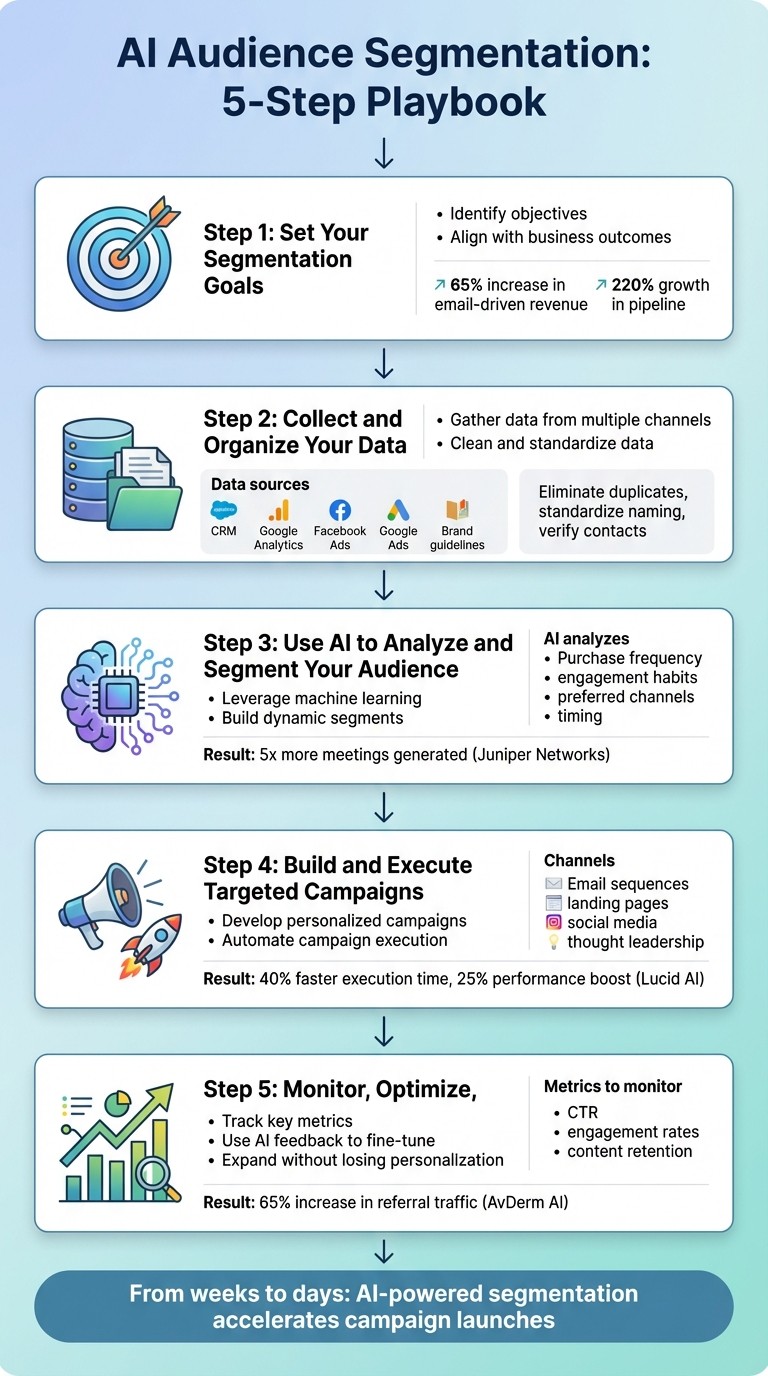
5-Step AI Audience Segmentation Process for Marketing Teams
How to Build Customer Segments with AI (Real-World Use Case)
Step 1: Set Your Segmentation Goals
Before diving into data analysis, establish clear and measurable goals. These should tie directly to business outcomes, such as boosting conversions, lowering customer acquisition costs, or increasing organic reach. Defining these objectives ensures your audience segmentation efforts are focused and effective.
Identify Your Objectives
Start by zeroing in on specific, quantifiable targets. For instance, if your email campaigns are underperforming, aim to increase email-driven revenue by 65%. If your goal is to enhance your sales funnel, focus on high-intent segments with personalized outreach to drive a 220% growth in your pipeline [1]. Make sure your objectives are tied to meaningful metrics that impact your bottom line rather than vanity numbers.
Compare your current performance metrics against industry benchmarks to uncover areas for improvement. As David from Thorn explains:
"Averi doesn't just give us insights, it helps us act on them. That's the gap every other platform misses. We're finally turning data into real campaigns" [1].
With well-defined goals in place, you’ll be ready to organize and analyze your data for effective segmentation.
Align with Business Outcomes
Once your objectives are clear, ensure they align with your company’s broader priorities. For example, if you're entering a new market, focus on identifying and reaching potential customers in that region. If reducing churn is a leadership priority, segment your audience based on engagement levels and purchase patterns to identify at-risk customers early.
This alignment ensures your efforts are targeted and strategic, turning AI into a competitive edge. Companies across various sectors have seen impressive results by adopting similar approaches, from booking more qualified meetings to cutting operational costs through automation.
With goals and alignment in place, the next step is to gather and refine your data to create actionable segments.
Step 2: Collect and Organize Your Data
To achieve effective segmentation, all your data must come together in one place. Scattered or incomplete data slows decisions and undermines accuracy. By consolidating everything into a unified system, you create a solid base for AI-driven segmentation.
Gather Data from Multiple Channels
Start by pulling information from every point where your audience interacts with your brand. Your CRM holds key details like accounts, contacts, and sales history. Tools like Google Analytics track website behavior and campaign performance, while platforms like Facebook Ads and Google Ads provide engagement metrics and conversion stats. Don’t overlook internal resources - brand guidelines, tone documents, and product details offer crucial context for segmentation.
Modern AI platforms simplify this process with thousands of integrations [2]. Instead of manually exporting data, use tools that centralize everything into a single system. As Ashley Levesque, VP of Marketing at Banzai, explained:
"I didn't even know AI workflows were something that I was lacking until someone said, 'Did you know you could do all of this with Copy.ai?'" [2]
Clean and Standardize Your Data
Raw data often comes with issues - duplicates, inconsistent formatting, or outdated records - that can distort your segments and waste resources. To avoid these pitfalls, eliminate duplicates, standardize naming conventions, fill in missing fields, and verify contact details. For example, if one system labels customers as "leads" and another calls them "prospects", your AI might fail to connect the dots.
AI-powered workflows can automate much of this cleanup, ensuring that data is accurate and up-to-date [2]. Train your AI to understand your business context and brand guidelines so it can identify and prioritize high-quality data [1]. This preparation ensures that your segmentation is based on reliable, actionable insights - not flawed or incomplete information. With clean data in place, you're ready to leverage AI for precise audience targeting.
Step 3: Use AI to Analyze and Segment Your Audience
Once your data is clean and organized, it’s time to let AI do the heavy lifting. By analyzing campaign performance, lead behavior, account details, and engagement metrics, AI moves beyond surface-level demographics to uncover patterns that can predict customer actions.
Leverage Machine Learning for Deeper Insights
AI thrives when it comes to recognizing patterns in complex data sets. It dives into customer behaviors - like purchase frequency, engagement habits, preferred channels, and timing - to help define Ideal Customer Profiles (ICPs) and create tailored messaging strategies [1].
To get the most from AI, you need to train it with context specific to your business. Feed it key information such as your brand guidelines, product details, and historical campaign data. This helps the platform understand what success looks like for your company [1]. When AI is equipped to analyze accounts, industries, and personas at a granular level, it delivers insights that drive highly relevant and scalable content [2].
Build Dynamic Segments
Static segmentation is often a recipe for outdated strategies. Dynamic segments, on the other hand, adapt in real-time as customer behaviors shift. AI-powered workflows make this possible by continuously monitoring data and updating segment membership automatically [2].
Set up workflows that define clear segmentation rules and ensure accuracy. For example, your AI can enrich new leads with additional data, research them, and assign them to the right segment for tailored engagement. This approach reduces the time it takes to act on leads and boosts conversion rates [2].
"Thanks to Averi, we're generating 5x more meetings with our personalized, AI-powered GTM strategy." [2]
Jean English, Former Chief Marketing Officer at Juniper Networks
The best AI platforms consolidate data from multiple sources into a single, unified view. This integration allows for real-time decision-making and ensures that your segments reflect current customer behavior rather than outdated snapshots. With this capability, you can scale personalized campaigns without the need for constant manual adjustments.
Once your dynamic segmentation is up and running, you’ll be ready to move on to Step 4: building and executing targeted campaigns.
Step 4: Build and Execute Targeted Campaigns
With your dynamic segments ready, it’s time to transform insights into action. Craft messaging that resonates with each segment’s specific needs, and use automation to scale your efforts without overloading your team.
Develop Personalized Campaigns
Equip your AI with your brand guidelines, product details, historical data, and customer insights. By doing this, the AI can create content that aligns with your brand voice and feels tailored rather than generic. This approach works across all channels - whether it’s email sequences, landing pages, social media posts, or thought leadership pieces [1].
The real game-changer lies in AI's ability to dive deep into accounts, industries, and personas. This granular understanding enables the creation of highly relevant, context-rich materials that are perfect for account-based marketing strategies [2].
"I've been testing it against ChatGPT…I love how it's customized to the information that I have in there in terms of my brand and tone." - Payton, Broadside [1]
Once you’ve developed personalized content, automation ensures smooth and efficient deployment.
Automate Campaign Execution
Personalized messaging is just the start - automation takes it to the next level by scaling your efforts. Manual execution can bog down teams, but automating processes such as content creation and deployment eliminates delays and ensures a steady flow of campaigns. AI-driven platforms codify your marketing workflows and best practices, bringing cross-functional teams together for consistent and efficient execution [2].
In 2025, Indy from Lucid AI shared that by consolidating five disconnected tools into Averi, they achieved a 40% faster execution time and saw a 25% boost in performance [1].
Let AI handle tasks like drafting, research, and initial asset creation, while your team focuses on strategic decisions and fine-tuning. This approach balances speed and quality, setting the stage for continuous optimization in the next step.
Step 5: Monitor, Optimize, and Scale Your Strategy
Your segments are live, and the campaigns are up and running. Now it’s time to ensure those efforts lead to more than just a short-term boost. Continuous monitoring is where initial wins are transformed into lasting success. By analyzing performance, refining strategies, and expanding your audience without losing that personal touch, you can ensure your campaigns remain effective and impactful.
Keep an Eye on Key Metrics
To get a clear picture of what’s working, integrate your AI with tools like revenue trackers, analytics platforms, and ad systems. Centralizing this data allows you to pinpoint which segments are converting, which campaigns aren’t pulling their weight, and where your budget is delivering the best results. Metrics such as click-through rates (CTR) on paid social ads, engagement rates, and content retention are especially telling. AI tools can highlight underperforming areas while showing you what’s driving success [1].
Take this example: AvDerm AI used Averi to power a campaign that leveraged micro-influencers. Within just a month, referral traffic jumped by 65%, showcasing the potential of targeted, data-driven strategies [1].
Use AI Feedback to Fine-Tune Segments
AI does more than just crunch numbers - it provides actionable insights. Let’s say a campaign from Q3 shows impressive CTRs on paid social ads but struggles with content retention. AI can identify the issue and recommend channel-specific adjustments to address it [1]. This kind of feedback loop ensures your segments are constantly evolving based on real-world performance.
By training your AI to understand your business and linking it to real-time data, the system becomes better at spotting opportunities and suggesting refinements. This approach doesn’t just boost conversion rates - it can also enhance customer lifetime value. With optimized segments in place, you’re ready to expand your reach without losing the personalized touch that drives results [1].
Expand Without Losing Personalization
Scaling your strategy means reaching a larger audience while keeping your campaigns tailored and relevant. Rely on an AI-native platform that handles the heavy lifting, like automating tasks and managing dynamic segments. These tools make it possible to target broader audiences with precision, ensuring that your messaging remains effective even as you grow.
For instance, Lucid AI consolidated five separate tools into a single Averi platform. The result? Execution speeds improved by 40%, and overall performance saw a 25% boost. This demonstrates how the right tools can simplify scaling while maintaining the quality of your campaigns [1].
Conclusion
AI-powered audience segmentation is changing the game, turning raw data into actionable strategies that drive revenue. By following the five-step framework - defining goals, organizing data, leveraging AI to identify patterns, running targeted campaigns, and refining continuously - marketers can adopt a streamlined approach that accelerates campaign launches from weeks to just days [1].
The transition from traditional manual segmentation to AI-driven methods has become essential. As mentioned earlier, connecting insights to actionable strategies shifts marketing from endless analysis to effective execution. This evolution is redefining how teams think about and implement audience targeting.
Platforms like Averi AI simplify this transformation by offering an all-in-one solution where segmentation, campaign execution, and real-time optimization come together effortlessly. From setting clear objectives to refining strategies on the fly, this approach turns marketing into a system that builds momentum with every campaign.
FAQs
How does AI make audience segmentation more accurate than traditional methods?
AI brings a new level of precision to audience segmentation by analyzing massive datasets at lightning speed and identifying patterns that human methods might miss. Traditional segmentation often depends on static criteria and smaller datasets, but AI goes a step further. It continuously learns and evolves, fine-tuning audience segments to keep them accurate and relevant. This adaptive process allows marketers to reach their target audiences with unmatched accuracy and efficiency.
How can I ensure my data is ready for AI-driven audience segmentation?
To get your data ready for AI-powered audience segmentation, it's crucial to prioritize data quality. Here's how you can do it:
Clean and validate your data: Remove errors, duplicates, and inconsistencies to ensure accuracy.
Standardize formats: Align all datasets to a consistent structure for seamless analysis.
Address missing values: Fill in gaps to prevent incomplete insights.
Verify accuracy: Cross-check data against trusted sources to confirm reliability.
Establish data governance policies: Put systems in place to maintain data quality over time.
These steps will lay the groundwork for precise AI segmentation, leading to sharper marketing strategies and improved results.
How can businesses use AI to create more personalized and effective marketing campaigns?
Businesses can tap into AI's capabilities to design marketing campaigns that feel personal and leave a lasting impact. By combining AI-powered insights with human creativity, marketers can better understand customer behavior, preferences, and interaction patterns. This allows for the delivery of highly targeted content and messages in real time.
AI also streamlines processes by creating brand-specific assets, automating outreach efforts, and fine-tuning campaigns using performance data. These tools ensure that marketing strategies remain relevant and flexible, driving higher engagement and improving ROI. With AI, companies can scale their personalized approaches without sacrificing accuracy or efficiency.
Related Blog Posts

Zach Chmael
CMO, Averi
"We built Averi around the exact workflow we've used to scale our web traffic over 6000% in the last 6 months."
Your content should be working harder.
Averi's content engine builds Google entity authority, drives AI citations, and scales your visibility so you can get more customers.