

In This Article
Scale culturally accurate content with AI using bias audits, clear governance, regional prompts, human review, and continuous feedback.
Updated:
Trusted by 1,000+ teams
Startups use Averi to build
content engines that rank.
AI content localization in 2025 is about more than just translating text - it’s about creating content that resonates with local audiences by incorporating regional expressions, cultural nuances, and market-specific insights. Businesses are prioritizing this approach to maintain brand consistency while expanding globally. Here’s what you need to know:
AI localization offers speed and cost savings: Traditional translation services are slow and expensive. AI platforms deliver real-time, context-aware translations by leveraging brand data and regional insights.
Risks include cultural missteps: AI models can misinterpret tone or miss sensitive nuances, leading to errors. Human oversight is essential to ensure accuracy and appropriateness.
Preparation is key: Auditing AI for bias, setting clear governance policies, and centralizing brand controls are crucial steps before deploying AI localization.
Best practices for AI localization: Use specific prompts for regional content, go beyond language to adjust formatting (e.g., prices, dates), and establish safeguards for sensitive topics.
Continuous improvement matters: Regularly update AI models, gather feedback, and save localized assets to refine future outputs.
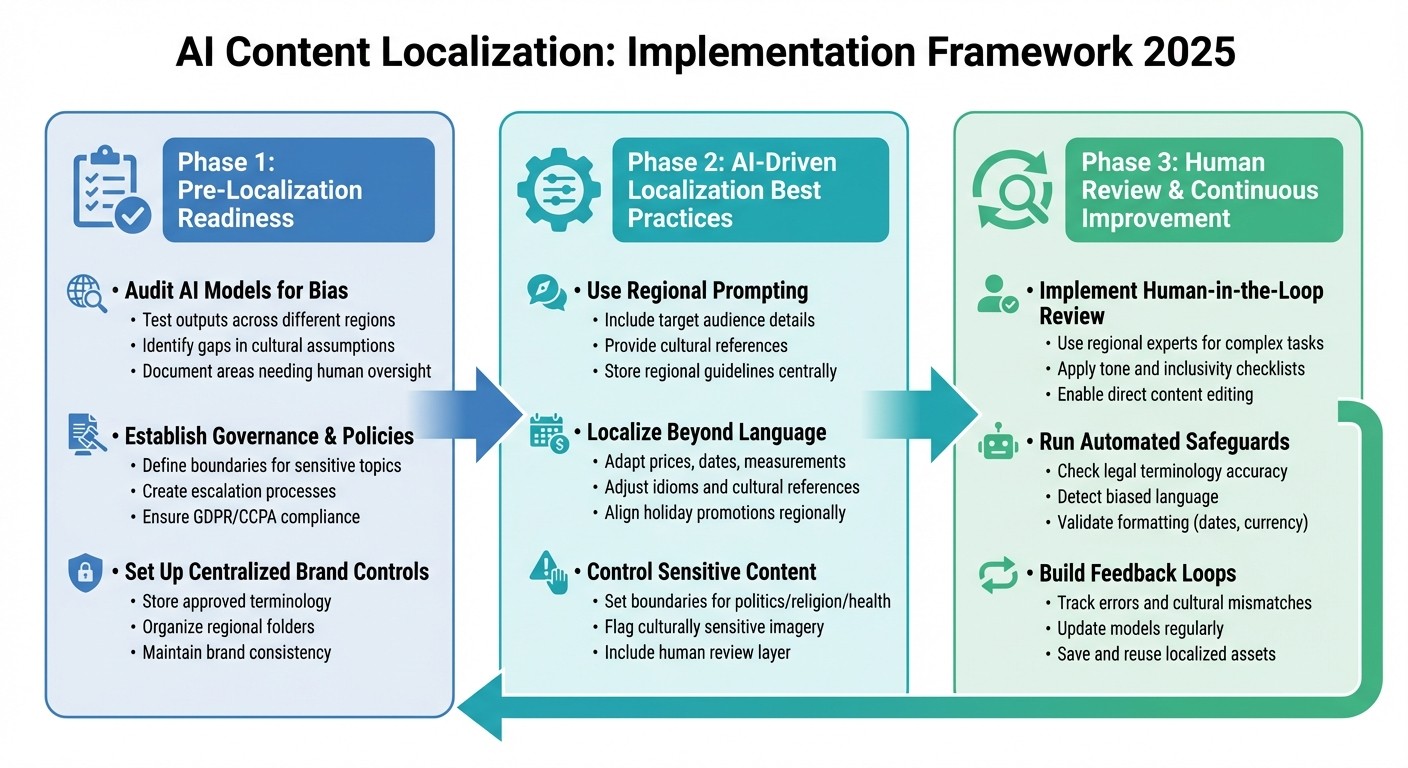
AI Content Localization Implementation Checklist: 3-Phase Framework for 2025
AI and Localization: Beyond Cost-Saving
Pre-Localization Readiness Checklist
Before rolling out AI localization, it’s crucial to lay a strong groundwork. Skipping this step could lead to cultural missteps, inconsistent branding, and wasted resources. Use this checklist to ensure your localization efforts are thoughtful, consistent, and ready to meet regional expectations.
Audit AI Models for Bias
Start by reviewing the training data used by your AI. Many systems rely heavily on English-language content, which can lead to gaps when creating localized material. Test the AI's outputs across different regions and languages to see if the tone and cultural assumptions match local expectations. For instance, run the same campaign brief through Japan, Brazil, and Germany, and take note of any generic or off-target results. This will highlight areas where human oversight might be necessary to refine the content.
Establish Governance and Policies
Define clear boundaries for what your AI can and cannot do. Sensitive topics - such as religion, politics, health claims, or legal compliance - should always be reviewed by humans. Create an escalation process to route such content to regional experts, and document best practices for handling legal and cultural reviews. Don’t forget to address data privacy regulations like GDPR in Europe or CCPA in California, ensuring your governance framework is regionally compliant.
Set Up Centralized Brand Controls
Consistency is key when managing a brand across multiple markets. Platforms like Averi AI can help you integrate your brand’s identity, tone, and regional nuances into AI-generated content. Use a centralized repository to store essential company resources, such as approved terminology, region-specific guidelines, and key brand information. Organize your workflow with regional folders to easily manage different versions and track approvals for each market.
This centralized approach becomes even more critical as you expand into new regions, where the challenge lies in balancing local adaptation with brand consistency.
AI-Driven Localization Best Practices
Once you've established a solid foundation, the next step is to guide your AI toward authentic localization. This means going beyond simple translation to crafting content that feels natural and relevant to each specific market. The aim is to make your AI a true collaborator in localization, rather than just a tool for language conversion.
Use Regional Prompting for AI
Specific prompts lead to content that feels more native. Instead of a generic request like "write a social media post", include details about the target audience, region, and context. For example: "Create a LinkedIn post for German B2B software buyers, focusing on data privacy and efficiency." This level of precision helps the AI draw from the right training data and adapt to the cultural nuances of the audience.
You can also provide your AI with localized market insights, cultural references, and successful examples of past content. Tools like Averi AI allow you to store these regional guidelines in a centralized Infobase. This ensures that every piece of content generated aligns with the local cultural framework, transforming your AI into an adaptive content creator rather than just a translator.
From here, the focus should expand to adapting all aspects of the content to truly engage with local audiences.
Localize Beyond Language
Localization goes far beyond mere translation. It includes adapting prices (e.g., $49.99), dates (e.g., 12/14/2025), and measurements (e.g., imperial units for U.S. audiences). But the process doesn’t stop at formatting. Idioms, humor, and cultural references must also align with the local audience. For instance, a "home run" analogy might resonate in the U.S., but it could fall flat in regions where baseball isn’t widely followed.
Holiday references are another area requiring attention. A Black Friday promotion might work perfectly for a U.S. audience, but in China, Singles' Day could be more relevant, while Boxing Day might be better suited for the UK. AI can help create highly tailored content by researching regional preferences, industries, and personas, ensuring the message fits the entire cultural context [2]. By configuring AI workflows to automatically adjust these elements, you can maintain consistency without needing to manually tweak every piece of content.
Once you've tailored the language and context, it's equally important to address content sensitivities.
Control Sensitive Content
Set clear boundaries for sensitive topics. Subjects like politics, religion, health claims, or culturally sensitive imagery need careful handling, as what’s acceptable in one region might not be appropriate in another. Equip your AI with guardrails and a detailed Brand Core to flag potentially sensitive topics automatically [2].
This approach helps respect cultural norms and reduces risks. For example, your AI should recognize that imagery featuring bare shoulders might be acceptable for U.S. audiences but inappropriate in some Middle Eastern markets. Similarly, certain color combinations can carry unique meanings depending on the region. To ensure these nuances are respected, always include a layer of human review [1]. This final step adds a level of cultural sensitivity that AI alone might not fully grasp.
Human Review and Compliance Safeguards
While AI can efficiently scale content production, it’s human judgment that ensures localized content resonates authentically and respects cultural nuances. Even the most advanced AI systems can misinterpret regional sensitivities or create translations that, while technically accurate, lack emotional or cultural authenticity. Combining AI-driven content creation with human oversight ensures both quality and compliance, forming a safety net for effective localization.
Implement Human-in-the-Loop Review
For complex tasks like crafting campaign messaging, reviewing legal disclaimers, or addressing culturally sensitive topics, regional expertise is essential. A native German reviewer, for instance, can ensure formal language aligns with local B2B expectations, while a U.S.-based reviewer might identify when humor or idiomatic expressions fall flat.
To streamline this process, use clear checklists focused on tone, inclusivity, and regional appropriateness. Tools like Averi AI even allow direct editing of AI-generated content, making refinements more efficient. By involving skilled human reviewers, you can achieve content that feels genuinely tailored to its audience.
Run Automated Safeguards and Testing
Incorporate compliance checks directly into your AI workflows to catch potential issues before content goes live. Automated safeguards can flag problems like incorrect legal terminology, biased language, or formatting errors. For example, regional compliance tools can verify legal accuracy, while bias detection systems identify potentially offensive phrases. Formatting validators ensure details like dates, currencies, and measurements are correctly adapted - for instance, ensuring "$49.99" appears instead of "€49.99" for U.S. audiences, or that dates follow the "12/14/2025" format instead of "14/12/2025."
Centralized compliance guidelines and brand standards provide the framework for AI generation, helping prevent mistakes rather than merely fixing them after the fact. With AI handling initial content creation and localization, and automated safeguards serving as a first line of defense, these systems create a proactive and efficient content pipeline.
A/B Test Localized Content
A/B testing offers another layer of validation by using real-world audience feedback to fine-tune localized content. For example, in German markets, testing whether a direct, benefit-driven headline outperforms a storytelling approach can reveal what resonates best. Similarly, in Japanese B2B content, a formal tone might yield better results than a casual one. Metrics like click-through rates, time spent on the page, and conversion rates can provide insights into what works for each audience.
Regular testing also helps uncover errors that might slip past AI generation and human review. If localized content consistently underperforms, it’s worth revisiting your prompts, review processes, or assumptions about the target audience. These insights can refine your workflows and localization guidelines, creating a feedback loop that enhances both accuracy and relevance over time.
Continuous Improvement in AI Localization
Localization is not a one-and-done effort. It’s a dynamic process that evolves alongside shifting regional norms, changing audience preferences, and the growth of your brand. As previously discussed, strong governance and human oversight form the bedrock of effective localization. To maintain cultural accuracy over time, it’s essential to refine your AI localization strategies using feedback from real-world applications. By building on tools like bias audits and human reviews, you can ensure your localization efforts stay relevant and precise.
Build Feedback Loops for Regional Sensitivity
Systematically tracking errors and cultural mismatches is key to improving regional sensitivity. For instance, if a German campaign falls flat because the tone is too informal or a Japanese ad doesn’t meet expectations for formality, document the issue. Record what went wrong, why it happened, and how to fix it. This feedback becomes invaluable training data for future content.
Tools like Averi AI make real-time collaboration between humans and AI possible. Marketing professionals and regional reviewers can tweak AI-generated content directly, and these edits are fed back into the system. By capturing these human corrections, your AI adapts based on real-world usage rather than relying solely on pre-existing datasets.
Update Models and Guidelines Regularly
Cultural norms don’t stand still. What resonates with a U.S. audience in 2024 might feel outdated by the middle of 2025. Slang changes, political contexts shift, and consumer preferences evolve - your AI models and localization guidelines need to keep up.
Regular updates to models and guidelines ensure your content reflects current regional realities. Platforms like Averi AI offer tools to integrate your "Brand Core" with specific regional nuances, helping your AI produce outputs that align with both your brand identity and the latest cultural expectations. Features like "Optimize My Content For GEO" provide workflows tailored to geographical adjustments, ensuring your messaging remains relevant and effective [1][2].
Save and Reuse Localized Assets
Every piece of localized content refined by regional experts is a valuable asset. Don’t let it disappear into email threads or scattered folders. Instead, use AI-powered asset management systems to store and organize this content in one centralized location. For example, Averi AI’s "Folders" feature allows teams to systematically save and reuse localized assets, which can then be used to train future AI outputs [1].
This practice strengthens the feedback loop by allowing your AI to learn not only from general training data but also from your brand’s specific voice and proven regional adaptations. Over time, this results in content that feels more natural, aligned with your brand, and requires less manual fine-tuning.
Conclusion
While AI localization offers impressive speed and scalability, achieving true cultural relevance requires more than just automation. This guide highlights four key areas to focus on: preparing thoroughly with bias audits and strong governance, using region-specific AI prompts that go beyond simple translation, incorporating human expertise to catch cultural subtleties, and maintaining a cycle of improvement through consistent feedback and model updates.
As Kevin from Fieldgrade aptly put it:
The AI handles what it should, and my team handles what we do best. No confusion about roles, no redundant work. Just better marketing, faster. [1]
Striking the right balance between automation and human oversight is what makes a localization strategy thrive. Localization isn’t static - cultural norms shift, and audience preferences evolve over time. Tools like Averi AI demonstrate how combining brand guidelines with ongoing human insights allows teams to tailor content to regional audiences effectively.
FAQs
How can businesses use AI to localize content while respecting cultural differences?
Businesses can use AI to localize content effectively by blending cutting-edge technology with human insight to respect and reflect local nuances. A few crucial steps include training AI systems with data specific to the region, collaborating with local professionals to review and fine-tune content, and applying strict quality checks to ensure it aligns with regional customs, language, and expectations.
AI platforms with real-time translation and native-level language features can also play a significant role in adapting messages for targeted audiences. This combination ensures the content feels genuine while staying accurate and aligned with local cultural norms.
What are the essential steps to prepare for deploying AI-powered content localization?
To get ready for implementing AI-driven content localization, start by outlining your goals and determining the extent of localization needed. Assess your source material to pinpoint regional differences and cultural subtleties that require attention. Train the AI with localized datasets to ensure it grasps language variations and regional specifics.
Maintaining quality is essential. Establish review processes to safeguard both accuracy and cultural appropriateness. Incorporate the AI into your current workflows, and rigorously test its outputs to ensure consistency. Equip your team with the necessary training to effectively use and evaluate AI-generated content. Lastly, keep refining the AI system based on ongoing performance feedback to enhance its effectiveness.
How can AI localization and human expertise work together effectively?
AI and human expertise work hand in hand to bring out the best in localization efforts. AI shines when it comes to handling massive amounts of content at lightning speed, offering real-time translations, and tweaking text to suit various languages and regions. However, humans add the critical layer of ensuring the content respects cultural subtleties, stays true to the brand's voice, and genuinely connects with local audiences.
This partnership of AI's speed with human judgment allows businesses to produce localized content that is not only precise but also culturally meaningful. The result? A smooth, engaging experience tailored for diverse audiences worldwide.
Related Blog Posts

Zach Chmael
CMO, Averi
"We built Averi around the exact workflow we've used to scale our web traffic over 6000% in the last 6 months."
Your content should be working harder.
Averi's content engine builds Google entity authority, drives AI citations, and scales your visibility so you can get more customers.