

In This Article
AI makes blog writing faster and more ROI-driven by handling research and drafts while humans ensure brand voice, GEO optimization, and multi-modal visibility.
Updated:
Trusted by 1,000+ teams
Startups use Averi to build
content engines that rank.
AI is now transforming blog writing into a faster, more efficient process. By 2026, 88% of marketers use AI daily, cutting production time and costs while boosting ROI by 70%. Tools like Averi and Jasper streamline content creation, integrating research, drafting, and optimization into seamless workflows. However, 86% of marketers still refine AI drafts manually to maintain quality and brand voice.
Key takeaways:
AI and human collaboration: AI handles 70% (research, drafting, optimization), while humans focus on strategy and creativity.
Generative Engine Optimization (GEO): Content must be structured to be cited by AI tools like ChatGPT and Google AI.
Multi-modal content: AI prioritizes blogs with integrated text, visuals, and videos.
Top tools: Averi for end-to-end workflows; Jasper for drafting; Writesonic for flexibility.
In 2026, success depends on balancing AI efficiency with human oversight, optimizing for both search engines and AI-driven platforms, and staying consistent with updates and performance tracking.
AI Blog Writing Statistics and ROI Impact 2026
You're Using AI Wrong: Create BETTER Content AND Save Time in 2026
AI-Powered Blog Writing in 2026: Current State
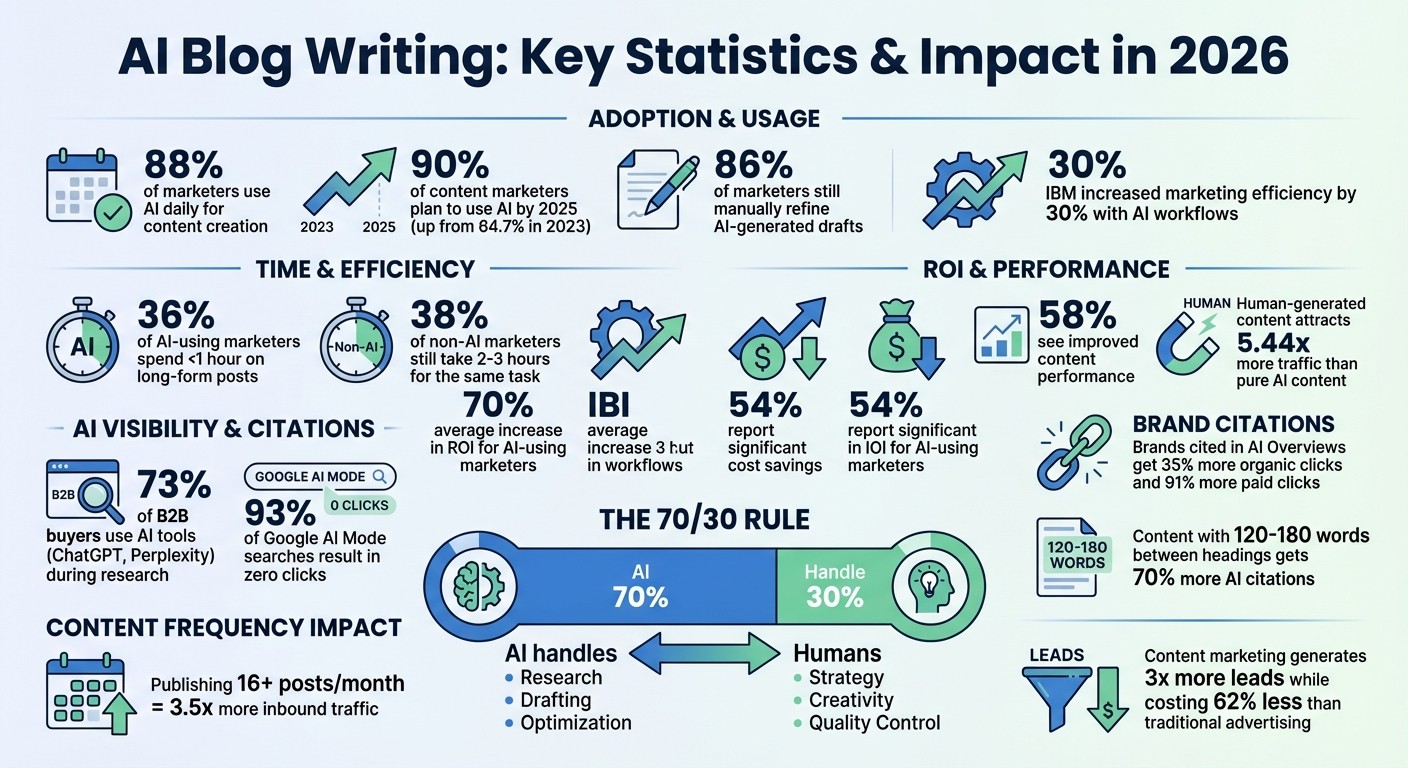
The way blogs are written has undergone a dramatic transformation. Integrated workflows now seamlessly connect research, drafting, and distribution, with 90% of content marketers planning to use AI by 2025, a sharp rise from 64.7% in 2023 [1]. This shift isn’t just about adopting new tools - it’s reshaping how teams approach their work. For instance, 36% of marketers using AI spend less than an hour crafting a long-form blog post, while 38% of those not leveraging AI still take 2–3 hours to complete the same task [1].
The technical tools supporting this evolution have also reached new levels of sophistication. AI assistants like Jetpack AI are now embedded directly into platforms like WordPress, enabling writers to adjust tone, translate content, and optimize posts - all without leaving their workflow [5]. Today’s systems automate every step of the process, from data-driven topic ideation to multi-channel distribution, allowing leading brands to consistently produce 8–12 expert-backed articles each month [2][4].
Main Trends in AI Blog Writing
In 2026, three key trends define the way teams operate.
First, end-to-end automation has replaced fragmented tools. Modern platforms now handle everything from keyword research to publishing in a single, uninterrupted process [2]. Second, Generative Engine Optimization (GEO) has become the new gold standard, moving beyond traditional SEO. Content is now structured to be cited by AI models rather than merely ranked by algorithms [4][6]. Third, multi-modal content creation has become essential. AI search engines prioritize content that integrates text, visuals, and videos, making this a critical factor for visibility [4].
The numbers behind these shifts are striking. 93% of Google AI Mode searches result in zero clicks, pressuring brands to adopt "Zero-Click SEO" strategies [4]. However, brands cited in AI Overviews enjoy 35% more organic clicks and 91% more paid clicks compared to those that aren’t [4]. To adapt, marketers are employing new tactics: pages with 120–180 words between headings see 70% more citations from AI models, while comprehensive schema markup boosts citation rates by up to 47% [4].
Optimization tailored to specific platforms has also gained importance. ChatGPT, for example, sources 47.9% of its citations from Wikipedia and branded domains, favoring well-organized, encyclopedic content. Perplexity, on the other hand, pulls 46.7% of its data from Reddit, prioritizing real-time, community-driven insights. Google AI Mode leans heavily on YouTube (23.3%) and Reddit (21%), favoring multi-modal content that aligns with E-E-A-T (Experience, Expertise, Authoritativeness, and Trustworthiness) principles [4]. A January 2026 report from Vercel highlighted that ChatGPT now refers 10% of its new user signups, a significant jump from just 1% six months earlier [4].
"The B2B SaaS companies winning AI visibility in 2026 aren't just 'doing GEO'… they're running platform-specific playbooks that match content architecture to each engine's citation patterns." - Zach Chmael, Head of Marketing, Averi.ai [4]
These trends underscore the growing importance of AI in shaping today’s content marketing strategies.
Why AI Matters for Content Marketing Today
The case for AI in content marketing is no longer theoretical. Marketers using AI report an average 70% increase in ROI, with 54% also noting significant cost savings [1]. Additionally, 58% of marketers using generative AI have seen improved content performance [1]. This isn’t just about working faster - it’s about solving the challenge of scaling high-quality content without escalating costs.
This shift is crucial because audience behavior has evolved dramatically. 73% of B2B buyers now rely on AI tools like ChatGPT and Perplexity during their research phase [4]. Traditional organic click-through rates have dropped by 15–35% due to Google’s AI Overviews [6]. If your content isn’t appearing in AI-generated answers, you’re losing visibility where it matters most. This has led to the adoption of the "30% Rule", where AI takes care of 70% of the workload (research, drafting, and optimization), leaving humans to focus on the remaining 30% (strategy, creativity, and quality control) [10].
Beyond audience behavior, the operational benefits of AI are transformative. For example, IBM’s AI-powered content workflows increased their marketing efficiency by 30% in 2025 [7]. Teams that strike the right balance can produce more content at a faster pace, all while maintaining the strategic thinking and unique voice that only humans can deliver.
"AI supports your strategy, it does not set it. AI can help you find content gaps, cluster topics, and brainstorm angles. But it should not decide what markets you go after." - Montana Thomas, Author, QuickSprout [3]
Best AI Tools for Blog Writing
Finding the right tool depends on your specific needs. Averi offers an all-in-one content workspace, covering everything from strategy to publishing. Jasper and Copy.ai provide flexibility in drafting while leaving workflow management in your hands. For those seeking freelance talent, Upwork connects you to writers, though maintaining quality is up to you.
These tools showcase how content creation has evolved, incorporating features like brand memory (preserving your unique tone without constant input), platform-specific optimization (tailoring content for ChatGPT, Perplexity, or Google AI), and multi-modal integration (combining text, images, and video seamlessly). Here’s a closer look at what each tool brings to the table.
Averi: Full Content Engine
Averi leads the way for teams seeking an end-to-end solution. Designed for startups and lean teams, it handles everything from strategy to publishing, eliminating the need for a dedicated content team. Averi begins by analyzing your website to understand your product, positioning, and tone, then crafts a comprehensive content marketing plan. It continuously queues content ideas, analyzing industry trends, competitors, and high-potential topics, neatly categorized by type (e.g., listicles, how-to guides, comparisons). You simply approve what gets created.
Once you select a topic, Averi dives into detailed research, including hyperlinked sources, and structures content with SEO and GEO optimization - 120-180 word sections for ChatGPT and 40-60 word leads for Perplexity. The first draft is delivered to a collaborative editing canvas, where you can refine before publishing directly to major CMS platforms. All content is saved in your Library, enhancing future AI performance. Averi also tracks metrics like impressions, clicks, and rankings, offering recommendations on updates and new content.
Its Synapse architecture combines AI workflows with expert input for technical SEO and strategy, making it more than just a drafting tool. Starting at $100/month, Averi’s Plus Plan offers self-serve onboarding, avoiding the hassle of sales calls. This makes it a practical choice for scalable, AI-driven content strategies.
Jasper: AI for Long-Form Content
Jasper positions itself as a co-pilot for enterprises, excelling in long-form blog writing while maintaining brand consistency. Its Brand Voice feature uses uploaded style guides and previous content to ensure drafts match your tone. The Campaigns feature allows you to map out content strategies, from awareness-focused articles to conversion-oriented landing pages.
Jasper is ideal for teams prioritizing consistent branding across editorial content. It offers tiered plans, including "Creator" for individuals and "Pro" or "Business" for teams needing advanced features like Brand Voice. Unlike Averi, Jasper focuses solely on drafting, leaving research, publishing, and analytics to you.
"My team now uses AI to generate a solid outline and structure, which frees us up to focus on adding insights and making sure the content feels human and aligned with our brand." - Colleen Barry, Head of Marketing, Ketch [9]
Copy.ai and Writesonic: Flexible Content Generation
Copy.ai has shifted toward Workflows and Go-to-Market automation, emphasizing content repurposing and sales outreach. Its Infobase acts as a "company brain", storing product catalogs and style guides to ensure accurate AI output. Best suited for quick-turn social media content and transforming blog posts into multiple assets, Copy.ai offers a free plan with word limits and paid tiers like "Pro" and "Enterprise", which scale with user needs.
Writesonic provides a more comprehensive ecosystem. Its Article Writer 6.0 creates detailed, 2,000+ word articles with citations and internal links, while Chatsonic integrates real-time search data, and Botsonic enables custom chatbot creation. Writesonic includes a free trial with word credits, and its paid plans vary by monthly word count and features. While both tools include SEO capabilities, tasks like publishing, analytics, and content management remain manual.
It’s worth noting that 86% of marketers still edit AI-generated content for quality assurance [1]. While Copy.ai and Writesonic offer creative freedom and lower initial costs, you’ll need to take charge of workflow management - something to keep in mind when building scalable content strategies.
Workspaces vs. Marketplaces vs. Point Tools: Picking the Right AI Solution
When selecting an AI solution, it’s essential to consider its primary function - whether it’s designed for end-to-end orchestration, tapping into human talent, or handling specific tasks. AI workspaces, such as Averi, streamline the entire content creation process, from strategy and drafting to publishing and analytics, all within a unified platform. Talent marketplaces like Fiverr and Upwork connect you with skilled human writers who bring creativity and judgment to the table, but you’ll need to manage timelines, quality, and coordination. Meanwhile, point tools like Jasper or Writesonic focus on specific tasks, such as drafting long-form content or creating social media copy, but leave you responsible for workflow management, publishing, and performance monitoring.
Modern execution platforms combine multiple tools into a cohesive system, whereas point tools require manual integration, and marketplaces often come with higher costs. In 2026, while 88% of marketers will rely on AI for content creation, only 25% report seeing real value due to poor implementation [11]. The key difference lies in how seamlessly the solution integrates into your workflow. AI workspaces provide this integration by combining essential functions, unlike point tools that require piecing together various elements. Marketplaces, while offering human expertise, tend to be more expensive and slower - traditional agencies, for instance, typically charge between $5,000 and $15,000 per month [11].
"The winning model combines AI speed with human judgment." - Zach Chmael, Head of Marketing, Averi [11]
Feature and Cost Comparison
Here’s a breakdown of how workspaces, point tools, and marketplaces compare across key factors like workflow type, brand memory, integrations, speed, and cost structure:
Feature | AI Workspaces (e.g., Averi) | AI Point Tools (e.g., Jasper, Writesonic) | Talent Marketplaces (e.g., Fiverr, Upwork) |
|---|---|---|---|
Focus | End-to-end execution & strategy | Content generation & templates | Human creativity & specialist tasks |
Workflow | Orchestrated (Research → Publish) | Self-serve (Drafting only) | Manual (Brief → Delivery) |
Brand Memory | Permanent; learns brand once | Limited; often starts from scratch | Dependent on individual freelancer |
CMS Integrations | Direct (Webflow, WordPress, etc.) | Minimal or via third-party | None (manual delivery) |
Quality Controls | Built-in brand voice & style guides | Data-driven scores (SEO/ROI) | Human editorial review |
Speed | Instant generation + fast shipping | Instant generation | Slow (days to weeks) |
Cost Structure | Mid-to-high ($100+/month) | Low-to-mid ($0–$399/month) | High (Per project or retainer) |
Workspaces like Averi start at $100/month, offering a subscription model that streamlines research, formatting, and publishing. Point tools, on the other hand, range from free tiers (e.g., Copy.ai, Rytr) to $399/month for enterprise features (e.g., Writesonic). Marketplaces operate on a per-project basis, with costs varying based on expertise. While point tools may seem cost-effective initially, they often demand extra time for managing tasks that workspaces handle seamlessly.
When to Use Each Option
The choice between these solutions depends on your team’s needs and priorities:
Workspaces are ideal for fast-growing startups or lean teams looking to scale content production without building a full marketing team. They consolidate essential tools, ensuring consistency in output, direct CMS publishing, and performance analytics that guide content decisions. Teams using AI workspaces achieve 40% higher output while maintaining quality [11].
Point tools work best for solopreneurs or small teams with a clear content strategy who need help with specific tasks like drafting blog posts or optimizing for SEO. These tools are budget-friendly for low-volume needs but require manual effort to manage the overall workflow.
Marketplaces are the go-to option when you have a higher budget and need expert human input for specialized content, such as thought leadership or technical writing. While human-generated content can attract 5.44x more traffic[11], it comes at the cost of slower turnaround times and higher expenses. This makes marketplaces suitable for projects where accuracy and unique insights are non-negotiable.
Ultimately, the decision hinges on factors like integration needs, team expertise, workflow requirements, and budget. Many successful teams in 2026 will adopt a hybrid approach, combining the speed of AI for research and drafting with human expertise for brand voice and quality control. In fact, 73% of marketers already mix AI tools with human input to achieve streamlined, impactful content creation [11].
This framework provides a solid foundation for building a more efficient, AI-driven content workflow.
How to Build an AI-Powered Blog Writing Workflow
In earlier discussions, we touched on the importance of combining AI's efficiency with human creativity. By 2026, many marketing teams have streamlined their blog writing processes by assigning research, structure, and technical tasks to AI, while reserving strategy, tone, and final decisions for humans. This approach has enabled 36% of marketers to craft long-form posts in under an hour, compared to the 2–3 hours it typically takes without AI [1].
The secret lies in viewing AI as a collaborative partner, not a stand-in for human effort. Amy Rigby from HubSpot illustrates this perfectly:
"If I wouldn't ask a human to do it, I don't feel comfortable asking AI to do it. I wouldn't ask my classmates to write my essay, but I would ask them to workshop my draft" [8].
This shift in mindset - from outsourcing to teamwork - is what separates generic, cookie-cutter content from blogs that maintain brand integrity while scaling production.
Planning and Research with AI
Start by aligning your blog content with your business goals. Are you aiming to generate leads, boost brand visibility, or support a product launch? Map these objectives to your buyer's journey and let AI tools like SE Ranking, Ahrefs, or Semrush identify the topics that will help you achieve them. These platforms excel at clustering keywords into relevant themes and highlighting gaps your competitors have overlooked [2][3].
To ensure AI-generated content reflects your brand, provide it with brand guidelines, voice instructions, and 10–15 of your top-performing posts. This step is essential - without proper training, AI output can lack distinction. Be specific: Should your tone be formal or conversational? Are there words or phrases you avoid? What terminology reinforces your brand identity?
"My team now uses AI to generate a solid outline and structure, which frees us up to focus on adding insights and making sure the content feels human and aligned with our brand" [9].
AI can also automate your content pipeline by monitoring industry trends, tracking competitor activity, and flagging high-opportunity keywords. Instead of scrambling for ideas weekly, you'll have a steady flow of pre-approved topics aligned with your goals and audience. Consistency pays off - companies publishing 16+ posts per month see 3.5x more inbound traffic than those with irregular schedules [11].
Once research and planning are in place, it’s time to move on to drafting and editing.
Drafting, Editing, and Collaboration
Leverage AI to create detailed outlines before diving into full drafts. This step-by-step approach ensures your content remains structured and comprehensive, compared to asking AI to generate an entire post in one go [1]. A solid outline should include H2 and H3 headers, key points for each section, and placeholders for examples or data to be added during the editing process.
Adopt a human-in-the-loop model for drafting: let AI handle the initial draft, then refine it with human expertise. Focus on areas that need more depth, adjust for clarity, or expand technical sections. However, keep introductions and conclusions in human hands - these sections require a personal touch and original perspective.
Set up editorial guardrails by implementing a multi-layer review process. Start with an AI review for grammar and brand alignment, followed by a subject matter expert (SME) review for accuracy and relevance, and end with an editorial review to fine-tune voice and style [1]. This layered approach minimizes robotic-sounding output while maintaining efficiency. Additionally, ensure AI is never used to fabricate quotes, testimonials, or research data - 86% of marketers report spending time editing AI-generated content to maintain quality [1].
For SEO and AI assistant optimization, structure your content to perform well in traditional search engines and get cited by tools like ChatGPT and Perplexity. Include 40–60 word answer blocks at the start of sections, use hierarchical headings (H1 → H2 → H3), and add FAQ blocks with schema markup [11][4]. Research shows that sections with 120–180 words between headings earn 70% more citations in ChatGPT than shorter sections [4]. Tools like NeuronWriter and SurferSEO can help you optimize drafts in real time [2][12].
After finalizing your draft, the focus shifts to publishing and ongoing refinement.
Publishing and Performance Optimization
Automate the publishing process to save time and reduce errors. Tools like Averi can publish directly to platforms like Webflow, WordPress, or Framer while preserving formatting and internal links. Archive each post in a content library to inform future AI drafts [1].
The real advantage comes from closing the performance loop. Track metrics like impressions, clicks, and keyword rankings, but don’t stop there - use AI to analyze the data and generate actionable insights. What topics are gaining traction in your industry? Which posts are ranking just below page one and need a boost? What competitor content should you address? Averi’s analytics can transform performance data into a clear roadmap for your next 30 days [11].
Adopt a 90-day optimization cycle to refine your strategy. Spend the first 30 days establishing your foundation (audience personas, brand voice, and content queue), the next 30 days ramping up production (publishing 2–4 times weekly), and the final 30 days analyzing and improving based on performance data [11]. Refresh high-performing content monthly with updated statistics - 76% of highly cited pages in AI engines were updated within the last 30 days [11]. This recency can improve AI rankings by up to 95 positions [4].
To maximize reach without additional workload, repurpose your long-form blogs into social media posts, email newsletters, and video scripts [2][9].
Conclusion
AI-powered blog writing in 2026 flourishes as a partnership between technology and human creativity. While AI excels at speeding up research, drafting, and structuring, human input ensures the content retains its voice and delivers meaningful insights. Data supports this balance - human-generated content attracts 5.44 times more traffic than purely AI-produced material [11], and 88% of marketers now incorporate AI into their daily workflows [1]. The key to success lies in how these tools are implemented.
The most effective strategy combines frequent publishing with strict quality controls. Publishing 16 or more posts per month, while maintaining rigorous standards, can increase inbound traffic by 3.5 times [11]. Additionally, content marketing proves to be highly efficient, generating three times more leads while costing 62% less than traditional advertising methods [11].
Content today must perform across two search ecosystems: traditional SEO and Generative Engine Optimization (GEO). With B2B buyers increasingly relying on AI tools for research and most searches in Google's AI Mode ending without a click [4], it’s critical for brands to be cited within AI-generated responses. Achieving this requires a dual optimization approach, as outlined in this guide. Structuring content with concise 40–60 word answer blocks, using clear hierarchical headings, and regularly updating top-performing posts is essential - 76% of highly cited pages in AI engines were refreshed within the past month [11].
The tools and workflows discussed earlier, from Averi's content engine to modular stacks like SE Ranking, Jasper, and NeuronWriter, enable brands to scale production while maintaining quality. These systems automate performance analysis, helping refine strategies for future content.
Start today: train your AI to reflect your brand voice, draft content with a strong structure, refine it with human oversight, and optimize for both SEO and GEO. Every piece you publish builds on the last, creating a compounding effect that strengthens your overall content strategy.
FAQs
How can marketers ensure AI-generated content reflects their brand voice?
Marketers can make sure AI-generated content stays true to their brand voice by using AI as a support tool, not the sole content creator. Start by developing a well-defined style guide that outlines your brand’s tone, word choice, and overall personality. Use this guide to craft specific AI prompts. For example: “Write in a warm, conversational style that’s easy to understand, suitable for a 6th-grade reading level, and avoids complex terminology.” This approach helps ensure the AI generates content that feels aligned with your brand.
In addition, integrate layered reviews into your content process. Human editors should step in to check for tone consistency, accurate terminology, and overall quality before publishing. Meanwhile, AI can handle tasks like initial drafts or research. To further refine the process, tools like tone analyzers or custom classifiers can flag inconsistencies, allowing you to make adjustments and improve future AI prompts.
By embedding your brand’s voice into AI instructions, maintaining quality through human oversight, and regularly reviewing results, you can scale AI-driven content while keeping your brand’s personality intact.
What is Generative Engine Optimization (GEO), and how is it different from traditional SEO?
Generative Engine Optimization (GEO) is all about tailoring your content for AI-driven search tools like ChatGPT, Microsoft Copilot, and Google's AI summaries. Unlike traditional search engines, these tools don’t simply rank links - they generate answers. To stand out, GEO focuses on crafting AI-friendly content by providing clear, structured responses, backing claims with factual citations, and ensuring semantic relevance. This approach increases the likelihood of your content being selected and referenced in AI-generated outputs.
Traditional SEO, by contrast, is built around optimizing for search engines like Google that rely on ranked lists of links. It emphasizes keywords, backlinks, meta-tags, and site speed to boost rankings and attract organic traffic. The success of traditional SEO is typically measured by metrics like clicks and user engagement, rather than mentions in AI-generated responses.
The distinction is clear: GEO is about preparing content to fit seamlessly into AI-generated answers, while traditional SEO remains focused on improving visibility on search engine results pages (SERPs).
Why is multi-modal content essential for AI-powered platforms?
Multi-modal content - blending text, images, audio, video, and interactive elements - has become essential for AI-powered platforms. This approach mirrors the way people today prefer to consume information. By incorporating multiple formats, AI systems can produce content that’s not only more engaging but also adaptable to various needs, all while streamlining the creation process.
Looking ahead to 2026, advanced AI platforms are expected to feature specialized tools for each type of media. This will allow teams to easily switch between formats, such as infographics, videos, or audio clips, without missing a beat. Such versatility enables marketers to customize content for different platforms, enhance audience interaction, and strengthen SEO results. These multi-modal capabilities ensure that AI-driven workflows can deliver both speed and quality, addressing the growing complexity of content strategies.
Related Blog Posts

Zach Chmael
CMO, Averi
"We built Averi around the exact workflow we've used to scale our web traffic over 6000% in the last 6 months."
Your content should be working harder.
Averi's content engine builds Google entity authority, drives AI citations, and scales your visibility so you can get more customers.