

In This Article
AI scales personalization for speed and volume, manual methods deliver nuance and relationship depth — the best results come from a hybrid approach.
Updated:
Trusted by 1,000+ teams
Startups use Averi to build
content engines that rank.
In the race between AI and manual personalization, the choice depends on your needs. AI delivers speed and scale, automating tasks like data analysis and content creation for large campaigns. Manual personalization, however, excels in nuanced messaging and relationship-driven efforts. Most businesses find success by blending both approaches, using AI for efficiency and humans for creativity and strategy.
Key Takeaways:
AI Strengths: Fast, scalable, cost-effective for high-volume tasks.
Manual Strengths: Precise, emotionally resonant, ideal for niche or high-value audiences.
Hybrid: Combines AI's efficiency with human oversight for balanced results.
Quick Comparison:
Approach | Best For | Key Benefit | Challenge |
|---|---|---|---|
AI-Driven | High-volume, data-heavy tasks | Saves time and scales easily | Needs clean data and oversight |
Manual | High-touch, niche campaigns | Tailored, nuanced communication | Time-consuming, costly |
Hybrid | Balanced marketing strategies | Efficient yet personalized | Requires managing both inputs |
AI works best for large-scale efficiency, while manual methods shine in high-stakes scenarios. A hybrid model often provides the optimal balance.
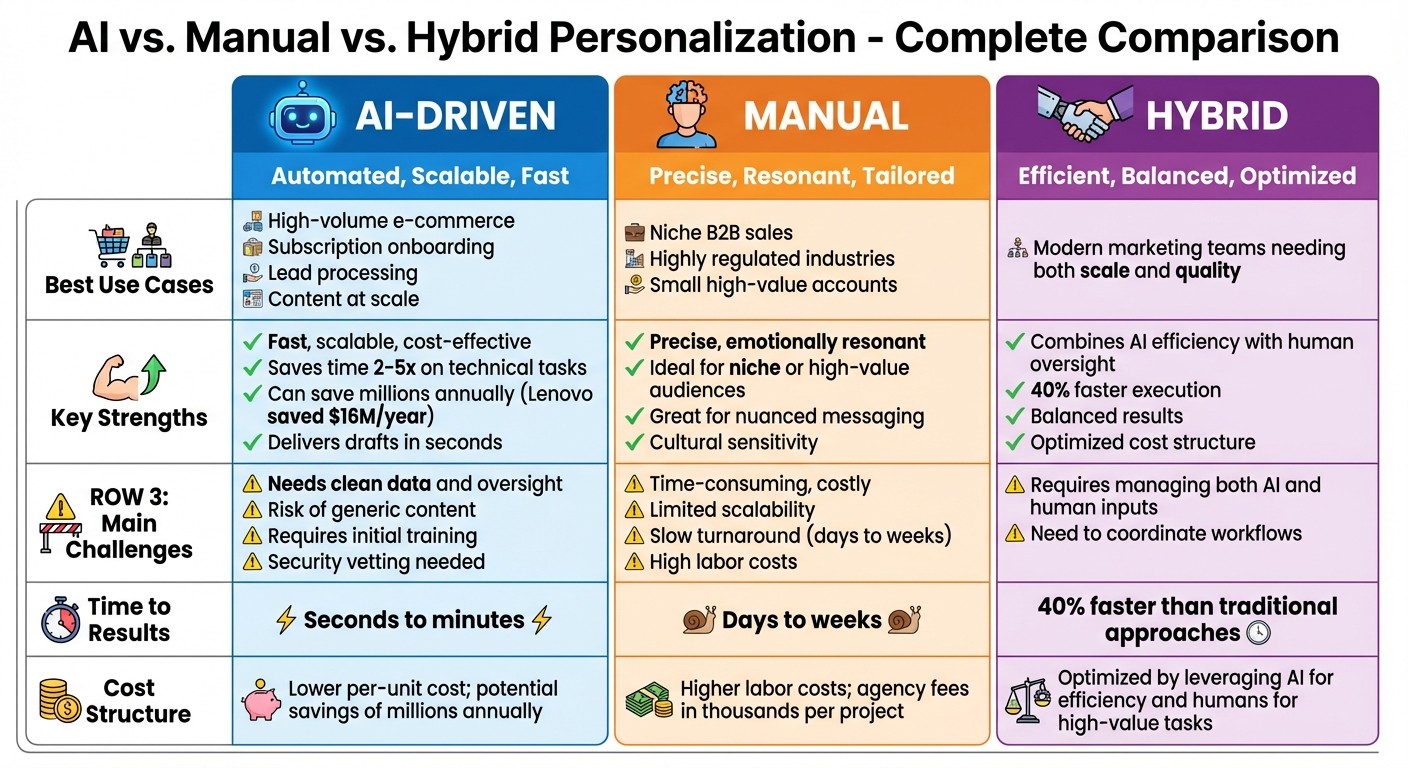
AI vs Manual vs Hybrid Personalization: Complete Comparison Guide
How AI and Manual Personalization Work
AI-Driven Personalization
AI-driven personalization integrates seamlessly with your existing business tools - think CRM platforms, analytics software, advertising accounts, and revenue databases. Using AI Marketing Workspaces, these systems consolidate fragmented data into a single, accessible framework that can be analyzed in real time. The AI then digs into this data to uncover key insights about customer behavior and preferences for each segment.
Once the analysis is complete, AI platforms take over content creation, producing personalized materials at scale. This includes everything from SEO articles and thought leadership pieces to social media posts, email campaigns, and landing pages - all generated in seconds. Platforms like Averi combine strategy and content creation into a single workspace, eliminating the hassle of juggling multiple tools.
The standout benefit here is speed and scale. AI can process massive amounts of customer data simultaneously and deliver tailored experiences without requiring marketers to craft each message individually. While this approach excels in efficiency, manual methods bring a level of creativity and nuance that AI can't yet replicate.
Manual Personalization
Manual personalization, on the other hand, puts human marketers at the helm of every detail. Marketers analyze CRM data and spreadsheets to segment customers, map out customer journeys step-by-step, and then craft offers, write copy, and design campaigns specifically tailored to each audience segment.
This method relies heavily on analytical expertise, creativity, and intuition. While tools like CRM systems, marketing automation platforms, and A/B testing software provide support, the strategic and creative decisions rest entirely with humans. As Kevin from Fieldgrade explains:
"The AI handles what it should, and my team handles what we do best. No confusion about roles, no redundant work. Just better marketing, faster."
Kevin, Fieldgrade [1]
Where manual personalization truly shines is in capturing subtle nuances. A skilled marketer can identify cultural references, craft emotionally resonant messages, and make judgment calls that AI simply can't replicate. However, this approach requires significantly more time and effort; what AI can accomplish in seconds might take a human team hours or even days.
Comparison Table: AI vs. Manual Workflows
Feature | AI-Driven Personalization | Manual Personalization |
|---|---|---|
Core Tools | AI Marketing Workspaces (e.g., Averi, Copy.ai), generative AI/LLMs, integration platforms, unified data systems | CRM systems, manually configured marketing automation, content creation software, analytics tools, spreadsheets |
Data Handling | Automated integration and analysis across multiple sources; instant querying and segmentation | Manual data extraction, analysis, and segmentation using spreadsheets and reports |
Automation Level | High - content generation, segmentation, and campaign execution occur in seconds | Low - each step is crafted and executed manually |
Required Skills | Marketing strategy, defining brand voice, editing AI outputs, and data interpretation | Deep customer understanding, analytical skills, creative writing, and campaign design expertise |
Speed to Market | Seconds to minutes for content creation; immediate scalability | Hours to days per campaign; limited by human capacity |
Best for Company Size | Mid-size to enterprise teams needing volume and speed | Small teams with niche audiences or complex, high-touch campaigns |
This side-by-side comparison highlights the distinct strengths of each approach, setting the stage for a deeper dive into their respective advantages and limitations.
AI-Driven Personalization: Strengths and Limitations
Where AI Personalization Excels
Understanding both the advantages and challenges of AI-driven personalization is key to finding the right balance between technology and human expertise.
AI brings unmatched speed and scale to personalization efforts. For instance, Lenovo streamlined processes that once took weeks and cost thousands of dollars through agencies, saving an impressive $16 million in just one year. Similar stories from other companies highlight how quickly AI can deliver results [2].
One of AI's standout features is real-time optimization, which allows for rapid analysis, adjustments, and deployment of personalized content across countless audience segments. This eliminates the bottleneck of human capacity in high-volume campaigns. Ghost Note, for example, managed to launch campaigns in days rather than weeks by integrating strategy, content, and execution [1]. Meanwhile, Lucid AI reported a 40% faster execution time and a 25% performance boost after replacing five separate tools with Averi's unified platform [1].
The labor savings are also worth noting. Chris from Noded AI shared that for every hour a marketing expert spends using Averi, they save roughly 2 hours - and even more for highly technical tasks, ranging from 3 to 5 times that [1]. These efficiencies free up marketing teams to focus on strategic initiatives instead of repetitive tasks.
However, while these strengths are impressive, AI personalization does come with its own set of challenges.
Where AI Personalization Falls Short
Despite its many benefits, AI personalization has limitations that can affect brand integrity and security.
Brand consistency is a common challenge. Without proper training and oversight, AI-generated content can come across as generic or even off-brand [1] [2]. Ensuring that content feels authentic and aligned with a brand’s voice requires ongoing quality checks.
Data quality and security also pose significant hurdles. AI platforms rely on clean, well-structured data to perform effectively. For companies handling sensitive customer information, it’s crucial to ensure their chosen platform meets strict security standards [2]. Additionally, AI systems require well-defined guardrails to avoid unintended outcomes [2].
Initial setup can be labor-intensive. Training AI to understand a brand's voice and integrating data requires a significant upfront investment of time and effort. While platforms like Averi offer tools like Brand Core to help train the AI on specific guidelines and customer profiles, this process still demands thoughtful human involvement [1].
Finally, AI cannot replace human creativity and judgment in all areas. Tasks such as complex creative direction, strategic decision-making, and emotionally engaging messaging often require a human touch. This limitation leads many marketers to blend AI-driven personalization with manual efforts to achieve the best results.
Comparison Table: AI Pros and Cons
Factor | Strengths | Limitations |
|---|---|---|
Speed & Efficiency | Delivers content quickly; launches campaigns in days; saves 2–5x time on technical tasks | Requires significant initial training on brand voice and data integration |
Cost & ROI | Reduces agency expenses by millions; scales without increasing labor costs | Initial investment in platform setup; ongoing oversight needed to maintain quality |
Scalability | Handles thousands of segments at once; generates high-volume personalized content | Dependent on clean, well-organized data to function effectively |
Brand Consistency | Can be trained on brand guidelines and voice through tools like Brand Core | Risk of producing generic or off-brand content without human quality control |
Strategic Depth | Automates repetitive tasks; frees up time for high-level strategy | Falls short in areas requiring nuanced messaging or complex creative direction |
Security & Compliance | Offers encryption and data controls on enterprise platforms | Requires thorough vetting of platform security; needs guardrails to prevent unintended outcomes |
Manual Personalization: Strengths and Limitations
Where Manual Personalization Excels
Manual personalization shines when a human touch is essential. It's especially effective in situations where tone, nuance, and cultural sensitivity play a pivotal role in maintaining or enhancing brand reputation. Human marketers bring a unique ability to interpret subtle cues, adjust messaging, and connect with audiences on a deeper emotional level. These qualities make manual efforts particularly valuable for campaigns that demand a fine-tuned approach.
Where Manual Personalization Falls Short
Despite its strengths, manual personalization has clear limitations. The most obvious challenge is scalability. Humans simply can't match the speed and volume of AI-driven content creation. While AI systems can churn out thousands of tailored messages in mere seconds, manual processes often require hours or even days to produce just one version. This gap makes it difficult to keep pace with large-scale campaigns or rapidly test multiple variations.
Cost is another significant hurdle. Manual personalization involves higher expenses, including labor and agency fees, and takes longer to execute. For example, Lenovo reportedly saved $16 million in a single year by automating these processes with AI [2]. Such savings highlight the stark contrast in efficiency between manual and automated methods.
Time is another critical factor. Manual efforts are slow, which can delay everything from campaign rollouts to responding to leads. In competitive markets where speed is crucial, these delays can become a major disadvantage. AI, by comparison, offers "Drafts delivered in seconds, not weeks" [2], making manual approaches seem sluggish in comparison.
Comparison Table: Manual Pros and Cons
Here’s a quick look at how manual personalization stacks up:
Factor | Strengths | Limitations |
|---|---|---|
Human Judgment | Great for nuanced, emotionally resonant messaging | Limited by individual capacity |
Cost Structure | No platform or setup fees | High labor and agency costs |
Speed & Volume | Enables careful review and refinement | Slow turnaround and poor scalability |
Audience Fit | Best for campaigns needing deep emotional or cultural relevance | Inefficient for large-scale, high-volume outreach |
Choosing the Right Approach: AI, Manual, or Hybrid
When to Use AI
AI shines in scenarios that demand speed and scale. For example, e-commerce businesses sending out thousands of product recommendations daily, subscription services tailoring onboarding experiences, or B2B companies managing hundreds of inbound leads each week can reap enormous benefits from AI automation.
The efficiency of AI lies in its ability to process vast amounts of data at lightning speed. It's particularly useful when your team is stretched thin, needs quick turnaround times for drafts [2], or aims to standardize best practices across your marketing efforts [2]. In such cases, AI doesn’t just save time - it enables your team to focus on higher-value tasks.
When to Use Manual Methods
Manual personalization is indispensable for high-stakes, relationship-driven sales. If you’re closing six-figure deals with Fortune 500 companies or working in a regulated industry requiring meticulous oversight, the human touch becomes non-negotiable.
While manual methods excel in creating emotional connections and handling culturally sensitive messaging, they come with trade-offs in speed and scalability. This approach is most effective for small, high-value audiences where tailored communication is paramount. By focusing on quality over quantity, manual methods ensure a level of personalization that AI alone cannot achieve.
How Hybrid Models Work
A hybrid approach blends AI’s efficiency with human creativity to deliver the best of both worlds. In this model, AI takes care of data analysis, content generation, and repetitive tasks, while humans focus on brand strategy, creative refinement, and compliance oversight [1][2]. This division of labor ensures campaigns are both efficient and thoughtfully crafted.
For instance, platforms like Averi illustrate how hybrid systems can work seamlessly. Averi’s Synapse architecture leverages AI for strategy and content creation but integrates human expertise to fine-tune messaging and maintain brand voice. This smart combination bridges the gap between AI’s speed and the nuanced understanding only humans can bring, resulting in campaigns that are both effective and engaging.
Comparison Table: AI, Manual, and Hybrid
Approach | Best Use Cases | Typical Cost Range | Time to Results | Long-term Maintenance |
|---|---|---|---|---|
AI-Driven | High-volume e-commerce, subscription onboarding, lead processing, content at scale | Lower per-unit cost; potential savings of millions annually [2] | Seconds to minutes for drafts [2] | Requires training on brand data and ongoing optimization [2] |
Manual | Niche B2B sales, highly regulated industries, small high-value accounts | Higher labor costs; agency fees in the thousands per project [2] | Days to weeks per campaign | Continuous team training and development |
Hybrid | Modern marketing teams needing both scale and quality | Optimized by leveraging AI for efficiency and humans for high-value tasks | Approximately 40% faster execution than traditional approaches [1] | Managing both AI systems and human collaboration [1] |
AI in Marketing: How CMOs Leverage AI for Personalization at Scale
Conclusion
Deciding between AI and manual personalization comes down to understanding what aligns best with your business goals. AI shines when it comes to analyzing vast amounts of data and delivering tailored content quickly, making it ideal for scaling operations. On the other hand, manual methods excel in managing critical relationships and navigating complex cultural nuances. The real key is finding the right balance - leveraging AI's efficiency while maintaining the strategic oversight only humans can provide.
Hybrid models are increasingly becoming the go-to solution for blending speed with thoughtful strategy. These models assign tasks like data analysis and content generation to AI, while humans focus on brand strategy and creative refinement. Across industries, this approach has proven to save both time and money, offering clear guidance on when to rely on AI, manual effort, or a mix of the two.
For businesses dealing with high-volume e-commerce or a large number of leads, AI-driven automation is a natural fit. If you're negotiating major B2B contracts or working in highly regulated industries, manual oversight remains critical. And for those looking to scale without sacrificing quality, hybrid platforms like Averi offer a compelling solution. These tools combine the speed of AI with the ingenuity of human creativity, striking a balance that drives results.
The AI handles what it should, and my team handles what we do best. No confusion about roles, no redundant work. Just better marketing, faster. - Kevin, Fieldgrade [1]
FAQs
What’s the best way to combine AI and human expertise for personalization?
To make the most of AI and human expertise, assign AI to tasks that thrive on speed and scale, like analyzing data, segmenting audiences, and generating content. Meanwhile, let human professionals focus on areas requiring creativity, complex decision-making, and fostering meaningful customer relationships. This balanced approach combines the efficiency of AI with the irreplaceable personal touch of human insight.
Platforms like Averi AI streamline this collaboration by automating routine tasks while engaging human experts where their judgment and creativity matter most. This hybrid model not only boosts productivity and maintains consistency but also creates a more tailored and engaging customer experience.
What challenges come with using AI for personalization?
Using AI to deliver personalized experiences comes with its own set of hurdles. A primary concern is ensuring that the AI generates content that reflects your brand’s unique voice and maintains consistent quality. AI outputs can sometimes feel overly generic or stray from your established tone, often necessitating human oversight and revisions. This extra layer of review can disrupt workflows and slow down processes.
Another significant challenge involves data privacy and security. To create tailored experiences, AI systems often need access to customer data, which brings compliance risks that must be carefully managed. Lastly, integrating AI tools with existing platforms like CRM, CMS, or marketing software can be a daunting task. These systems need to work together seamlessly to maintain efficiency and support growth, but achieving that level of integration can require considerable effort and expertise.
When should you choose manual personalization over AI-driven methods?
When tasks require flawless brand consistency, deeply customized outputs, or strict quality assurance, manual personalization often stands out as the better option. It also proves invaluable in scenarios where data privacy or intellectual property security are non-negotiable, as manual processes allow for tighter control and oversight.
For companies with complex or highly specific requirements, especially those in regulated industries, manual methods can deliver a level of human insight and strategic alignment that AI tools might struggle to match.
Related Blog Posts

Zach Chmael
CMO, Averi
"We built Averi around the exact workflow we've used to scale our web traffic over 6000% in the last 6 months."
Your content should be working harder.
Averi's content engine builds Google entity authority, drives AI citations, and scales your visibility so you can get more customers.