

In This Article
Five-step framework to use AI for standardizing competitor data, spotting engagement trends, building benchmarks, and turning insights into repeatable marketing workflows.
Updated:
Trusted by 1,000+ teams
Startups use Averi to build
content engines that rank.
AI-powered competitor engagement analysis simplifies the process of understanding your competitors' strategies by analyzing large datasets quickly and offering actionable insights. This guide breaks down how you can use AI tools to monitor competitors and improve your marketing outcomes. Key steps include:
Define your analysis scope: Focus on specific goals, competitors, and platforms. Track metrics like engagement rates, click-through rates (CTR), and content retention.
Collect and standardize data: Use consistent timeframes, align metrics across platforms, and clean data to ensure accuracy.
Leverage AI for insights: Use AI to categorize content, analyze sentiment, and identify trends or performance benchmarks.
Turn insights into action: Develop testable hypotheses, create a content playbook, and maintain brand consistency while experimenting.
Establish workflows: Assign clear team roles, schedule regular reviews, and validate AI outputs to ensure continuous improvement.
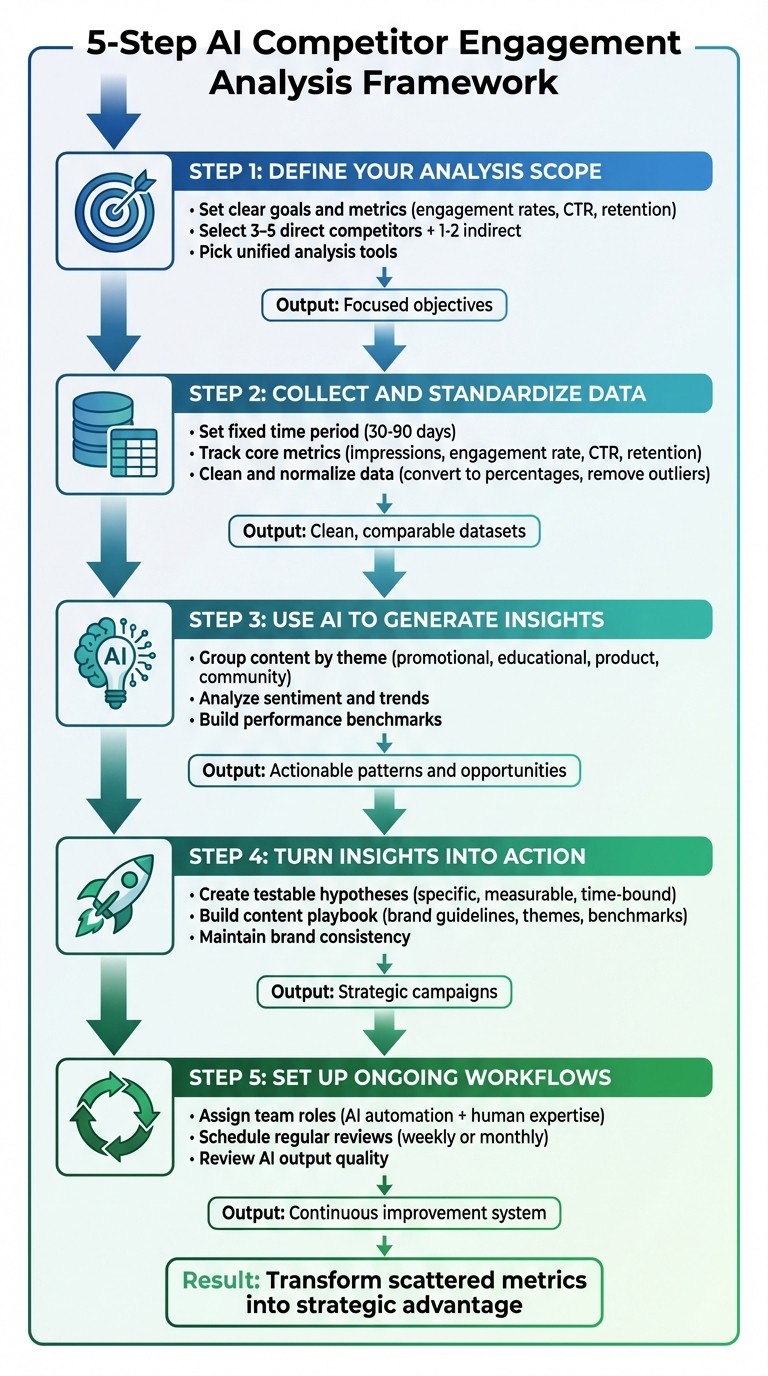
5-Step AI Competitor Engagement Analysis Framework
How to use AI to do quick competitive analysis
Step 1: Define Your Analysis Scope
Before diving into data collection or leveraging AI tools, it’s essential to clarify your objectives. Trying to monitor every competitor across all platforms without a clear purpose will only lead to scattered and ineffective insights. Instead, focus on specific goals, key competitors, and the tools that will help you achieve results. Start by defining your objectives and pinpointing the metrics that truly matter.
Set Clear Goals and Metrics
Establish a single, focused objective - whether it’s increasing social engagement, analyzing competitor performance, or identifying strategic gaps. For example, if your goal is to boost social engagement, track metrics like engagement rates (likes, comments, and shares per post). If your focus is on paid campaigns, monitor click-through rates (CTRs). For content performance, measure retention to see how long audiences stay engaged with videos or blog posts.
"Your paid social CTRs are strong, but content retention is lagging - want me to map fixes by channel?" [1]
Averi AI excels at identifying gaps like these, helping you move quickly from raw data to actionable strategies. Once your goals and metrics are in place, you can zero in on the competitors and platforms that align with your objectives.
Select Competitors and Platforms
Identify three to five direct competitors and one or two indirect ones to ensure a balanced perspective. Focus your analysis on the platforms where these competitors are most active. For instance, if your competitors dominate LinkedIn and YouTube, prioritize those platforms over others where their presence might be minimal.
Pick the Right Analysis Tools
Choose tools that consolidate data and provide meaningful insights. Averi AI, for example, integrates generative AI with marketing expertise, combining your brand’s core data with analytics, revenue, and advertising performance [1]. It doesn’t just present numbers - it interprets them, offering actionable recommendations for your strategies. Similarly, Copy.ai provides tools for content creation and account-based marketing insights [2]. Avoid juggling multiple disconnected tools that can complicate workflows. A unified platform not only saves time but also ensures your analysis directly supports execution. These foundational steps will prepare you for generating actionable insights in the next phase.
Step 2: Collect and Standardize Data
When raw engagement data comes in, it often looks like a chaotic puzzle. Instagram might count saves and shares one way, while LinkedIn uses entirely different metrics for engagement. YouTube’s watch time doesn’t line up with Twitter’s retweets. If you don’t standardize this data, you risk drawing unreliable conclusions - essentially comparing apples to oranges. To make sense of it all, follow these key steps.
Set a Fixed Time Period
Start by defining a consistent time frame for your analysis. For fast-moving trends, a 30-day window works well, while a 90-day period is better for capturing seasonal shifts. It’s also crucial to align time zones - Eastern or Pacific time is standard for U.S.-based audiences. For instance, examining Q3 campaigns can reveal how summer engagement differs from other seasons like the holidays [1].
Track Core Engagement Metrics
Zero in on the metrics that matter most: impressions, engagement rate, click-through rate (CTR), and content retention. These provide a solid foundation for understanding performance. For example, Micah J from Averi achieved a 48% boost in ad CTR by focusing on these measures [1]. Don’t stop there - record additional details like content format (video, carousel, or article), themes or topics, posting schedules, and whether the content was organic or paid. These specifics can uncover trends, such as why competitor videos might consistently outperform static images on certain platforms.
Clean and Normalize Your Data
Raw numbers can be misleading without proper context. Normalize your data by converting it into percentages - 500 likes from 10,000 followers (5%) is far more impressive than 1,000 likes from 100,000 followers (1%). Be sure to clean your data by removing outliers like giveaway posts, viral spikes, or one-off events that could skew results. Tools like Averi AI simplify this process by consolidating data from multiple sources into a unified system, ensuring your benchmarks reflect genuine performance [2]. This streamlined approach eliminates the headaches of managing fragmented data and keeps your insights accurate.
Step 3: Use AI to Generate Insights
Once your data is clean and standardized, AI can step in to uncover patterns, categorize content, and highlight opportunities that might otherwise go unnoticed. This step transforms raw numbers into actionable insights that can shape your strategy.
Group Content by Theme
AI can quickly sort competitor posts into meaningful categories like promotional, educational, product-focused, community-driven, or even cultural content. Unlike manual tagging, which can be time-consuming, AI analyzes text, visuals, and engagement metrics to pinpoint recurring themes. For example, if a competitor’s educational posts consistently outperform their other content, this might indicate an untapped opportunity for your own strategy. By using AI platforms tailored to your brand’s specific context, you can go beyond generic classifications to uncover nuances unique to your audience and market [1].
"I love how it's customized to the information that I have in there in terms of my brand and tone." - Payton, Broadside [1]
Analyze Sentiment and Trends
AI tools can also gauge audience sentiment by scanning comments, reviews, and mentions to detect emotions like excitement, frustration, or indifference. Beyond sentiment, these tools identify emerging trends, such as popular hashtags, frequently asked questions, or shifts in audience conversations. These insights can signal changes in behavior or preferences. Platforms like Averi AI go a step further by consolidating data from multiple sources and providing standardized trend analysis [2].
"Averi doesn't just give us insights, it helps us act on them. That's the gap every other platform misses. We're finally turning data into real campaigns." - David, Thorn [1]
Build Performance Benchmarks
AI can generate detailed comparison tables that break down engagement rates, highlight top-performing themes, and assess overall brand sentiment. This process provides a clear picture of how your brand stacks up against competitors. For instance, Averi AI once flagged for a client:
"Your paid social CTRs are strong, but content retention is lagging - want me to map fixes by channel?" [1]
This insight became a starting point for prioritizing content experiments and testing competitor-inspired strategies. These benchmarks not only reveal areas for improvement but also lay the groundwork for more focused, data-driven strategy development in the next phase.
Step 4: Turn Insights into Action
Identifying patterns through AI is just the starting point - the real impact comes from turning those findings into actionable marketing strategies. This step is all about transforming benchmarks into experiments, insights into structured plans, and observations into campaigns that align with your brand. Here's how you can make that happen.
Create Testable Hypotheses
Once you’ve gathered clear data, the next move is to frame actionable hypotheses. For instance, if your analysis shows that a competitor’s educational posts consistently outperform their promotional content, turn that into a hypothesis like: "Shifting 30% of our social media content from product-focused posts to how-to guides will increase engagement by 15% over the next 30 days." Each hypothesis should be specific, measurable, and time-bound. This way, you’re not simply imitating competitors - you’re testing whether their strategies resonate with your audience.
Build a Content Playbook
A content playbook helps translate insights into consistent processes for your team. The goal isn’t to replicate your competitors but to understand the factors driving their success and adapt those to fit your brand’s unique identity. Your playbook should include:
Centralized brand guidelines
Proven content themes
Performance benchmarks
This structured approach bridges the gap between analysis and execution, making it easier to move from raw data to actionable campaigns. It’s about creating a system that allows your team to work more efficiently while staying aligned with your overall strategy.
"Averi turned our marketing chaos into a system. We're launching campaigns in days instead of weeks, and our team finally has the clarity they've been craving." - Sarah, Ghost Note [1]
By building a framework that balances speed and strategy, you can empower your team to act decisively without sacrificing creativity or consistency.
Maintain Brand Consistency
Experimenting with new strategies doesn’t mean losing sight of your brand’s voice. Adapting competitor tactics requires a firm grasp of your own brand’s tone, values, and identity. Tools like Averi AI can help by training AI systems on your specific brand guidelines, ensuring that even when testing new ideas, your content stays true to your core identity [1].
As outlined in Step 1, keeping your goals measurable relies on staying consistent with your brand’s voice. This ensures that while you explore fresh formats or tactics, your audience still recognizes and connects with your brand. By filtering every piece of content through your established guidelines, you can innovate confidently without worrying about going off-brand.
Step 5: Set Up Ongoing Workflows
Competitor analysis isn’t a one-and-done activity; it’s an ongoing process that requires structured workflows to keep insights actionable and relevant. Without a clear system in place, valuable information can slip through the cracks, team roles may overlap, and efforts could become more reactive than proactive. The goal here is to establish repeatable processes that combine AI automation with human expertise, ensuring your analysis remains consistent and impactful over time. This step transforms your initial findings into long-term, strategic actions.
Assign Team Roles
To turn AI-driven insights into continuous improvements, it’s essential to define team responsibilities clearly. Let AI handle tasks like data collection, pattern identification, and drafting, while your team focuses on validating insights, interpreting strategies, and making decisions. For example, in 2025, Fieldgrade utilized Averi's AI Marketing Workspace to streamline these roles effectively. Their team noted:
"The AI handles what it should, and my team handles what we do best. No confusion about roles, no redundant work."
Kevin, Fieldgrade [1]
Key roles to assign include AI configuration, insight validation, and translating findings into actionable campaign briefs. By clarifying these responsibilities upfront, you can eliminate bottlenecks and ensure your workflow operates smoothly.
Schedule Regular Reviews
With roles in place, the next step is to establish a review schedule that aligns with the pace of your industry. Fast-moving spaces like social media or e-commerce may require weekly check-ins, while industries like B2B or enterprise markets might find monthly reviews more practical. These sessions should focus on measuring performance against benchmarks, identifying new trends, and refining strategies. By setting these reviews as recurring events in your team’s calendar, you can ensure your analysis stays proactive and aligned with your goals.
Review AI Output Quality
Human oversight remains critical to catching shifts in context, industry-specific nuances, or potential biases in AI findings. Build checkpoints into your process where team members review AI-generated insights before they’re used to shape strategy. Tools like Averi AI integrate expert validation with AI insights, reinforcing the importance of collaboration. As Averi.ai emphasizes, "Gen AI plus human expertise, not instead of", ensures that competitive intelligence remains accurate and dependable.
To maintain high-quality outputs as you scale, implement automated checks alongside human reviews. This dual approach provides the guardrails necessary to keep your AI’s decision-making aligned with your strategic objectives. Regular quality reviews also reinforce earlier steps like data standardization, creating a cohesive system that supports long-term success.
Conclusion
AI-powered competitor engagement analysis becomes truly effective when paired with a solid framework and the right tools. By setting clear objectives, standardizing data, extracting actionable insights, and maintaining consistent workflows, you can turn scattered metrics into a meaningful strategic advantage.
The real difference between gaining insights and driving impact lies in execution. Successful campaigns don’t just rely on data - they depend on translating those insights into decisive actions that strengthen your competitive position.
Platforms like Averi AI illustrate the power of contextualized analysis. By aligning with your brand's core and integrating revenue and analytics data, these tools deliver insights that are both immediate and relevant. With AI handling the heavy lifting - such as data consolidation and pattern recognition - your team can focus on refining strategies and making informed decisions. This creates a system that builds momentum, reinforcing your competitive edge over time.
The aim isn’t to automate every aspect or replace human judgment. Instead, it’s about crafting a workflow where AI scales up content generation and insight discovery, while human expertise ensures precision, context, and execution. This balanced approach transforms competitor analysis from an occasional task into a continuous, strategic process that drives every campaign, content strategy, and marketing decision. By embedding these practices into your operations, you ensure that competitor analysis evolves into a lasting strategic asset, not just a periodic review.
FAQs
How does AI enhance competitor engagement analysis?
AI brings a new level of precision to competitor engagement analysis by providing real-time insights and uncovering patterns in engagement trends across various platforms. By automating the process of gathering data from multiple sources, it not only saves time but also reduces the likelihood of human error.
With the help of advanced algorithms, AI can spot subtle trends and irregularities that might otherwise go unnoticed. This delivers a clearer, more objective view of how competitors are performing, enabling marketers to make smarter, faster, and more data-driven decisions.
What metrics should I prioritize when analyzing competitor engagement?
When evaluating how competitors engage with their audience, it's essential to focus on metrics that offer practical insights. Pay attention to engagement rates - likes, comments, and shares - as they reveal how actively audiences interact with content. Keep an eye on content reach and audience growth to understand how far their message is spreading and whether they're attracting new followers. Metrics like conversion rates provide a clear picture of how well their efforts translate into tangible results.
Don't overlook sentiment analysis, which helps gauge how audiences feel about their content, and content performance metrics such as click-through rates and bounce rates, which shed light on user behavior and content effectiveness.
By zeroing in on these areas, you'll uncover patterns, learn what appeals to your audience, and fine-tune your own approach to stay competitive.
How can I maintain brand consistency while using competitor strategies?
Maintaining your brand’s identity while drawing inspiration from competitors calls for a balanced strategy. Begin by customizing your AI tools to reflect your brand's distinct voice, values, and guidelines. Tools like Averi make this possible, enabling you to train AI on your specific brand assets so that all generated content aligns seamlessly with your identity.
To ensure everything stays on track, integrate human oversight into the process. Having a review system in place allows you to catch any missteps and ensure the content remains true to your standards. By blending AI-driven efficiency with human judgment, you can confidently incorporate competitor insights without compromising your brand’s authenticity.
Related Blog Posts

Zach Chmael
CMO, Averi
"We built Averi around the exact workflow we've used to scale our web traffic over 6000% in the last 6 months."
Your content should be working harder.
Averi's content engine builds Google entity authority, drives AI citations, and scales your visibility so you can get more customers.