How to Build a Content Engine That Feeds SEO, GEO, and LinkedIn

Averi Academy
Averi Team
8 minutes

In This Article
Automate a content engine that feeds SEO, GEO, and LinkedIn—plan, draft with AI, refine, publish, repurpose, and measure performance.
Updated:
Trusted by 1,000+ teams
Startups use Averi to build
content engines that rank.
Want to create content that drives traffic, builds authority, and generates leads across SEO, GEO, and LinkedIn? Here's how you can build an automated content engine to save time, reduce costs, and maximize impact.
Key Takeaways:
Streamline Content Creation: Automate keyword research, content drafting, and publishing with AI tools like Averi AI.
Multi-Channel Strategy: Align SEO (search visibility), GEO (AI-driven visibility), and LinkedIn (professional engagement) into one system.
Content Framework: Start with a "Hero" piece (long-form blog), support it with "Hub" content (emails, social posts), and create "Hygiene" variations (LinkedIn posts).
Automate and Optimize: Use tools to manage content queues, analyze performance, and refine strategies for better results.
With the right system, you can create content faster, publish consistently, and drive measurable business outcomes - all while spending less time on manual tasks.
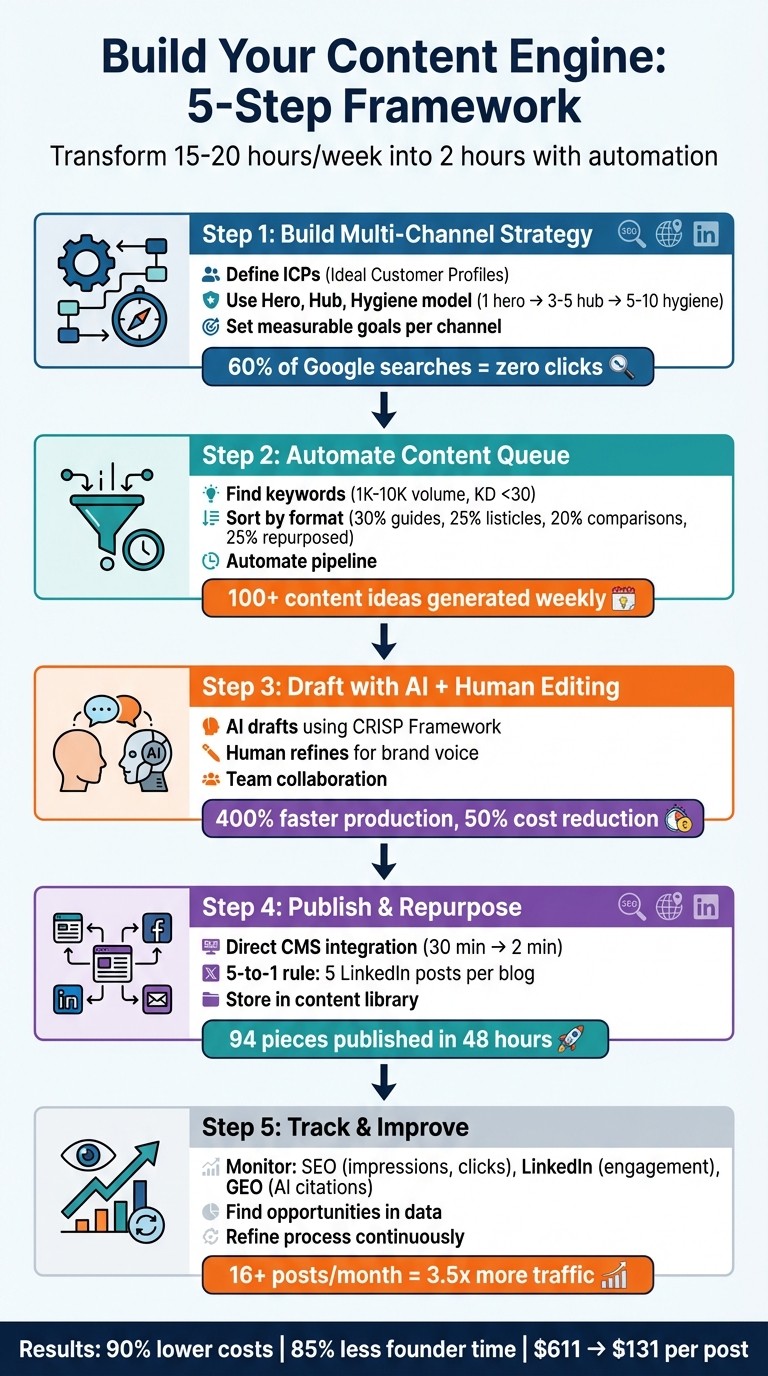
5-Step Content Engine Framework for SEO, GEO, and LinkedIn
The Latest AI-Powered Content Creation Workflow for Business (Speed Challenge!)
Step 1: Build Your Multi-Channel Content Strategy
Before diving into content creation, take a step back and develop a strategy that ties together SEO, GEO, and LinkedIn into a unified plan. By aligning these channels into a single system, you can amplify your efforts without multiplying your workload.
A helpful framework to follow is the "Hero, Hub, and Hygiene" model. Start with a primary, in-depth piece of content - such as a long-form blog post tailored for SEO and GEO. From there, create 3–5 supporting pieces (Hub content), including social media posts or email campaigns. Finally, produce 5–10 platform-specific variations (Hygiene content), such as LinkedIn posts designed to highlight thought leadership [1]. This approach ensures your content works across multiple channels efficiently.
Define Your Target Audience and ICPs
The success of your content strategy hinges on knowing exactly who you're speaking to. Start by defining your ideal customer profiles (ICPs) - the companies, roles, and challenges your product addresses. Tools like Averi AI can analyze your website and suggest ICPs based on your current positioning. It can also help you research how competitors are targeting similar audiences [2].
Once you’ve outlined your ICPs, align their needs with the right channels. For example:
SEO content should answer the questions they’re actively searching for.
GEO content must provide credible, reference-worthy answers that AI tools can cite.
LinkedIn content should focus on their professional pain points, offering insights tailored to their industry - not just rehashing blog links [1][3].
With a clear understanding of your audience, you can set targeted goals for each channel.
Set Measurable Goals for Each Channel
Establish specific goals for each channel that connect directly to business outcomes. For example:
For SEO, aim to "increase organic traffic by 25% in Q2" or "rank in the top three for five target keywords."
For GEO, track mentions in AI tools like ChatGPT or Perplexity.
For LinkedIn, set objectives like "generate 40 qualified leads per month" or "boost connection requests by 30%" [5].
Given that almost 60% of Google searches now result in zero clicks [4], traditional metrics like keyword rankings are becoming less relevant. Instead, focus on KPIs tied to business results, such as booked discovery calls, email sign-ups, or purchase intent. Publishing consistently also makes a difference - companies that release 16 or more blog posts per month see 3.5x more inbound traffic than those posting sporadically [1]. However, this only works if your content aligns with measurable business objectives.
By linking metrics to specific content goals, you set the stage for scalable success.
Use Tools to Set Up Your Foundation
Managing research and content creation across multiple channels manually is a heavy lift. Leverage tools like Averi AI to streamline the process. These tools can analyze your site, pinpoint gaps in competitor strategies, and help craft a cohesive content plan. This ensures every piece of content - whether a detailed SEO blog or a LinkedIn post - aligns with your brand voice and strategic goals.
AI tools also offer significant cost savings. On average, AI-assisted content creation reduces the cost of a blog post by $480 compared to traditional methods [2]. It’s no wonder that 85% of marketers now use AI tools to boost their productivity [1]. The key is to establish a solid foundation early on - defining your ICPs, goals, and content priorities - so every piece you create builds on that groundwork and delivers consistent results.
Step 2: Build and Automate Your Content Queue
Once your multi-channel content strategy is in place, the next step is to create a self-sustaining content queue. This eliminates the need for constant brainstorming by automating updates with SEO insights, GEO-specific opportunities, and LinkedIn trends.
Find Keywords and Content Opportunities
The first step is understanding what your audience is actively searching for. Tools like Ahrefs or SEMrush can help you identify keywords with monthly search volumes between 1,000 and 10,000 and a keyword difficulty (KD) below 30. These are prime targets. For GEO-specific content, use filters in Google Trends or Local Falcon to pinpoint regional searches, such as "best CRM for NYC startups." On LinkedIn, tools like Sales Navigator or SparkToro can highlight trending professional topics - think "AI tools for marketers" gaining traction.
Don’t stop at a single keyword. One idea can branch into hundreds of variations. Cross-reference these by search volume, intent (whether informational or transactional), and local relevance. Then, score them based on factors like ease of production, seasonality, and audience value. This ensures your content isn’t just driving clicks - it’s driving meaningful engagement and conversions.
Sort Content Ideas by Format
Different content formats work better on different platforms. For example:
SEO performs well with in-depth guides (2,000+ words).
GEO-focused content thrives with listicles like "Top 10 SEO Agencies in Chicago."
LinkedIn sees high engagement from comparisons such as "Notion vs. ClickUp for teams."
Organize your ideas by channel, format, and priority in a tracking table. Use data from Google Analytics or LinkedIn Insights to validate your approach. For instance, if 60% of your audience prefers listicles, allocate 40% of your queue to that format. According to the Content Marketing Institute, listicles convert 22% better on social platforms, making them a smart investment.
A balanced content queue might look like this: 30% how-to guides, 25% listicles, 20% comparisons, and 25% repurposed content. This structure ensures you’re delivering what your audience wants without overloading any single format.
Automate Your Content Pipeline
With your ideas sorted and prioritized, it’s time to streamline execution. Manual processes can’t keep up with demand, but automation can. Tools like Averi AI combine keyword research, content ideation, and queue management into one seamless system. By inputting your ideal customer profiles (ICPs) and target channels, the tool pulls data from sources like Google and Ahrefs APIs, generating 100+ content ideas weekly. These ideas are sorted by format, scored for viability, and added to a drag-and-drop queue with built-in scheduling. You can even export directly to platforms like Google Sheets or WordPress.
For example, a mid-stage SaaS company used automation to publish 94 pieces in just 48 hours, accelerating feature adoption. In another case, a U.S. real estate firm leveraged SEMrush and Averi AI to queue 50 GEO-specific ideas, such as "Top 10 Homes Under $500,000 in Seattle", boosting local searches by 35% in three months. According to G2 reviews (4.8/5 stars), the automation saved them 70% of the time they previously spent on content creation.
"You don't need more time for content. You need a system that creates content without requiring your time." – Zach Chmael, Head of Marketing, Averi AI [2]
To keep your pipeline running smoothly, automate daily GEO searches and weekly LinkedIn trend checks. Tools like Zapier can push CMS notifications and send Slack alerts. Review your queue every two weeks, dropping ideas with fewer than 500 monthly searches. This creates a self-sustaining system that keeps your content pipeline full and relevant.
Step 3: Draft with AI and Refine with Human Editing
Now that your automated content workflow is set up, it’s time to turn those ideas into drafts that pack a punch. AI can churn out drafts in no time, but the magic happens when human editors step in to fine-tune them. This isn’t about letting AI do all the heavy lifting - it’s about using AI for efficiency while your team polishes the content for accuracy, tone, and strategy.
Crafting Content for SEO, GEO, and LinkedIn
AI tools excel at creating content tailored for search engines and platforms like ChatGPT and Perplexity. For SEO, they can weave keywords into headers, meta titles, and descriptions, suggest internal links, and even generate schema markup. For GEO, AI structures content for featured snippets and FAQ sections, while for LinkedIn, it focuses on compelling openings that drive engagement [1].
Using the CRISP Framework - Context (your brand and audience), Role (the perspective you want to convey), Instructions (specific tasks), Specifications (format and style), and Performance (success metrics) - can help generate better-quality drafts that require less revision. AI writing tools can speed up production by up to 400% while cutting costs by half for each article [1].
Once the draft meets technical requirements, human editors step in to align it with your brand’s voice and vision.
Refining for Brand Voice and Accuracy
AI drafts are just the starting point. Human editors add the finishing touches by incorporating your brand’s personality, expert insights, and verified details that AI can’t replicate. Strengthen the content with updated statistics, firsthand case studies, and expert quotes. Make sure data points are accurate and that the tone reflects your brand’s identity.
"Human editors shouldn't rewrite AI content - they should enhance it with insights, personality, and strategic nuance that AI cannot provide." – Averi Academy [1]
A thorough credibility check is non-negotiable. Each draft should include at least one external citation, expert quote, or unique data point. Tools like Hemingway or Grammarly can simplify complex sentences and ensure critical information is clear and upfront for both readers and AI systems.
Team Collaboration in the Editing Process
Leverage tools like Averi AI’s real-time collaborative editing features to streamline teamwork. Tag colleagues, leave comments, and flag sections for rewrites. For high-priority content, involve specialists for final validation [1][2].
For example, in August 2025, a B2B SaaS company used Averi’s AI-driven workflow to launch a new feature. By blending AI-generated drafts with expert input, the team produced 94 pieces of content across six platforms in just 48 hours. The result? A 340% boost in feature adoption within the first week and a 67% reduction in the launch timeline [1].
To maintain consistency, create a brand guide that includes official spellings, a concise positioning statement, and key entity associations. Focus approvals on strategic alignment rather than minor details by using conditional approvals. This approach prevents bottlenecks and keeps your content machine running smoothly.
Step 4: Publish and Repurpose Content
This step ensures your content doesn’t just sit idle - it gets out there and works hard for you. By publishing efficiently and repurposing strategically, you can maximize your reach without doubling your workload.
Push Content Directly to Your CMS
Skip the tedious copy-pasting and streamline your publishing process with direct CMS integration. Tools like Averi AI allow seamless connections to platforms like WordPress, Webflow, and Framer, enabling you to publish with just one click. What used to take 30 minutes can now be done in about 2 minutes [2]. Plus, metadata, internal links, and schema markup transfer automatically, reducing formatting errors and speeding up the workflow. This kind of efficiency is a game-changer, especially when you're working on a consistent publishing schedule.
With your content live, the next step is to adapt it for LinkedIn.
Adapt Blog Content for LinkedIn
Once your blog post is live, it’s time to tailor it for LinkedIn, where professional audiences thrive. Follow the 5-to-1 rule: generate at least five LinkedIn posts from every long-form blog [9]. Break down subheadings into bite-sized insights, or transform step-by-step guides into carousel PDFs - an engaging format that performs particularly well on LinkedIn [6][7].
Start your posts with a hook: a question, a bold statement, or an unexpected fact to grab attention in crowded feeds [6]. Wrap things up with an open-ended question to encourage discussion and position yourself as a thought leader [6]. Stick to 3-5 hashtags to boost visibility without overdoing it [6].
"Repurposing isn't about being lazy. It's about being smart. You don't need 30 new ideas every month. You just need one good one, told seven different ways." – Rubaisha Khan, SEO Writer [7]
Avoid linking out in your main caption - LinkedIn's algorithm tends to favor content that keeps users on its platform [6][8]. Instead, focus on delivering value upfront, keeping readers engaged with your insights. By presenting your content in various formats, you can maintain your audience’s interest over time.
Store Content in a Library
A centralized content library is your secret weapon for improving future AI drafts and maintaining consistency. Every piece you publish should be saved along with its performance data, keyword rankings, and engagement metrics. This creates a feedback loop that sharpens your content strategy over time [2]. With tools like Averi AI’s Library feature, all your published content is automatically stored, ensuring a consistent brand voice and reducing the need for heavy revisions later [2]. Think of it as an investment - each article you save makes the next one easier to create and more in tune with your audience’s needs.
Step 5: Track Performance and Improve Your Engine
A content engine thrives on constant monitoring and refinement. By analyzing performance data and making informed adjustments, you can ensure your strategy evolves and improves over time. This process transforms raw insights into actionable changes that boost results with every iteration.
Monitor Metrics for Each Channel
Each channel you use requires a tailored approach to measurement. For SEO, focus on metrics like impressions, clicks, and keyword rankings to understand how visible your content is in search engines [2]. On LinkedIn, pay attention to engagement rates, share rates, and the sentiment of comments to gauge how your professional audience interacts with your posts [1]. For GEO (Generative Engine Optimization), track whether AI tools like ChatGPT and Perplexity cite your content. This involves monitoring FAQ sections and ensuring your structured data is properly formatted [2].
Prioritize meaningful engagement signals such as save rates, share rates, and how deeply users interact with your content (e.g., scroll depth and time spent on the page). With 74% of marketers focusing more on first-party data collection after cookie deprecation [10], tracking direct engagement - like email interactions and logged-in user behavior - is more important than ever. Companies that implement structured content analytics report a 45% boost in marketing ROI compared to those without measurement systems [10].
Here’s a breakdown of what to track across different channels:
Metric Category | Key Metrics to Track | Purpose |
|---|---|---|
Traditional SEO | Impressions, Clicks, Keyword Rankings | Assess search visibility [2]. |
Social/LinkedIn | Engagement Rates, Share Rates, Comment Sentiment | Evaluate audience interaction [1]. |
Business ROI | Conversion Rates, Feature Adoption, Lead Quality |
These metrics help uncover trends and opportunities within your data.
Find New Opportunities in Your Data
Performance data reveals what’s working and what needs improvement. AI tools can identify content opportunities, such as posts ranking at position #8 that could be optimized to reach page 1 or low-competition keywords with high relevance [2]. Keeping an eye on competitor rankings and their content themes can also inspire counter-strategies or highlight gaps they’ve overlooked [2].
Instead of simply counting leads, evaluate them based on demographics and engagement levels to ensure you’re attracting high-value prospects [13]. Use sentiment analysis tools to dive deeper into feedback from comments, distinguishing praise from criticism rather than just tallying responses [10][12]. Track your "impression decay rate" to see if your reach is sustainable or dependent on fleeting viral moments [10].
"If you measure only traffic, you're seeing just the surface. The real story lies in engagement, in what users do after reading your content, how often they return, and how much you truly help them." – EasyContent [12]
AI can also detect anomalies, flagging posts that perform exceptionally well. This helps you identify successful headline styles or content formats faster than manual analysis [10]. Additionally, AI-optimized posting times can boost engagement by an average of 28% compared to relying on human judgment [10]. Dedicate 15–20 minutes each week to reviewing your dashboard to decide which content to amplify and which to refine [2].
Refine Your Content Process
While automation speeds up production, continuous refinement ensures every new piece outperforms the last. Adjust AI prompts based on insights from top-performing content to improve the strategic briefs guiding your content engine [1]. Keep all published content, along with performance data, keyword rankings, and engagement metrics, in a centralized library. This creates a "contextual memory" that strengthens your authority and ensures new content builds on past successes [2].
Teams that excel in content marketing tweak posting schedules, amplify successful formats, and refine calls-to-action (CTAs) in real time [1]. Use A/B testing for significant changes, like landing page designs or ad bidding strategies, to gather reliable data instead of relying solely on intuition [11]. Companies that publish 16+ blog posts per month generate 3.5x more inbound traffic than those publishing fewer than four [1], proving that consistency paired with data-driven improvements yields exponential results.
The key difference between a content engine and a basic content calendar lies in the feedback loop. Each piece of content builds on the last, making future efforts smarter, more focused, and increasingly effective - as long as you stay closely attuned to the data.
Conclusion
Creating a content engine that powers SEO, GEO, and LinkedIn ensures your efforts grow exponentially over time. The five-step framework lays out the path: define your multi-channel strategy with clear ICPs and goals, automate your content queue through keyword research and format organization, draft with AI and refine with human editing to keep your brand voice consistent, publish and repurpose content across platforms seamlessly from your CMS, and track performance to refine and improve continuously. Each step connects to the next, transforming disconnected content tasks into a system that sustains itself.
With tools like Averi AI, what used to take 15–20 hours a week now takes just 2 hours. The platform manages everything from research to optimization and analytics, leaving you to focus on approvals and strategic tweaks. Businesses adopting this method have reported over 90% lower costs and 85% less time spent by founders on marketing tasks [2]. For context, while traditional workflows cost $611 per blog post, AI-assisted processes bring that down to just $131 per piece [2].
Publishing 16 or more posts per month can drive 3.5 times more inbound traffic compared to irregular posting [1][2]. Additionally, AI-optimized posting times have been shown to increase engagement by 30–40%. For example, a US-based marketing agency targeting GEO-specific terms like "AC repair Dallas TX" saw SEO traffic rise by 180% in six months, achieved a 15% lead conversion rate from local searches, and boosted LinkedIn connections by five times by refining their strategy weekly based on performance data.
Here are three steps to get started right now: audit your current content using tools like Google Analytics and LinkedIn Insights (spend about an hour), try Averi AI for free by inputting 5–10 keywords to generate your first automated content queue (this takes just 15 minutes), and define one ICP with three SMART goals for each channel - such as "Increase Seattle GEO traffic by 20% in 90 days." Take action today, and you’ll start seeing results sooner than you think.
FAQs
What is GEO, and how is it different from SEO?
Generative Engine Optimization (GEO) leverages AI to streamline the process of planning, creating, and ranking content. This approach not only saves time but also enhances visibility by automating many aspects of content optimization. On the other hand, traditional Search Engine Optimization (SEO) relies on methods like keyword targeting, building backlinks, and making technical adjustments to boost rankings in search results.
What should I automate vs. keep human in this content engine?
Automating repetitive tasks - such as research, drafting, optimization, and publishing - can drastically improve the efficiency of content production. With AI tools managing up to 80% of these processes, workflows can move much faster without sacrificing output volume.
Meanwhile, human efforts should center on strategic decision-making, quality control, brand consistency, and fine-tuning edits. This collaboration between AI and human expertise ensures content remains high-quality and genuine, blending the speed of automation with the creativity and precision only humans can provide.
How do I measure ROI across SEO, GEO, and LinkedIn?
To gauge ROI for SEO, GEO, and LinkedIn, focus on tracking performance metrics specific to each channel:
For SEO: Monitor revenue generated from organic search, track keyword rankings, and observe growth in branded search queries.
For GEO (Generative AI Optimization): Measure visibility and mentions in AI-generated responses to assess how often your brand is cited or recommended.
For LinkedIn: Analyze engagement metrics such as reach, clicks, and conversions to understand audience interaction and campaign effectiveness.
Align these metrics with your goals for each platform to get a clear picture of performance and impact.
Related Blog Posts

Zach Chmael
CMO, Averi
"We built Averi around the exact workflow we've used to scale our web traffic over 6000% in the last 6 months."
Your content should be working harder.
Averi's content engine builds Google entity authority, drives AI citations, and scales your visibility so you can get more customers.