

In This Article
Set clear goals, plan quarterly, and use AI to automate research, drafting, publishing, and repurposing so solo founders can scale content.
Updated:
Trusted by 1,000+ teams
Startups use Averi to build
content engines that rank.
You don’t need more time to create content - you need a system that works for you. A content engine is a repeatable process that simplifies how solo founders produce and manage content, cutting weekly workloads from 15–20 hours to just 2 hours while increasing output to 8–12 posts per month. Here’s how to build one:
Set clear goals: Focus on one primary (e.g., 10 monthly discovery calls) and one secondary goal (e.g., 200 email subscribers).
Start with your website: Use existing content to define your brand voice and identify gaps.
Plan quarterly: Use a 30-60-90 day framework for consistent publishing.
Streamline workflows: Break content creation into five stages - ideation, briefing, drafting, publishing, and review.
Leverage AI tools: Platforms like Averi automate research, drafting, SEO, and publishing.
Track performance: Focus on metrics like traffic, keyword rankings, and conversions.
Scale smartly: Repurpose content for multiple platforms to maximize reach.
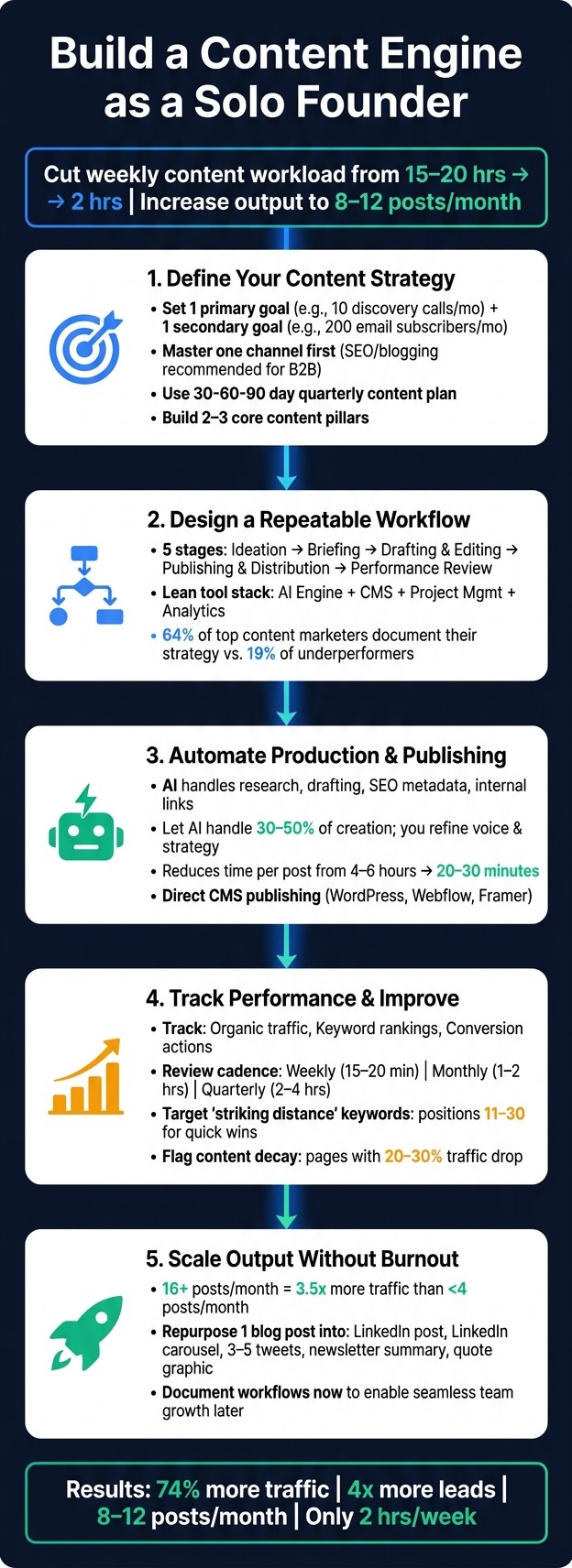
How to Build a Content Engine as a Solo Founder: 5-Step System
Step 1: Define Your Content Strategy
Set Clear Goals and Priorities
Start by clarifying your content's purpose. Without specific goals, solo founders can easily spread themselves too thin, achieving little in the process.
Focus on one primary and one secondary goal to stay on track. For example, aim for 10 discovery calls per month as your primary goal and 200 new email subscribers per month as your secondary goal. This approach isn't about curbing ambition - it's about using your time effectively. Trying to tackle three or more goals at once often leads to none being achieved.
The same principle applies to choosing channels. As Averi advises: "Master one channel before adding another." [3] For most B2B founders, SEO and blogging are the best starting points. Unlike social media, SEO provides long-term benefits. A blog post published today can steadily bring in traffic over time, while also positioning your content for AI-powered search tools like Perplexity and ChatGPT. This practice, known as Generative Engine Optimization (GEO), ensures your content remains relevant in the evolving search landscape.
Once your goals and focus are clear, turn to your website to build a strong foundation for your strategy. You can even simplify your marketing plan in just 48 hours to move faster.
Use Your Website as a Starting Point
Your website already holds valuable content that reflects your brand's message and value. Pages like your homepage, product descriptions, and about section can provide a solid starting point.
Tools like Averi make this process easier. Averi scans your website in minutes to identify your brand voice, target audience, and gaps in competitor content. What typically takes hours of manual work is automated in about 10 minutes [1]. This analysis ensures that every new piece of content aligns with your brand and becomes part of a smarter, evolving system.
"One hour of good keyword research or content planning returns more value than three hours of drafting topics nobody searches for." - Averi Resources [4]
Build a Quarterly Content Plan
To maintain consistency, organize your strategy into a quarterly plan using a 60-day content machine framework:
Timeframe | Status | Level of Detail |
|---|---|---|
30 Days | Committed | Fully planned and scheduled |
60 Days | Directional | Topics and keywords identified but not yet fully briefed |
90 Days | Aspirational | General themes and goals; subject to revision based on data |
Structure your plan around 2–3 core content pillars that tie directly to your product's value. For example, if you're selling a project management tool for agencies, your pillars might include Client Communication, Team Efficiency, and Agency Growth. Each piece of content should connect to one of these pillars to keep your messaging focused.
Set a realistic publishing pace - start with at least 2 posts per month but aim for 4 to take advantage of compounding traffic. Research shows companies publishing 16 or more posts monthly can generate up to 3.5x more traffic than those publishing fewer than four [1].
[Webinar] How solo marketers turn AI into a consistent content engine
Step 2: Design a Repeatable Content Workflow
Once you’ve got a strategy in place, the next step is building a workflow that simplifies every stage of content creation.
Map the Full Content Lifecycle
A well-structured workflow eliminates guesswork and ensures every step is clear and efficient. This kind of standardized content creation framework is key to maintaining a consistent and productive content engine.
Break your workflow into five main stages: Ideation → Briefing → Drafting & Editing → Publishing & Distribution → Performance Review. Each stage should have a defined input, a clear output, and a specific tool to support it. For instance:
Ideation: Produces a list of approved topics.
Briefing: Turns a single topic into a structured brief, including the target keyword, audience, and call to action.
Drafting & Editing: Results in a polished draft ready for your CMS.
Publishing & Distribution: Shares content across platforms.
Performance Review: Analyzes results to refine future efforts.
Keep it simple - your workflow should fit on one page and be easy to follow each week. Research shows that 64% of top-performing content marketers document their strategy, compared to just 19% of those struggling [6]. Writing down your process is a small step that can have a big impact, especially for solo founders.
Choose the Right Tool Stack
The tools you use should be minimal yet effective, focusing on integration rather than sheer quantity. You only need four essential categories: an AI content engine, a CMS, a project management tool, and analytics.
Here’s an example of a lean tool stack:
Category | Recommended Tools | Estimated Monthly Cost | Role |
|---|---|---|---|
AI Content Engine | Averi AI | $100/mo [1] | Automates research, drafting, and publishing |
CMS | Varies | Hosts and manages published content | |
Project Management | $8–$16/mo [3] | Tracks tasks and content stages | |
Analytics | Google Analytics 4 + Search Console | Free | Measures performance and informs decisions |
For example, Averi AI can directly publish to platforms like Webflow, Framer, and WordPress, reducing manual handoffs. The goal is to ensure all tools work seamlessly together, saving time and effort.
Use Templates to Standardize Your Process
Templates are your secret weapon for efficiency. They remove the need to start from scratch with every piece of content, turning repetitive tasks into simple fill-in-the-blank exercises.
Start with these three essential templates:
Content Brief: Covers the audience, goal, primary keyword, outline, and call to action.
Blog Post Structure: Includes an H1, introduction hook, H2/H3 sections, CTA placement, and meta description.
Distribution Checklist: Details steps for LinkedIn posts, email summaries, and internal links.
Store these templates in your AI tool so they’re ready to use with every prompt.
"A solo marketer using AI produces 2–3x more content at the same quality level." - Averi Resources [3]
Additionally, create a "brand voice profile" for your AI tool. This ensures your tone stays consistent across all drafts. By sticking to your templates, you’ll speed up the content creation process and make it easier to delegate tasks when your team grows.
With this streamlined workflow in place, you’re ready to automate and scale your content production.
Step 3: Automate Content Production and Publishing
Once your workflow is mapped out and templates are set, automation takes your content creation to the next level. This is where a content engine truly shines - managing research, drafting, and publishing so you’re spending minutes fine-tuning instead of hours creating from scratch.
Automate Research and Topic Generation
Deciding on topics is often the biggest bottleneck. Traditional keyword research can eat up 1–2 hours per session, while full post research might take 15–20 hours [1]. AI tools can eliminate this time drain entirely.
Platforms like Averi continuously track industry trends, monitor competitor strategies, and identify keyword gaps. They then present you with a curated content queue featuring suggested titles, target keywords, and tailored content angles for your audience [1]. Topics are neatly categorized - how-to guides, comparison posts, thought pieces - so you’re always hitting the right content at the right time. Your role? Spend just 15 minutes weekly approving topics, with a more in-depth 60-minute session monthly to refresh the queue [1].
A key development here is Generative Engine Optimization (GEO). Unlike traditional SEO, GEO focuses on structuring content to be referenced by AI search tools like ChatGPT and Perplexity, giving solo founders a clear advantage in building long-term visibility [1].
Speed Up Drafting and Editing
Once topics are approved, AI can generate a detailed draft in minutes, complete with SEO metadata, internal links, and FAQs. By providing the AI with a 500+ word sample of your writing, you can ensure it mirrors your tone and style [7].
The smart move is to let AI handle 30–50% of the content creation process [8]. Use it for brainstorming, outlining, and drafting, while you focus on refining the voice, adding perspective, and polishing the final version. This balance keeps the content personal and authentic while reducing production time by 4–6 hours per post [1]. For critical pieces - like a positioning statement or a public-facing response - it’s best to keep AI in a supporting role only.
"You need to own the brain and the voice; you can outsource the hands." - Averi [2]
Publish Directly to Your CMS
Direct integrations with your CMS eliminate the need for manual formatting or tedious copy-pasting. Tools like Averi can publish finalized content straight to platforms like WordPress, Webflow, or Framer, streamlining the process [4]. Every published piece also feeds into a growing content library, which helps refine future drafts to better align with your brand voice [1].
The results compound over time. As Zach Chmael, CMO of Averi, explains:
"We built Averi around the exact workflow we've used to scale our web traffic over 6,000% in the last 6 months." [1]
Step 4: Track Performance and Improve Over Time
Publishing content regularly is just the beginning. The real challenge lies in understanding what works - and making timely adjustments to stay ahead.
Focus on Metrics That Matter
Zero in on the metrics that directly impact your business. Organic traffic helps you gauge if the right audience is discovering your content. Keyword rankings indicate your progress in search visibility. Most importantly, conversion actions - like demo requests, trial signups, or email opt-ins - show whether your content is driving meaningful results.
For a complete picture, track awareness (impressions), engagement (time spent on pages), and revenue-related actions (demo requests). Tools like Google Analytics 4 (GA4) and Google Search Console make this easier. GA4 monitors traffic, engagement, and conversions, while Search Console reveals which queries drive clicks and where your content ranks. Together, they provide valuable insights without added costs.
Leverage AI Analytics for Smarter Decisions
After identifying key metrics, let AI tools guide your next steps. Platforms like Averi offer precise recommendations, such as: "This post is ranking #8 - here’s how to push it to page 1" or "Your competitor just published on X - here’s your counter-strategy." [1]
Refreshing older content can often yield better results than constantly creating new material. AI tools can detect content decay, flagging pages that have seen a 20–30% traffic drop in recent months. Updating these posts is a proven strategy among top-performing marketers, who routinely audit and refresh content based on performance data. This practice is a key factor in the success gap between leading and average content marketers.
"Revenue-attributable content is the most defensible content operation." - Averi [2]
Establish a Simple Review Routine
A consistent review schedule keeps your content strategy on track without overwhelming your workload. A tiered cadence ensures you’re continuously improving while staying efficient.
Cadence | Time | Focus |
|---|---|---|
Weekly | 15–20 min | Check impressions, clicks, keyword shifts; approve AI recommendations. |
Monthly | 1–2 hours | Evaluate traffic trends, conversion rates, and update one high-performing post. |
Quarterly | 2–4 hours | Conduct competitor analysis, audit content, and align overall strategy. |
During weekly reviews, use Google Search Console to identify "striking distance" keywords - queries ranking between positions 11 and 30. These are quick-win opportunities where small updates to titles, introductions, or on-page structure can push a page to the first search results page. Monthly reviews should include refreshing at least one older post, while quarterly sessions allow for a broader strategy check, eliminating underperformers and doubling down on what works.
As Zach Chmael, CMO of Averi, explains: "The goal isn’t to become a full-time content marketer. The goal is to build the minimal infrastructure that produces results while you focus on product and customers." [9]
Step 5: Scale Output Without Burning Out
Once your tracking process is on point, the next step is figuring out how to scale your content output without overloading yourself. The goal isn't to work harder or hire more people - it’s about creating smarter systems to maximize what’s already in place.
Publish More Without Extra Effort
Did you know companies publishing 16 or more posts a month see 3.5 times more traffic than those publishing fewer than four? [1] For a solo founder juggling multiple responsibilities, that might sound impossible. But with AI in your corner, it’s not only achievable - it’s manageable.
AI tools can take over time-consuming tasks like research and drafting, cutting your time per post from 4–6 hours to just 20–30 minutes. [1] This shift makes it realistic to go from 2–4 posts a month to 8–12 without burning out. That’s exactly how Averi’s workflow is designed: let AI handle the heavy lifting, while you step in for approval and refinement.
"A content engine is a system that produces, publishes, and optimizes content with minimal ongoing founder involvement." - Zach Chmael, CMO, Averi [1]
Once you’ve got the content, the next step is to make sure it reaches as many people as possible by repurposing it across platforms.
Repurpose Content Across Platforms
Scaling your content output doesn’t mean starting from scratch every time. The key is repurposing - taking one blog post and tailoring it for different platforms instead of just sharing a plain link.
For example, a single 2,000-word blog post can be transformed into:
A LinkedIn text post
A LinkedIn carousel
3–5 tweet-sized insights
A newsletter summary
A quote graphic
AI tools make this process quick and painless. Eddie Larsen, Founder of OncePost, highlights the importance of this approach:
"Turning one post into 9 platform-specific versions is boring work, and I always skip it. Which means I'm leaving a ton of distribution on the table." [10]
Tools like OncePost ($19–$49/month) or Castmagic ($29/month) can generate platform-ready versions of your content in under a minute. [10][11] To stay efficient, create a simple distribution checklist. For instance, after publishing a blog post, plan for one LinkedIn post with key takeaways, a newsletter feature, and several short social snippets. Time-blocking this process - say, every Thursday afternoon - prevents it from becoming an ongoing distraction. [4]
As your content library grows, you’ll also want to prepare for the day when you might bring in collaborators.
Build a System for Future Team Growth
The systems you set up now don’t just help you today - they lay the groundwork for seamless team integration later. By documenting your workflows, such as content briefs, distribution checklists, and brand voice guidelines, you’ll make onboarding new team members a breeze. [4][2]
Platforms like Averi can store your brand context in a persistent library that evolves as you publish more content. This means when you eventually hire a part-time editor or contractor, they can hit the ground running without weeks of onboarding. The ultimate goal? Adding a team member should multiply your output, not create more coordination headaches.
Conclusion: Building a Content Engine That Runs Itself
Creating a content engine is about setting up a system that works continuously with minimal intervention. By defining a clear strategy, establishing a repeatable workflow, automating production and publishing, monitoring key metrics, and scaling output, every piece of the process supports the next. This structured approach delivers measurable outcomes.
Publishing consistently can generate 74% more traffic and up to four times more leads[9]. Successful entrepreneurs rely on efficient systems rather than sheer effort. From strategic planning to automation and performance tracking, every step fuels growth.
As one expert from Averi aptly states:
"The goal isn't to replace human judgment. It's to stop paying human labor rates for tasks that don't require human judgment." - Averi Resources [5]
A well-built content engine uses AI to handle the execution, freeing you to focus on refining your strategy in as little as two hours a week[1]. Over time, your content becomes more effective, your brand voice sharpens, and the system keeps improving itself.
Want to turn content creation from a chore into a valuable asset? Averi offers a self-sustaining content engine for just $100/month. It covers strategy, execution, publishing, and analytics - without the need for expensive agency fees. Sign up, share your website, and let the system take it from there.
FAQs
What should I publish first if I have no content?
If you're starting from scratch, begin by crafting a cornerstone piece of content that acts as the backbone of your strategy. Aim for something impactful, such as an in-depth guide, a pillar article, or a well-researched resource that aligns with your audience's needs and your objectives. This foundational piece will serve as a launchpad for future content efforts, making it easier to attract traffic, streamline distribution, and build credibility effectively.
How do I keep AI-written content sounding like me?
To make AI-generated content align with your personal style, focus on careful review and thoughtful adjustments. Spend time refining drafts to match your tone and brand identity. During the editing process, infuse your unique perspective to maintain a sense of individuality. Tools such as Averi can handle repetitive tasks, freeing you up to concentrate on adding a personal touch and ensuring the final product genuinely reflects your voice - all while streamlining the process.
When should I refresh old posts vs write new ones?
When older posts become outdated, fall out of sync with current trends, or could benefit from AI-driven improvements, refreshing them can be a smart move. It’s often more resource-efficient than creating entirely new content, especially when time or budgets are tight. On the other hand, writing new posts is essential when existing material no longer resonates with your audience or misses out on addressing timely topics. Tools like trend analysis and audience feedback can help pinpoint these gaps and guide your content strategy effectively.
Related Blog Posts

Zach Chmael
CMO, Averi
"We built Averi around the exact workflow we've used to scale our web traffic over 6000% in the last 6 months."
Your content should be working harder.
Averi's content engine builds Google entity authority, drives AI citations, and scales your visibility so you can get more customers.