

In This Article
Create SEO content that answers buyer questions, maps to funnel stages, and syncs with sales workflows to influence deals.
Updated:
Trusted by 1,000+ teams
Startups use Averi to build
content engines that rank.
SEO content often fails to align with sales needs, leading to wasted resources and missed opportunities. To bridge this gap, focus on creating content that directly addresses buyer questions, aligns with their decision-making stages, and supports sales workflows. Here's a quick breakdown of actionable steps to ensure your SEO content drives results:
Focus on Buyer Needs: Address specific questions and objections prospects have at various stages of the sales funnel.
Sales Integration: Link content to sales workflows, making it easily accessible and relevant for reps during conversations.
Match Content to Funnel Stages: Allocate 40% to educational content, 30% to decision-focused pieces, 20% to thought leadership, and 10% to product details.
Leverage Sales Insights: Use CRM data, sales call notes, and objections to guide content creation.
Streamline Content Management: Centralize assets in tools like Notion or Airtable, tagging by persona, funnel stage, and content type.
Utilize AI for Efficiency: Tools like Averi can speed up content creation, research, and updates while aligning with sales goals.
Track and Measure Impact: Go beyond traffic metrics - monitor content-influenced deals, win rates, and organic customer acquisition costs.
Sales and Marketing Alignment: Essential for GTM Success
Mapping SEO Content to the Buyer's Journey
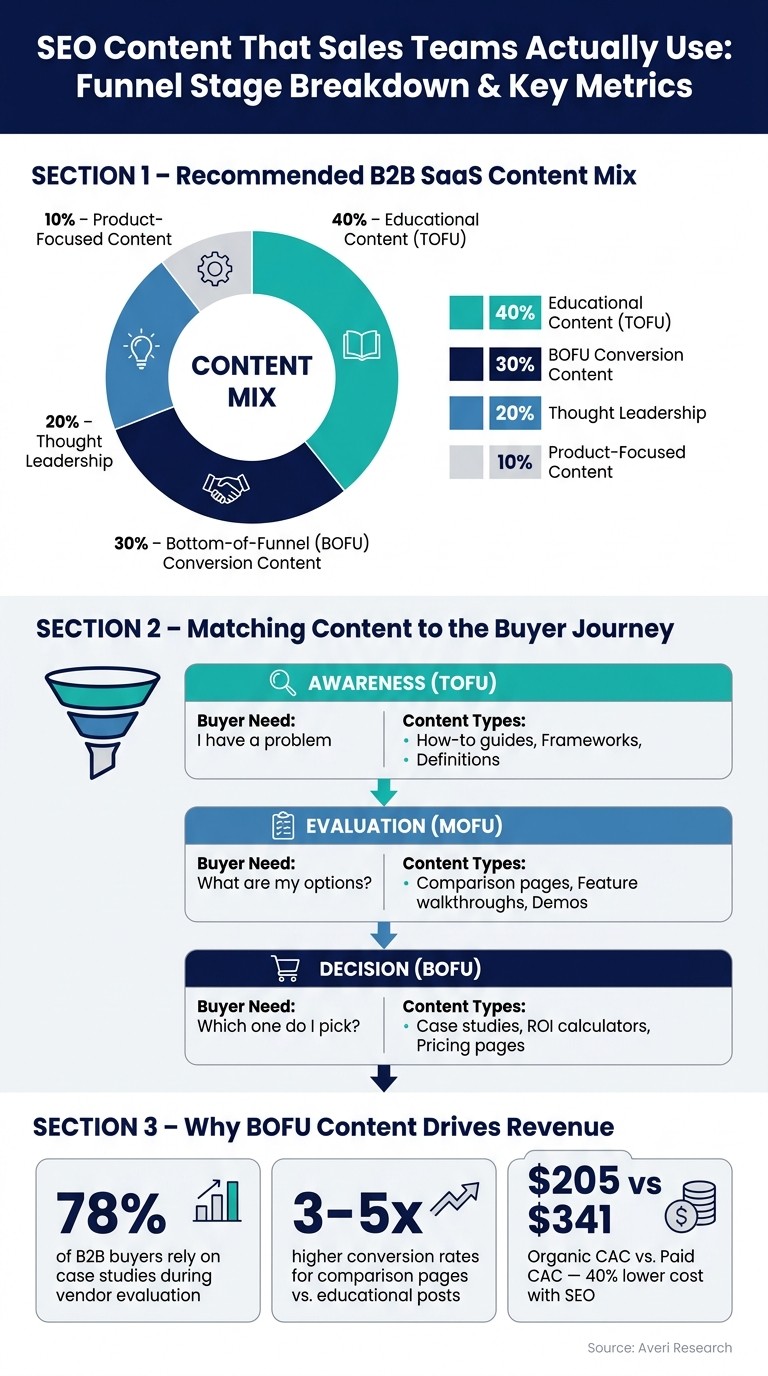
SEO Content Strategy: Funnel Stage Breakdown & Key Metrics
How to Identify Buyer Personas and Pain Points
Your CRM is a goldmine for building accurate buyer personas. Dive into sales call recordings, win/loss notes, and closed-lost reasons to uncover the exact language buyers use when they’re unsure, skeptical, or ready to commit. These insights help pinpoint the questions your content needs to address across an average sales cycle of 134 days [1].
Ask your sales team to share the top three objections they hear during discovery calls each month. These objections are essentially content briefs in disguise. For example, if prospects frequently ask, “How does this integrate with Salesforce?” or “What does implementation actually look like?” - those are content gaps waiting to be filled. Addressing these questions through SEO content ensures your prospects get answers before they even speak to a rep, laying the groundwork for a smoother sales process.
Matching Content Types to Sales Stages
Each stage of the sales funnel requires a specific type of content to meet buyer needs. A well-rounded B2B SaaS marketing strategy typically allocates 40% to educational content, 30% to bottom-of-funnel (BOFU) conversion content, 20% to thought leadership, and 10% to product-focused content [1].
Funnel Stage | Buyer Needs | Content Types |
|---|---|---|
Awareness (TOFU) | "I have a problem" | How-to guides, frameworks, definitions |
Evaluation (MOFU) | "What are my options?" | Comparison pages, feature walkthroughs, demos |
Decision (BOFU) | "Which one do I pick?" | Case studies, ROI calculators, pricing pages |
The decision stage is often overlooked, yet it’s critical for closing deals. Consider this: 78% of B2B buyers rely on case studies during vendor evaluation [1]. Investing in BOFU content like case studies and ROI calculators not only supports prospects but also reduces the manual effort required from sales reps during calls.
Building a Shared Content Mapping System
Once you’ve nailed down buyer personas and stage-specific content, the next step is creating a centralized system to manage it all. Content strategy tools like Notion or Airtable are ideal for building a shared matrix that links keywords, buyer personas, funnel stages, and content owners in one accessible place [1]. The goal? A single source of truth that allows sales reps to quickly filter by criteria like "decision stage" and instantly find the right case study or ROI calculator to share with prospects.
"The winning play is to treat enablement as a living system: content that is continuously generated, checked, deployed, and improved based on real performance." - Ameya Deshmukh, EverWorker [2]
To make this system effective, tag every content asset by cluster, funnel stage, persona, and content type. Schedule quarterly reviews to retire outdated pieces and identify gaps. This transforms what could be a static spreadsheet into a dynamic tool that both marketing and sales teams actively use, ensuring it doesn’t just gather dust after being shared.
Turning Sales Insights Into SEO Content That Converts
Once your content mapping system is in place, it’s crucial to keep it fueled with ongoing sales insights. Incorporating real-time input from sales teams not only sharpens your SEO content but also directly helps move buyers through their decision-making process. Often, there’s a disconnect between what marketers think buyers care about and the actual objections sales teams hear daily. By leveraging precise sales insights, you can close this gap and create content that directly addresses buyer concerns.
How to Gather Sales Input Without Adding Extra Work
One common mistake is burdening sales reps with lengthy forms or additional meetings when they’re already stretched thin. Instead, streamline the process with a quick, 15-minute biweekly sync centered on a single, focused question: “What objections or questions did buyers raise this week that we don’t yet have solid answers for?”
Complement this with a shared Slack channel or a simple Notion form where reps can jot down notes on the go - like objections, competitor mentions, or recurring buyer queries. Marketing teams can then review these inputs regularly, spotting patterns and trends without disrupting the sales team’s workflow. From there, turn these insights into actionable SEO briefs.
Turning Buyer Objections Into SEO Briefs
Recurring sales feedback, like frequent pricing objections, can be quickly transformed into SEO content that answers buyer questions. Start by using a keyword tool, such as Ahrefs, to uncover relevant search terms buyers are using. For instance, pricing concerns might translate into queries like "[Product] vs. [Competitor] pricing" or "[Product] alternatives." These are high-intent, bottom-of-funnel keywords signaling buyers who are close to making a decision.
Create a brief that includes the target keyword, the buyer persona, the relevant stage of the funnel, and the specific objection to address. Tools like Averi can simplify this process by pulling in brand context and competitor data, ensuring the final content is accurate and aligned with your product’s strengths rather than relying on generic claims.
Choosing the Right Content Formats for Sales Scenarios
Different content formats serve distinct purposes in advancing deals. For example, comparison pages like "Product vs. Competitor" consistently deliver conversion rates 3–5 times higher than general educational posts [1]. ROI calculators are ideal for helping prospects justify their decision internally by showcasing cost savings or efficiency improvements. For technical buyers, implementation guides tackle the common concern of setup complexity, while security and compliance documentation addresses the needs of enterprise buyers, particularly CTOs and legal teams.
Building an AI-Driven Workflow for Marketing and Sales Collaboration
An AI-driven workflow can simplify content production while addressing buyer needs more effectively. Once buyer objections and preferred content formats are mapped out, the next challenge is execution speed. Many marketing teams waste hours juggling keyword tools, Google Docs, CMS platforms, and Slack threads. By consolidating these tasks into one streamlined, repeatable process, AI bridges the gap between sales insights and fast, actionable content creation.
Content Workflow: From Idea to Publication
A well-structured workflow ensures efficiency and clarity, with six key stages and defined responsibilities for both AI and human contributors:
Stage | AI's Role | Human's Role |
|---|---|---|
Ideation | Clustering keywords and mapping intent | Choosing topics with commercial relevance |
Outlining | Generating H2/H3 structures | Adjusting for better narrative flow |
Drafting | Producing structured first drafts | Adding unique data, quotes, and perspectives |
Review | Checking SEO and formatting | Ensuring factual accuracy and brand alignment |
Enablement | Repurposing content for sales formats | Approving and distributing sales materials |
Maintenance | Highlighting outdated or underperforming content | Prioritizing updates and refreshes |
Automating the handoffs between these stages ensures a continuous workflow, moving content seamlessly from brief to publication.
How Averi Speeds Up Content Research, Drafting, and Optimization
Averi takes the heavy lifting out of research, drafting, and optimization, aligning content with sales goals in record time. Traditionally, research, brief creation, and post-publish optimization are some of the most time-consuming tasks. With AI assistance, the entire process - from writing to CMS posting and publishing - takes just 16 minutes on average, compared to 69 minutes when done manually [8].
Averi uses your website as a learning source, embedding your brand's context into every piece of content. Once a topic is approved, Averi conducts in-depth research with linked sources, structures drafts optimized for both Google search and AI citation engines like Perplexity, and even generates internal links and meta descriptions. This means the first draft is already tailored to your sales objectives.
"AI content has a reputation problem... Most of it was produced by people who thought 'AI writes content' meant 'AI writes content and you publish it directly.'" - Averi Resources [4]
The collaborative editing canvas allows marketing and sales teams to leave comments, refine tone, and suggest edits, ensuring the final product resonates with buyer language rather than being generic, keyword-heavy content.
Connecting Content Tools Across Your Tech Stack
Even the best content is ineffective if sales teams can't access it when needed. The solution lies in integrating your AI-powered workflow with the tools your sales reps already use. By connecting your AI content system to your CRM - whether it's HubSpot, Salesforce, or another platform - you can automatically notify reps when new, relevant assets go live [6][7]. This eliminates the need for manual searches and redundant requests.
For deeper insights, tools like Gong or Chorus can analyze recurring objections from buyer conversations and feed those insights directly into the content creation process [6]. Averi's integrations with platforms like Webflow, Framer, and WordPress further simplify the process by removing the need for manual formatting, enabling content to go live seamlessly after approval. As your content library expands, the AI becomes more effective, using past publications to refine and enhance future recommendations.
Measuring Whether Your SEO Content Is Actually Helping Sales
Once your content is live and integrated into the sales process, the key question becomes: is it making a difference? Many teams focus solely on organic traffic as a performance metric. But traffic alone doesn’t reveal whether a blog post helped close a deal or advanced a prospect from "just curious" to "ready to buy." To ensure your SEO content contributes to revenue, you need to measure its impact on both search performance and sales outcomes.
Metrics That Connect SEO to Sales
The best metrics are those that bridge the gap between search visibility and revenue generation. Start by tracking organic sessions, keyword rankings (especially in positions 1–3), and impressions. Pair these with content-influenced pipeline - the total value of deals where prospects engaged with your content during their journey.
Two additional metrics to keep an eye on are win rates for deals where content was shared versus those where it wasn’t, and organic customer acquisition cost (CAC). On average, organic CAC is $205, significantly lower than the $341 typical for paid channels - a 40% difference that compounds over time [1]. Monitoring this disparity highlights the financial advantages of investing in SEO content. Together, these data points help refine both marketing and sales strategies.
"Stop attributing individual conversions to individual pieces of content... Content marketing is a system, not a collection of independent campaigns." - Zach Chmael, CMO, Averi [1]
Beyond numbers, qualitative insights also play a vital role in understanding how content supports sales.
Tracking Content Usage by Sales Teams
To know what content sales teams are actually using, integrate your content library with your CRM. Tools like HubSpot or Salesforce, when set up with multi-touch attribution, allow you to trace a prospect’s journey from their first blog visit to a closed deal [5][9]. This reveals which pieces are most often associated with closed-won deals versus those linked to closed-lost ones.
For deeper insights, gather direct feedback from sales reps. Train them to ask a simple question during discovery calls: "What content have you seen from us?" [5] This feedback highlights which assets prospects remember and trust, which may differ from the ones that generate the most clicks. Combine this with data on follow-up actions - like meetings booked after sharing a piece or how quickly deals progress through stages - to pinpoint the content that truly drives results [2].
Updating Content Based on Performance Data
Effective content updates start with regular reviews of performance data. Spend 30 minutes each week in Google Search Console to identify opportunities. Focus on pages with high impressions but low clicks - these are ranking but not enticing users to engage. Prioritize updates to bottom-of-funnel content, such as comparison or "alternative to" posts, which convert at rates 3–5 times higher than educational pieces [1].
Averi’s analytics tools can simplify this process by flagging opportunities. For example, it may highlight a post ranking at position 8 with suggestions to boost it to page 1 or alert you when a competitor publishes on a topic you already cover. As Averi’s blog explains, "Content refreshes on existing pages show movement in days to weeks" [1], making updates one of the most impactful activities in any content strategy.
Conclusion: How to Build a Content Engine That Supports Sales
Creating SEO content that sales teams actively use requires a well-thought-out plan. Successful teams stick to a defined structure: around 30% of content focuses on bottom-of-funnel buyers, 40% aims to educate, 20% establishes thought leadership, and 10% is product-focused [1].
Shifting from sporadic content creation to a systematic process ensures consistent results. This involves moving through four key stages - Ideation, Creation, Refinement, and Distribution - instead of reacting to ad hoc sales requests [3]. Each stage has a designated owner, clear inputs, and defined outputs, fostering a seamless collaboration between marketing and sales through an ongoing feedback loop.
Incorporating direct sales insights at every step strengthens this partnership. When objections, call transcripts, and win/loss notes are integrated into content briefs, the resulting materials become far more relevant in real-world conversations. Tools like Averi speed up this process by anchoring drafts in approved messaging and brand guidelines, ensuring every piece resonates with buyers [2][4].
Ameya Deshmukh from EverWorker sums up the importance of this continuous effort:
"The opportunity for marketing is clear: build a system where enablement content is produced and refreshed continuously - without burning out your team." - Ameya Deshmukh, EverWorker [2]
Organic customer acquisition costs (CAC) average $205 - 40% lower than the $341 typical for paid channels - and this cost advantage grows as your content library expands [1]. A structured weekly routine, dedicating just 3–5 hours, can sustain publishing momentum and keep content aligned with ongoing sales conversations. Leveraging AI tools to simplify research and updates ensures your content engine keeps pace with evolving sales needs.
FAQs
How do I pick SEO topics my sales team will actually use?
To select SEO topics that your sales team will actually use, center your efforts on addressing the questions and concerns buyers often have. Focus on topics that align with what buyers are researching, their challenges, and the factors influencing their decisions. This approach ensures your sales reps can easily share content that resonates. Consider the relevance of each topic, how quickly it can generate results, and how seamlessly it fits into your team's workflows. This way, the content not only engages buyers but also actively supports your sales process.
What sales data should I use to create SEO briefs?
To refine your sales enablement strategy, it's crucial to rely on sales data that highlights how your content influences buyer engagement and deal progression. Start by examining metrics such as how frequently sales reps use specific assets, the level of prospect interaction (like total viewing time or clicks), and the content's role in closing deals.
Dive deeper into three key areas:
Internal Views: Track how often your sales team accesses and uses the materials. High usage rates suggest that your reps find the content relevant and valuable.
External Engagement: Measure how prospects interact with the content. Metrics like time spent viewing, shares, or repeated access can reveal what resonates most with buyers.
Revenue Impact: Analyze how content contributes to deal progression and revenue generation. Identify which assets consistently correlate with closed deals or shorter sales cycles.
By focusing on these data points, you can prioritize creating and refining content that not only supports your sales team but also aligns with buyer needs, ensuring a more effective and streamlined sales process.
How can I measure if SEO content is driving revenue?
To determine if your SEO content is contributing to revenue, it's crucial to tie content objectives to measurable financial results and track relevant metrics. Start by defining specific KPIs, such as lead generation or conversion rates. Keep an eye on engagement metrics like organic traffic, time spent on pages, and bounce rates. Use attribution models to link user interactions directly to sales. Lastly, rely on analytics tools to evaluate how SEO efforts influence revenue by integrating data on traffic, user engagement, and sales performance.
Related Blog Posts

Zach Chmael
CMO, Averi
"We built Averi around the exact workflow we've used to scale our web traffic over 6000% in the last 6 months."
Your content should be working harder.
Averi's content engine builds Google entity authority, drives AI citations, and scales your visibility so you can get more customers.