

In This Article
Practical tactics for seed-stage startups to build predictable lead engines: define ICP, clean data, use AI outbound and content.
Updated:
Trusted by 1,000+ teams
Startups use Averi to build
content engines that rank.
Lead generation is a survival skill for seed-stage startups. At this stage, your product is new, your team is small, and every lead matters. Building a predictable system to attract and convert leads is key to driving revenue, validating your product, and proving scalability to investors. Here’s what you need to know:
Challenges: Limited brand recognition, outdated contact records (30% annually), and low cold email response rates (1–5%) make lead generation tough.
Solutions: AI tools like Apollo, Clay, and ZoomInfo streamline outreach, saving time and improving targeting accuracy by 25%.
Steps: Define your Ideal Customer Profile (ICP), build a marketing strategy, and use AI-driven tools for personalized outbound campaigns.
Content Strategy: Combine outbound efforts with inbound content marketing to create a steady lead flow. Tools like Averi simplify content creation for lean teams.
Metrics to Track: Focus on Cost Per Lead (CPL), Lead Velocity Rate (LVR), and Customer Acquisition Cost (CAC) to measure efficiency and growth.
Webinar: 20 Proven B2B Lead Generation Strategies for Startups
Defining Your ICP and Building a Lead Database
Before building a B2B marketing strategy and launching campaigns, it’s crucial to define your target audience. Without a well-defined Ideal Customer Profile (ICP), your outreach efforts become a guessing game, wasting both time and money - resources that are especially precious for seed-stage startups.
How to Define Your Ideal Customer Profile (ICP)
Your ICP identifies the company and decision-maker most likely to purchase and benefit from your product. Start by analyzing your early customers. What traits do they share? Pay attention to firmographic signals (such as company size, industry, or funding stage), technographic signals (the tools they already use), and behavioral signals (what prompted their search for a solution like yours).
For example, a B2B SaaS startup used AI to analyze customer interactions and discovered that its most successful conversions came from companies that preferred Slack over Microsoft Teams and were located in secondary markets. By narrowing its ICP around these traits, the company reduced its customer acquisition cost (CAC) by 67% and increased conversion rates by 156% [2].
Another key insight: 70% of the B2B buying journey happens anonymously before prospects ever engage with a vendor [3]. Many potential customers conduct their research in private Slack groups, Reddit threads, or peer communities, staying under the radar. This "dark funnel" highlights the importance of basing your ICP on real customer data and interviews rather than assumptions.
How to Set Up and Maintain a Lead Database
Once your ICP is clear, the next step is building a lead database that aligns with it. For seed-stage teams, starting with a free-tier CRM is often the most practical approach. Tools like Apollo or ZoomInfo can integrate with your CRM to automatically update records and prevent duplicates.
It’s worth noting that 30% of B2B contact records become outdated every year [1]. To combat this, automation is key. Set up weekly automated list updates to ensure your database remains accurate and to keep email bounce rates below 5% [1].
With a clean and up-to-date database, the next focus is choosing the right prospecting tools to support your outreach efforts.
Prospecting Tools for Seed-Stage Startups: A Comparison
The right prospecting tool depends on your team’s specific needs. Below is a comparison of popular tools and their core functions:
Tool | Core Function | Best For | Starting Price |
|---|---|---|---|
Apollo | Data enrichment + rules-based sequencing | Cost-effective email verification and outreach | Free tier available |
Clay | No-code data orchestration + persona prompting | Custom workflows without engineering resources | Paid plans vary |
Real-time firmographic and technographic enrichment | Automatically appending data to inbound leads | Contact for pricing | |
ZoomInfo Copilot | Intent data + AI-assisted targeting | Scaling teams with larger budgets | Contact for pricing |
Fully autonomous SDR agent | Replacing early SDR hires entirely | Contact for pricing |
For seed-stage startups, Apollo is an excellent starting point, offering affordable data enrichment and sequencing. As your workflows become more defined, Clay can help you create customized outreach strategies without requiring coding expertise. Larger-scale tools like ZoomInfo Copilot or Jeeva AI typically make sense for startups that are scaling rapidly and need more advanced capabilities.
"Gartner predicts 50% of B2B organizations will deploy autonomous prospecting agents by 2027, creating a competitive moat for early adopters." - Gaurav Bhattacharya, CEO, Jeeva AI [1]
At the seed stage, simplicity is key. Focus on a lean stack: a CRM, one data enrichment tool, and one sequencing tool. A clean database paired with a well-defined ICP and AI-powered workflows will deliver better results than an overly complicated tech stack built on unclear targeting.
Outbound Lead Generation: AI-Driven Workflows
Once you've nailed down your Ideal Customer Profile (ICP) and built a solid lead database, it’s time to start reaching out. For seed-stage startups, outbound outreach is often the quickest way to land those crucial first customers - cold outreach accounts for 75% of a startup's first 10 customers[6]. AI tools now make it possible for small founding teams to scale outbound efforts in ways that previously required a full sales team.
Running Cold Email Campaigns as a Seed-Stage Startup
Cold emails work best when they feel personal, almost like a one-on-one conversation. Here’s a practical workflow that lean teams can use without needing to hire a Sales Development Representative (SDR):
Extract ICP-matching leads with Apollo ($59/month): Apollo's firmographic and technographic filters help you find contacts that match your ICP. Its built-in email verification tools ensure your bounce rates are kept low.
Enrich and personalize leads with Clay ($185/month): Clay’s "Claygent" AI agent can research each prospect in seconds, pulling insights like recent news, LinkedIn activity, and company pain points. This enriched data feeds directly into your email templates, making each message feel personalized. Clay also supports other outreach channels with similar benefits.
Send and warm up emails using Instantly ($47/month): Instantly offers unlimited email account warmup, which is critical for ensuring your cold emails land in inboxes rather than spam folders. With a 4.8/5 rating on G2[7], it’s a reliable tool for early-stage teams focused on deliverability.
For follow-up sequences, aim for three to five touches over a two-week period. Keep your emails short and to the point, focusing on securing a quick call rather than pitching a full demo. To maximize your reach, combine email outreach with other channels for a multi-touch strategy.
LinkedIn Prospecting with Automation Tools
Email might be the foundation, but LinkedIn messages can add a layer of personalization that makes a big difference. Including a LinkedIn message on Day 1 of your outreach sequence - before your first email - is shown to significantly improve reply rates. In fact, multichannel AI sequences have been shown to book more than twice as many meetings compared to email-only approaches[1].
LinkedIn automation tools can help scale your efforts by automating connection requests and follow-up messages. However, it’s important to use these tools responsibly. LinkedIn actively monitors for bot-like behavior, so limit daily connection requests and always review AI-generated messages before sending. Clay’s AI agent can help by summarizing key details about a prospect’s company, such as recent funding news or their unique challenges, allowing you to craft messages that feel genuinely personalized.
Trigger-Based Outreach Targeting Recently Funded Startups
Trigger-based outreach is a high-return strategy for seed-stage teams. When a company announces new funding, they’re often ready to invest in tools and services. The best time to reach out is within one to two weeks of their funding announcement[8][9]. This approach is perfect for startups looking to focus on high-impact outreach with minimal wasted effort.
Use platforms like Crunchbase or Fundraise Insider to track funding announcements, and automate lead routing into your CRM with tools like Zapier. From there, enrich each lead with details such as the founder’s LinkedIn profile, their tech stack, and company size. When reaching out - whether by email or LinkedIn - reference the funding round to quickly establish credibility and relevance.
For pre-seed and seed-stage companies, direct your outreach to decision-makers like the CEO, Co-Founder, or CTO[9]. These are the individuals most involved in early-stage budgeting.
"Intent data will automatically trigger sequences, eliminating manual RevOps handoffs." - Gaurav Bhattacharya, CEO, Jeeva AI[1]
The key advantage of this approach isn’t just the timing - it’s the precision. By focusing on specific triggers like recent funding, you avoid wasting time on broad, untargeted outreach that can hurt your sender reputation and stretch your team’s resources thin.
Inbound Lead Generation: Content Marketing for Startups
While outbound strategies can generate quick wins, inbound content marketing ensures a steady flow of leads over time by keeping prospects engaged. Outbound efforts might open doors rapidly, but inbound builds relationships and sustains growth. The tricky part for startups? Content marketing demands time, and most founders can't spare hours for keyword research, writing, and publishing. That’s where tools like Averi step in to make the process more manageable.
Using Averi as Your Content Engine
Averi is designed specifically for startups with lean teams that need a steady stream of content. It simplifies content marketing into six efficient phases, handling everything from capturing your brand voice and brainstorming topics to drafting, publishing, and continuously improving based on performance data.
Here’s the bottom line: with Averi, founders can cut their involvement down to 1–2 hours for reviewing and approving content, saving over 5 hours weekly. At just $100/month for the Plus plan, it’s a far more affordable alternative to hiring a content agency, which could cost over $5,000/month. Better still, Averi retains your brand’s context, so each piece of content builds on the last, creating a seamless, scalable system.
Once you’ve got a content engine running smoothly, the next step is to focus on content formats that actually drive conversions.
Content Formats That Generate Leads
Not all content is created equal when it comes to converting leads. To maximize results, allocate resources strategically:
40% for Bottom-of-Funnel (BOFU) content: This includes comparison pages, pricing guides, and "best X for Y" posts - ideal for buyers who are ready to make a decision.
35% for Middle-of-Funnel (MOFU) content: Focus on how-to guides and tutorials that address specific problems and educate potential customers.
25% for Top-of-Funnel (TOFU) content: Use industry trend pieces and thought leadership to raise awareness and attract new audiences [5].
For startups keeping a close eye on costs, content marketing offers a compelling advantage. The average cost-per-lead (CPL) for content marketing is $31, significantly lower than LinkedIn Ads, which can exceed $400 CPL [3][5]. That kind of savings can make a huge difference for a tight budget.
How to Distribute Content Across Channels
Creating content is only half the battle - you also need an effective distribution plan. A three-tier approach works well for startups with limited resources:
Tier 1: Owned channels: Share every piece of content on your blog, LinkedIn personal profile, and email newsletter. For LinkedIn posts, start with a strong hook, provide context, highlight a key insight with evidence, and include a clear CTA linking to your article [5].
Tier 2: Earned reach: Platforms like Reddit, industry Slack groups, and Hacker News are ideal for distributing high-value, non-promotional content. These channels are where your audience is already having conversations.
Tier 3: Paid amplification: Once you have the budget, consider promoting high-converting BOFU content through LinkedIn Ads or newsletter sponsorships. Start with a modest budget of $50–$100 per piece[5].
Consistently showing up in Tier 2 earned channels is critical - it’s where many of your future customers are already spending their time. By combining smart content creation with strategic distribution, startups can make the most of every dollar while growing their audience and pipeline.
Tracking Results and Refining Your Lead Generation Strategy
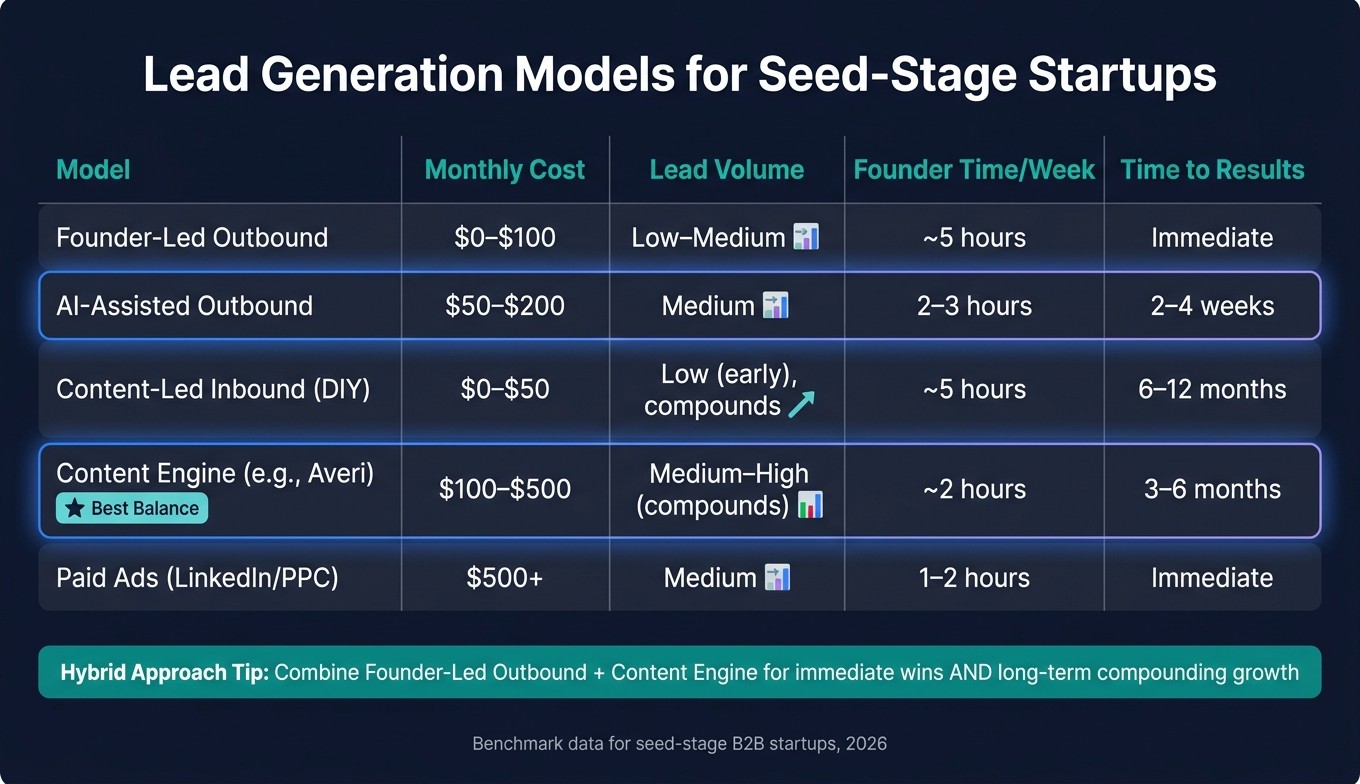
Lead Generation Models for Seed-Stage Startups: Cost, Time & Results
Once both your outbound and inbound efforts are in motion, the next step is to monitor their performance and adjust your approach as needed. A well-defined measurement system ensures you’re not wasting money or effort.
Key Metrics to Track for Lead Generation
At the seed stage, it’s essential to zero in on metrics that highlight both cost efficiency and the health of your sales pipeline:
KPI | 2026 Benchmark (Seed Stage) | Why It Matters |
|---|---|---|
Cost Per Lead (CPL) | <$50 | Helps manage spending [10] |
Lead Velocity Rate (LVR) | 15–25% MoM | Indicates future revenue growth [10] |
MQL Rate | 25–40% | Screens out unqualified traffic [10] |
SQL Rate | 30–50% | Reflects pipeline quality [10] |
CAC | <$5,000 | Signals scalability to investors [10] |
Payback Period | <90 days | Demonstrates capital efficiency [10] |
LTV:CAC Ratio | >3x | Shows sustainable growth potential [10] |
Among these, Lead Velocity Rate (LVR) stands out as a critical indicator at the seed stage. Unlike vanity metrics like impressions or website traffic, LVR focuses on month-over-month growth in qualified leads, making it a solid predictor of future revenue. A healthy LVR typically falls between 15–25% MoM [10]. For example, TestGorilla achieved remarkable growth, scaling to over 5,000 customers while maintaining an 80-day payback period - an accomplishment that helped secure their $70M Series A funding [10].
Automating Feedback Loops for Continuous Improvement
Manually tracking performance can eat up valuable time. Instead, automate the process. Tools like Zapier or native integrations between Google Ads, HubSpot, and Google Sheets can generate real-time dashboards, eliminating the need for weekly manual exports [10].
For content tracking, platforms like Averi simplify the process further. Its analytics feature monitors impressions, clicks, and keyword rankings while offering actionable insights. It identifies which content needs updates, which keywords to target, and where competitors are gaining ground. This automated feedback loop ensures your content strategy keeps evolving without adding extra work. By integrating these tools, you can fine-tune both your outbound and inbound strategies with minimal effort.
"Your data is what turns generic AI algorithms into differentiated and relevant capabilities that give your business a competitive advantage." - Scott Brinker, VP Platform Ecosystem at HubSpot [11]
Lead Generation Models for Seed-Stage Startups: A Cost and Time Comparison
With your lead generation channels in place, it’s crucial to pick a tracking model that aligns with your team’s bandwidth and budget. Here’s a quick breakdown:
Model | Monthly Cost | Lead Volume | Founder Time/Week | Time to Results |
|---|---|---|---|---|
Founder-Led Outbound | $0–$100 | Low–Medium | ~5 hours | Immediate |
AI-Assisted Outbound | $50–$200 | Medium | 2–3 hours | 2–4 weeks |
Content-Led Inbound (DIY) | $0–$50 | Low (early), compounds | ~5 hours | 6–12 months |
Content Engine (e.g., Averi) | $100–$500 | Medium–High (compounds) | ~2 hours | 3–6 months |
Paid Ads (LinkedIn/PPC) | $500+ | Medium | 1–2 hours | Immediate |
For most seed-stage startups, a hybrid approach combining founder-led outbound efforts with a scalable content engine strikes a good balance. This strategy delivers both immediate results and long-term growth. A great example is Playvox, which achieved a 10x reduction in CPL and boosted lead volume by 163% by restructuring their accounts with precision [10].
Conclusion: Growing Lead Generation with Limited Resources
The central takeaway from every strategy outlined here is straightforward: focus on building systems, not just campaigns. Sporadic outreach efforts often lead to wasted time and minimal long-term impact. The difference between startups that scale predictably and those that falter lies in creating a structured engine - one that targets your ideal customer profile (ICP), nurtures inbound content, and closes feedback loops automatically.
This is more critical than many founders might think. 90% of B2B startups fail within three years, with 70% of those failures attributed to poor go-to-market (GTM) execution [2]. The upside? AI-powered workflows can dramatically shorten your market entry timeline to as little as six months while slashing customer acquisition costs (CAC) by an average of 43% [2]. These efficiencies make transitioning to unified marketing tools much smoother.
The trend is clear: fragmented tool stacks - where separate apps handle research, SEO, drafting, and publishing - are being replaced by unified content engines. Tools like Averi simplify the entire process, integrating strategy, research, drafting, SEO, GEO optimization, and direct publishing to platforms like Webflow, Framer, or WordPress for just $100/month. This reduces founder involvement to 1–2 hours of review time per week, compared to the 15+ hours typically spent managing freelancers or handling tasks manually. Unlike general-purpose AI tools like ChatGPT or Claude, which lose context with every session, Averi’s persistent Brand Core retains your unique voice and ICP, applying it consistently across all content [4]. The numbers back this up: SEO-driven content costs an average of $31 per lead compared to $65+ for paid social, while delivering a 702% ROI versus 200% from paid search [5]. Over time, this approach compounds efficiency, underscoring the importance of establishing an owned content engine early.
Content created through such systems remains resilient, even when budgets tighten. Startups that prioritize this now will benefit from stronger domain authority and a robust library of high-intent content when it’s time to engage in Series A discussions.
Stay lean, stick to a systematic approach, and let your engine fuel sustainable growth.
FAQs
How do I choose the right ICP with only a few customers?
When dealing with a smaller customer base, it's important to zero in on the common characteristics, challenges, and behaviors they share to shape your ideal customer profile (ICP). Begin by narrowing your focus to particular industries, company sizes, or job roles that clearly benefit from your solution. As you gather feedback, continuously adjust and improve your approach. Lean on strategies like referrals and highly targeted outreach to test your assumptions and concentrate on leads with the greatest potential for success.
What’s the smallest tool stack I need to start outbound fast?
To get your outbound strategy off the ground with minimal tools, pair an AI-driven content platform with a lead enrichment and outreach tool. For example, an AI tool like Averi can handle SEO research, content creation, and publishing, while platforms such as Apollo.io or Clay streamline prospect research and engagement. This combination allows seed-stage startups to efficiently generate and convert leads, even with tight resources.
How do I balance outbound and content with limited founder time?
To make the most of your time while managing outbound efforts and content creation, focus on building a streamlined, automated content system that aligns with your revenue objectives. Concentrate on impactful tasks, such as producing 2–4 bottom-of-funnel pieces each month. Leverage AI tools for research, drafting, and optimizing for SEO to speed up the process. Share your content through blogs, LinkedIn, and email campaigns, and maximize its reach by repurposing it with AI assistance.
Combine this with AI-powered outbound tools to handle research and outreach automatically. This approach helps you save time and ensures your brand remains visible and engaged with your audience.
Related Blog Posts

Zach Chmael
CMO, Averi
"We built Averi around the exact workflow we've used to scale our web traffic over 6000% in the last 6 months."
Your content should be working harder.
Averi's content engine builds Google entity authority, drives AI citations, and scales your visibility so you can get more customers.