

In This Article
SMBs in 2026 spend $1k–$40k/month on content; this guide breaks down creation, distribution, tools, team models, and ROI to plan budgets.
Updated:
Trusted by 1,000+ teams
Startups use Averi to build
content engines that rank.
Content marketing is a smart investment for small and medium-sized businesses (SMBs), offering significant returns at lower costs than traditional marketing. In 2026, SMBs typically spend between $5,001 and $10,000 per month on content marketing, with budgets varying based on company size, goals, and industry. Here’s what you need to know:
Monthly Budgets by Business Size: Startups and small businesses (1–50 employees) spend $1,000–$10,000, while mid-sized companies (51–250 employees) allocate $5,000–$40,000.
Key Cost Drivers: Factors like industry competition, content type (e.g., blogs vs. videos), and team structure (in-house, agency, hybrid) heavily influence budgets.
Content Creation Costs: Written content ranges from $40–$6,000 per piece, while video production averages $3,500 per minute. Bundled monthly services cost $2,000–$12,000.
Distribution Costs: Effective promotion requires 20–25% of the total budget, with paid ads, email marketing, and influencer collaborations being common channels.
Tools and Automation: SMBs allocate 10–15% of their content budget to tools like AI tools for content marketing, SEO platforms, and analytics software.
Content marketing delivers measurable ROI, with businesses seeing 3x more leads and 62% lower costs compared to traditional methods. To succeed, SMBs should balance creation, promotion, and technology investment while tailoring strategies to their growth stage.
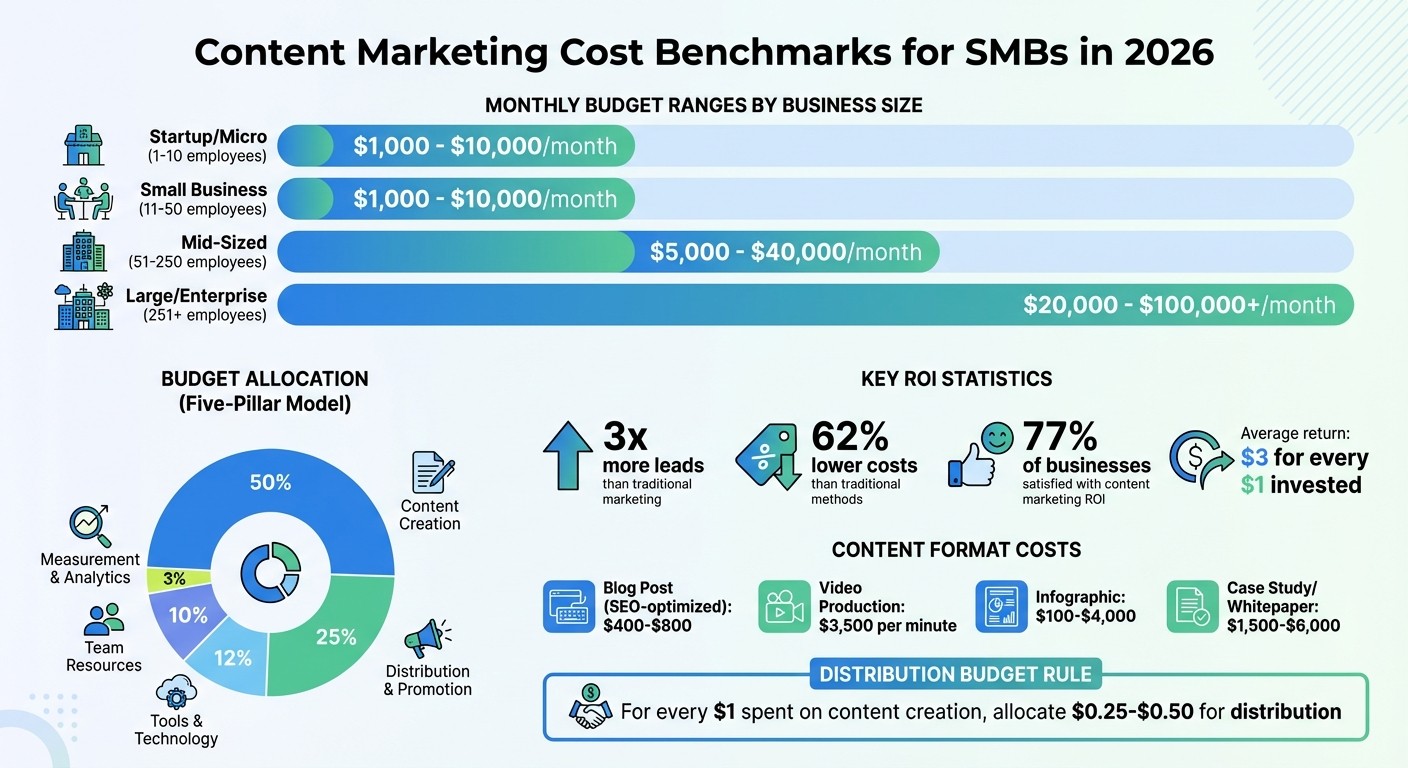
Content Marketing Budget Breakdown by Business Size 2026
How Much SMBs Spend on Content Marketing
Monthly and Annual Budget Ranges
The amount small and medium-sized businesses (SMBs) allocate to content marketing in 2026 depends largely on their size and stage of growth. For instance, 58% of businesses report spending between $5,001 and $10,000 monthly, while startups and micro-businesses typically operate within a range of $1,000 to $10,000 per month, or $12,000 to $120,000 annually [1]. However, the range widens as companies grow.
Small businesses with 11–50 employees often maintain similar budgets, focusing on essentials like blogging and local SEO. Mid-sized companies, with 51–250 employees, significantly increase their spending - allocating anywhere from $5,000 to $40,000 monthly, or $60,000 to $480,000 annually. This higher budget supports more advanced strategies, such as video production, multi-channel marketing, and lead generation as part of a comprehensive B2B marketing strategy [1][2][4].
Business Size | Employees | Monthly Budget Range | Annual Budget Range |
|---|---|---|---|
Startup / Micro | 1–10 | $1,000 – $10,000 | $12,000 – $120,000 |
Small Business | 11–50 | $1,000 – $10,000 | $12,000 – $120,000 |
Mid-Sized | 51–250 | $5,000 – $40,000 | $60,000 – $480,000 |
Large / Enterprise | 251+ | $20,000 – $100,000+ | $240,000 – $1.2M+ |
Revenue also plays a key role in determining budgets. For B2B companies earning between $1 million and $5 million annually, content budgets typically range from $2,500 to $10,000 per month, accounting for 25–30% of their total marketing spend. As revenue grows to $5 million to $10 million, this allocation often increases to 30–35%, translating to $10,000 to $20,000 monthly [4].
"Content marketing costs vary depending on the type and volume of content assets you create, as well as your choice to work in-house or with an agency."
Next, let’s explore the factors that influence these budget variations.
What Affects Your Content Marketing Costs
Several factors drive content marketing costs, with industry competition being the most significant. For example, technology and SaaS companies often dedicate 35–40% of their marketing budgets to content due to intense competition, while retail businesses allocate around 20–25%. Manufacturing companies, by contrast, tend to spend just 2–8% of their marketing budget on content [4][10].
The type and complexity of content also play a major role. A standard SEO blog post typically costs between $400 and $800, but producing just one minute of professional video can average around $3,500 [2]. Adopting video-first or interactive strategies can quickly drive up expenses.
Team structure further impacts costs. In-house teams require salaries, benefits, and software tools, creating fixed overhead expenses. Freelancers provide more flexibility, charging anywhere from $1,000 to $10,000 monthly, while agencies often cost between $5,000 and $10,000 per month [1].
Lastly, a company’s growth stage and goals shape its spending approach. Businesses in aggressive growth phases may allocate 40–50% of their marketing budget to content, while those aiming to maintain their position might spend closer to 25–35%. Companies launching new products or entering new markets often temporarily increase budgets to drive rapid awareness. These spending patterns align with broader economic trends, helping businesses focus their resources on strategies that deliver the best return on investment by tracking the right KPIs.
How 730+ SMB’s Spend Their Budgets : The Big Small Business Marketing Survey
Content Creation Costs by Format
Content creation costs can vary significantly depending on the format, making it essential to plan your budget wisely.
Written Content Costs (Blogs, Whitepapers, Case Studies)
The price of written content depends on the level of expertise and the strategic goals of the project. Budget-friendly writing services charge between $40–$100 per 1,000 words, but these often lack the technical accuracy and SEO fine-tuning needed for competitive visibility [2]. Freelancers, offering more flexibility, typically charge $100–$500 per piece, though managing them may require additional effort on your part [2].
For SEO-optimized content from agencies, expect to pay $400–$800 per post. Posts that include professional editing and strategic distribution can range from $800–$1,500 [2]. High-end content, such as executive-level case studies or whitepapers, can cost between $1,500–$6,000 per piece, with a 10–20% premium if subject matter experts are involved [2].
"When considering content marketing options and pricing, look for providers that have experience in your niche. You want content that's both valuable for readers and ranks well in search results."
Emily C., Content Delivery Lead, WebFX [1]
For small to medium-sized businesses (SMBs) operating on tighter budgets, monthly content packages priced between $2,000–$12,000 may offer better value. These often include bundled services like SEO implementation, social media promotion, and ongoing optimization [1]. Hourly rates for freelance professionals vary: writers typically charge $75/hour, strategists $100/hour, and editors $85/hour [3].
Next, let’s delve into the costs associated with video and multimedia content, where production demands can significantly influence pricing.
Video and Multimedia Content Costs
Creating video content can be a substantial investment. On average, video production costs about $3,500 per minute, making a two-minute explainer video approximately $7,000 [2]. Custom videos, which include scripting, casting, and shooting fresh footage, typically range from $6,000–$8,000 [2].
"The cost of video production can vary widely depending on the complexity of the shoot... videos that require fresh footage can cost significantly higher than those that can be accomplished with stock footage."
Daniel E. Lofaso, Founder and CEO, The Digital Elevator[2]
Infographics and data visualizations also vary in cost. Simple data graphics range from $100–$400, while more intricate, professionally designed infographics - featuring original research and custom illustrations - can cost $3,000–$4,000. Animated infographics, which add motion design elements, may go up to $7,000 [2]. For hourly rates, freelance video producers charge a median of $38/hour, while graphic designers average $24/hour [2].
The impact of video content is undeniable. Websites featuring video are 53 times more likely to rank on Google’s first page, and landing pages with video can see an 80% increase in conversion rates [1].
After video production, it’s worth considering the costs associated with improving existing content through SEO strategies.
SEO and Content Enhancement Costs
Optimizing existing content can often yield quicker returns on investment. Freelancers specializing in SEO charge around $80/hour for keyword research and on-page improvements, while content audits cost about $95/hour [3]. Refreshing older content - updating it with new data, better structure, and refined keywords - typically costs $55/hour, with total project costs ranging from $501–$1,000 for 1–15 pages [1].
A comprehensive content audit to identify optimization opportunities is priced between $100–$700 [1]. Link-building services, which enhance search rankings and domain authority, can cost anywhere from $500 to $15,000 per month [2]. These efforts increase the overall effectiveness of your content and improve your marketing ROI.
Interestingly, 65% of companies report better SEO outcomes with AI tools, and 68% see improved ROI in content marketing through AI integration [12]. Many agencies now include proprietary AI-powered tools for keyword research and optimization in their service packages, eliminating the need for separate software subscriptions [1]. For SMBs managing SEO internally, hiring freelancers at $80/hour for keyword research and optimization can be a cost-effective alternative to agency retainers [3].
Content Distribution and Promotion Costs
Creating content is only part of the equation - getting it in front of the right audience requires a dedicated budget for distribution. Small and medium-sized businesses (SMBs) are advised to allocate 20–25% of their total content marketing budget specifically for this purpose[4]. For every dollar spent on content creation, an additional $0.25–$0.50 is typically needed to ensure effective distribution[4].
"Distribution budget is not an optional add-on - it's the multiplier that transforms content investment into business results."
The importance of paid promotion can't be overstated. With organic reach dwindling to just 5.2% on Facebook and 2–5% on LinkedIn[4], even the most compelling content won’t succeed without a solid distribution strategy. This shift has led 84% of B2B marketers to rely on paid channels to amplify their efforts[8].
Paid Ads and Social Media Promotion
When it comes to social media ads, costs vary by platform, and the choice should align with your audience's preferences. LinkedIn stands out for B2B marketers, with 85% of professionals acknowledging its effectiveness[8]. Ads on LinkedIn typically cost $5–$12 per click, with CPMs ranging from $30–$80[4]. For SMBs targeting decision-makers, a monthly budget of $1,000–$3,000 is common[4].
For broader reach at lower costs, Facebook and Instagram are reliable options. Their CPCs range from $0.50–$3.00, and CPMs fall between $5–$15[4]. These platforms are ideal for brand awareness campaigns, with suggested monthly budgets of $500–$2,000[4]. Twitter (now X) offers mid-range costs, with $0.50–$2.00 per engagement and CPMs of $6–$20. Typical budgets for this platform range from $300–$1,000 monthly[4]. Meanwhile, YouTube video ads are the most cost-effective for views, at $0.10–$0.30 per view, requiring monthly budgets of $500–$2,000[4].
If managing social media feels overwhelming, agencies typically charge $1,000–$3,000 per month to handle 3–25 posts[1]. Freelance social media managers, on the other hand, charge $20–$50 per hour. Content syndication networks like Outbrain or Taboola offer another route, driving traffic at $0.30–$1.00 per click, with monthly spends ranging from $1,000–$3,000[4].
Email Marketing and Content Syndication
Email marketing continues to be one of the most cost-effective channels, delivering an average return of $42 for every $1 spent[4]. However, costs vary based on the size of your subscriber list. Platforms charge anywhere from free or under $50 per month for lists under 2,000 subscribers to $600–$2,000+ monthly for lists exceeding 50,000[4].
"Many marketers have a hard time calculating the ROI of their content initiatives because they don't count both the creation and the distribution of their content. Most look only at the distribution costs alone."
Amy Higgins, Director of Content Strategy, Cloudflare[8]
Segmented email campaigns yield far better results than generic blasts, with 30% higher open rates and 50% more clickthroughs[5]. For SMBs managing email campaigns internally, freelance specialists charge between $10 and $120 per hour[3]. Additionally, list cleaning services cost $0.01–$0.03 per contact[4].
LinkedIn Thought Leader Ads are a premium syndication option for B2B marketers, requiring $2,000–$5,000 monthly budgets and delivering cost-per-lead rates of $40–$150[4]. For media pitching and earned placements, fractional PR support costs $2,000–$5,000 monthly[4], while freelance PR specialists charge $15–$150 per hour, with an average rate of $80 per hour[3].
Influencer Marketing and Partnership Costs
Influencer collaborations and partnerships can be a powerful way to amplify content, typically consuming 10–20% of an SMB's distribution budget[4]. Micro-influencers - those with 10,000 to 100,000 followers - offer strong engagement rates of 3% to 8% at affordable rates of $200–$1,000 per collaboration[4]. These smaller influencers often provide a more authentic connection with their audiences compared to larger accounts.
Collaborations with industry experts for guest content or co-created projects typically cost $500–$2,000 per deliverable[4]. These partnerships not only enhance credibility but also provide access to established audiences. Co-marketing initiatives, such as newsletter swaps, webinar co-hosting, and joint content creation, cost $300–$1,000 monthly[4], allowing businesses to share production costs while reaching broader audiences.
Guest posting and media outreach programs vary widely in cost, starting at $200–$400 monthly for basic services and climbing to $500–$15,000 for comprehensive link-building and media relationship efforts[2][4]. Freelance link builders charge $10–$220 per hour, with an average rate of $115 per hour[3]. Sponsorships are another effective paid distribution channel, with 65% of B2B marketers using them and 49% reporting positive results from this approach[7].
Strategic investments in distribution not only expand your reach but also ensure you maximize the return on your content marketing efforts.
Content Marketing Tools and Automation Costs
Software and automation platforms typically account for 10% to 15% of your overall content marketing budget [4]. For a small-to-medium business (SMB) spending $5,000 per month on content, this translates to around $500–$750 dedicated to technology. While it may feel like an added expense, the right tools can significantly cut down the hours spent on each asset, boosting both efficiency and focus on strategy.
Interestingly, 38% of marketers admit they don’t fully utilize their existing technology [8]. Before subscribing to new tools, it’s worth auditing your current stack to eliminate redundant features and trim unnecessary costs.
"Use AI to automate the boring stuff that gets in the way of creativity. Don't offload your creativity to AI."
Ann Handley, Chief Content Officer, MarketingProfs[8]
While 95% of B2B marketers use AI-powered tools, only 32% pay for them [11]. Many rely on free versions, which often lack advanced features like brand voice customization, team collaboration, or direct publishing to content management systems (CMS). Investing in these premium features can be worthwhile, particularly for teams looking to streamline their workflow and enhance content quality.
AI Content Tools and Writing Assistants
AI tools are widely employed for tasks like written content generation (89% of users), creative asset editing (53%), and SEO analysis (41%) [11]. These tools have delivered notable productivity gains, with 87% of marketers reporting improved efficiency and 80% citing smoother workflows. However, only 58% see a boost in content quality, and 12% have noticed a decline [11]. While AI accelerates output, human oversight remains essential for refining tone, accuracy, and style.
Averi is one such AI-powered platform, offering an all-in-one solution for strategy, research, drafting, optimization, publishing, and analytics. By analyzing your website, Averi captures your brand's essence and builds a content strategy. It continuously identifies high-potential topics, drafts content with hyperlinked sources to ensure accuracy, and optimizes pieces for SEO and AI search engines. Once a draft is ready, you can fine-tune it collaboratively before publishing directly to platforms like WordPress or Webflow. Averi’s Plus Plan costs $100 per month, with a self-serve onboarding process - no sales calls required.
Other popular tools, such as Jasper and Copy.ai, focus on AI-assisted drafting but lack Averi’s integrated workflow. These platforms, typically priced between $100 and $300 per month, are excellent for generating blog introductions, social media captions, and ad copy but require separate tools for strategy, research, and publishing. Similarly, content optimization tools like MarketMuse and Writer fall within the same price range and specialize in SEO grading, brief creation, and competitive analysis.
It’s important to remember that every AI-generated draft still requires human input for fact-checking and voice refinement - costs that should be factored into your overall tool budget.
Project Management and Workflow Tools
Coordinating content production across teams of writers, editors, designers, and stakeholders often calls for robust project management platforms. These tools typically range from $100 to $200 per month [4]. While many offer free or entry-level plans, don’t overlook the hidden costs of setup and training, which can add 10 to 20 hours to your schedule.
Analytics and Performance Tracking Tools
Tracking performance is crucial to proving ROI and optimizing your content efforts. However, 84% of B2B marketers struggle with integrating and correlating data across platforms [7]. Many SMBs begin with Google Analytics to monitor traffic, user behavior, and conversion paths. For more advanced SEO capabilities, tools like SEMrush and Ahrefs are industry leaders, offering keyword research, site audits, rank tracking, and competitor analysis. Subscriptions typically cost $200 to $400 per month [4].
For those seeking affordable solutions, marketing automation platforms like HubSpot and ActiveCampaign combine analytics with tools for lead tracking and email engagement. HubSpot’s free CRM tracks blog post conversions, while its paid tiers (starting at $45 per month) add features such as attribution reporting and ROI dashboards. ActiveCampaign, priced between $15 and $29 per month, is known for its detailed email performance tracking.
When choosing tools, focus on the specific questions you need answered - whether it’s identifying which blog posts generate leads or pinpointing high-value keywords. As your content budget increases, scaling your tool investments becomes essential. For a monthly content spend of $2,000–$5,000, allocate $200–$750 to tools. For budgets of $5,000–$15,000, consider spending $500–$2,250. For enterprises with budgets over $25,000, investing $2,500 or more can support advanced analytics, AI tools, and full-stack automation [4].
"AI is like giving every marketer a turbo-charged typewriter. Hooray! We can all crank out words faster. But the bigger prize is what we do with the time saved: the slower, deeper work of thinking."
Ann Handley, Chief Content Officer, MarketingProfs [11]
Agency vs. In-House vs. Hybrid: Cost Comparison
Deciding between agency, in-house, or hybrid content marketing models is a key step in aligning your budget with your goals. Each option comes with its own cost structure and trade-offs, making it essential to understand how these models impact both expenses and results. Here's a closer look at how businesses allocate their resources and the financial implications of each approach.
Currently, 39% of businesses rely on in-house teams, 34% partner with agencies, and 26% work with freelancers, reflecting the growing popularity of hybrid models that combine in-house management with outsourced expertise [1]. Small and medium-sized businesses (SMBs) often favor the hybrid model, where an internal strategist manages the overall plan while delegating specialized tasks - such as SEO, video production, or web design - to external experts. This approach offers a balance between maintaining brand control and accessing niche skills, all without the cost of building a large, full-time team.
Cost Breakdown by Model
The expenses for each model extend beyond salaries. In-house teams come with added costs like benefits, taxes, training, and software. Agencies typically include these in their retainer fees, while hybrid models demand careful coordination and separate investments in tools.
Expense Category | In-House (2-3 FTEs) | Agency (Full Service) | Hybrid (1 FTE + Freelancers) |
|---|---|---|---|
Direct Fees/Salaries | $120,000 - $180,000 | $60,000 - $120,000 | $80,000 - $110,000 |
Benefits & Taxes (~25%) | $30,000 - $45,000 | $0 | $15,000 - $20,000 |
Tools & Software | $5,000 - $10,000 | Bundled with retainer | $3,000 - $7,000 |
Training & Overhead | $2,000 - $5,000 | $0 | $1,000 - $2,000 |
Total Est. Annual Cost | $157,000 - $240,000 | $60,000 - $120,000 | $99,000 - $139,000 |
For agencies, most businesses spend between $5,001 and $10,000 per month on services, with high-competition campaigns reaching $30,000 to $60,000 monthly [1][14]. Freelancer costs, on the other hand, vary based on workload and project scope. In-house strategies often come with higher recurring expenses, particularly when scaling requires additional hires [13].
"For most SMBs, it's not worth the price to create content in-house. If you want to create more content, you'll need to hire more writers - a steep investment."
Emily C., Content Delivery Lead, WebFX [1]
Pros and Cons of Each Model
Beyond costs, each model offers distinct advantages and challenges. In-house teams bring a deep understanding of the brand but struggle with scalability and higher fixed costs. Agencies provide a comprehensive team of experts but can be less flexible for tasks outside their scope. Hybrid models strike a balance but require strong coordination to manage multiple contributors effectively.
Model | Pros | Cons |
|---|---|---|
In-House | Deep brand knowledge; dedicated focus; immediate access to experts | High overhead (benefits/taxes); expensive to scale; limited skill range |
Agency | Access to a team of specialists; includes tools; scalable; strategic focus | Higher monthly cost; less flexibility for tasks outside the agreed scope |
Hybrid | Cost-efficient; flexible; combines brand control with expertise | Requires active management; risk of inconsistent quality |
54% of in-house teams consist of just two to five people, limiting the range of available skills [8]. Agencies, on the other hand, offer access to a team that covers multiple specialties - SEO, design, strategy, and video - under a flat fee, avoiding the costs of hiring multiple full-time employees [14][1]. However, 54% of in-house teams cite "lack of resources" as their primary challenge, which often leads to irregular publishing schedules [8].
"Many marketers have a hard time calculating the ROI of their content initiatives because they don't count both the creation and the distribution of their content. It takes time to create content - whether the hours you pay an agency or your in-house team, their time costs money."
Amy Higgins, Director of Content Strategy, Cloudflare [8]
Measuring ROI: How to Justify Content Marketing Costs
Calculating ROI is straightforward: [(Revenue – Investment) / Investment] x 100 [15][17][19]. The tricky part is accounting for all costs involved. Your investment should include everything - personnel time, software tools, and distribution expenses like paid promotions or syndication fees [17][19].
Key Metrics for Calculating ROI
To assess ROI effectively, start with revenue metrics. These include direct sales, leads generated from gated content, and revenue from newsletters [17]. Efficiency metrics, like Customer Acquisition Cost (CAC), are crucial; content marketing can reduce CAC by up to 55% compared to paid channels. Cost-per-lead is another valuable indicator [19]. For mid-funnel performance, track conversion rates - the percentage of visitors completing actions like form submissions or email sign-ups [15][17]. Engagement metrics, such as time spent on a page or click-through rates, reveal how well your content connects with your audience [15][17].
For a long-term perspective, monitor Net Revenue Retention (NRR) and Customer Lifetime Value (CLTV) [15][16]. A strong ROI ratio is often defined as 5:1 - $5 in revenue for every $1 spent [16]. Content marketing typically delivers $3 for every $1 invested, a significant improvement over paid advertising’s $1.80 return [19]. SEO-driven strategies can yield even higher returns; B2B companies report an impressive 748% ROI from SEO efforts [19].
Attribution models are evolving, offering deeper insights. While last-click models often miss the broader impact, multi-touch attribution shows that content can influence twice as many conversions as traditional analytics suggest [19]. Video content, in particular, is proving to be a game-changer, delivering ROI 49% faster than text-based formats - an essential consideration for small businesses seeking quicker results [19]. Additionally, AI tools are becoming indispensable, with 80% of marketers using them and 88% reporting improved efficiency that directly enhances ROI by cutting production costs [19].
Industry | 3-Year Average New Revenue | 3-Year Average ROI | Landing Page Conversion Rate |
|---|---|---|---|
Real Estate | $2.3 Million | 1,486% | 2.8% |
Medical Device | $2.2 Million | 1,344% | 3.1% |
Energy / Oil & Gas | $2.0 Million | 1,233% | 3.1% |
Financial Services | $1.8 Million | 1,078% | 1.9% |
Manufacturing | $1.6 Million | 967% | 1.1% |
Biotech | $1.1 Million | 844% | 1.3% |
Source: First Page Sage [18]
These metrics provide a solid framework for evaluating the timeline and overall impact of your content investments.
When Content Marketing Pays Off
Most small to mid-sized businesses (SMBs) begin to see ROI from content marketing within 3 to 6 months, while SEO-focused efforts may take 6 to 9 months to show results [19]. Companies that blog consistently outperform those that publish sporadically, achieving 13 times better ROI [19]. The secret lies in creating evergreen content - timeless pieces that continue to attract traffic with minimal updates over the years [17].
"Content marketing is a long-term investment, and with regular refreshes, it can continue driving value for your business for years."
Emily C., Content Delivery Lead, WebFX [1]
Organizations with documented strategies see better results, with 29% reporting high effectiveness. This highlights the importance of setting clear goals and ROI targets [19]. When calculating your investment, don’t overlook hidden costs like distribution and personnel time [17][19]. Overall, 77% of businesses report being satisfied with their content marketing ROI [1]. Furthermore, content marketing costs about 62% less than traditional marketing while generating three times as many leads [19].
How to Plan Your Content Marketing Budget
Your content marketing budget should align with both your current business stage and your growth objectives. A general guideline is to dedicate 20–30% of your overall marketing budget to content creation and promotion [6]. Keep in mind that these allocations often shift as your business evolves.
Budget Allocation by Business Stage
The stage of your business plays a major role in determining how much of your marketing budget goes toward content and how those funds are used.
Startups and small businesses (1–50 employees): Typically allocate 15–25% of their marketing budget [4][9]. The focus here is on building organic visibility through blogging, social media, and email campaigns. Monthly budgets generally range from $1,000 to $5,000 [1].
Growth-stage companies (51–250 employees): These businesses usually set aside 25–35% of their marketing budget for content [4][9]. With scaling efforts in mind, they invest in tools like advanced SEO platforms, analytics software, and larger production capabilities. Monthly budgets often fall between $5,000 and $10,000 [1]. Content strategies expand to include video, podcasts, and more sophisticated distribution methods.
Established SMBs and larger companies (251+ employees): These organizations dedicate 30–45% of their marketing budget to content [4][9]. The focus shifts to producing high-quality assets like documentary-style videos, data-driven research reports, and thought leadership campaigns. Monthly budgets frequently exceed $10,000 [1]. For SaaS and tech companies, this allocation often lands between 35–40% [4].
A practical way to divide your content marketing budget is by following the "Five-Pillar Model", which suggests:
50% for content creation (e.g., blogs, videos, whitepapers)
25% for distribution and promotion (e.g., paid ads, social media amplification)
12% for tools and technology (e.g., CMS, SEO tools, AI platforms)
10% for team resources (e.g., project management, coordination)
3% for measurement and analytics (e.g., tracking performance, ROI analysis) [4]
"For small businesses, the 2025 content marketing budget is about maximizing impact with limited resources. These companies focus on micro-influencer collaborations and creating authentic content that drives engagement without breaking the bank."
Jennifer Collins, Marketing Manager [9]
With these tailored allocations, you can ensure your investments are directed toward strategies that deliver the best returns.
Where to Spend for Maximum Impact
As we move into 2026, the focus should shift from producing large volumes of content to prioritizing smarter, ROI-driven strategies [9]. Small and mid-sized businesses (SMBs) are increasingly allocating more of their budgets toward paid distribution, such as LinkedIn ads, Google Discover placements, and sponsorships in industry newsletters, to ensure their high-value content reaches the right audience.
Startups: Concentrate on organic growth with foundational content strategies and cost-effective AI tools. Use AI to draft initial content, refining it with human editors for tone and accuracy. Efforts should center around blogging, social media, and email marketing [9].
Growth-stage companies: Expand content production and adopt high-engagement formats. Video content is a priority, as 69% of B2B marketers plan to increase video investments, with 92% reporting positive ROI [7][5]. Short-form videos (e.g., TikTok, Reels, Shorts) and high-quality webinars are especially effective. Leverage AI for efficiency and analytics tools to track performance [9].
Established SMBs: Focus on creating marquee content assets that establish thought leadership. These include original research, data-rich reports, and documentary-style videos. For 2026, aim to tie content directly to revenue with bottom-of-the-funnel assets like case studies, ROI calculators, and comparison guides [9].
For every dollar spent on content creation, allocate $0.25–$0.50 to distribution [4]. This balance between creation and promotion can lead to up to a 3x increase in lead generation [9]. Additionally, maintain 15–20% of your budget as flexible funds to reallocate toward top-performing content types mid-quarter [4].
Business Stage | % of Marketing Budget | Monthly Budget Range | Primary Focus |
|---|---|---|---|
Startup / Small (1–50 employees) | 15–25% | $1,000 – $5,000 | Foundational organic growth (blogging, social, email) |
Growth / Mid-Sized (51–250 employees) | 25–35% | $5,000 – $10,000 | Scaling production, video, advanced SEO & analytics |
Established / Large (251+ employees) | 30–45% | $10,000+ | Marquee assets, thought leadership, high-production video |
Source: Matrix Content Team [4][9]
Key Takeaways
For most small to medium-sized businesses (SMBs), monthly content marketing budgets typically fall between $5,001 and $10,000. These funds are generally divided into three main areas: 45–55% for content creation, 20–25% for promotion, and 10–15% for tools and team resources [1][4].
This investment pays off in a big way. Content marketing can cost as much as 62% less than traditional marketing while delivering three times more leads [2]. In fact, 77% of businesses report being satisfied with their return on investment (ROI) from content marketing [1]. Among the most effective formats are case studies, customer stories, and videos, with 69% of B2B marketers planning to boost their video budgets by 2026 [7].
But it’s not just about spending - it’s about quality. Ann Handley, Chief Content Officer at MarketingProfs, emphasizes the importance of leveraging AI tools for marketing for efficiency:
"Use AI content creation tools to automate the boring stuff that gets in the way of creativity. Use it to free up time to be more strategic and creative" [8].
The key is to focus on creating content that stands out and delivers real value, steering clear of generic material.
For budget planning, keep 15–20% flexible for unexpected opportunities. Additionally, for every dollar spent on content creation, it’s wise to allocate $0.25 to $0.50 for promotion [4].
Finally, think of content as a long-term asset. By refreshing and optimizing your materials regularly, you can extend their value for years after they’re first published [1].
FAQs
What’s the best way for SMBs to allocate their content marketing budget between creation and promotion?
To make the most of your content marketing budget, consider a 60/40 split - dedicating 60% to content creation (like blogs, videos, and graphics) and 40% to promotion (such as paid ads, SEO, and email campaigns). For instance, with a $6,000 monthly budget, allocate about $3,600–$4,000 to producing high-quality content and $2,000–$2,400 to promoting it through targeted strategies.
If your budget is more limited, a 2:1 ratio for creation versus promotion is a good starting point. Focus on building a strong library of content first. Once that's established, you can shift more resources toward promotion to extend your reach and boost engagement.
To stretch your budget further, define clear objectives - whether it’s generating leads or driving traffic - and prioritize impactful formats like videos or in-depth guides. Tools like Averi AI can help cut production costs without sacrificing quality. Regularly assess your ROI and adjust your spending to focus on the channels that consistently deliver the best outcomes.
What are the advantages of using a hybrid content marketing approach for small and medium-sized businesses?
A blended approach to content marketing - leveraging AI-powered tools for efficiency alongside human expertise for strategy and creativity - can be a game-changer for small and medium-sized businesses (SMBs). Here’s why:
For starters, it can significantly lower costs compared to hiring a full-service agency or a team of freelancers. Many SMBs typically spend between $4,000 and $10,000 monthly on content marketing. By using AI to automate routine tasks, businesses can trim expenses while still meeting their content production goals. This means staying within budget without cutting corners on quality.
It also boosts efficiency and speeds up the time it takes to bring content to market. AI tools excel at tasks like drafting content, conducting keyword research, and scheduling posts. This frees up human editors to focus on more strategic aspects, such as refining the brand voice or ensuring accuracy. The result? Faster delivery of content without sacrificing its quality.
Lastly, this hybrid model increases ROI and offers more flexibility. AI handles repetitive, low-complexity tasks at a lower cost, which allows businesses to channel their resources into creating premium, high-impact content like detailed articles or engaging videos. These types of content tend to drive better engagement and higher conversions, making it easier for SMBs to stretch their budgets while achieving tangible results.
How do content marketing costs compare to traditional advertising for small and medium-sized businesses?
Content marketing offers a much more budget-friendly option for small and medium-sized businesses (SMBs) compared to traditional advertising. Research highlights its efficiency, showing that content marketing can generate three times more leads while costing around 62% less than traditional advertising methods like TV, radio, or print.
For SMBs, monthly content marketing expenses typically fall between $4,000 and $10,000 for smaller businesses and $10,000 to $40,000 for medium-sized ones. On the other hand, traditional advertising often demands significantly higher budgets. TV, radio, and print ads can cost hundreds to thousands of dollars per placement, while digital ad campaigns range from $250 to $20,000 per month.
By allocating resources to content marketing, SMBs can cut their costs by about two-thirds while enjoying a threefold boost in lead generation, making it a smart and scalable choice for businesses aiming to grow efficiently.
Related Blog Posts

Zach Chmael
CMO, Averi
"We built Averi around the exact workflow we've used to scale our web traffic over 6000% in the last 6 months."
Your content should be working harder.
Averi's content engine builds Google entity authority, drives AI citations, and scales your visibility so you can get more customers.