Content Marketing for Founders Who Don’t Have Time to Blog

Averi Academy
Averi Team
8 minutes

In This Article
Use AI to automate strategy, drafting, and repurposing so busy founders can produce consistent, high-quality content in 5–7 hours per week.
Updated:
Trusted by 1,000+ teams
Startups use Averi to build
content engines that rank.
Founders often struggle with content marketing because they’re consumed by other priorities like building products, raising funds, and managing teams. Writing consistent, high-quality content feels impossible when time is scarce. However, skipping content can mean losing out on growth opportunities, as 70% of companies using AI-driven marketing report revenue increases, averaging 10%.
The solution? Shift from traditional blogging to an automated content system. By dedicating just 5–7 hours per week, founders can use AI tools to streamline strategy, creation, and publishing. A single 30-minute voice memo can produce 10+ pieces of content, including blogs, social posts, and emails. This approach not only saves time but ensures consistent output and better results.
Key Takeaways:
Use AI for topic research, drafting, and content repurposing.
Focus on a "Head Chef" model: AI drafts 80%, and you refine the final 20%.
Automate publishing and track performance to improve over time.
Tools like Averi combine AI and human expertise for seamless workflows.
By implementing an automation-first system, founders can scale content without sacrificing quality or adding to their workload.
Creating an AI-Driven Content Marketing Workflow
Building an Automation-First Content Workflow
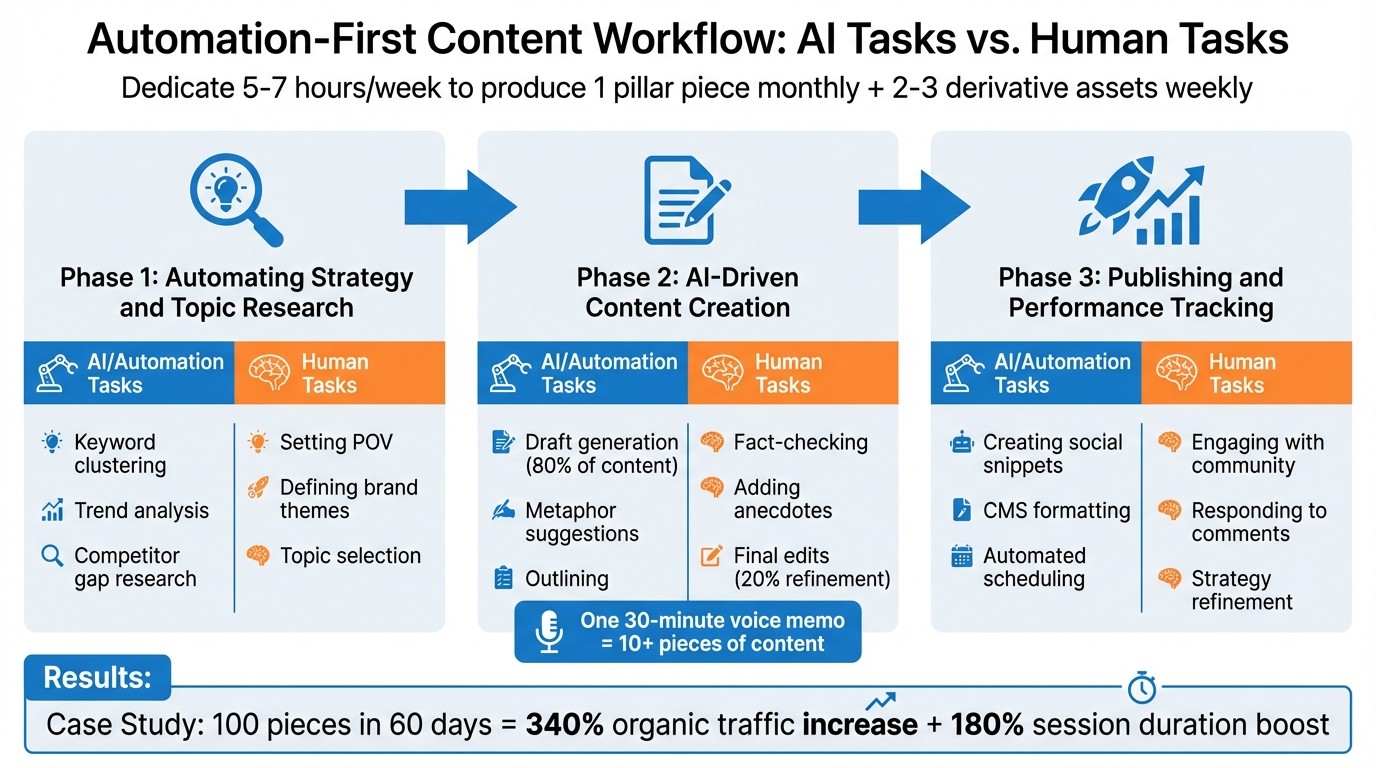
3-Phase Automation-First Content Workflow for Founders
Shifting to an automation-first content workflow changes your role from a content creator to an editor-in-chief. The idea is to dedicate 5–7 hours per week to a Minimum Viable Content Engine (MVCE). This system focuses on producing one major "pillar" piece each month, complemented by 2–3 smaller derivative assets weekly [3][6]. With this approach, a single 30-minute discussion can be transformed into over 10 pieces of content - think blog summaries, social media snippets, email campaigns, and more [3][6]. The process is divided into three key phases.
Phase 1: Automating Strategy and Topic Research
Start by using AI to establish your strategic foundation. Instead of manually sifting through keywords, let AI handle the heavy lifting. Tools like Ahrefs or Semrush can provide data exports, which AI can then cluster into topic groups, identify gaps, and pinpoint opportunities your competitors may have overlooked [2]. Once you’ve gathered ideas, test their originality and audience appeal by prompting AI with direct, critical questions [7]. Your responsibility here is to guide the strategy - define your brand’s core themes, take a bold perspective, and make the final call on which topics to pursue [4].
Phase 2: AI-Driven Content Creation
Here’s where the "Head Chef" model comes into play: AI handles the bulk of the work, producing 80% of the draft, while you refine the remaining 20%. Kyle Coleman from Copy.ai explains:
"AI takes me from zero to an 80% first draft. But the final 20%, the careful, thoughtful editing, that's still entirely human." [5]
One efficient approach is the voice-to-draft method. Record a brief 5-minute voice memo - essentially a brain dump - and let AI transcribe and structure it into a draft [5]. To ensure the output matches your style, train the AI by feeding it 5–10 examples of your best work and asking it to reverse-engineer your tone into reusable templates [5][7]. As Stewart Hillhouse, VP Content at Storyarb, notes:
"The hack behind the hack here is simple: find something you really like, ask AI to reverse-engineer it into a prompt, and use that as your starting point." [5]
A case study from May 2025 illustrates how Averi built a "Content Machine" in just 60 days. By combining AI-assisted keyword research, brand voice training, and first-draft generation with human reviews, they published over 100 pieces of content. The results? A 340% jump in organic traffic, a 180% increase in session duration, and newsletter growth to 3,400 subscribers with a 47% open rate [4].
Once the draft is complete, use the ABCD feedback loop to refine it. Ask AI to evaluate what’s Awesome, Boring, Confusing, or Didn't Believe [5]. This helps you identify weak spots before finalizing the piece. Your last step is to fact-check and add personal insights to ensure the content feels authentic and polished [2][5].
Phase 3: Publishing and Performance Tracking
Once content is approved, automate the publishing process. Platforms like WordPress or Webflow can handle direct uploads [4]. For social media, tools such as Buffer or Metricool can schedule posts, while automation platforms like Zapier or Make can generate social drafts whenever a new blog post goes live - all for a budget-friendly stack costing $0–$50 per month [6].
The key to maximizing content impact lies in treating each pillar piece as a modular asset. AI can break down sections of long-form content into bite-sized pieces for social media, email campaigns, or carousel posts. Finally, use performance data from tools like Google Search Console or social analytics to refine your strategy. This feedback loop highlights what resonates, identifies underperforming areas, and uncovers fresh content opportunities - creating a cycle of continuous improvement [4][7].
Workflow Phase | AI/Automation Task | Human Task |
|---|---|---|
Phase 1: Strategy | Keyword clustering, trend analysis, competitor gap research [2][4] | Setting POV, defining brand themes, topic selection [4] |
Phase 2: Creation | ||
Phase 3: Distribution | Engaging with the community, responding to comments [4] |
Choosing the Right Tools for Your Content System
When building a content system, selecting the right tools is a critical step that can directly influence how efficiently your system operates.
Workspaces, Point Tools, and Marketplaces: Understanding the Options
When it comes to structuring your content system, you’re essentially choosing between three distinct approaches. Let’s break them down:
Point tools like Jasper or ChatGPT are AI-driven generators designed to create drafts quickly. They’re affordable - allowing you to assemble a stack with tools like ChatGPT, Canva, and Buffer for as little as $0–$50 per month [6]. However, they require constant input from you for prompts and edits, and they don’t retain your brand’s unique context over time.
Marketplaces such as Upwork or Fiverr connect you with freelancers who bring human creativity and judgment to the table. While this can lead to high-quality results, it also means you’ll need to manage the entire process - vetting freelancers, briefing them on your brand, reviewing their work, and handling revisions. Quality can vary significantly, and scaling up introduces more complexity and coordination.
Workspaces like Averi combine the speed of AI with the expertise of human professionals, all within a single platform. Instead of juggling between tools like ChatGPT, Google Docs, and email threads, everything happens in one system. The AI learns and retains your brand’s context, ensuring consistency. When human expertise is required, vetted specialists step in, fully informed about your brand, eliminating the need for repetitive briefings.
Here’s a quick comparison to highlight the differences:
Comparison Table: Key Features and Trade-Offs
Feature | Point Tools (Jasper, ChatGPT) | Marketplaces (Upwork, Fiverr) | Workspaces (Averi) |
|---|---|---|---|
Setup Time | Fast (minutes) | Slow (hiring/vetting needed) | Moderate (brand training) |
Founder Effort | High (prompting & editing) | High (managing freelancers) | Low (automated workflows) |
Brand Consistency | Low (requires re-prompting) | Variable (freelancer-dependent) | High (persistent memory) |
Scalability | High volume, variable quality | Limited by human hours/budget | High (AI + human expertise) |
Strategic Context | None (isolated generation) | Human-dependent | Integrated (strategy-driven) |
This breakdown makes it clear why Averi stands out for founders who value both speed and consistent quality.
Why Averi Aligns with Founders’ Needs
For busy founders who can’t afford the inefficiencies of switching between tools and managing multiple workflows, Averi simplifies the process. Its Brand Core acts as a centralized hub, storing your brand’s voice, mission, and target audience details. This ensures that every piece of content aligns with your style and goals. The /create mode streamlines content creation through three phases - Discuss, Draft, Edit - so you can go from idea to deployment without ever leaving the platform.
When specialized input is required, Averi’s Human Cortex brings in vetted experts who refine drafts in real time, armed with your brand’s complete strategic context.
The results speak for themselves. Between March and May 2025, Averi’s team produced over 100 pieces in just 60 days. This effort led to a 340% surge in organic traffic, a 220% increase in newsletter subscribers (adding 3,400 new readers), and a 190% boost in demo requests [4]. What’s more, the system builds on itself - every project, interaction, and saved draft contributes to smarter, more efficient future outputs.
Getting Started: Launching Your Content System in 30 Days
Instead of spending endless time perfecting workflows, aim to launch your content system within 30 days. This focused sprint takes your automated strategies and tools from planning to actual results.
Week 1: Laying the Groundwork
Start by identifying 3–5 unique brand pillars. These should reflect specific and bold perspectives, not generic values like "innovation" or "customer focus." For instance, Averi’s pillars include "AI + Human" and "Execution Over Ideas" [4]. These pillars serve as a compass for your content, ensuring it aligns with your brand's voice and message.
Next, gather 5–10 pieces of writing that showcase your tone - these could be customer emails, high-performing LinkedIn posts, or even internal Slack messages. Spend about 45–60 minutes compiling these examples. They’ll help train your AI to replicate your style, creating a reusable prompt template for the coming weeks.
Set up a simple content calendar using tools like Notion, Trello, or Averi’s Library. Keep it straightforward with columns for Ideas, In Progress, and Published. Populate it with 5–10 recurring customer questions or challenges - these will form the foundation of your first content pieces. This preparation ensures your system is ready to make the most of AI’s capabilities.
Week 2: Producing and Polishing Content
Kick off the week by recording a 20–30 minute voice memo answering one of the customer questions you’ve identified. Speak casually, explaining the problem, its solution, and why it matters. Use tools like Otter.ai or Descript to transcribe your recording, then feed the transcript into your AI tool to create a 4–6 point outline [3].
By Tuesday, use the AI-generated outline to draft your content. The AI will handle the structure and give you an 80% complete draft [5]. Your role is to refine the remaining 20% - add specific examples, tweak the tone, and verify accuracy. As Kyle Coleman, CMO of Copy.ai, puts it, this process reduces "20 or 30 minutes of grinding at the keyboard" to "three to five minutes of quick editing" [5].
On Wednesday, finalize your content. Add clear headings, internal links to related resources, and at least one visual element like a screenshot. Run the content through the ABCD Framework to ensure it’s polished before scheduling it for publication.
Week 3–4: Publishing and Expanding
By the end of Week 2, publish your first piece. In Week 3, repurpose this content into 2–3 additional formats, such as a LinkedIn post summarizing key insights, an email snippet for your newsletter, or a Twitter thread highlighting the main points [6]. Schedule these derivatives to roll out over the next week.
Set aside 45–60 minutes on Thursday to batch-create these social and email derivatives [6]. This approach minimizes distractions and keeps you in a creative flow. By Week 4, aim to have published 2–3 main content pieces and 6–9 derivative posts, all within a manageable 5–7 hours per week [6].
Connect your content system to your CMS and social tools using automation platforms like Zapier or Make. For example, you can create a workflow that automatically generates three social media drafts with UTM tags whenever a blog post is published [6]. This eliminates manual tasks and ensures consistent distribution. Track basic metrics like page views, time on page, and conversions in a simple spreadsheet. The goal isn’t perfection but building a habit and proving your system works.
Day | Time Box | Task |
|---|---|---|
Mon | 45–60 min | Record insights and outline pillar |
Tue | 60–90 min | Draft pillar with AI and revise tone |
Wed | 30–45 min | Edit, format, and add visuals/links |
Thu | 45–60 min | Create 2–3 derivatives (social/email) |
Fri | 20–40 min | Schedule and publish |
Maintaining Quality and Avoiding Common Pitfalls
Even with a well-oiled content system, uninspired output can creep in without thoughtful human oversight. Back in early 2025, Averi's content team struck the perfect balance, publishing over 100 pieces in just 60 days while maintaining a 47% average email open rate and achieving a staggering 340% boost in organic traffic [4]. Their secret? Not more AI, but smart human intervention at key moments.
Ensuring Consistent Brand Voice
One effective approach to maintaining a consistent tone is the "Head Chef" model. Here, AI handles the initial drafting, while a human editor ensures every piece aligns seamlessly with your brand's identity. To make this work, establish clear guidelines for your AI by focusing on three key elements:
Structure: Define format and paragraph length.
Style: Specify brand voice descriptors, like “conversational but not casual.”
Context: Provide proprietary company information and product details.
Embedding these brand guidelines directly into your AI workspace ensures every piece stays on-brand, even as you scale production [5]. This framework acts as a safety net, preventing your content from veering off course.
Avoiding Over-Automation
While automation can be a game-changer, over-relying on it can strip your content of its human touch. A common mistake is applying AI to traditional editorial workflows instead of designing a system tailored to AI’s capabilities [2]. Letting the tool dictate your entire strategy or produce complete pieces without human input is a recipe for robotic, disengaging content. To avoid this, explicitly prohibit AI from fabricating quotes, testimonials, data, or any regulated advice.
To keep originality alive, schedule regular "analog-only" writing sessions where human creativity takes center stage. Use AI to draft the first 80% of a piece, but reserve the final 20% for thoughtful human editing. This step allows you to infuse authenticity and fresh insights into your content [5].
Using Performance Data for Continuous Improvement
Beyond ensuring quality through human oversight, it’s crucial to measure performance to gauge success. Focus on metrics that reflect engagement depth rather than surface-level vanity stats. For example, track meaningful interactions like saves, shares, and comments to see if your content resonates. Use tools like Search Console to monitor Click-Through Rates (CTR) and confirm that AI-generated titles align with user intent. Consistent UTM tagging for all links can help pinpoint which automated assets are driving conversions [6][3].
Metric Category | Key Performance Indicators | Purpose |
|---|---|---|
Engagement | Social Saves/Shares, Session Duration, Email CTR | |
Search Performance | CTR, Impressions, Ranking Position | Validates if AI titles and meta descriptions match user intent [6][3] |
Conversion | Demo Requests, Newsletter Signups, Assisted Conversions |
To refine your content further, apply the ABCD Framework when reviewing AI drafts. Identify what is Awesome (keep), Boring (cut), Confusing (clarify), and Didn't Believe (add evidence) [5]. This structured review process ensures every piece meets your standards before publication.
Conclusion: Scaling Content Marketing Without Scaling Effort
The traditional approach to blogging - manually crafting each post, coordinating freelancers, and juggling multiple tools - can slow growth to a crawl. But with automation-first systems, this bottleneck disappears. Companies leveraging AI for marketing have seen a 15–20% boost in ROI, and 73% of marketers are already using AI tools to get more done with fewer resources [1]. This shift calls for a smarter, more automated way to approach content creation.
Moving from reactive, ad-hoc processes to systematic workflows allows founders to maintain consistent content output without being bogged down by full-time management. As Christina Inge wisely points out:
"Your job will not be taken by AI. It will be taken by a person who knows how to use AI. So, it is very important for marketers to know how to use AI." [1]
The secret lies in building a system where AI takes care of the heavy lifting - handling tasks like research, drafting, and formatting - so you can focus on strategic decisions and final edits.
Averi's workspace model is one example of how this can work seamlessly. It integrates strategy, drafting, and execution into a streamlined process: Plan → Create → Execute → Scale. By training the AI on your brand's voice and positioning through Brand Core, using /create mode to turn briefs into ready-to-deploy content, and storing every project in the Library for smarter future work, you create a self-sustaining content engine. When human expertise is needed, vetted specialists can step in with full context - no time wasted on back-and-forth re-briefings.
Start small with one automation goal. Think of it like the head chef model: let AI handle 80% of the work, while you refine the final 20% using your unique data, such as sales call transcripts or internal insights. This ensures your content stands out while being efficient [5].
The outcome isn’t just faster content creation - it’s a system that grows stronger with time. Every piece you publish helps the AI better understand your brand, making future projects even easier. Over time, your content becomes part of an automated infrastructure that drives growth while freeing you to focus on building your business.
FAQs
How can busy founders use AI to simplify and scale content marketing?
Founders can tap into AI as a game-changer for content creation by treating it as a reliable system rather than a one-time fix. Start by defining your main objective - whether it’s increasing demo requests, boosting newsletter sign-ups, or another key metric. Then, commit to a realistic schedule, like producing one high-quality piece of content each week. This central "pillar" content can later be repurposed into smaller, bite-sized assets such as social media posts, videos, or graphics, helping you extend its reach and impact.
Select an AI platform that blends advanced language capabilities with human oversight to ensure quality and consistency. These tools can assist with drafting content, crafting headlines, and creating SEO-friendly copy - all while preserving your brand’s unique voice. To get the most out of AI, provide clear prompts and detailed style guides to shape its output, and focus on batch production to save time. Set aside a dedicated block each week to create and review content, and streamline distribution by integrating AI with your CMS, CRM, or other platforms. By following this approach, founders can maintain a steady flow of content while investing just a few focused hours each week.
What are the main advantages of using an automation-first content workflow?
An automation-first content workflow blends AI into essential stages like research, drafting, editing, and publishing. However, it leaves critical aspects - like strategy, brand voice, and final approvals - firmly in human hands. This setup takes care of repetitive tasks such as creating outlines, refining copy, and refreshing evergreen content, cutting down the time it takes to go from concept to publication.
The standout advantage here is the ability to scale content production without compromising quality. By using tools like style guides, fact-checking systems, and structured review processes, this workflow ensures the output remains polished and consistent, steering clear of the pitfalls often associated with generic AI-generated material. It also reduces the risk of human mistakes, trims costs, and builds efficient systems that can be replicated across teams. The result? A streamlined content schedule that evolves into a dependable engine for growth.
What makes Averi different from tools like Jasper or platforms like Upwork?
Averi is an AI-human workspace designed to simplify the content creation process by blending cutting-edge AI tools with the expertise of seasoned marketing professionals. It covers everything from aligning with your brand's voice to managing multi-step approvals and integrating seamlessly with platforms like CMS, ad tools, and CRMs. This unified workflow enables founders to create and publish content efficiently, eliminating the hassle of coordinating with freelancers or manually refining AI-generated outputs.
Jasper, in contrast, functions as a standalone AI writing tool. While it excels at generating text quickly, users are responsible for crafting prompts, editing content, and managing distribution outside the platform. It doesn’t offer human expertise or integrated workflows, leaving more of the process in the hands of the user.
Upwork operates as a freelance marketplace, connecting businesses with a vast pool of talent for individual projects. While it provides flexibility and often competitive pricing, it lacks AI-driven tools, automated workflows, and consistency in maintaining a unified brand voice. The quality of results largely depends on the freelancer you choose.
To sum it up, Averi merges the speed of AI with human expertise in a managed system, Jasper focuses solely on generating AI-based content, and Upwork offers access to freelancers without integrated tools or automated workflows.
Related Blog Posts

Zach Chmael
CMO, Averi
"We built Averi around the exact workflow we've used to scale our web traffic over 6000% in the last 6 months."
Your content should be working harder.
Averi's content engine builds Google entity authority, drives AI citations, and scales your visibility so you can get more customers.