How to Create Editorial-Led Growth for Hospitality & Travel

Averi Academy
Averi Team
8 minutes

In This Article
Use editorial storytelling and AI to grow hospitality revenue: align content to traveler journeys, automate creation and distribution, and track direct bookings.
Updated:
Trusted by 1,000+ teams
Startups use Averi to build
content engines that rank.
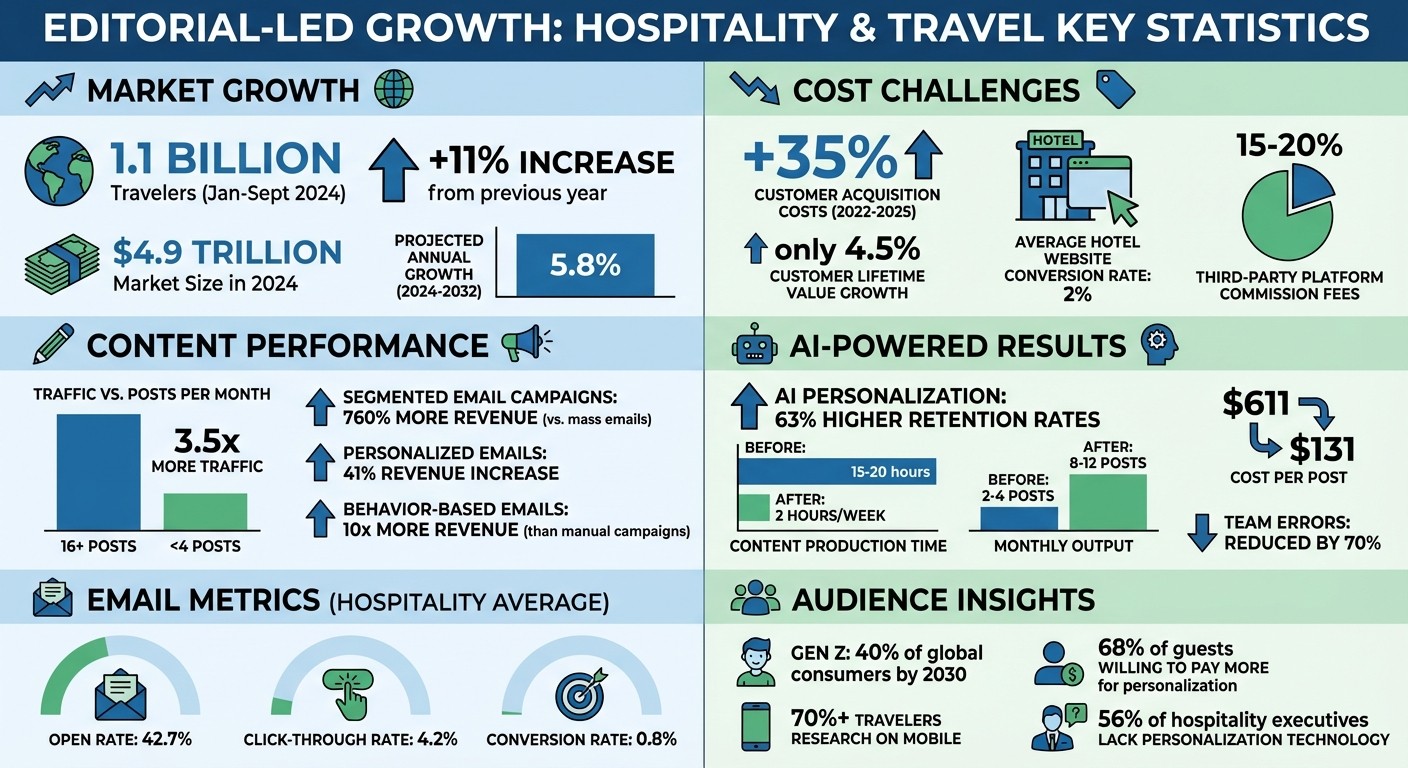
The hospitality and travel industry is booming, with global tourism welcoming 1.1 billion travelers between January and September 2024 - an 11% increase from the previous year. However, rising customer acquisition costs (up 35% from 2022 to 2025) and minimal lifetime value growth (just 4.5%) demand a shift in strategy. Traditional marketing methods are falling short as travelers prioritize meaningful experiences and sustainability.
Key Takeaways:
Editorial-led growth focuses on storytelling to build emotional connections, covering themes like wellness, regenerative travel, and tailored itineraries.
AI tools streamline content creation, personalizing workflows to improve customer retention by up to 63%.
Align content with the traveler’s journey: inspire with destination guides, build trust with testimonials, simplify booking, and re-engage post-trip with tailored offers.
Measure success with metrics like organic traffic, conversion rates, and direct bookings, while continuously refining strategies.
Editorial-Led Growth Statistics for Hospitality and Travel 2024-2025
Discover How Content Creation Is Revolutionizing Luxury Travel Sales
Define Your Editorial Strategy
An effective editorial strategy begins with themes that resonate deeply with travelers, focusing on the topics they care about most. Modern travelers are drawn to guest experiences, destination highlights, wellness retreats, solo travel adventures, and personalized itineraries. These preferences reflect a desire for journeys that feel meaningful and tailored. Trends like wellness tourism and workations are seeing rapid growth, driven by Gen Alpha, remote workers, and solo travelers [4]. As Dr. Carlos Martin-Rios points out, personalization powered by big data not only enhances guest experiences but also increases spending and loyalty [4].
To identify what resonates most, tap into CRM systems, surveys, and reviews to uncover priorities such as authentic experiences, sustainability, or immersive travel. Gen Z, projected to make up 40% of global consumers by 2030, values socially conscious brands and digital-first content. Feedback-driven, AI-personalized strategies are proving to be highly effective in boosting retention [7][5]. These insights highlight the importance of combining personalized storytelling with emerging market trends.
Identify Core Themes and Audience Needs
Aligning your themes with traveler preferences is essential. Start by mapping content to specific traveler segments. For example, consider industry trends like the anticipated 5.8% annual growth in travel through 2032, and survey your audience to understand their priorities [4]. Pilot new content ideas to test engagement. Topics like regenerative hospitality - such as zero-waste cuisine - can differentiate your brand as sustainability becomes a baseline expectation. Similarly, content targeting ultra-high-net-worth travelers is a growing opportunity, with seven-figure bookings surging by 75% [4][7]. Tailor your themes to match audience segments: Gen Z craves authenticity, while remote workers are looking for practical workation guides.
Analyze Competitor Content and Market Gaps
Conduct content audits, SEO research, and social media monitoring to identify gaps in the market. Examine competitors’ top-performing content in areas like luxury travel, wellness, or workations, and pinpoint underserved topics. For example, solo travel narratives, the influence of Gen Alpha on family vacations, or trends like "retailification" - such as pop-up tours - might be areas where competitors are lacking [7][6]. If wellness content is underrepresented despite its growth potential, make it a priority. With customer acquisition costs expected to rise by 35% between 2022 and 2025, filling these gaps is critical for maximizing ROI [5]. Consider creating exclusive content series, such as "Hidden Destination Stories" or AI-curated wellness itineraries, to establish your brand as an authority in these spaces.
Map Content to the Customer Journey
Travelers move through distinct phases: inspiration, consideration, booking, and post-trip engagement. Each stage calls for specific types of content that align with their mindset and needs. At the inspiration stage, travelers are drawn to destination guides, travel tips, and aspirational stories that spark their imagination and curiosity [5][9]. Platforms like Instagram, TikTok, and Pinterest excel here, offering visual storytelling that helps travelers picture themselves enjoying your property or destination.
During the consideration phase, the focus shifts to trust-building. This is where comparison content, sample itineraries, guest testimonials, and detailed FAQs about amenities and policies come into play [8]. When it’s time to book, the goal is to remove barriers with clear calls-to-action, customer reviews, and exclusive perks like complimentary breakfast or room upgrades for direct bookings [8]. Finally, post-trip content keeps the relationship alive through personalized thank-you emails, review requests, referral incentives, and offers like return-guest discounts [8].
Create Content for Each Journey Stage
To engage travelers effectively, the content must match their stage in the journey. For inspiration, highlight destination guides and insider tips that showcase one-of-a-kind experiences. During the consideration phase, sample itineraries and authentic user-generated content, such as photos or reviews from previous guests, can help prospects visualize their stay [8]. The booking stage demands clarity and simplicity, with features like live reviews, ratings near "Book Now" buttons, and mobile-friendly booking tools - especially since over 70% of travelers research trips on their phones [8]. Social proof is especially powerful here to ease any last-minute doubts.
In the post-trip phase, loyalty-focused content ensures that one-time visitors become repeat customers and advocates. Automated workflows can send thank-you messages, satisfaction surveys, and tailored offers for future stays [8]. Consistent engagement is key, as businesses that publish 16 or more blog posts per month see 3.5x more inbound traffic compared to sporadic posting [1][2]. Since guests are likely to switch brands after just 2.4 negative experiences, it’s essential to address feedback promptly and show that their input matters [5].
To take your marketing strategy for hospitality a step further, integrating AI-powered audience segmentation can elevate personalization.
Use AI to Segment Audiences and Personalize Content
AI-driven segmentation allows brands to personalize content more effectively, enhancing engagement at every stage of the customer journey. By organizing audiences based on factors like demographics, travel preferences, booking history, and behavior, brands can deliver highly relevant content. For example, AI tools can recommend destinations during the inspiration phase, provide tailored FAQs during consideration, and send loyalty-focused messages post-trip [5]. Businesses using AI-powered personalization report up to 63% higher retention rates [5].
For Gen Z travelers, who prioritize mobile-first experiences, AI segmentation ensures smoother booking processes [5]. Additionally, segmented email campaigns can generate 760% more revenue than generic mass emails, while personalized email marketing can boost revenue by 41% [3]. The key to this level of personalization lies in consolidating data from various systems - such as booking platforms, CRM tools, loyalty programs, and call centers - into a unified guest profile. This is especially important given that 56% of hospitality executives currently lack the technology to deliver the personalization that 68% of guests are willing to pay more for [10].
Build AI-Powered Content Workflows with Averi
Creating high-quality content at scale is no longer optional - it’s essential. With customer acquisition costs climbing over 35% while lifetime value grows by just 4.5% [5], the pressure is on to produce personalized, SEO-friendly content that aligns with every step of the customer journey. Traditional, manual workflows simply can’t keep up. That’s where Averi’s AI Content Engine steps in, reducing production time from 15–20 hours to just 2 hours per week and increasing monthly output from 2–4 posts to 8–12 [1]. It’s an all-in-one solution for streamlining content creation across your marketing funnel.
Set Up an Automated Workflow
Getting started is simple: input your website, and Averi learns your brand’s context, products, and voice [1]. From there, it generates tailored topic suggestions, focusing on trends like wellness travel, remote work vacations, and sustainable hotel experiences. All it takes is 15 minutes a week to review and refine [1][13].
Averi integrates seamlessly with your existing content calendar and keyword tools, identifying trending themes in hospitality and creating prompts that match your brand’s voice. These prompts are customized for specific stages of the customer journey, whether it’s awareness-focused topics like "best wellness resorts in 2026" or consideration-stage content such as "sustainable hotel experiences" [13]. The AI also optimizes drafts with advanced SEO techniques, including semantic analysis and schema markup [12][14]. And here’s the kicker: companies that publish 16 or more posts monthly drive 3.5 times more traffic than those with irregular posting schedules [1][2].
Combine AI and Human Input
Averi’s AI takes care of the heavy lifting. It conducts in-depth research, links to credible sources, and builds drafts with SEO-optimized structures, complete with FAQ sections and concise summaries. But the human touch is where the magic happens - adding emotional resonance, unique narratives, and fact-checked insights. For example, human editors can weave in personalized angles like wellness retreats tailored to specific demographics or authentic stories about regenerative tourism [4][12].
The platform’s collaborative editing canvas allows teams to fine-tune drafts, leave comments, and tag teammates for input. Editors can even highlight sections for the AI to rewrite, expand, or adjust [1]. To maximize efficiency, allocate about 20% of your time to enhancing AI drafts with creative and factual elements, such as verifying data like the projected 5.8% annual growth in travel through 2032 [4][12]. This hybrid approach reduces the time needed per piece to just 20–30 minutes, compared to the 4–6 hours traditional methods require. On average, this saves $480 per blog post [1].
Averi also includes features like version control and role-based permissions, ensuring that team workflows stay smooth and error-free. For instance, editors can approve tone for campaigns targeting solo travelers, while AI-suggested revisions catch inconsistencies, such as branding mismatches, cutting team errors by up to 70% [5].
Publish Directly and Store Content
Once your content is polished, Averi allows direct publishing to platforms like WordPress, Webflow, or Framer - no need for tedious copy-pasting or reformatting. Before publishing, the system automatically generates SEO meta titles, descriptions, and internal linking suggestions [1][11]. This one-click process slashes time-to-publish from days to hours, making it easier to test conversion-driven ideas like booking funnels [5].
All published content is saved in Averi’s Library, which serves as a central hub for your brand’s content. Over time, the system learns from your existing materials, improving the quality of future drafts [1][11]. The Library also simplifies repurposing content across multiple properties or destinations, letting you tag assets by journey stage (e.g., "awareness: workations") and refresh outdated posts with updated data, like replacing 2025 trends with 2026 projections on AI-driven trip planning [4][12]. This ensures your content stays relevant and effective, no matter how fast the industry evolves.
Automate Distribution and Personalization
Once you've streamlined content creation with Averi, the next step is ensuring that content reaches the right audience at the right time. Crafting content is only half the battle - delivering it effectively is what drives results. The days of manually posting to each platform or sending out generic emails are long gone. Why? Because segmented email campaigns can generate up to 760% more revenue compared to mass sends [3]. AI-powered distribution takes the guesswork out of the process, automating delivery while tailoring every interaction to match traveler preferences. Dynamic campaigns take this even further, ensuring your content resonates with the right audience at every stage of their journey.
Create Dynamic Campaigns
A great way to start is by using a content pyramid strategy. For instance, you could take a detailed guide - like a 2,000-word article on "Best Wellness Resorts in California for 2026" - and use AI to break it down into 15–20 smaller pieces. These could include social media posts, email teasers, or even bite-sized quote graphics [3]. The key is to design campaigns that adapt in real time. For example, if someone clicks on your email about sustainable hotels but doesn’t book, AI can step in and send a personalized follow-up featuring eco-certified properties in the location they browsed.
The order in which you roll out content also plays a critical role. High-performing teams often start with email campaigns targeting high-intent subscribers, then move to SEO-optimized blog posts, and finally, push to social platforms for broader visibility [2]. This method creates a seamless, self-improving campaign. In one case, an e-commerce skincare brand using Averi's AI workflow produced 127 content pieces in just 48 hours. The result? A 284% boost in email click-through rates and a 43% drop in cost-per-acquisition compared to traditional methods [2]. These dynamic campaigns don't just increase engagement - they deliver measurable ROI.
Improve ROI with AI-Powered Distribution
The efficiency gains are striking. Traditional methods might require 15–20 hours per week for content distribution. With Averi, that workload drops to just 2 hours - a 90% reduction in time [1]. This shift enables businesses to publish 8–12 posts per month instead of just 2–4, while cutting the cost per post from $611 to $131 [1]. For example, TUI Group used AI tools to segment their audience and monitor behavior across social media, leading to a 150% jump in comments on their posts [15].
The real game-changer, however, is personalization at scale. Triggered or behavior-based emails generate 10 times more revenue than manual campaigns [3], while personalized emails alone can increase revenue by 41% [3]. AI takes care of the heavy lifting - analyzing guest behavior, refining messages on the fly, and optimizing when emails are sent - all while freeing you up to focus on strategy. Zach Chmael, Head of Marketing at Averi, captures this perfectly:
"A content engine is a system that produces, publishes, and optimizes content with minimal ongoing founder involvement" [1].
The payoff? Consistent growth that compounds over time, without the need for bloated marketing teams. AI-powered distribution transforms your marketing operations into a lean, results-driven machine.
Measure and Optimize Performance
Creating content is just the beginning; understanding its performance is what turns effort into revenue. With the average hotel website converting at a modest 2% [17], even small improvements in tracking and optimization can lead to significant financial gains. Instead of focusing on surface metrics like impressions, shift attention to business-driven metrics such as direct bookings, conversion rates, and incremental revenue. As Julie Hoffmann, Global Executive Advisor at Adobe, explains:
"Clicks and impressions no longer cut it. With margins tightening, marketing must prove its value across the full guest lifecycle" [5].
Once you’ve automated your content distribution, the next step is to track results that directly impact your bottom line.
Track Key Metrics
Focus on metrics that directly influence bookings. On your website, monitor:
Organic traffic: A measure of how effective your SEO efforts are.
Bounce rate: Indicates whether your content aligns with visitors’ expectations.
Average session duration: Reflects how engaging your content is.
Conversion rate: Tracks the percentage of visitors who book or take another desired action [16][17].
For email campaigns, key metrics include:
Open rates: Currently averaging 42.7% globally for hoteliers.
Click-through rates: Averaging 4.2%.
Conversion rates: Averaging 0.8%[17].
On social media, track engagement rates (likes, shares, comments) and social sentiment to gauge how audiences perceive your brand [16][17]. A great example comes from Evaneos, a travel-planning platform that used Amplitude Feature Experimentation in 2024 to adjust call-to-action wording for different regions. This small tweak doubled their click-through rates and improved conversions by 20% [19].
Use Analytics to Refine Strategy
Performance data isn’t just numbers - it’s your guide for what to do next. Conduct quarterly audits to identify your best-performing content and build content clusters to strengthen SEO authority [16]. For example, if a blog post is ranking at #8, AI tools like Averi can identify it and suggest actionable steps to push it to the top of search results.
Another key metric to watch is your direct booking ratio - the percentage of reservations made through your website versus third-party platforms. Reducing reliance on third-party platforms can save you the typical 15–20% commission fees [20][21]. AI-powered tools also help refine guest segmentation, which can increase revenue per email recipient by an average of 2.6x [17]. As Femke Nollet, Content Specialist at Lighthouse, puts it:
"You can't manage what you don't measure" [18].
The secret to sustained success lies in creating a test-and-learn loop. Use your performance data to make real-time adjustments. For example, if content about wellness resorts is performing well, double down on similar topics. On the flip side, if a destination guide isn’t resonating, refresh it or pivot to something more relevant. This constant fine-tuning transforms one-off content efforts into a well-oiled editorial engine that drives long-term growth. Implementing a structured AI content creation framework ensures this engine remains efficient across all channels.
Conclusion
With your content strategy aligned and distribution optimized, the next step is solidifying your progress for long-term impact.
Editorial-driven growth creates a self-sustaining content engine that turns strategy into measurable revenue. The travel and hospitality industries are particularly poised for this evolution. As the market is projected to reach $4.9 trillion in 2024, and global tourism numbers climb to 1.1 billion travelers in the first nine months of the year (an 11% increase from 2023), there’s an undeniable opportunity for brands to connect with emerging groups like Gen Alpha travelers, wellness enthusiasts, and professionals blending business and leisure [4].
The process is clear: start with a AI-powered content strategy, align content with each phase of the customer journey using AI-driven segmentation, streamline workflows with AI-driven repurposing with a mix of AI tools and human expertise, distribute content dynamically, and monitor key performance metrics. Each step feeds into the next, creating a cohesive system that transforms engagement into conversions. This is especially critical as customer acquisition costs have surged over 35% between 2022 and 2025, while customer lifetime value has grown by only 4.5% [5].
Averi simplifies and accelerates this entire process - from strategy development to publishing - delivering maximum ROI. By learning your brand’s tone, automating repetitive tasks, and publishing directly to your CMS, Averi eliminates inefficiencies that often slow teams down. The benefits are clear: brands publishing 16 or more posts per month generate 3.5x more traffic than those posting fewer than four [1].
In 2026, success hinges on more than just producing high volumes of content - it’s about orchestrating efforts systematically. For example, Fauchon l'Hotel in Paris uses data-driven personalization to enhance guest spending, while AI-powered service recovery has shown to improve retention by 63%, turning potential setbacks into loyalty-building moments [4][5]. With AI becoming integral to trip planning, search, and daily operations, the message is clear: build your content engine now, or risk losing ground to competitors.
Take the first step by creating a cornerstone piece of content, map it to the customer journey, let AI assist with drafting, refine it with your team, publish, track its performance - and repeat. This iterative process of creation and optimization lays the foundation for sustainable growth.
FAQs
What should I publish first to start editorial-led growth?
To build trust and maintain visibility over time, it's essential to focus on producing high-quality, consistent content. Start by identifying a specific niche or set of core themes that align with your goals. Develop an editorial calendar to stay organized, planning quarterly themes and breaking them into weekly deliverables. Using AI tools can help streamline tasks like research and drafting, saving time without sacrificing quality.
Begin with foundational pieces such as blog posts, detailed guides, or niche-specific articles. These types of content not only establish your authority but also help attract organic traffic, laying the groundwork for long-term, editorial-driven growth.
How do I connect content to more direct bookings?
To encourage more direct bookings, take advantage of tools like Google’s hotel search platform. This feature showcases your property and includes free booking links that direct users straight to your website. Ensure your direct booking site is optimized with clear calls-to-action and an easy-to-navigate design. Amplify its reach by using social media ads, targeted email campaigns, and local SEO efforts. These steps not only help reduce dependence on OTAs but also build trust, making direct booking a more attractive option for travelers.
What metrics show editorial content is delivering results?
Metrics such as guest satisfaction, repeat booking rates, revenue per available room (RevPAR), and return on ad spend (ROAS) are key to showing how well editorial content is working. These figures highlight not only how engaged customers are but also how the content impacts financial outcomes.
Related Blog Posts

Zach Chmael
CMO, Averi
"We built Averi around the exact workflow we've used to scale our web traffic over 6000% in the last 6 months."
Your content should be working harder.
Averi's content engine builds Google entity authority, drives AI citations, and scales your visibility so you can get more customers.