How to Create Editorial-Led Growth for Media & Entertainment

Averi Academy
Averi Team
8 minutes

In This Article
Use storytelling and AI to build an editorial-led growth engine: plan high-impact topics, scale content production, distribute across channels, and optimize results.
Updated:
Trusted by 1,000+ teams
Startups use Averi to build
content engines that rank.
Media and entertainment companies are losing ground to creator platforms and social media giants. Audiences now demand engaging, story-driven content, leaving traditional ad-focused models struggling to keep up. Editorial-led growth offers a solution by prioritizing storytelling and leveraging AI tools to scale content production, improve efficiency, and drive audience loyalty.
Key Takeaways:
Shift to Storytelling: Video content generates 85% higher engagement, with 40% of marketing budgets now focused on narrative-driven strategies.
AI-Powered Content Strategy: Tools like Averi AI boost production speeds by up to 400%, handling topic generation, research, and distribution.
Data-Driven Priorities: Focus on high-performing content areas and use tools like SEMrush to identify gaps and trends.
Always-On Strategy: Build an editorial calendar using AI to stay ahead of trends and create consistent, impactful content.
Measure Success: Track metrics like engagement rates, conversions, and retention to refine strategies.
This guide outlines a five-step process to build a scalable, editorial-driven growth engine, combining AI efficiency with human oversight to create a self-sustaining content ecosystem.
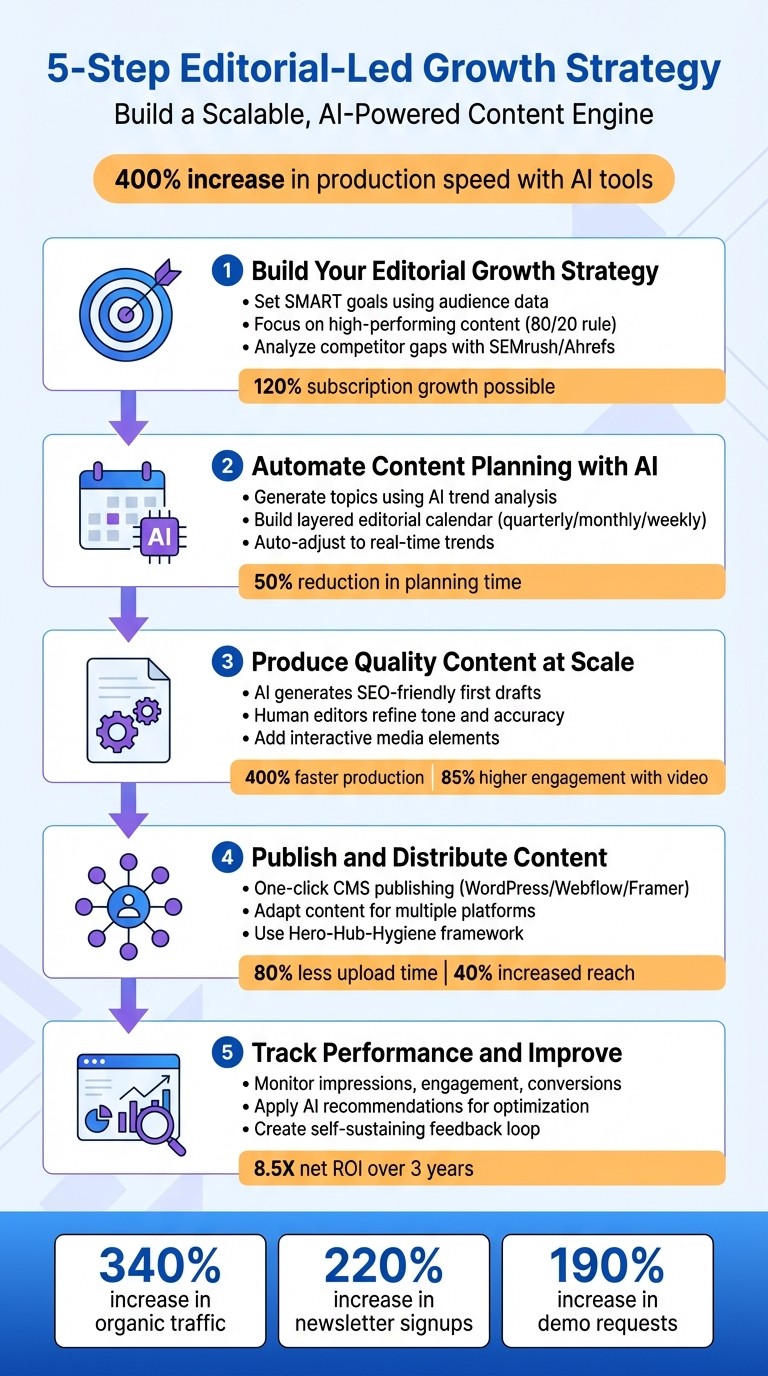
5-Step Editorial-Led Growth Strategy for Media Companies
Step 1: Build Your Editorial Growth Strategy
Set Editorial Priorities Using Data
Start by diving into audience data from tools like Google Analytics, social media insights, and your CRM. Look for patterns - if 80% of your engagement stems from just 20% of your content, focus your energy on those high-performing areas. This approach ensures you're prioritizing content that already delivers results.
Set SMART goals that connect directly to business objectives. For instance, aim for a 15% boost in subscriber retention by offering personalized content recommendations, or work to increase email open rates from 12% to 20%. This strategy has proven effective for global brands, with some reporting subscription growth of up to 120% by aligning goals with data insights [8].
Take a close look at your competitors using tools like SEMrush or Ahrefs. These platforms can help you uncover traffic-driving topics and keyword gaps. For example, if competitors are ignoring trends like interactive content or niche markets such as eSports, you can step in to fill those voids. Netflix, for example, has successfully differentiated itself by focusing on unique storytelling approaches [7][6]. These insights provide a strong foundation for leveraging AI in content ideation.
Find High-Impact Content Topics
AI tools like Averi AI can be game-changers for identifying trends, audience behaviors, and content opportunities. For instance, Averi's team managed to produce over 100 pieces of content in just 60 days, combining AI-driven ideas with human oversight. The results? A 340% surge in organic traffic, a 220% increase in newsletter signups, and a 190% jump in demo requests.
Focus on low-difficulty keywords (with scores between 0–29%) to gain traction more quickly in competitive markets. AI tools can pinpoint content gaps by comparing your competitors' outputs with user queries. They might suggest fresh angles like behind-the-scenes content for movie releases, interactive polls to engage fans, or gaming collaborations tied to the growing popularity of eSports. Short-form video content, for example, can generate 10x higher engagement rates than static posts [5], and AI can help you identify which formats and topics will resonate most before you commit resources.
Measure what matters. Keep an eye on metrics like engagement rates (time on page, shares), conversion rates (subscriptions, ticket sales), and audience retention. Sentiment analysis can help you tweak your strategy in real-time, much like streaming platforms that optimize for binge-worthy content. The goal is to close the feedback loop - use performance data to decide what to amplify, what to adjust, and what to create next.
Step 2: Automate Content Planning with AI
Generate Topics with AI
AI tools have revolutionized the way content planning is handled, turning it into a seamless, ongoing process. Platforms like Averi AI, Ahrefs, and SEMrush draw insights from SEO trends, social media activity, and audience behavior to suggest relevant topic ideas automatically. For instance, Averi AI can analyze viewing habits on streaming platforms and buzz from social media to propose ideas like "interactive short-form video trends", which drove 85% higher engagement in 2024 entertainment marketing [3].
By creating an always-updated content queue, you can monitor industry trends and identify high-potential keywords in real time [2]. This setup allows the system to suggest topics for approval, sparing your team the stress of scrambling for ideas at the start of the week. This method is particularly effective for industries like entertainment, where keeping up with fast-moving trends or viral user-generated content can reduce cost-per-engagement by 60% [3].
Advanced tools now go beyond basic keyword matching, analyzing user intent, mood, and social context to recommend emotionally resonant topics [4]. This shift lets editorial teams focus on refining and enhancing ideas rather than starting from scratch. With a steady flow of AI-generated suggestions, the next step is to organize and schedule them using an AI content creation framework for maximum impact.
Build an Editorial Calendar
Once you have a pool of ideas, structure them into a layered editorial calendar that aligns with your business objectives. This calendar should operate on three levels: quarterly themes tied to overarching goals (such as promoting a new streaming series), monthly campaigns targeting specific initiatives (like awards season coverage), and weekly content tailored to peak audience interest [1].
AI tools like Averi AI simplify this process by importing topic suggestions, scheduling them based on predicted engagement, and dynamically adjusting to real-time trends [4]. For example, if a music artist announces a tour and it starts trending, the system can prioritize related content, such as behind-the-scenes videos or interactive fan polls. With the global creator economy expected to surpass $480 billion by 2027 [4], having a flexible, responsive calendar is critical to staying competitive.
AI can also transform strategic objectives into detailed content briefs, complete with messaging priorities, SEO keyword clusters, and platform-specific recommendations [1]. Automating these steps can reduce the time spent on data analysis and planning by up to 50% [1], freeing up your team to focus on creative execution. The result is a dynamic, self-adjusting calendar that not only responds to audience behavior but also supports broader goals like growing subscriptions or increasing ticket sales.
Step 3: Produce Quality Content at Scale
Use AI for Research and First Drafts
AI tools like Averi AI take on the initial workload of content creation by gathering insights and generating SEO-friendly first drafts. These platforms analyze high-ranking pages, spot trending topics, and seamlessly incorporate high-search-volume keywords into outlines and full drafts. This process can accelerate production by up to 400% and reduce drafting time by 70% [1][3].
Instead of starting from scratch, your team receives a fully developed outline complete with headlines, SEO-optimized sections, and metadata recommendations, all ready for CMS integration. This streamlined process allows media teams to quickly produce episode recaps, promotional articles, or movie trailer campaign briefs, freeing up time for creative refinements rather than exhaustive research [3][4].
Advanced AI tools also adapt content to regional preferences through GEO capabilities - using en-US spelling, imperial measurements, and localized references like U.S. tour dates. For instance, when crafting a research brief for a movie trailer campaign, AI can pull audience data from platforms like TikTok, which experienced a 1,900% surge in searches [3][5], and format the content for maximum relevance to American audiences. With a solid AI-generated draft, the next step is to add the human touch for a polished final product.
Refine Content with Human Editors
While AI can handle the bulk of the work, human editors bring the finesse and nuance that make content truly resonate. Editors tweak AI drafts to reflect the brand's specific tone - whether dramatic, playful, or conversational - ensuring the voice aligns with what the audience expects. This step is critical for addressing AI's limitations in emotional depth and cultural sensitivity, avoiding generic or impersonal results.
The refinement process involves several key steps: verifying the factual accuracy of AI drafts, adjusting tone and style to meet brand guidelines, and weaving in editorial priorities like compelling narrative arcs. Teams using this hybrid approach have reported an 85% increase in engagement rates for video storytelling [3], showcasing the impact of combining AI efficiency with human creativity.
Editors also play a crucial role in maintaining credibility. They fact-check AI-generated research, incorporate proprietary data such as exclusive interviews, and add behind-the-scenes insights to transform functional drafts into engaging narratives. This collaboration between AI and human editors allows media companies to scale their content production while maintaining the quality their audiences expect. But to truly captivate modern audiences, content must go beyond text.
Add Media and Interactive Elements
Once the text is refined, amplify its impact by incorporating dynamic media and interactive features. Static text alone often fails to capture today’s entertainment-driven audiences. Short-form videos, for instance, generate 2.5× more engagement than long-form content [1], and media companies report 10× higher engagement from short-form videos compared to static posts [3][5]. AI tools can assist by suggesting ideal image placements, generating alt-text for accessibility, and even creating video scripts complete with scene breakdowns and auto-captions.
Interactive elements like polls, quizzes, AR filters, and fan-driven campaigns further boost engagement. For example, user-generated content campaigns have been shown to drive 35% higher engagement while cutting cost-per-engagement by 60% [3][5]. Embedding platform-specific features, such as Instagram polls for fan feedback, ensures content is optimized for mobile-first audiences in the U.S.
Efficiency is key when integrating these elements. Use AI to draft video scripts and create social media variations, then let human creatives handle the final visual and narrative touches. Adding features like on-screen shopping prompts or QR codes during video playback can merge editorial content with e-commerce, with live streams generating 3–5× higher conversion rates compared to traditional online shopping [4]. This approach turns content into an interactive experience, driving both audience engagement and revenue growth.
Step 4: Publish and Distribute Content
Publish Directly to Your CMS
Averi AI integrates seamlessly with your CMS, eliminating the need for manual copy-pasting. With one-click publishing options, it connects to WordPress via API plugins, Webflow through custom export templates, and Framer using direct JSON data injection. This streamlined process can cut manual upload time by as much as 80%, according to user benchmarks [3]. The system also takes care of formatting adjustments for each platform, fills in SEO metadata, and schedules releases - all without requiring technical expertise.
After human editors finalize AI-generated drafts, the tool optimizes them for platform-specific formats, such as WordPress Gutenberg blocks or Webflow layouts. It also handles preview generation, A/B testing, and deployment in under five minutes per article. For example, streaming services have leveraged similar tools to publish episode recaps directly to WordPress during live events, slashing publishing delays from hours to minutes and achieving 40% faster go-live times compared to manual workflows [3].
This automation minimizes formatting errors and version mismatches. Intelligent content parsing ensures that headlines, images, and embeds align with platform requirements, whether it’s WordPress plugins or Framer’s design systems, reducing errors by 70% [3]. For entertainment outlets managing high volumes of content during premieres or awards season, this level of scalability is invaluable.
With content published efficiently, the next step focuses on adapting and distributing it across various channels to maximize impact.
Adapt Content for Multiple Channels
Once published, your content can be transformed for different platforms to broaden its reach. AI tools analyze the original article and create platform-specific versions. For instance, a long-form movie review can be repurposed into a 15-60 second TikTok script with auto-captions, an Instagram Reel with visual overlays, or a LinkedIn post emphasizing industry insights - all while preserving your brand’s tone and aligning with each platform’s algorithm.
The Hero-Hub-Hygiene framework offers a structured way to scale content: start with a comprehensive "Hero" piece, then use AI to generate 3-5 "Hub" pieces like social media posts or email content, followed by 5-10 "Hygiene" variations tailored for specific platforms [1]. For OTT services, this might mean turning articles into episode summaries or binge-watch guides with embedded video thumbnails. Email newsletters could feature personalized subject lines and condensed content segmented by user viewing habits - approaches that have been shown to boost conversion rates by 45% [3][8].
Adapting content across platforms has proven to increase reach by 40% for entertainment brands. Short-form video adaptations, particularly on TikTok, have delivered 3x engagement rates [3]. Additionally, campaigns involving user-generated content have reduced cost-per-engagement by 60%, as seen in fan-driven promotions for music and film launches [3]. For U.S. audiences, AI tools ensure regional relevance by formatting dates as MM/DD/YYYY, using $ for currency, applying imperial units, and incorporating cultural touchpoints like NFL tie-ins for sports newsletters. These adjustments can boost engagement by 35% [3][8].
Step 5: Track Performance and Improve Results
Monitor Key Performance Metrics
Focus on the numbers that truly matter for growth. Impressions reveal how many people are exposed to your content, while engagement rates - likes, shares, comments, and time spent - highlight whether your audience finds it compelling. Conversions, such as subscriptions, purchases, or sign-ups, directly tie your efforts to revenue. Media companies that prioritize insights-driven strategies have reported up to 120% increases in subscriptions by concentrating on these metrics [8].
For streaming platforms and entertainment brands, offering personalized experiences can boost time spent on the platform by 35%, which enhances ad delivery and increases lifetime value [4]. Short-form videos, in particular, drive higher engagement [5]. Keep an eye on metrics like platform stickiness and lifetime value - these reflect how strongly audiences connect with your content [4].
To stay on top of these numbers, use tools like Google Analytics, YouTube Analytics, TikTok Insights, or AI-driven platforms that provide real-time KPI tracking. Set clear benchmarks aligned with your goals, such as engagement rates above 5%, conversion rates over 2%, and consistent growth in reach across channels [5]. Reviewing these metrics weekly helps you spot underperforming content early and identify trends that drive success.
Once you’ve established a solid foundation of performance insights, use AI to fine-tune and elevate your content strategy.
Apply AI Recommendations to Optimize Content
Let your performance metrics guide AI-driven content improvements. This creates a feedback loop that strengthens your editorial strategy over time. Instead of relying on guesswork, AI can identify areas for optimization. For instance, it might suggest adding internal links or updating examples to move a piece ranking at #8 closer to the top of search results. AI can also flag trending topics in your industry and provide ready-to-use content angles [4].
Predictive algorithms analyze historical data - impressions, engagement, and conversions - to forecast which topics are likely to perform well. This allows you to tweak underperforming content before it’s widely distributed [4]. Companies that leverage these tools set higher standards for discovery and monetization. AI doesn’t just improve content; it also enables personalization at scale, like recommending content based on user preferences, sending alerts for new episodes, or reducing churn through behavioral insights [8].
This process becomes self-sustaining: performance data informs AI recommendations, which guide your next content decisions, generating new data for further refinement. For example, Connected TV (CTV) advertising, expected to hit $51 billion by 2029, thrives on this constant optimization loop to maximize both impressions and conversions [4]. Entertainment brands tracking live engagement during premieres or interactive shopping events have seen conversion rates 3-5 times higher than standard e-commerce [4]. Over time, your editorial strategy evolves automatically as the system learns what resonates and what doesn’t.
Conclusion: Build a Self-Running Editorial Engine
Key Takeaways for Media Teams
To achieve editorial-led growth, media teams need a unified workspace that seamlessly integrates planning, creation, distribution, and optimization. By adopting AI-powered workflows, teams can experience up to an 8.5X net ROI over three years, with around 75% of these gains stemming from new revenue streams [9]. Tools like Averi AI simplify the entire content pipeline, eliminating the need to juggle multiple platforms for writing, analytics, and CMS uploads.
Creative teams often lose nearly 30% of their time searching for assets and repurposing content. Automating tasks such as keyword research and draft creation allows them to dedicate more energy to refining tone, verifying facts, and shaping strategy [9]. This shift not only saves time but also creates a feedback loop where real-time insights help refine content strategies and amplify the brand's voice.
Instead of focusing solely on page views, prioritize deeper engagement metrics like Read Depth and Attention Time. For instance, the 2025 benchmark for Read Depth is 44.06%, while Attention Time averages 45.04 seconds [10]. Additionally, track loyalty indicators like Average Active Days [12] and measure Message Pull-through to evaluate how effectively your narratives resonate with your audience [11].
Start Building Your Editorial Growth Strategy
Using these insights, you can craft a self-running editorial engine that combines strategy, execution, and optimization into a seamless cycle. Start by identifying your audience profiles, analyzing competitor gaps, and selecting impactful topics. Let AI generate content ideas while you curate and approve the best ones. This process blends strategic foresight with AI-driven execution, driving consistent media growth. Publish directly to your CMS, monitor results, and use AI recommendations to fine-tune or capitalize on emerging trends.
Over time, this approach builds a robust content library, sharpens data insights, boosts rankings, and enhances recommendations - each piece of content reinforcing the next. For immediate access to an AI Content Engine that handles everything from strategy to publishing, consider Averi AI's Plus Plan at $100/month. Skip the demo calls and waiting lists, and start focusing on delivering exceptional entertainment experiences while your editorial engine runs itself.
Creating an AI-Driven Content Marketing Workflow
FAQs
How do I pick the right content topics to focus on first?
To create content that resonates, begin by aligning your topics with both your objectives and what your audience cares about. Start by clearly defining your goals - whether it's driving traffic, building trust, or educating your readers. Then, dive into understanding your audience: What are their needs, preferences, or pain points?
Use tools like Google Trends to spot emerging topics or Reddit to explore real conversations happening in your niche. Pay attention to frequently asked questions, industry updates, and even the feedback or comments your audience leaves on your existing content. These insights can help you uncover gaps or untapped areas of interest.
By blending strategic research with what your audience truly wants, you’ll create content that not only grabs attention but also keeps them engaged.
How do we use AI without losing our brand voice or accuracy?
To incorporate AI effectively while preserving your brand's voice and accuracy, position it as a tool that complements human expertise rather than replacing it. Let humans take charge of key aspects like strategy, tone, and final approval, while AI assists with tasks such as research, drafting, or editing.
Implementing tools like style guides, rigorous fact-checking, and detailed review checklists can help maintain quality and consistency. By integrating AI into structured workflows, teams can streamline processes without sacrificing authenticity or alignment with brand objectives.
What metrics best demonstrate that editorial-led growth is effective?
Key indicators of success include audience engagement metrics such as increased website traffic, longer time spent on pages, improved search rankings, and higher engagement rates. Additionally, content performance can be evaluated through factors like shares, comments, and subscription growth. Together, these metrics reveal how effectively editorial strategies are connecting with and growing the audience.
Related Blog Posts

Zach Chmael
CMO, Averi
"We built Averi around the exact workflow we've used to scale our web traffic over 6000% in the last 6 months."
Your content should be working harder.
Averi's content engine builds Google entity authority, drives AI citations, and scales your visibility so you can get more customers.