Content Marketing ROI Benchmarks for B2B SaaS (2026 Data)

Averi Academy
Averi Team
8 minutes

In This Article
What ROI should your content deliver? 2026 benchmarks by company size, content type, and funnel stage. Plus the formula to calculate your own ROI in 5 minutes.
Updated:
Trusted by 1,000+ teams
Startups use Averi to build
content engines that rank.
Content marketing delivers unmatched long-term ROI for B2B SaaS companies. While paid ads stop generating leads once the budget runs out, content continues to drive compounding returns over time, with three-year average ROIs reaching 844%. For example, Zapier's content efforts achieved a 454% ROI by factoring in all costs and using a three-year lifetime value (LTV) multiplier. High-performing teams track metrics like Customer Acquisition Cost (CAC), Lifetime Value (LTV), and pipeline contribution to align content with revenue goals.
Key Takeaways:
SEO ROI: Averages 702%, compounding over 3 years.
Email ROI: $42 earned per $1 spent, driven by personalization.
Paid Ads ROI: $1.80 per $1 spent, with LinkedIn leading B2B.
Challenges: 42% of marketers struggle with ROI tracking due to long sales cycles and complex attribution.
By focusing on revenue-driven metrics, adopting multi-touch attribution, and using tools like HubSpot or Dreamdata, content teams can prove their impact and secure long-term investment. The key is patience - content ROI often peaks after 24–36 months.
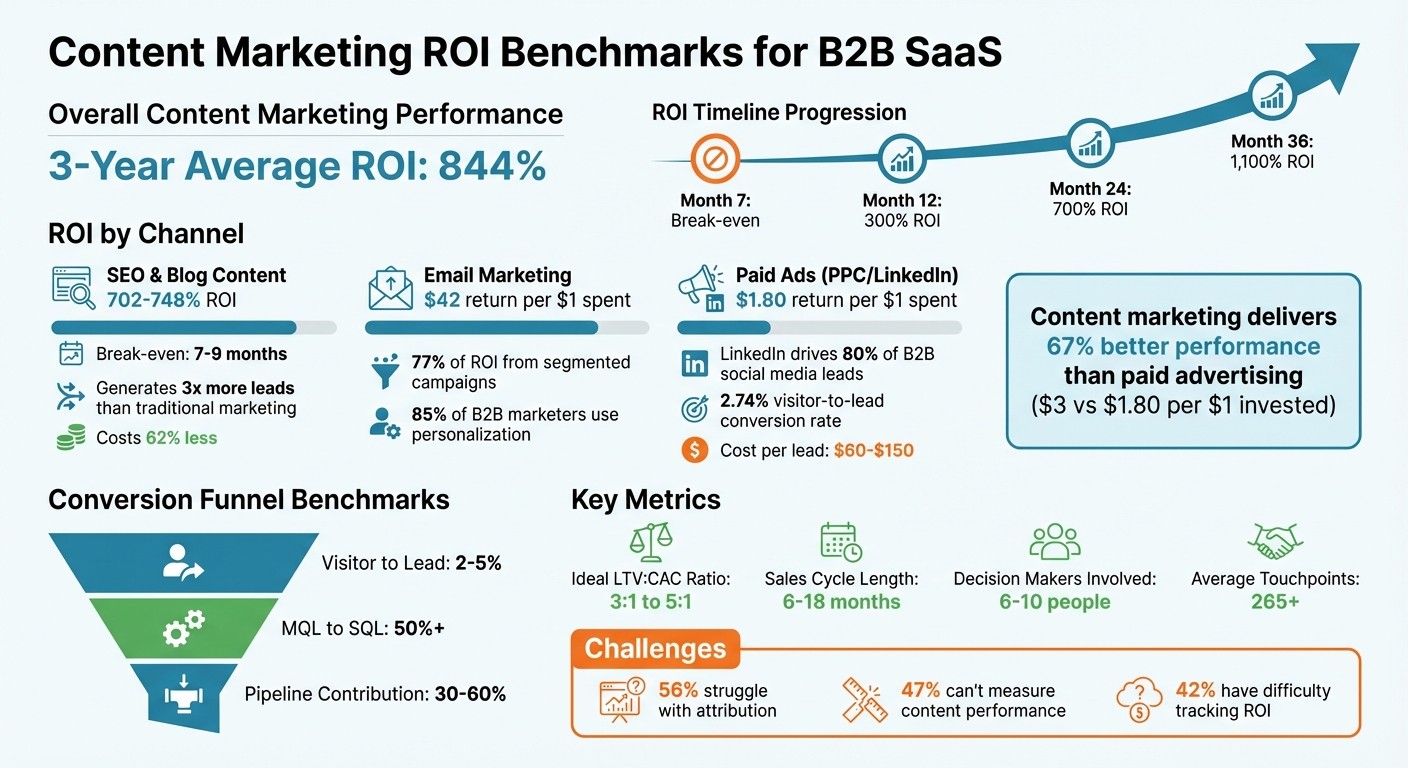
B2B SaaS Content Marketing ROI Benchmarks by Channel and Timeline
Is Marketing Attribution Really Dead in B2B SaaS with Adam Holmgren
Core Metrics for Measuring Content Marketing ROI
Tracking the right metrics is what separates content teams that can prove their worth from those that can't. While nearly half (49%) of B2B marketers report that content directly impacts revenue [3], more than half (56%) still struggle with attribution [3]. To bridge this gap, it’s essential to use frameworks that tie content efforts to tangible business outcomes. Below are key methods to measure these metrics effectively.
Basic ROI Calculation Formula
To truly understand content ROI, precision is key. The formula is straightforward: (Revenue Generated – Total Investment) ÷ Total Investment × 100. However, the challenge lies in accurately calculating the "total investment." This includes not just distribution costs but also team hours, tools, and other related expenses. Amy Higgins, Director of Content Strategy at Cloudflare, highlights a common mistake: many marketers only factor in distribution costs, ignoring internal efforts and technology expenditures [3].
For example, Lane Scott Jones at Zapier achieved an impressive 454% ROI by incorporating all costs - team salaries, freelancers, and tech stack - against revenue generated from signups. He applied a three-year lifetime value multiplier with last-touch attribution to paint a complete picture [1]. This comprehensive approach underscored how content can directly drive revenue growth.
The long-term impact of content ROI is even more striking. It typically breaks even by the seventh month, hits 300% by the twelfth month, and can exceed 1,100% by the thirty-sixth month [2]. On average, content marketing delivers a three-year ROI of 844% [2].
Customer Acquisition Cost (CAC) and Lifetime Value (LTV)
The balance between Customer Acquisition Cost (CAC) and Lifetime Value (LTV) is critical for assessing the health of your content strategy. The ideal LTV:CAC ratio falls between 3:1 and 5:1 [2]. To calculate CAC, divide your total content costs by the number of new customers acquired. Then, compare this figure to the lifetime value of each customer. By breaking this down by channel - such as organic search, email, or social media - you can identify which platforms bring in the most profitable customers. Content marketing, on average, generates three times more leads than traditional marketing while costing 62% less [2].
At Runn, Iryna Viter, Head of Content, used HubSpot to track the impact of a single high-intent blog post. By analyzing return visits and demo requests tied to that one URL, she discovered it accounted for 15% of the company’s total revenue [1]. This level of granularity not only helps calculate CAC but also pinpoints which pieces of content deliver the best results.
Pipeline Contribution from Content
Another critical metric is content’s influence on the sales pipeline. This includes tracking metrics like content-attributed revenue, cost per SQL (Sales Qualified Lead), and deal velocity. Content typically contributes 30–60% of the overall sales pipeline [2]. For instance, strategic content paired with robust CRM tracking has led to results like an 800% increase in leads and a 60% rise in conversions [2].
To measure this effectively, integrate your analytics tools with your CRM. Use standardized UTM parameters across campaigns, sync platforms like HubSpot or Salesforce with web analytics, and adopt multi-touch attribution models (e.g., Linear, U-Shaped, or W-Shaped). This setup allows you to track the entire B2B sales cycle, which often spans 6–18 months [2]. By doing so, you can prove that content isn’t just a cost - it’s a revenue-driving asset with a measurable impact on the pipeline.
ROI Benchmarks by Content Channel
Not all content channels deliver the same level of returns. Knowing which platforms yield the best ROI allows you to build a marketing strategy that focuses resources where they'll have the greatest impact. Here's a breakdown of how key content channels perform for B2B SaaS companies, starting with SEO.
SEO and Blog Content
SEO and blog content consistently stand out as top performers, delivering an average ROI of 748% for B2B companies [5]. While some reports suggest the B2B SaaS average is slightly lower at 702% [2], these figures still far exceed the returns of other channels. Results typically begin to show within 3–6 months, with full break-even achieved between 7 and 9 months [5][2]. Beyond this, the compounding effect takes over: ROI hits 300% by Month 12, climbs to 700% by Month 24, and reaches 1,100% by Month 36 [2].
"Content marketing generates $3 for every $1 invested... compared to just $1.80 for paid advertising. This 67% performance advantage stems from content's compound value." - Matteo Tittarelli, Genesys Growth [5]
What sets SEO and blog content apart is their compounding value. Unlike paid ads, which stop working the moment the budget runs out, high-quality content continues to attract organic traffic and leads over time [5][2]. Companies that maintain a consistent blogging schedule report 13x more positive ROI than those who publish irregularly [5]. Leveraging content strategy software can help automate these schedules and identify high-impact topics.
Take Datanyze as an example. By integrating a content strategy with CRM tracking, the B2B intelligence platform saw a 135% increase in organic search traffic, a 5x boost in leads, and a 23% lead-to-customer conversion rate [2]. This is why 72% of businesses say content marketing effectively increases lead generation [5]. While SEO compounds over time, email marketing offers more immediate, targeted returns.
Email Marketing
Email marketing remains one of the most profitable tools in the B2B SaaS arsenal, delivering an average return of $42 for every $1 spent [5]. However, the success of email campaigns depends heavily on strategy. Segmented, behavior-triggered campaigns generate 77% of total email ROI, far outperforming generic broadcast emails [5].
One way to maximize email ROI is by repurposing high-performing blog content into email sequences. This approach extends the reach of existing assets without requiring new content creation. This synergy between content and email distribution is what separates high-performing teams from those struggling to show results.
For instance, Kelly Services, a global workforce solutions company, shifted from generic email content to personalized, segmented campaigns. Within eight months, they achieved a 60% increase in conversions [2]. The takeaway? Personalization and automation are no longer optional - they're essential for success. Today, 85% of B2B marketers use personalization in their email strategies, and 36% are adopting AI-powered tools to optimize email performance [4].
Paid Ads (PPC and LinkedIn)
Paid advertising operates differently from organic content. While it delivers quick results, the returns are linear: stop spending, and the leads stop too. On average, paid ads generate $1.80 for every $1 invested [5]. While respectable, this ROI falls short of what SEO and email campaigns can achieve over time.
"Paid ads have linear returns. Stop spending, get zero leads. Content has compound returns... which is why B2B content marketing delivers 844% ROI over three years." - Daniel Riojas, Senior Content Strategist, Directive Consulting [2]
LinkedIn dominates the B2B paid ad space, driving 80% of all B2B social media leads with a 2.74% visitor-to-lead rate - nearly triple the rate of Facebook or Twitter [6]. However, this performance comes at a cost: LinkedIn CPCs in the U.S. average $8.00–$10.00, which is 3–5x higher than Google Ads [6]. For B2B SaaS companies, typical cost per lead (CPL) ranges from $60 to $150, with enterprise targeting often exceeding $200 [6].
An emerging trend in paid advertising is Thought Leader Ads, which promote personal posts from founders or executives instead of traditional brand content. These ads deliver a 1.7x higher click-through rate and 1.6x more engagement than standard company ads, often with 40% lower costs per lead [6]. AddVision leveraged this strategy alongside multi-touch attribution and centralized marketing automation, resulting in an 800% increase in monthly leads [2].
Conversion Rate Benchmarks by Funnel Stage
When it comes to understanding content effectiveness, conversion rates at different funnel stages play a crucial role. Each stage serves as a multiplier in your ROI calculations. Even a small improvement in bottom-funnel conversions can often generate more revenue than a larger gain at the top. High-performing B2B SaaS companies have clear targets for each stage of the funnel, as outlined below.
Visitor to Lead Conversion
At the top of the funnel, the focus is on turning website visitors into leads. This happens when users fill out forms, download resources, or sign up for trials. The industry benchmark for this stage ranges between 2–5%, though results can vary greatly depending on traffic sources and the quality of content [1]. Companies leveraging interactive tools like ROI calculators or assessments grow 80% faster than those relying solely on static content [1].
A common pitfall here is creating content without a clear conversion goal. In fact, 55% of B2B marketers identify their biggest challenge as "creating content that prompts a desired action" [3]. The solution? Develop a full-funnel marketing strategy where every piece of content addresses a specific buyer question or objection. This ensures a structured approach rather than relying on scattered content efforts. Once visitors convert into leads, the next task is nurturing them into qualified prospects.
MQL to SQL Conversion
The middle of the funnel measures how effectively marketing-qualified leads (MQLs) transition into sales-qualified leads (SQLs) - those your sales team actively wants to engage with. Top-performing organizations achieve conversion rates of 50% or more [1]. Falling below this benchmark often signals issues like poor lead scoring or ineffective nurturing sequences.
To improve this stage, multi-touch attribution can provide valuable insights. For example, a prospect might engage with various pieces of content - a blog post, a comparison guide, and a webinar - before requesting a demo. Without tracking these interactions, it’s easy to overlook which assets are driving conversions. Strengthening collaboration between marketing and sales teams and refining lead scoring systems are key to boosting this metric.
SQL to Closed-Won Deals
The final funnel stage focuses on your win rate - the percentage of SQLs that become paying customers. Benchmarks vary depending on deal size and sales cycle length, but this stage is critical for ROI since it reflects the culmination of all prior acquisition efforts [2]. Content that accelerates the sales process, such as implementation guides, ROI calculators, and customer case studies, can directly enhance outcomes.
Real-world examples highlight the impact of optimizing this stage. Zapier, under Head of Content Lane Scott Jones, analyzed content spend against signup revenue using a three-year LTV multiplier. Their efforts delivered a 454% ROI, which led their CMO to invest further in content [1]. Similarly, Datanyze achieved a 23% lead-to-customer conversion rate by identifying the content sources that generated the highest-quality leads, resulting in a 5x increase in leads [2].
Funnel Stage | Benchmark | Key Optimization Focus |
|---|---|---|
Visitor to Lead | 2–5% | Interactive tools, clear CTAs, content relevance |
MQL to SQL | 50%+ | Lead scoring, nurturing sequences, sales alignment |
SQL to Closed-Won | Varies by deal size | Deal velocity, sales enablement content, case studies |
These benchmarks provide actionable insights to fine-tune your strategies and maximize ROI at every stage of the funnel.
Improving ROI Measurement and Solving Common Problems
Measuring the true return on investment (ROI) in content marketing goes beyond just tracking metrics - it requires tackling persistent challenges that can obscure the bigger picture. For instance, 56% of marketers identify attribution as their biggest hurdle, while 47% struggle to measure content performance overall [3]. Let’s dive into the attribution challenges unique to SaaS and how they impact ROI tracking.
Attribution Problems in SaaS
In B2B SaaS, the buyer's journey is anything but straightforward. A typical deal involves 6–10 decision-makers, each consuming different content over an extended period [8][9]. One example: a VP of Marketing might read a blog post in January, the CTO downloads a whitepaper in March, and the CFO checks out a case study in May - long before a demo is even scheduled. Yet, standard analytics tools often credit only the final click, like a paid ad or demo request, ignoring the 265+ touchpoints that helped build trust along the way [8].
To make matters more complex, customer interactions are scattered across CRM systems, marketing automation platforms, and analytics tools. This fragmentation makes it nearly impossible to connect an anonymous blog visitor to a closed deal six months later [7]. Additionally, much of the content sharing happens in "dark social" channels like Slack or email, which are notoriously difficult to track [7][10].
Despite these challenges, 67% of B2B marketing teams still rely on last-touch attribution, which undervalues early-stage content like thought leadership and educational guides [10]. Companies that adopt multi-touch attribution (MTA) report 37% more accurate ROI measurement and 24% better budget allocation [10]. For example, W-shaped attribution assigns 30% credit each to the first touch, lead creation, and opportunity creation, ensuring all stages of the buyer's journey are recognized [7][9].
"B2B content is part of a complex matrix of various touchpoints, seen and unseen... We want to believe the purchase journey is a straight, orderly line of attribution: Read blog post > Hit demo > Buy. But B2B - or any marketing - doesn't work that way."
Ann Handley, Chief Content Officer at MarketingProfs[3]
To improve attribution, start by extending attribution windows. For high-value deals over $20,000, tracking windows should be at least 180 days to give early-stage content the credit it deserves [9]. Implement closed-loop reporting by syncing attribution data with your CRM, linking content directly to closed-won revenue [9]. And don’t just rely on numbers - use qualitative tools like session recordings or heatmaps to uncover why certain content resonates or causes drop-offs [8].
Tools for Tracking ROI
Addressing attribution challenges requires an integrated tech stack. At a minimum, you’ll need these four tools working together:
Content analytics (e.g., Google Analytics 4)
CRM (e.g., Salesforce, HubSpot)
Attribution platforms (e.g., HockeyStack, Dreamdata, Bizible) [1][2]
The real magic happens when these systems are integrated, allowing you to track a prospect’s journey from their first anonymous blog visit to a closed deal [2].
For example, Zapier used HubSpot to calculate "return on content spend", comparing investments against revenue using a three-year lifetime value (LTV) multiplier. This approach delivered a 454% ROI, convincing their CMO to increase content marketing investment [1]. Similarly, Runn discovered that a single blog post drove 15% of the company’s revenue after analyzing high-intent leads who browsed over 50 pages before booking a demo [1].
Attribution platforms simplify multi-touch tracking. Tools like Dreamdata (starting at $750/month) and Ruler Analytics ($179–$999/month) are tailored for B2B SaaS, offering no-code integrations and account-based attribution that consolidates all touchpoints into a single journey [9]. For qualitative insights, tools like Hotjar provide session recordings and heatmaps to optimize user engagement and call-to-action effectiveness [1].
One often-overlooked step is to standardize UTM parameters across campaigns. Inconsistent tagging is a common culprit behind corrupted attribution data [1][10].
"Many marketers have a hard time calculating the ROI of their content initiatives because they don't count both the creation and the distribution of their content. Most look only at the distribution costs alone."
Amy Higgins, Director of Content Strategy at Cloudflare [3]
To get a true picture of ROI, account for all costs: content creation (whether in-house or outsourced), distribution (including paid ads), and your tech stack (CMS, SEO tools) [1][3].
Content Audits and Update Strategies
Regular content audits are crucial to maintaining search rankings and ensuring your statistics stay relevant. Without updates, rankings can slip as competitors publish newer, more relevant content.
Datanyze serves as a prime example, achieving a 135% increase in organic search traffic, a 5x boost in leads, and a 23% lead-to-customer conversion rate by auditing and doubling down on high-performing content channels [2]. Similarly, Kelly Services saw a 32% jump in website users and a 60% rise in conversions within just eight months by pivoting to personalized content based on audit findings [2].
Timing plays a significant role. Content ROI typically breaks even after 7 months, but the real payoff can take years, with returns reaching up to 1,100% by month 36 [2]. Ending content programs too early is a common mistake. Use tools like Google Analytics’ multi-channel funnel reports to identify blog posts that nurture leads, even if they aren’t the final touchpoint before a demo [2].
"Strategy beats scale. The biggest driver of improvement wasn't more budget; it was refining the plan. Translation: fewer random acts of content, more coordinated direction."
Robert Rose, Chief Strategy Advisor at Content Marketing Institute[4]
Conclusion
Measuring the ROI of content marketing in the B2B SaaS world is an ongoing process that demands constant fine-tuning to ensure continued investment. The key lies in moving beyond surface-level metrics like page views and focusing on revenue-driven indicators such as pipeline influence, LTV:CAC ratios, and cost per SQL. These metrics not only justify the value of content programs but also help secure the resources needed to keep them thriving [1][2].
Success in this space requires patience and a long-term approach. Content marketing often delivers its highest returns - 700%–1,100% ROI - after 24–36 months, rewarding companies that stick with it [2]. This is especially critical in the B2B sector, where sales cycles can last 6–18 months and involve numerous stakeholders and touchpoints [2]. Tracking and optimizing performance over time is essential to navigating these complexities and maximizing results.
Rather than simply increasing budgets, the real driver of success is refining strategy. In fact, 74% of marketers attribute better outcomes to improving their approach rather than just producing more content [4]. This includes conducting regular content audits, using standardized UTM parameters, and implementing multi-touch attribution models to ensure early-stage content gets the recognition it deserves - not just the final touchpoint before a demo request [1][2].
"If you can't measure, you can't prove value. And if you can't prove value, you'll always be first in line for budget cuts."
Robert Rose, Chief Strategy Advisor, Content Marketing Institute [4]
To keep content marketing positioned as a strategic asset, stay disciplined. Align your efforts with overarching business goals, account for all costs - including staff time and distribution - and continually refine your approach to demonstrate measurable value [1][3].
FAQs
How can B2B SaaS companies measure the ROI of their content marketing efforts?
B2B SaaS companies can evaluate the return on investment (ROI) of their content marketing by viewing it as a continuous, long-term strategy rather than a one-off project. The process begins with aligning content efforts to core business objectives, such as boosting website traffic, generating qualified leads, and driving revenue growth. From there, performance can be measured across three critical areas:
Engagement metrics: Keep an eye on factors like page views, time spent on a page, and downloads to gauge how well your content resonates with your audience.
Pipeline metrics: Assess how your content influences the sales funnel by tracking Marketing-Qualified Leads (MQLs), Sales-Qualified Leads (SQLs), and conversion rates.
Revenue metrics: Quantify the financial impact of your content by analyzing metrics like revenue attributed to specific pieces, cost per lead, and overall ROI.
To translate these metrics into actionable insights, adopt an attribution model that reflects the buyer's journey - whether that's first-touch, last-touch, or multi-touch attribution. By integrating these insights with tools like your CRM and marketing platforms, you can gain a clearer picture of how content contributes to business outcomes.
Set measurable goals, such as achieving $10 in annual recurring revenue (ARR) for every $1 spent on content, and compare your performance against industry benchmarks. Continuously refine your strategy using data to ensure your content efforts stay aligned with your revenue objectives.
How can I effectively measure the impact of content on my sales pipeline?
To understand how your content contributes to your sales pipeline, start by bringing together all your marketing and sales data into a centralized dashboard. This unified view allows you to track how content impacts prospects at every stage - from their first interaction to closing a deal - while eliminating the confusion caused by scattered data. Advanced attribution tools can help you assign credit to your content, whether it played a role in the initial touchpoint, assisted along the way, or sealed the deal.
To get started, focus on a few key actions:
Define meaningful metrics, such as content-assisted opportunities or MQL-to-SQL conversion rates.
Select an attribution model that reflects your buyer's journey, ensuring you capture how content supports their decision-making process.
Connect your marketing automation tools with your CRM to monitor content's influence seamlessly.
Once your system is in place, benchmark your results against industry standards and leverage predictive analytics to identify and prioritize content that delivers the most impact. To quantify success, calculate revenue-linked ROI by comparing the revenue generated from content-driven opportunities to your content spend. Present these findings in straightforward, executive-ready figures (e.g., $1,250,000), making it clear how your content contributes to business growth. This approach provides the clarity and confidence needed to showcase the true value of your content strategy.
Why is multi-touch attribution essential for measuring content marketing success in B2B SaaS?
Understanding the real impact of content marketing in the B2B SaaS world requires a solid grasp of multi-touch attribution. This approach ensures credit is shared across all content interactions, offering a more accurate view of how your efforts contribute to the sales pipeline and overall ROI.
With multi-touch attribution, marketers can pinpoint which content strikes a chord with their audience at various stages of the buyer’s journey. This insight paves the way for smarter campaign adjustments, more efficient use of resources, and alignment with broader business objectives, driving better results and a stronger return on investment.
Related Blog Posts

Zach Chmael
CMO, Averi
"We built Averi around the exact workflow we've used to scale our web traffic over 6000% in the last 6 months."
Your content should be working harder.
Averi's content engine builds Google entity authority, drives AI citations, and scales your visibility so you can get more customers.