What Founders Get Wrong About AI Content (And How to Fix It)

Averi Academy
Averi Team
8 minutes

In This Article
Founders often misuse AI and publish generic, error-prone content. Adopt a strategy-first workflow: guide AI with human review, prioritize quality, and track results.
Updated:
Trusted by 1,000+ teams
Startups use Averi to build
content engines that rank.
AI content tools promise speed and scalability, but many founders misuse them, leading to generic, error-filled content that fails to deliver results. The key issue? Treating AI as a replacement for human effort rather than a collaborator. Here’s what’s going wrong and how to fix it:
AI isn’t ready to publish without human oversight: Raw drafts often lack polish, originality, and emotional depth.
Skipping reviews leads to errors: AI can present incorrect facts or miss your brand’s voice.
Focusing on quantity over quality: More content doesn’t mean better results; modern algorithms reward depth and engagement.
Lack of strategy: Without clear goals, AI generates irrelevant material that doesn’t connect with your audience.
Assuming AI eliminates your role: Founders must guide strategy, approve content, and ensure alignment with business goals.
How to Fix It
Start with a clear AI content strategy: Define your audience and goals before generating content.
Review every draft: Ensure accuracy, brand consistency, and originality.
Prioritize quality over volume: Publish fewer, more impactful pieces.
Track performance: Use insights to refine your approach and improve results.
By combining AI’s efficiency with human expertise, you can save time while creating content that resonates with your audience and drives measurable outcomes.
The Fatal AI Mistake Marketers Keep Making
5 Mistakes Founders Make with AI Content
Founders often expect AI to handle both strategy and final edits, only to be disappointed when the results fall short. The gap between AI’s potential and its actual output stems from common missteps that can undermine content marketing efforts. These pitfalls can derail even the most promising AI-driven initiatives.
Mistake 1: Expecting AI to Produce Publish-Ready Content
AI is excellent for generating quick first drafts, but those drafts require thoughtful refinement before hitting publish. Skipping this step results in content that feels mechanical and lacks polish. The assumption that AI can produce ready-to-go material often backfires, leading to time-consuming edits. In fact, you’ll likely spend more hours revising a rushed draft than you would have spent guiding AI properly from the start. Raw AI output also tends to lean on generic ideas, rehashing common points instead of delivering unique insights or perspectives.
Mistake 2: Skipping Human Review
Publishing AI-generated content without human oversight introduces several risks: factual inaccuracies, inconsistent brand voice, and a lack of distinctiveness. AI tools can confidently present incorrect facts, mix up dates or statistics, or even misrepresent your product. Without editorial judgment, the content won’t reflect your company’s expertise or stand out in a crowded market. Instead, it risks sounding like every other AI-generated piece - bland and forgettable.
Search engines and AI tools like ChatGPT and Perplexity are increasingly prioritizing content that showcases expertise and originality over recycled information. Without human intervention, AI content is unlikely to meet these standards.
Mistake 3: Chasing Volume Instead of Quality
The idea that publishing more leads to better rankings is outdated and counterproductive. While 44% of content marketers have reported success with increased posting frequency [6], that success hinges on maintaining quality. A high-volume, low-value approach often results in "content graveyards" - blogs packed with articles that drive no traffic or engagement.
83% of marketers agree that producing fewer, higher-quality pieces is more effective than churning out low-value content [5]. Modern algorithms prioritize engagement over sheer output, and low-quality AI content is increasingly penalized. As Adrian Iorga, Founder & President of 617 Boston Movers, puts it:
"Customer trust isn't something you can hack or hustle your way into. It's earned gradually - post by post, day by day." [5]
The numbers back this up: 61% of content teams struggle to create content that resonates with different stages of the buyer’s journey [6]. Chasing volume without a strategic plan only exacerbates this issue.
Mistake 4: Creating Content Without a Strategy
Using AI without a clear content strategy leads to irrelevant material that fails to connect with your audience. Only 29% of marketers with a documented strategy rate it as highly effective [7], and that effectiveness plummets when there’s no strategy at all.
70.6% of content marketers find it challenging to meet user intent [7], often because they focus on what’s easy to generate rather than what their audience truly needs. While AI can create content on virtually any topic, without strategic direction, it’s easy to miss your target audience, overlook their pain points, and fail to guide them through their buying decisions.
For example, in August 2025, a mid-stage SaaS company used Averi’s AI tools to launch a new feature. They began with an AI-generated campaign brief tailored to operations managers, resulting in 94 pieces of content across six platforms within 48 hours. The campaign led to a 340% increase in feature adoption within a week and a 67% reduction in the launch timeline compared to previous efforts [7]. The key difference? Strategy came first, and AI execution followed.
Mistake 5: Assuming AI Eliminates Founder Involvement
AI is a tool to amplify founder input, not replace it. Founders who assume AI can handle everything often discover that content marketing still requires their strategic vision, approval, and oversight. While AI excels at research, drafting, and optimization, founders must define the vision, approve messaging, and ensure alignment with business goals.
The most effective AI workflows treat the technology as a partner. Founders provide the insights, perspective, and direction that AI alone cannot replicate. While 85% of marketers use AI for content creation [1], those seeing the best results remain actively involved, guiding the process at a strategic level. This highlights the need for founders to stay engaged, ensuring the content reflects their brand’s unique voice and objectives.
How to Fix These Mistakes
AI's weaknesses often come from flawed workflows rather than the tools themselves. Founders who integrate AI into structured processes, treating it as a drafting assistant, typically achieve efficiency gains of 25–30% [9]. However, expecting AI to replace strategy and editing can lead to wasted time correcting errors instead of leveraging human expertise to guide its output.
The key isn’t to abandon AI but to create a system where it handles tasks like summarization, outlining, and brainstorming [9], while humans provide the expertise and critical judgment needed to produce engaging and trustworthy content. Below are four steps to reshape your AI content workflow.
Step 1: Start with a Clear Content Strategy
AI isn’t equipped to determine your audience’s needs or identify which topics will advance your business goals. Before generating any drafts, define your target audience, analyze competitors, and identify content gaps [8]. A well-thought-out strategy ensures AI supports your goals rather than generating generic material.
AI can help by creating initial Ideal Customer Profiles using your website data, which you can then refine to zero in on your best customers [4]. It can also monitor competitor rankings and industry trends, but the decision to pursue specific opportunities should align with your business objectives. Dedicate 15 minutes weekly to reviewing AI-generated topic suggestions - approve ideas that fit your strategy and discard those that don’t [4].
Step 2: Add Human Review to Your Workflow
Releasing AI-generated drafts without human oversight can lead to factual inaccuracies, an inconsistent brand voice, or content that simply doesn’t resonate. A robust review process is essential: verify facts, align content with your brand’s tone, and use tools to check for plagiarism and grammar issues.
AI sometimes misinterprets prompts or presents inaccurate information. For instance, a query about workplace safety might unintentionally result in content about natural disasters [3]. To prevent such missteps, schedule a 2-hour weekly review cycle: 15 minutes for topic approval, 45–60 minutes for refining drafts, and 15–20 minutes for analyzing performance. Remember, AI is a collaborative tool meant to enhance productivity, not replace human judgment [3].
With a review system in place, you can shift focus from volume to quality.
Step 3: Prioritize Quality Over Quantity
The assumption that producing more content automatically yields better results is outdated. Many marketers now find that fewer, high-quality pieces perform better than a flood of low-value material. Modern algorithms favor engagement, and poor-quality AI content is increasingly penalized.
Use AI to create fewer but more comprehensive pieces that offer meaningful insights and engage readers [8]. Refine AI drafts with your expertise to ensure they resonate with your audience. While AI-assisted content production can save an average of $480 per blog post compared to traditional methods [4], those savings only matter if the content delivers genuine value.
AI should handle the routine tasks, allowing your unique voice to shine through in the final product.
Step 4: Track Performance and Adjust
A successful content strategy evolves over time. Monitor key metrics like engagement, conversions, audience retention, and traffic sources to guide your decisions and improve future AI-assisted content [8]. This continuous feedback loop helps refine your approach.
Skip complex analytics dashboards and instead spend 15 minutes weekly reviewing automated performance summaries. These summaries can highlight top-performing content and shifts in keyword trends [4]. Use tools to track competitor rankings and identify new opportunities as they emerge [4]. By consistently linking performance data to content creation, you can focus on what works, update or retire underperforming pieces, and fill content gaps strategically - turning your AI tools into a dynamic, ever-improving content engine.
A Working AI Content Workflow
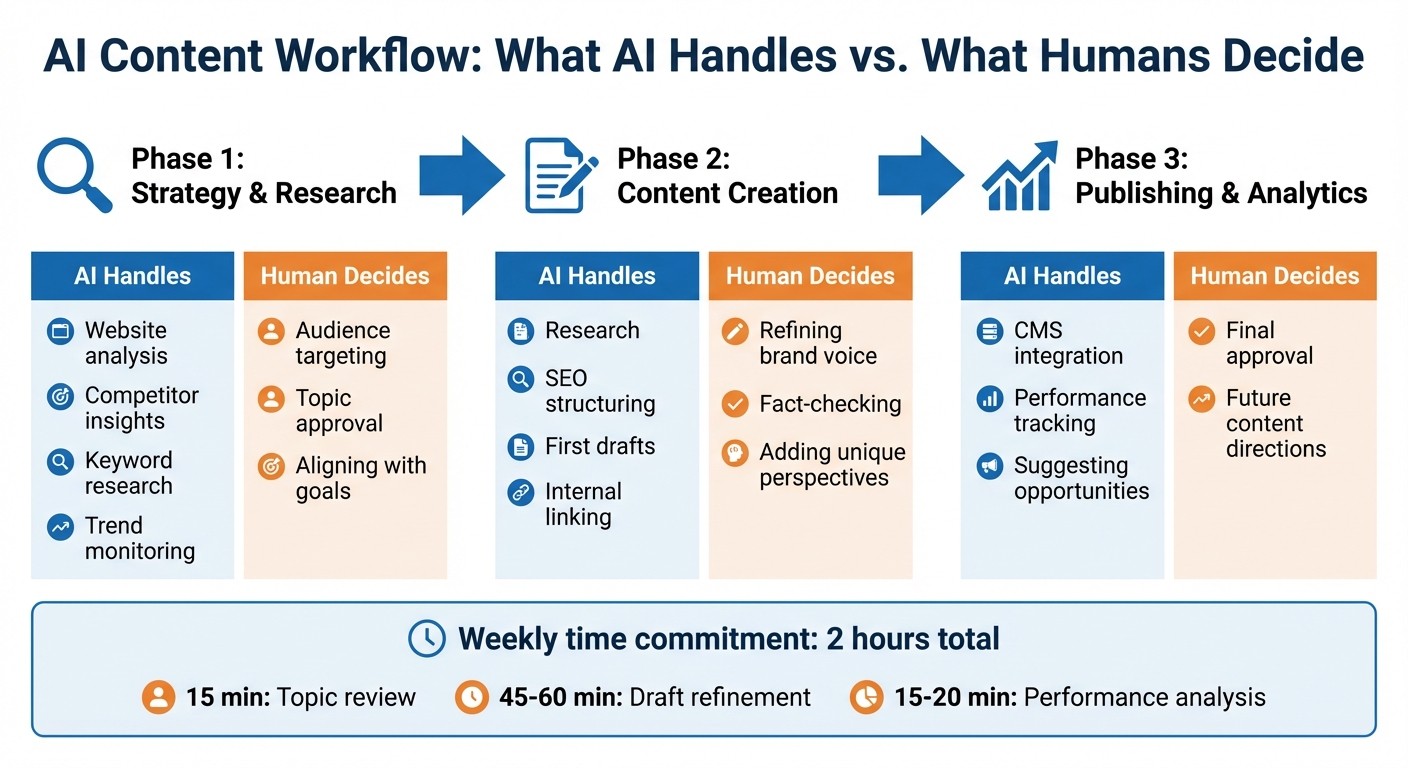
AI Content Workflow: Task Division Between AI and Human Input
The difference between struggling with AI-generated content and achieving efficient results often boils down to workflow design. Founders who treat AI as an isolated tool frequently end up fixing mistakes and rewriting drafts. On the other hand, those who establish a system - where AI manages research and drafting while humans oversee strategy and quality - unlock real productivity improvements.
An effective workflow breaks into three clear phases: strategy and research, content creation and editing, and publishing with analytics. Each phase assigns specific tasks to either AI or human input. The secret lies in understanding what AI excels at - like analyzing data, creating first drafts, and structuring content for SEO - and what requires human expertise, such as strategic thinking, maintaining the brand’s voice, and thorough fact-checking.
Platforms like Averi AI showcase this balance in action. The platform analyzes your website to understand your business, identifies gaps in competitor content, and tracks industry trends to suggest high-potential topics. You spend a brief 15 minutes each week reviewing and approving topics that align with your goals, while the AI handles the heavy lifting on research. This setup keeps you in control without bogging you down in tedious tasks.
When it comes to content creation, AI drafts initial versions complete with hyperlinked sources for easy verification. Human editors then step in to refine the tone, add fresh insights, and ensure accuracy through a strategic editing process - adding the depth and nuance only humans can provide. Collaborative tools allow editors to highlight areas for improvement or request rewrites, ensuring quality without needing to start from scratch.
The publishing phase integrates directly with your CMS (such as Webflow, Framer, or WordPress). Every piece of content is saved to a library, building a consistent brand voice over time. Analytics track performance, offering insights into rankings and audience engagement while recommending updates or new topics to explore. This feedback loop creates a self-improving system where every published piece informs the next.
Here’s how tasks are divided between AI and human effort:
Workflow Phase | AI Handles | Human Decides |
|---|---|---|
Strategy & Research | Website analysis, competitor insights, keyword research, trend monitoring | Audience targeting, topic approval, aligning with goals |
Content Creation | Research, SEO structuring, first drafts, internal linking | Refining the brand voice, fact-checking, adding unique perspectives |
Publishing & Analytics | CMS integration, performance tracking, suggesting opportunities | Final approval, deciding on future content directions |
This workflow operates on a streamlined two-hour weekly schedule: 15 minutes for reviewing suggested topics, 45–60 minutes for refining drafts, and 15–20 minutes for analyzing performance data and recommendations [4]. By cutting production time from 15+ hours to just 2 hours weekly, this approach eliminates repetitive tasks while maintaining strategic oversight. The result? A workflow that’s both efficient and effective.
Conclusion
To create impactful content, blending AI's capabilities with human expertise is key. While AI excels at tasks like research, drafting, and optimization, human involvement ensures the strategy stays aligned with business goals and maintains quality. Notably, 83% of top-ranking Google content benefits from significant human input [2].
Many challenges arise when AI is treated as a replacement rather than a tool. The solution? Start with a clear content strategy and design a workflow where AI handles repetitive tasks, leaving you free to focus on strategic decisions.
You don't need to overextend yourself to keep control. A structured workflow requiring just two focused hours each week [4] can drastically reduce production time - cutting it from over 15 hours weekly - while still delivering consistent, high-quality content.
Tracking performance is equally important. Regularly analyze results, tweak what isn't working, and use data to guide future efforts. Over time, as your content library grows, AI tools become more effective, amplifying your results.
Ultimately, success with AI-driven content isn't about finding the right AI content tools. It's about building a system that merges AI's speed with human insight. This combination creates a content engine that works efficiently, allowing you to focus on growing your business.
FAQs
What should humans do vs AI in a content workflow?
Humans bring strategic insight, refinement, and the ability to safeguard brand authenticity, while AI takes on tasks like research, drafting, and repetitive processes. AI shines in automating these foundational steps, but it’s the human touch that ensures accuracy, preserves the right tone, and aligns content with a brand’s core values. Together, this partnership blends AI’s efficiency with human creativity and critical thinking, producing content that’s both effective and meaningful.
How do I keep AI content accurate and on-brand?
To keep AI-generated content aligned with your brand and accurate, involve human oversight at key stages. Human reviewers play a vital role in checking drafts for tone, brand voice, and factual correctness, reducing the risk of mistakes or inconsistencies.
By pairing AI's efficiency with thorough human review, you can improve both precision and reliability, ensuring the content reflects your brand's identity and connects effectively with your audience. This approach builds trust and delivers content that feels both credible and engaging.
Which metrics matter most for AI-written content?
Key indicators for evaluating AI-generated content include content quality, authenticity, alignment with brand voice, user engagement, and efficiency in operations. Beyond these, ensuring accuracy, minimizing bias, reducing the hallucination rate, and maintaining relevance are essential for building trust and delivering effective content.
Related Blog Posts

Zach Chmael
CMO, Averi
"We built Averi around the exact workflow we've used to scale our web traffic over 6000% in the last 6 months."
Your content should be working harder.
Averi's content engine builds Google entity authority, drives AI citations, and scales your visibility so you can get more customers.