A Founder’s Guide to Scaling Content Without Agencies or Freelancers

Averi Academy
Averi Team
8 minutes

In This Article
Build an AI-powered in-house content engine to publish 8–12 posts monthly, cut costs and time, and track performance without agencies or freelancers.
Updated:
Trusted by 1,000+ teams
Startups use Averi to build
content engines that rank.
Content marketing can drive 3x more leads than outbound methods while costing 62% less. But for early-stage SaaS founders, scaling content without breaking the bank is a challenge. Agencies charge $5,000–$15,000/month, freelancers demand time, and hiring a content manager costs $120,000+ annually. The solution? Build an AI-powered in-house content system. Here's how:
Cost Savings: Reduce blog post costs from $611 to $131 with AI, saving $480 per piece.
Time Efficiency: Cut production time from 4 hours to 30 minutes per post, dedicating just 2 hours weekly.
Proven Results: Examples like Adam Robinson ($4M ARR via LinkedIn) show the effectiveness of founder-led, AI-driven content strategies.
This guide outlines a step-by-step framework for high-quality output at scale using AI for strategy, automation, and performance tracking - all without relying on agencies or freelancers. Start publishing 8–12 posts a month with minimal effort while maintaining full control over your brand’s voice and direction.
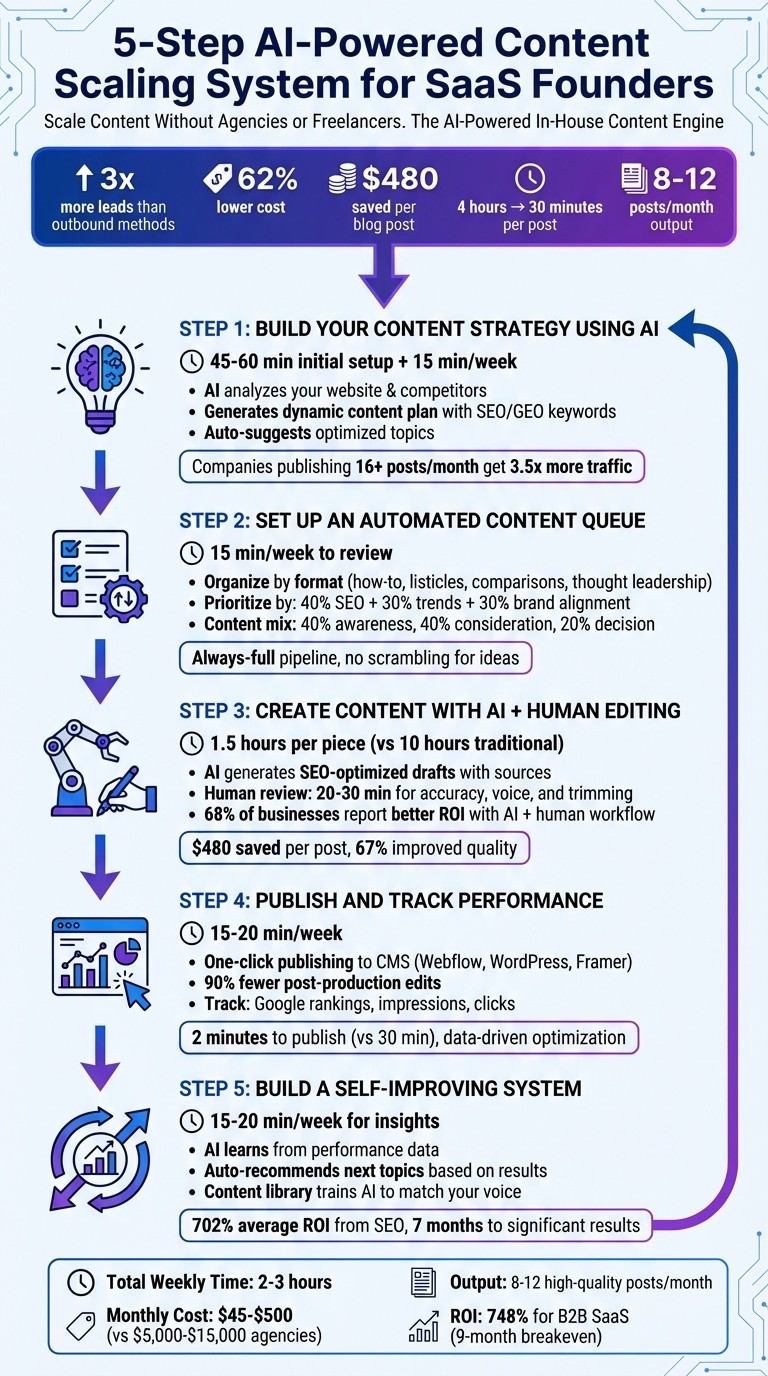
5-Step AI-Powered Content Scaling System for SaaS Founders
Creating an AI-Driven Content Marketing Workflow
Step 1: Build Your Content Strategy Using AI
Launching content without a well-thought-out plan is like setting sail without a map - you risk wasting time and resources on content that misses the mark entirely. A clear strategy ensures your efforts align with your business goals, target the right audience, and address topics people actually care about. Thankfully, AI tools can now do much of the heavy lifting that once required weeks of manual effort. But to get the most out of these tools, you need to set them up properly from the beginning.
Use AI for Market Research and Planning
Modern AI platforms like Averi can analyze your website to gain a deep understanding of your business model, products, brand voice, and positioning [1]. This goes far beyond basic keyword research - it’s a detailed dive into your audience, your strengths, and even your competitors' strategies. The AI identifies customer profiles and highlights gaps in your competitors' content, giving you a clear edge.
To ensure accuracy, spend 45–60 minutes refining the AI's initial findings [1]. Add any critical details it may have overlooked and weed out irrelevant competitor data. This small time investment helps maintain your brand’s unique voice and ensures your content strategy reflects your goals. With these refined insights, you’re ready to let AI guide you in creating a content plan that adapts to changing market conditions.
Create a Long-Term Content Plan
Once the AI understands your business landscape, it can generate a dynamic content plan designed to grow with your business. Instead of scrambling for new ideas every week, the system tracks market trends, competitor moves, and search behavior to suggest optimized topics automatically [1]. Each recommendation comes with SEO and GEO (Generative Engine Optimization) keywords, ensuring your content not only ranks well on Google but also gets noticed by AI-driven tools like ChatGPT and Perplexity.
Your role? Just 15 minutes a week to review and approve the AI-generated topics [1]. This small but consistent effort keeps your content strategy aligned with your evolving business needs. And the payoff is clear - companies publishing 16 or more blog posts per month drive 3.5 times more traffic than those publishing fewer than four [1].
Step 2: Set Up an Automated Content Queue
With your strategy ready, the next step is creating a system that keeps your content flowing smoothly. An automated content queue acts as a bridge between planning and execution, serving as a constantly updated backlog of prioritized topics. Instead of scrambling to decide what to write each week, the queue handles trend monitoring, competitor analysis, and idea generation. This setup ensures your content pipeline is always full, leaving you with just 15 minutes a week to review and approve.
Organize Content by Format and Priority
To keep things structured, divide your queue by content type. Group topics into categories such as how-to guides (addressing specific problems), listicles (e.g., tool roundups), comparison articles (your product versus competitors), and thought leadership pieces (covering industry insights). This variety helps you engage audiences at different stages of their buying journey.
Prioritization is key. Score each topic based on three criteria:
SEO potential: Monthly search volume and ranking difficulty.
Trend relevance: Emerging interest or gaps in competitor content.
Alignment with core content pillars: The 3-4 themes that define your brand.
Assign weights to these factors - 40% for SEO, 30% for trends, and 30% for brand alignment. Aim for a balanced content mix: 40% awareness content (attracting new visitors), 40% consideration content (educating potential customers), and 20% decision content (converting leads).
Review and Select AI-Generated Topics
AI tools like Averi can generate topic suggestions based on market trends, but it’s your judgment that ensures these ideas stay true to your brand. Once your queue is organized, dedicate 15 minutes every Monday to review it. Ask yourself: Does this topic align with your core content pillars? Does it address a genuine problem your audience faces? Make sure each topic reflects your brand’s voice and values.
Stick to the 90-10 rule: 90% value, 10% promotion. If a topic feels overly sales-driven or doesn’t resonate with your audience, discard it. Use prompts like “Would my target audience search for this?” or “Can I offer unique insights on this topic?” to refine your selection. While tools like Google Trends or Ahrefs can validate search volume, rely on your instincts to ensure each topic fits your brand and serves your audience.
This approach delivers consistency without overwork. Research shows that companies publishing 16 or more posts per month generate 3.5 times more traffic than those publishing fewer than four [1]. With an automated queue managing research and idea creation, you can maintain this pace while focusing your energy on strategy and approvals - not endless brainstorming sessions.
Step 3: Create Content with AI and Human Editing
Once your topics are approved, it’s time to turn those ideas into polished content. This step blends the efficiency of AI with the nuance of human touch. AI takes care of the heavy lifting - researching and drafting - while you focus on adding the insights and personality that only you can provide. This streamlined process slashes production time from 10 hours to just 1.5 hours per piece, saving an average of $480 per blog post compared to traditional methods[1].
Generate SEO-Optimized Drafts with AI
AI platforms like Averi's Synapse can generate drafts tailored to your brand guidelines, existing content, and marketing goals. These tools conduct real-time research and include hyperlinked sources, ensuring the content is ready for both traditional search engines and AI-driven platforms. The result? Content that’s optimized for both keyword-based SEO and Generative Engine Optimization (GEO), which helps AI systems like ChatGPT and Perplexity recognize and cite your brand.
These drafts come preloaded with essential SEO elements: H1–H3 tags, FAQ sections based on common user questions, concise meta descriptions (under 160 characters), and suggestions for internal links to your existing content. By automating these time-consuming tasks, you can scale your content production without adding staff. In fact, 68% of businesses have reported better ROI from content marketing after integrating AI tools into their workflows[1].
However, while AI speeds up the drafting process, the finishing touches require your expertise.
Add Human Review for Final Quality
AI can’t replace the depth and authenticity of human input. That’s where you come in. During a quick 20–30 minute review, you’ll refine the draft to ensure it aligns with your brand’s voice and delivers real value. Tools like Google Docs or Averi’s editing platform make it easy to collaborate and refine in real time. If a section feels too bland or overly technical, you can prompt the AI to adjust, asking for a more opinionated take or a simpler explanation.
Your review should focus on three priorities: checking for technical accuracy (especially for industry-specific data or metrics), adding your unique perspective, and trimming unnecessary content to make the piece more concise. Aim to cut fluff by 20–30% to keep the message sharp and engaging. The goal isn’t to make the draft perfect - it’s to ensure consistency and clarity. Research shows that 67% of businesses see improved content quality and SEO performance when AI is paired with thoughtful human oversight[1].
Think of each draft as a small experiment: spend no more than 1–2 hours refining it, focus on aligning it with your voice and audience needs, and then publish. Over time, this process not only builds a rich content library but also trains your AI tools to better emulate your style in future drafts.
Step 4: Publish and Track Content Performance
When your content is polished and ready, the next step is to publish it and learn from the results. By streamlining the publishing process and leveraging performance insights, you can save time and focus on creating content that resonates with your audience. This approach eliminates repetitive tasks and replaces manual data analysis with actionable insights that inform your next steps.
Connect Directly to Your CMS
Tools like Averi make publishing seamless by integrating with platforms such as Webflow, WordPress, and Framer. With just one click, you can publish content without the hassle of copying, reformatting, or correcting errors. These tools ensure your approved content goes live exactly as intended, maintaining design elements, heading structures, and SEO components like meta tags and internal links. Founders using these integrations have reported up to 90% fewer post-production edits, reducing publishing time from 30 minutes to just 2 minutes per piece[3].
Beyond saving time, automation also minimizes errors. Issues like missing alt tags or broken links are automatically addressed, allowing you to focus on broader strategies instead of technical fixes. Additionally, every published piece is stored in a central library, building a resource that helps refine future AI drafts to align more closely with your brand's tone and style.
Once publishing is automated and errors are reduced, the next focus is optimizing performance using data-driven insights.
Use Performance Data to Guide Content Decisions
Publishing is just the beginning. The real value comes from tracking how your content performs and using that data to shape your strategy. Focus on three key metrics: Google rankings (your position in search results), impressions (how often your content is seen), and clicks (the traffic your content generates). These figures can highlight what’s working and where improvements are needed. For instance, if an article has high impressions but low clicks, the issue might lie in the title or meta description - quick fixes that could significantly boost traffic.
Instead of manually combing through dashboards, set aside 15–20 minutes weekly to review automated recommendations. Modern AI tools can identify opportunities, such as articles ranking in positions #8–12 that could move to page one with minor updates, or emerging trends that align with your audience's interests. This creates a feedback loop where performance data refines your content strategy, leading to better results over time.
For example, DigitalOcean used this approach to grow to 10 million monthly visits. By tracking the performance of over 5,000 tutorials, they prioritized topics with the highest potential return - all without requiring constant oversight from leadership[3]. The key isn’t aiming for perfection but maintaining consistency and responding to data-driven insights effectively.
Step 5: Build a Self-Improving Content System
The real strength of an AI-powered content engine isn’t in what it delivers on day one - it’s in how it evolves with each piece you publish. Unlike a new content manager who might take months to fully understand your brand, an automated system creates a feedback loop that gets better over time. Every article you publish feeds data back into the system, sharpening its recommendations and improving the quality of future drafts. This ongoing refinement simplifies your content marketing efforts and amplifies results.
Automate Weekly Performance Analysis
Forget spending hours combing through analytics - AI tools can handle that for you. Set aside just 15–20 minutes each week to review automated insights that highlight actionable opportunities. These tools track key metrics and suggest specific improvements, like nudging an article from rank #8 to page one or identifying trending topics that resonate with your audience.
Platforms like Averi take it a step further by closing the loop. They use performance data to recommend what content to create next. For instance, if a particular topic generates high engagement, the system suggests related ideas to explore. If competitors are jumping on emerging trends, you’ll get alerts with counter-strategies tailored to your brand. This data-driven approach removes the guesswork and ensures your strategy adapts in real time. All insights feed directly into your content library, making your system smarter and more effective with each cycle.
Grow Your Content Library Over Time
By consistently acting on these insights, your content library evolves into a powerful resource that streamlines future efforts. Every published piece helps train the AI to better understand your brand voice, positioning, and audience preferences. Over time, this means drafts require fewer edits, as the system learns your unique patterns. As Zach Chmael, Head of Marketing at Averi, explains:
"A human hire has a learning curve. A content engine has a learning flywheel."[2]
The benefits of this approach extend far beyond efficiency. Regular publishing strengthens your domain authority and builds internal links, creating a compounding effect that boosts both new and existing content. Take SaaS founders, for example - many have driven millions in annual recurring revenue by committing to content creation, tracking performance in a CMS, and using those insights to refine their strategies. This self-improving loop not only enhances content quality but also directly impacts pipeline growth and revenue.
For B2B SaaS companies, the numbers speak volumes: the average 702% ROI from SEO proves the long-term value of this approach. While it typically takes about seven months to see significant results[2], starting early and maintaining a steady publishing cadence allows your content library to grow, your AI system to improve, and your organic reach to expand - all without scaling your team or increasing costs proportionally.
Conclusion
Using AI-powered systems like Averi to scale content in-house creates a cost-effective and efficient content engine that founders can fully control. These tools enable the production of 8–12 or more posts each month while maintaining a consistent brand voice and strategy. For comparison, agencies often charge over $1,000 per article [3], whereas an AI-driven content engine costs between $45 and $500 per month, resulting in substantial savings per post [1].
This approach reduces the founder’s time commitment to just a few focused hours each week - dedicated to tasks like reviewing topics, refining drafts, and tracking performance [1]. It allows for consistent publishing without pulling attention away from crucial areas like product development or customer interaction. In addition to cutting costs, this method ensures your brand’s messaging remains cohesive and aligned with long-term goals.
An in-house system also provides lasting benefits that agency relationships typically cannot. By building your own content library, you retain all strategic insights and create a self-improving system. Each new post strengthens your domain authority, improves internal linking, and refines the AI’s performance, creating a cycle of continuous growth. Unlike agencies, which may leave gaps when contracts end, your system becomes a permanent asset that evolves over time.
The benefits of scaling content are clear. Companies that publish 16 or more posts per month generate 3.5 times more traffic than those posting fewer than four [1]. For B2B organizations, SEO efforts typically yield a 748% ROI, with a breakeven point of about nine months [2]. By starting now and committing to a B2B SaaS marketing strategy, you can build a lasting competitive edge that grows stronger with every post.
The real challenge isn’t finding talent - it’s implementing the right systems. An AI-powered content engine allows you to achieve the output and quality of much larger teams without the complexity of managing freelancers or the expense of agencies. You stay in charge of strategy and quality while the system handles execution. By adopting this approach, founders can turn their content creation process into a scalable, growth-driving machine that operates independently of external support.
FAQs
What’s the minimum setup I need to start an AI content engine?
To kick off an AI-driven content engine, begin by outlining a clear content strategy that aligns with your goals. Next, establish templates and workflows to maintain consistency and efficiency. Incorporate AI tools like Averi to handle tasks such as research, drafting, and publishing. This entire setup process usually takes around 45–60 minutes, allowing you to simplify and speed up your content creation process.
How do I keep AI-written posts in my brand voice?
To keep AI-generated posts aligned with your brand's voice, start by setting clear rules for tone, style, and formatting. These guidelines should be well-documented in a detailed style guide and seamlessly integrated into your AI workflows. Additionally, involve humans in the process by having them review drafts to fine-tune the content. This blend of AI's speed with human judgment ensures your posts stay consistent, relatable, and true to your brand identity, steering clear of generic or mismatched messaging.
Which metrics should I review weekly to improve results?
To get better outcomes, take time each week to review metrics such as engagement, reach, and conversions to evaluate how your content is performing. Also, monitor workflow efficiency and the quality of your content to make sure everything aligns with your strategic goals. Use these insights to fine-tune your processes and improve results over time.
Related Blog Posts

Zach Chmael
CMO, Averi
"We built Averi around the exact workflow we've used to scale our web traffic over 6000% in the last 6 months."
Your content should be working harder.
Averi's content engine builds Google entity authority, drives AI citations, and scales your visibility so you can get more customers.