

In This Article
Benchmarks and tactics for Generative Engine Optimization—citation frequency, AI share of voice, referral traffic, and tools to boost AI citations.
Updated:
Trusted by 1,000+ teams
Startups use Averi to build
content engines that rank.
AI-driven search is transforming how brands are discovered. Generative Engine Optimization (GEO) focuses on ensuring your brand is cited in AI-generated answers, which are now the first touchpoint for many users. By 2026, traditional SEO is no longer enough as AI platforms like ChatGPT, Perplexity, and Google's AI Overviews dominate search behavior.
Key insights:
89% of B2B buyers use AI for decisions, with AI-driven visitors converting 4.4x higher than traditional search users.
Citation frequency (appearing in AI answers) and AI share of voice are now critical metrics for visibility.
Tools like Averi AI help create concise, structured content optimized for AI citations.
With AI referrals growing by 527% year-over-year and zero-click searches accounting for 60% of queries, brands must focus on content optimized for LLM search to stay visible in this evolving landscape.
How to do GEO - Full AI SEO Course to be Mentioned on LLMs
Core GEO Metrics and 2026 Benchmarks
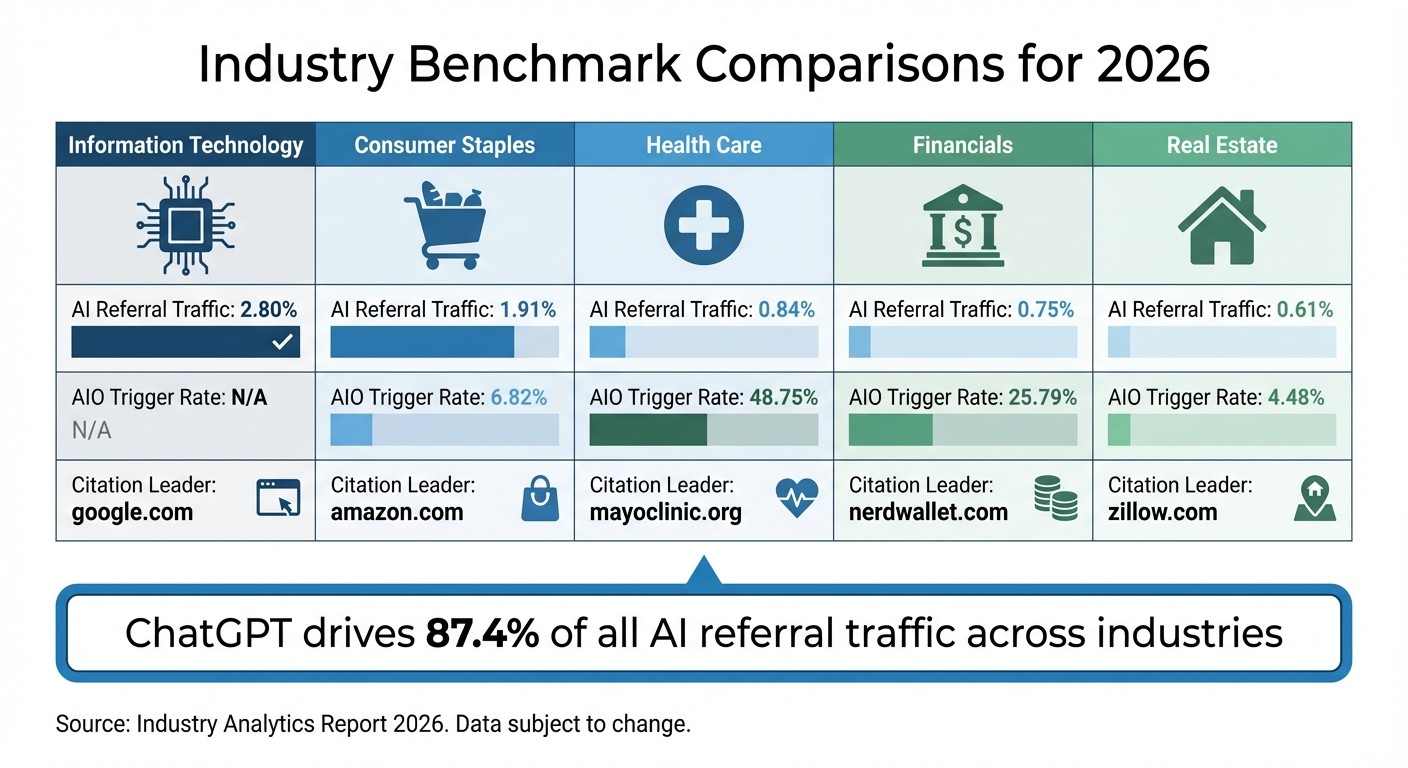
GEO Industry Performance Benchmarks 2026: AI Referral Traffic and Citation Leaders
Key Metrics for GEO Performance
As we look toward 2026, the metrics shaping GEO performance are increasingly influenced by AI-driven insights and LLM optimization. One standout measure is citation frequency - the rate at which your brand appears in AI-generated responses. With large language models (LLMs) typically citing only 2–7 domains per response, brands aiming for top-tier performance target citation rates above 30%, while elite brands push this figure beyond 50% [2].
AI Share of Voice (AI SOV) is another critical metric. It reflects your brand's share of total citations within a specific category, offering a clear picture of how your visibility stacks up against competitors. Complementing this is the Brand Visibility Score (BVS), which evaluates factors like where your citations appear, whether links are included, and the overall sentiment surrounding your brand [2].
Speaking of sentiment, sentiment analysis is essential for understanding how AI systems portray your brand - positively, neutrally, or negatively. Aiming for a positive sentiment rate of 70% or higher is crucial, especially since 52% of Gen Z users now rely on generative AI for decision-making [2].
Finally, LLM conversion rates have become a game-changer. Visitors arriving via AI-powered search convert at a rate 4.4 times higher than traditional organic search users and complete their journeys in just one-third of the sessions [1][2].
These metrics highlight the growing importance of AI in shaping brand performance, with notable variations across industries.
Industry Benchmark Comparisons for 2026
Performance benchmarks differ significantly by industry, with Information Technology leading the charge. This sector sees 2.80% of its total traffic coming from AI referrals, while Consumer Staples follows at 1.91%. In contrast, Health Care experiences lower referral traffic at 0.84%, but AI Overviews appear in nearly half (48.75%) of all searches, with MayoClinic.org dominating citations in this space [1].
Industry | AI Referral Traffic | AIO Trigger Rate | Citation Leader |
|---|---|---|---|
Information Technology | 2.80% | N/A | google.com |
Consumer Staples | 1.91% | 6.82% | amazon.com |
Health Care | 0.84% | 48.75% | mayoclinic.org |
Financials | 0.75% | 25.79% | nerdwallet.com |
Real Estate | 0.61% | 4.48% | zillow.com |
In the Financials sector, NerdWallet stands out with a 6.73% citation share, outperforming traditional banks by producing detailed, high-value educational content that addresses complex "Your Money or Your Life" (YMYL) queries [1]. Across all industries, ChatGPT dominates as the leading platform for AI referral traffic, driving a staggering 87.4% of such visits [1]. This underscores the need for brands to prioritize visibility within AI systems to stay competitive.
Regional Performance Benchmarks and Patterns
United States Regional Performance Data
In the U.S., AI-driven referral traffic makes up 1.08% of total website traffic, with a steady monthly growth rate of 1% [1]. However, search behaviors vary significantly across regions. Suburban search patterns, for instance, differ by 34% from urban areas, influenced by local demographics and intent [4].
The rise of hyperlocal AI search is reshaping the effectiveness of regional campaigns. Consumers now use highly specific, intent-driven queries like "coffee shops with Wi-Fi for remote work," which tend to yield higher conversion rates [4]. Notably, 78% of users conducting hyperlocal searches make an offline purchase within 24 hours [4].
Regional performance also highlights the importance of catering to diverse audiences. In areas where 15% or more of the population speaks a non-English language, multilingual AI support has been shown to increase satisfaction by 28% [4]. Additionally, incorporating local cultural insights can boost customer retention by 43% [4].
These U.S. trends provide a foundation for understanding how global AI adoption patterns diverge.
International GEO Performance Patterns
AI adoption across the globe reflects differences in privacy laws, cultural preferences, and technological infrastructure. Zero-click searches - where AI delivers answers directly without requiring users to visit a website - now account for nearly 60% of all Google searches in both the U.S. and the European Union [2]. While user behaviors are similar, the tactics for achieving visibility vary widely.
In the EMEA (Europe, Middle East, and Africa) region, stricter privacy regulations like GDPR and the upcoming European Accessibility Act have pushed marketers to focus on contextual and cohort-based targeting [5]. Accessibility is a significant factor in Europe, where AI favors clear, structured content. Yet, the average webpage in the region faces 297 accessibility issues [6].
On the other hand, JAPAC (Japan and Asia-Pacific) marketers prioritize first-party, behavioral, and demographic data more heavily than their counterparts elsewhere [5]. Meanwhile, North American companies often report tighter resource constraints but continue to allocate nearly 60% of their total marketing budgets to performance marketing, maintaining an aggressive stance [5].
Technical infrastructure also plays a critical role. ChatGPT dominates globally, driving 87.4% of all AI referral traffic across major industries [1]. However, achieving visibility demands a localized approach. What works in New York may not resonate in Tokyo or Berlin without considering factors like language nuances, regional cultural references, and platform preferences.
GEO Optimization Tools for 2026
Averi AI for GEO Optimization
Averi AI takes GEO optimization to another level by combining measurement and execution in one seamless process. It automates the entire content lifecycle, from research and strategy to publishing directly through platforms like Webflow, Framer, or WordPress [2][4]. Unlike tools that merely track your brand's presence in AI-generated answers, Averi focuses on creating content that AI systems are more likely to cite. This includes generating concise 40–60 word answer blocks, H1/H2 hierarchies, FAQ schema, and other structural elements designed to boost your content's visibility on platforms like ChatGPT and Perplexity [2].
The process begins with strategy. Averi scrapes your website to understand your product, positioning, and tone of voice. It then identifies high-potential topics based on SEO keywords, GEO citation opportunities, and emerging trends. From there, it drafts and structures content with thorough research, linking verified sources for better Google rankings and AI citations. Each published piece reinforces your brand's context, improving future content drafts.
"If you're still measuring marketing success purely through Google Analytics pageviews... you're operating with a critical blindspot." – Zach Chmael, Head of Marketing, Averi AI [2]
Averi AI is particularly suited for startups and smaller businesses that need fast, effective execution without the overhead of a full marketing team [4]. Its flexible pricing model, tailored to your workflow needs, makes it an accessible option for teams working with limited resources but aiming to stay competitive in the AI-driven search landscape.
Next, let’s see how Averi AI stacks up against other leading tools in the GEO optimization space.
GEO Tool Comparison
While Averi AI offers a fully automated workflow, other tools provide a range of features tailored to different team sizes, budgets, and goals. Selecting the right tool depends on whether you need tracking, automation, or a mix of both.
Semrush AI Visibility Toolkit: Priced at $99/month per domain, this toolkit offers a full view of how your brand appears across AI language models. It also provides strategic recommendations for filling content gaps and refining product positioning [7]. It’s an excellent choice for teams already using Semrush for traditional SEO who want to expand into AI visibility tracking [2].
Conductor: Designed for enterprise-level needs, Conductor focuses on tracking market share, citations, and crawler activity. It identifies technical issues that could affect your AI presence and provides competitive benchmarking and persona-driven insights [7]. Ideal for larger teams with complex requirements.
Profound AI: Starting at $499/month, Profound AI is tailored for industries like finance and healthcare, offering SOC 2 compliance and advanced "hallucination detection" to correct false AI-generated information about your brand [2][7].
Otterly.ai: With pricing ranging from $29/month (Lite) to $989/month (Premium), this tool specializes in prompt-level tracking, allowing teams to monitor specific phrases that potential customers might use when interacting with AI assistants [2][7].
Tool | Pricing | Key Features | Best For |
|---|---|---|---|
Averi AI | Custom/Fractional | End-to-end automation, CMS integration, answer block generation [2][4] | Startups needing full automation [4] |
Semrush | $99/mo (Add-on) | Sentiment analysis, prompt rankings, strategic recommendations [7] | Teams already in the Semrush ecosystem [2] |
Conductor | Custom | Market share tracking, crawler activity, persona insights [7] | Enterprise teams requiring competitive benchmarking [7] |
Profound | $499+/mo | ||
Otterly.ai | $29–$989/mo | Prompt-level tracking, automated link citation tracking [2] | Marketing agencies tracking multiple clients [2] |
AI-referred visitors are proving to be game-changers, converting at 4.4 times the rate of traditional organic search visitors and requiring only a third of the sessions to make a decision [1][2]. As of late 2025, ChatGPT dominates the AI referral traffic landscape, accounting for a staggering 87.4% of all such traffic across major industries [1]. The tools you choose should align with this shift, prioritizing metrics like citation frequency, brand visibility scores, and AI share of voice over traditional keyword rankings [2].
How to Measure and Improve GEO Performance
Setting and Tracking GEO KPIs
To evaluate GEO performance effectively, you need a focused dashboard that tracks the metrics shaping success in 2026. The top five to watch include: Citation Frequency (how often your brand is mentioned in AI-generated responses), Brand Visibility Score (a combined measure of citation frequency, placement, and link inclusion), AI Share of Voice (your share of total citations compared to competitors), Sentiment Analysis (whether AI mentions are positive, neutral, or negative), and LLM Conversion Rate (how well visitors from AI sources convert versus those from organic search) [2].
Start by configuring Google Analytics 4 (GA4) to recognize AI referrers as a distinct traffic channel. Set up custom channel groupings in GA4 for platforms like chatgpt.com, perplexity.ai, claude.ai, and gemini.google.com to ensure accurate tracking [2][8]. Once this is in place, establish benchmarks: aim for a Citation Frequency of 30% or higher in your core category queries, with top-performing brands often exceeding 50% [2]. Use targeted prompts, such as "Strengths and weaknesses of [Your Brand]?", to monitor sentiment weekly and address any negative narratives quickly [2].
Develop a library of 20–50 prompts that reflect how your audience searches for information. Conduct weekly audits across ChatGPT, Claude, Perplexity, and Gemini to track where your brand appears, how it's described, and which competitors are mentioned alongside it [2][8]. Tools like Otterly.ai (starting at $29/month) and Promptmonitor (starting at $29/month) can automate this otherwise time-consuming process, tracking hundreds of prompts efficiently [2]. For teams already using Semrush, the AI Toolkit add-on ($99/month per domain) integrates seamlessly into existing workflows [2].
Brands that appear in AI-generated answers often see a 38% boost in organic clicks and a 39% increase in paid ad clicks [2]. To connect these gains to revenue, track the LLM Conversion Rate in GA4. This provides a clear view of how AI visibility translates into tangible business outcomes, making it easier to justify continued investment in GEO optimization [2].
Once KPIs are in place, you can use these insights to scale regional campaigns with AI.
Scaling Regional Campaigns with AI
Tracking GEO KPIs isn’t just about measurement - it’s a roadmap for scaling regional campaigns strategically. To expand effectively, divide responsibilities between humans and AI: humans set the strategic direction (deciding which markets to target and why), while AI handles tactical execution, such as optimizing bids, placements, and content delivery [9].
For AI algorithms to perform well, ensure each region generates at least 30 monthly conversions [9]. Use conversion systems that capture meaningful business outcomes, such as offline CRM data, lead scoring, or assisted conversion tracking. High-quality signals are essential for AI to focus on impactful metrics rather than chasing irrelevant ones.
Between May and September 2025, Clemson University achieved a 91% AI Overview market share using Conductor for AI-driven topic research and content prioritization [1]. Their process moved from research to actionable insights, then to AI-generated frameworks (e.g., concise 40–60 word answer blocks with FAQ schema), followed by human refinement to ensure credibility and citation-worthy content [2]. This method allowed Clemson to outperform prestigious institutions like Cornell and Harvard during the same period [1].
To maintain performance, monitor for algorithmic drift by setting placement exclusions and refining audience signals [9]. For seasonal events like local sales or community festivals, use "seasonality adjustments" or "scheduled rules" to inform AI of expected changes without disrupting automated processes [9]. Additionally, apply "value rules" to prioritize high-value segments, such as new customers or specific regional markets, over lower-value repeat buyers [9].
This approach creates a scalable system that balances efficiency with local relevance, giving brands a competitive edge over those still relying solely on traditional search strategies.
Conclusion
The 2026 GEO benchmarks highlight a transformative change in how brands are discovered. AI hasn't eliminated traditional search - it has introduced an entirely new visibility channel where being mentioned and cited in AI-generated responses now holds as much weight as organic search rankings [1]. This evolution is reshaping the customer journey, making it clear that marketers who focus on optimizing for AI citations today are setting the foundation for future success.
To thrive in this new environment, brands must prioritize tracking metrics like Citation Frequency, Brand Visibility Score, AI Share of Voice, and LLM Conversion Rate - metrics that are just as critical as keyword rankings once were [2]. Leading the pack, brands like Clemson University, which commands an impressive 91% AI Overview market share, demonstrate the power of blending AI-driven content strategies with human expertise to create authoritative, citation-worthy materials [1]. Balancing efforts across both SEO and GEO is no longer optional - it's essential.
"AI hasn't replaced search - it's replaced your website as the first touchpoint. The brands showing up in AI answers today are shaping the new customer journey." – Seth Besmertnik, CEO and Co-Founder, Conductor [1]
Looking ahead, leveraging the right tools will be crucial for maintaining visibility in this AI-driven landscape. Platforms like Averi AI are already helping brands create GEO-optimized content, including concise 40-60 word answer blocks and FAQ schemas, designed to be easily cited by AI models [2][10]. To get started, audit your brand's presence on platforms like ChatGPT, Perplexity, and Google AI Mode. From there, establish a repeatable process: produce stronger content to earn more citations, attract higher-quality traffic, and refine your strategy based on these insights [2][3]. In 2026, the question isn't whether to embrace GEO - it’s how quickly your brand can adapt to capture this critical visibility before others do.
FAQs
What is Generative Engine Optimization (GEO) and why will it matter for brands by 2026?
Generative Engine Optimization (GEO) focuses on tailoring a brand's content to be featured in AI-generated answers, such as those provided by ChatGPT or Google's AI-driven search tools. Unlike traditional SEO, GEO emphasizes strategies like monitoring AI citations, boosting "AI share of voice", and fine-tuning prompts and metadata to ensure brands are accurately represented in AI-generated responses.
By 2026, GEO will be critical for maintaining digital visibility as AI-powered answers increasingly become the primary way customers interact with brands, often bypassing traditional websites entirely. Brands that secure a presence in these AI responses tend to enjoy substantial benefits, including conversion rates nearly 4.4 times higher than those from traditional search, along with a noticeable boost in referral traffic. To keep up in this AI-first landscape, marketers will need to pivot toward GEO-focused tools and metrics, ensuring their brands remain relevant and accessible in this evolving digital ecosystem.
How do AI Share of Voice and Brand Visibility Score influence a brand's success in AI-driven search results?
AI Share of Voice and Brand Visibility Score are two key metrics shaping success in AI-powered search landscapes. AI Share of Voice reflects how often your brand is mentioned in AI-generated responses, while the Brand Visibility Score indicates how prominently your brand appears in those search results.
When your Share of Voice is high, your brand becomes a frequent mention in AI-generated answers. Similarly, a strong Visibility Score ensures that users are more likely to notice your brand. Together, these metrics can drive more referral traffic, increase user engagement, and lead to higher conversions - giving your brand a competitive edge in the evolving world of AI-driven search.
What are the best strategies to increase how often AI-generated answers cite your content?
To increase the chances of your content being referenced in AI-generated responses, consider these three essential strategies:
Adapt for AI-driven search: Embrace Generative Engine Optimization (GEO) techniques. Focus on crafting concise, answer-focused content, incorporating clear brand markers, and utilizing structured data to make your material easy for AI systems to identify and use.
Monitor AI citation metrics: Leverage tools like AI-citation trackers to keep tabs on key indicators such as Citation Frequency, Brand Visibility Score, and AI Share of Voice. These insights help pinpoint which pieces of content are being cited and highlight areas for improvement.
Commit to consistent AI-friendly content: Treat AI visibility as an ongoing effort. Publish regularly, ensure your brand voice remains consistent, and address any gaps in areas where your content isn’t being referenced. Use feedback and performance data to fine-tune your strategy over time.
By integrating these approaches, you can strengthen your brand’s role as a reliable source in AI-driven platforms and enhance its visibility in AI-generated answers.
Related Blog Posts

Zach Chmael
CMO, Averi
"We built Averi around the exact workflow we've used to scale our web traffic over 6000% in the last 6 months."
Your content should be working harder.
Averi's content engine builds Google entity authority, drives AI citations, and scales your visibility so you can get more customers.