

In This Article
A step-by-step 90-day plan to build a content engine that ranks: target low-competition keywords, use AI to speed drafting, publish pillar-and-cluster pages.
Updated:
Trusted by 1,000+ teams
Startups use Averi to build
content engines that rank.
Want to rank on search engines in just 90 days? Here's a step-by-step guide to building a content engine that delivers measurable results - without requiring a full-time effort. By publishing consistently and leveraging AI tools, you can create a library of high-ranking content while saving hours each week.
Key Takeaways:
Timeline: 90 days split into 5 phases: strategy, keyword research, content creation, publishing, and performance tracking.
AI-Powered Efficiency: Reduce content creation time from 15–20 hours to just 2 hours per week.
Results: Achieve up to a 340% increase in organic traffic, 190% more demo requests, and thousands of new subscribers.
Quick Wins: Focus on low-competition keywords and structured topic clusters to rank faster.
This guide walks you through each phase, from defining your audience to monitoring performance, ensuring your content not only ranks but also drives leads and engagement.
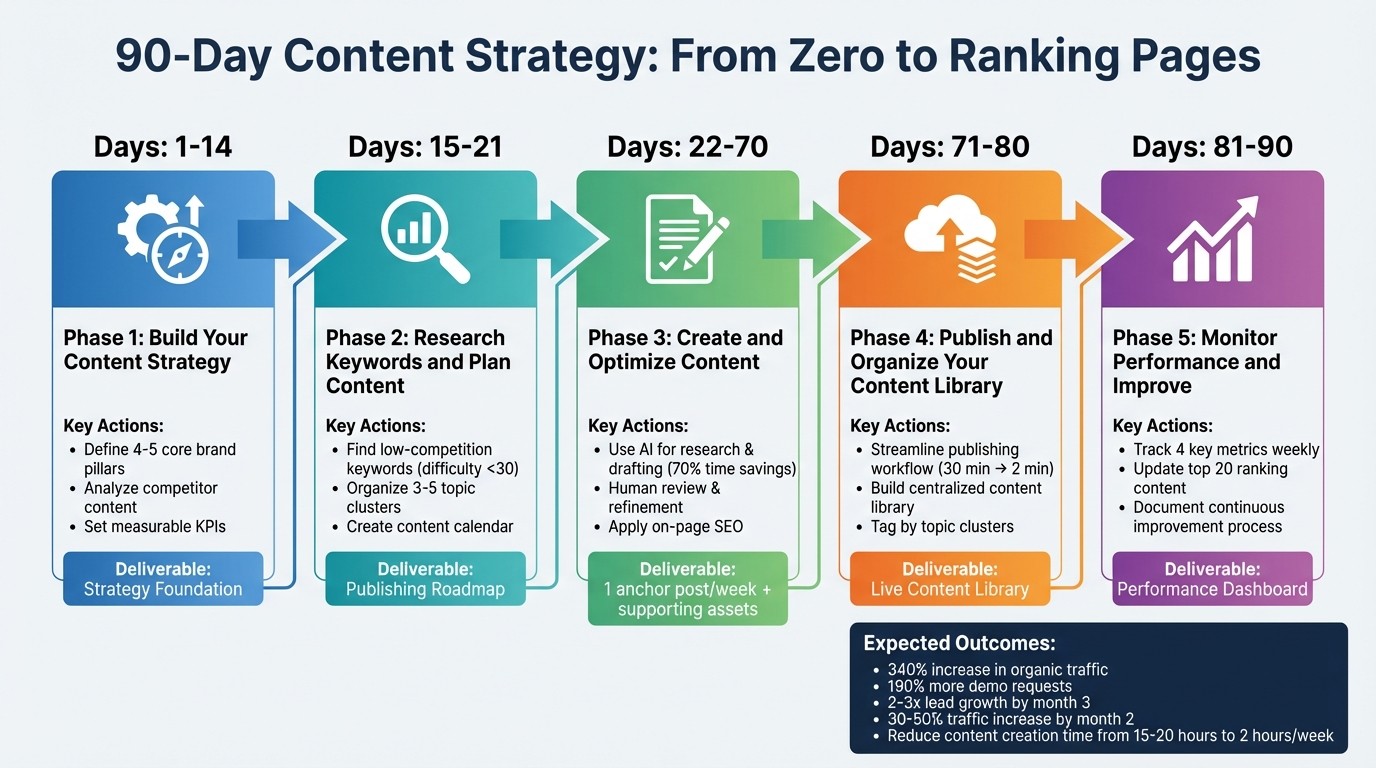
90-Day Content Strategy Timeline: From Zero to Ranking Pages
From 0 to 14,000 traffic in 90 days (with AI SEO)
Phase 1: Build Your Content Strategy (Days 1–14)
The first two weeks are all about laying the groundwork for a streamlined and effective content plan. While it takes some upfront effort, this phase ensures that everything moving forward becomes smoother and more efficient.
Define Your Target Audience and Goals
Start by pinpointing your audience and narrowing down 4–5 core brand pillars (e.g., "AI + Human collaboration") to guide your content. These pillars act as a compass, keeping your messaging focused and helping you avoid chasing fleeting trends [6].
Take a bold stance that sets your content apart. Ask yourself: what frustrates you about your industry, or what do you believe that others don’t? This unique perspective becomes your "flag" - a rallying point for your audience. Use AI tools like ChatGPT to uncover industry trends and brainstorm content ideas that address specific pain points [5][6].
Organize a stakeholder offsite to define your brand's voice. Develop a "voice fingerprint" by analyzing existing writing samples for tone, style, and personality. This fingerprint can be used to train AI tools to mimic your brand's unique style [6][7]. Map your content ideas to the buyer’s journey, prioritizing topics based on search volume and alignment with your perspective [6].
Once you’ve nailed down your audience and distinctive position, dive into competitor analysis to refine your strategy further.
Analyze Competitor Content
Understanding your competitors’ tactics is key to creating content that performs well. SEO success is always relative to the competition, and the landscape is constantly evolving [10]. Start by distinguishing between your business competitors and SEO competitors. Use incognito mode to search target keywords and identify the domains that frequently rank in the top 10 [8][9][11].
Dissect competitor content by examining its depth, structure, SEO elements, and user experience [8]. Break down their content briefs by looking at headings (H2s and H3s), word counts, sources, and visuals to understand their approach [8][11].
Conduct a keyword gap analysis to uncover opportunities. Look for:
"Missing" keywords: Competitors rank for these, but you don’t.
"Underperforming" keywords: Both you and your competitors rank, but they’re ahead.
"Quick Wins": Low-difficulty keywords that offer easy gains [8][9].
Pay attention to SERP features like featured snippets and "People Also Ask" boxes. Identify which competitors dominate these spaces and adapt their formatting to improve your chances [8]. Remember, 92% of global traffic comes from Google, and 75% of users never scroll beyond the first page [8].
"The goal is not to copy your competitors, but to reverse-engineer their success. By understanding the why behind their rankings, you can build a more intentional and effective strategy." - Outrank [11]
Differentiate your content by incorporating unique data, expert insights, or better visuals. Then, reach out to the backlink sources of your competitors [10]. Use an impact vs. effort matrix to prioritize actions, focusing first on "Quick Wins" that deliver high results with minimal effort [9][11].
Set Measurable Goals and KPIs
With your target audience and competitor insights in place, define clear, measurable goals to steer your content efforts. These KPIs will serve as benchmarks for your progress during the 90-day ranking process.
Identify one primary business goal - whether it’s generating leads, driving trials, or boosting sales [13]. Track operational metrics like "Draft Time" (aim for under 30 minutes using AI) and "Coverage Score" to monitor efficiency [13].
Establish a strong technical foundation by measuring "Crawl Depth" and resolving any critical errors, such as robots.txt blocks or redirect chains, to ensure smooth indexing [13]. For visibility, set goals for "Indexed Pages" within the first 30 days to confirm that search engines are recognizing your new content [13].
Organize your keywords into intent buckets - informational, comparison, and transactional - so you can track your coverage across the entire buyer journey [13]. Set achievable 90-day goals based on typical outcomes: publishing 15–30 URLs in the first month, achieving a 30–50% traffic increase in the second month, and doubling or tripling lead volume by the third month [13].
"The algorithm never sleeps, but you don't have to feed it." - Zach Chmael, Head of Marketing, Averi [13]
Phase 2: Research Keywords and Plan Content (Days 15–21)
With your strategy in place, the next step is to turn those insights into a well-structured publishing plan. Over the next week, you'll focus on identifying keywords that can deliver quick results, grouping them into clusters to build authority, and creating a content calendar to keep everything on track. This phase is all about aligning your content with your audience's needs while setting yourself up for faster rankings.
Find Keywords for Quick Wins
Start by identifying keywords that are both low in competition and high in intent. Look for terms with a difficulty score under 30 and monthly search volumes between 300 and 5,000. These should also have clear commercial or informational intent. Tools like Ahrefs or SEMrush can simplify this process by highlighting opportunities where top-ranking pages lack depth or miss key angles.
For example, keywords such as "AI tools for keyword research 2026" (difficulty 15), "build topic clusters fast" (difficulty 20, volume 300), or "90-day SEO content plan template" (difficulty 25) often rank faster because they target niche, underserved topics.
Double-check the top 10 search results to ensure the intent matches your audience. If you're targeting small business owners seeking quick SEO wins, consider phrases like "90-day content strategy for solopreneurs" - these often have search volumes between 500 and 5,000 and may not be fully addressed by existing content. Cross-reference these keywords with the audience personas you developed in Phase 1 to ensure a perfect fit.
Once you've compiled your quick-win keywords, organize them into topic clusters to build authority and improve visibility.
Organize Content with Topic Clusters
Topic clusters are essential for establishing credibility with search engines. They revolve around one central pillar page (2,500–4,000+ words) supported by 8–12 interlinked articles (1,500–2,500 words each). This approach signals to search engines that you're a comprehensive resource on a given subject.
Choose 3–5 pillar topics from your keyword research that align with your overall business goals. For each pillar, identify 10–20 related subtopics using tools like Ahrefs Content Gap to find areas your competitors may have overlooked. Plan your internal linking structure early - use descriptive anchor text (e.g., "learn keyword quick wins") and limit each page to 3–5 links to maintain link equity. A simple spreadsheet can help you track links and ensure bidirectional connections between pillar and cluster content.
Data shows that topic clusters can increase organic traffic by 43%, while strategic internal linking within clusters boosts traffic by an additional 37.1% [14]. To establish authority quickly, aim to publish one pillar page and four supporting posts each month during your 90-day sprint.
This structured approach lays the groundwork for a consistent content calendar that keeps your audience engaged.
Create a Content Calendar
A content calendar is your roadmap for consistent publishing. Set up a calendar that includes columns for Date, Topic, Format, Channel, and KPIs. Schedule one pillar post per week - for instance, Week 3 could feature a detailed keyword research guide - alongside 2–3 micro-content pieces like social media posts or newsletter snippets to support it.
To balance your content strategy, aim for a mix of 60% educational, 30% promotional, and 10% entertaining content. Establish clear milestones, such as "Finalize 12 pillar topics by Day 21" or "Publish first cluster by Day 28." Track metrics like gaining 50 new subscribers or achieving a 5% increase in traffic per piece. Here's an example of a simple content calendar:
Date | Content Type | Topic Cluster | Channel |
|---|---|---|---|
Sept. 1 | Anchor Post | Keyword Research | Blog |
Sept. 8 | Social MicroStory | Quick Win Tips | |
Sept. 15 | Newsletter | Anchor Promotion |
Stick to a weekly rhythm for planning, creating, repurposing, and scheduling content. Use AI-powered tools to streamline these tasks and ensure your content operation runs efficiently through the remaining phases. This structured approach will help you stay on track while maximizing audience engagement.
Phase 3: Create and Optimize Content (Days 22–70)
Over the next seven weeks, it’s time to bring your strategy to life by creating and publishing content. This phase shifts from planning to production, with a focus on consistently publishing high-quality pieces. The aim is to release one anchor article per week, along with supporting assets, while preserving your brand’s voice and ensuring accuracy. AI tools can speed up research and drafting, but human input remains essential for refining and maintaining engagement.
Use AI for Research and Drafting
AI can handle up to 70% of the time-consuming tasks in content creation, such as research and drafting. Begin by using AI to gather facts, statistics, and quotes, ensuring each source is hyperlinked for credibility. This approach eliminates the need for hours of manual searching. When drafting, give AI tools detailed prompts that align with your brand’s voice, target audience, and SEO goals. For instance, instead of a vague request like “Write about keyword research,” try something like: “Draft a 1,500-word guide on keyword research for solopreneurs launching their first content strategy. Use a conversational tone, include H2 headings every 300 words, and finish with an FAQ section.”
Tools like Averi AI streamline this process by storing your brand guidelines, audience personas, and value propositions, ensuring every draft aligns with your established tone without repetitive instructions. During the drafting stage, apply structured data like FAQ, How-To, and Article schema markup to improve visibility in AI-driven search results. Proper schema implementation can boost AI-generated response visibility by 30–40%[1][3]. Additionally, using tables and bullet points enhances readability and increases AI response visibility by the same margin[3].
Once AI drafts are ready, the focus shifts to refining them through human collaboration.
Refine Content Quality Through Collaboration
To elevate AI-generated drafts, implement a three-step review process: subject matter, editorial, and SEO. First, a subject matter expert ensures factual accuracy and identifies gaps (24–48 hours). Next, an editor refines clarity, tone, and engagement (24 hours). Finally, an SEO specialist optimizes on-page elements and internal linking (12–24 hours). To avoid delays, use asynchronous tools that allow reviewers to provide feedback simultaneously.
"Human editors shouldn't rewrite AI content - they should enhance it with insights, personality, and strategic nuance that AI cannot provide." – Zach Chmael, Head of Marketing, Averi[12]
Focus on adding proprietary data, specific statistics, and branded terminology to transform generic drafts into unique, engaging content. Data shows that human-edited AI content achieves 25% higher engagement rates, measured by metrics like time on page and social shares, compared to fully AI-generated pieces[4]. In one 2025 example, a consulting firm combined AI trend analysis with expert editing to publish 52 pieces across 8 platforms in a 48-hour news cycle. This effort led to a 1,247% spike in LinkedIn engagement and 23 media mentions within 72 hours[12].
To maintain momentum, keep the workflow moving by working on multiple pieces simultaneously. For example, while one draft undergoes editorial review, start drafting or refining the next. This approach allows you to publish one anchor piece weekly while generating 3–5 additional supporting assets from each anchor.
Apply On-Page SEO and Formatting
After refining drafts, ensure each piece is optimized for SEO. Start with the basics: write meta descriptions of 150–160 characters that include the primary keyword and a compelling call-to-action. Keep URLs concise and keyword-focused, and use one H1 tag per page, supported by relevant H2 and H3 headings to create a logical content structure.
Optimize content by placing the main keyword within the first 100 words and maintaining a keyword density of 1–2%. Add internal links to related content using descriptive anchor text and include 2–3 external links to authoritative sources to build topical relevance. For longer articles, include a “Key Takeaways” or TL;DR section at the top to provide quick value and improve AI summarization[1][2].
Enhance readability by keeping paragraphs to 3–4 sentences, bolding key phrases, and using numbered lists for step-by-step instructions. Update content regularly with fresh data (targeting 2024–2025 statistics) and include “Last Updated” dates to meet the recency bias of platforms like Perplexity[1][3]. For example, in August 2025, a D2C skincare brand used AI-powered personalization and real-time monitoring to create 127 assets for a seasonal campaign. By optimizing on-page elements and leveraging structured data, they achieved a 284% increase in email click-through rates, a 43% drop in cost-per-acquisition, and launched campaigns 89% faster than traditional methods[2][12].
Track your progress using metrics like time on page (aim for over 2 minutes), bounce rate (under 50%), and keyword ranking improvements through Google Search Console[4]. Save every piece in a content library to build a resource that enhances future AI drafts and streamlines your workflow.
Phase 4: Publish and Organize Your Content Library (Days 71–80)
After creating and refining your content, it’s time to bring it to life. This phase focuses on publishing efficiently and setting up a system that keeps everything organized for future updates. Over the next ten days, the goal is to ensure your content goes live seamlessly while building a structure that simplifies future production and enhances long-term value.
Streamline Your Publishing Workflow
Manual publishing can be a time sink and prone to errors. Instead, streamline the process by integrating directly with your CMS. Tools like Averi AI can export fully optimized drafts with SEO tags, meta descriptions, and structured data already in place, reducing the time to publish a single piece from 30 minutes to just 2 minutes. By automating exports in formats like HTML or Markdown, you can avoid common issues like broken links or formatting glitches.
Adopt a staggered publishing schedule to maintain visibility and optimize performance. For instance, publish a cornerstone piece on Day 1, followed by 2–3 supporting posts each week, and send out a mid-month newsletter. Automate checks for broken links, alt text, and meta tags to catch errors before they go live. A weekly workflow might look like this:
Monday: Spend 15 minutes planning content priorities.
Tuesday: Focus on creating core content.
Wednesday: Repurpose content into clips or social posts.
Thursday: Edit, refine, and schedule everything for automatic publishing.
With this system in place, you’ll free up time and ensure consistency across all your content.
Build a Content Library
Creating a centralized content library is essential for efficiency and improving future drafts. Use tools like Google Sheets, Notion, or Airtable to organize all your published work. Track key details such as:
Publish date (MM/DD/YYYY format)
Title
Primary keyword
Content type (e.g., blog, email, social post)
Live URL
Performance notes
Add a tagging system to categorize content by topic clusters, audience needs, and SEO goals. For example, you might use tags like #QuickWinKeywords, #HighTraffic, or #AudiencePainPoint. Keep track of updates by versioning each piece - label the original as v1.0 (e.g., 08/15/2026) and any subsequent refresh as v1.1 (e.g., 09/01/2026).
Structure your library around your brand’s core themes, such as "AI + Human" or "Sustainable Scaling", rather than just organizing by date. This makes it easier to locate related content when planning new projects. Review your library each month to identify content worth repurposing or updating. High performers can be expanded or reused, while underperformers may need a refresh or removal. Over time, this approach turns your content into a valuable resource that grows in impact and efficiency.
Phase 5: Monitor Performance and Improve (Days 81–90)
After implementing your content strategy, the final phase is all about refining and expanding your efforts. These last ten days are crucial for measuring success and setting up systems to ensure continuous growth. The goal is to turn your 90-day sprint into a repeatable process that builds momentum over time.
Track Content Performance Metrics
Dedicate 15 minutes each week to reviewing analytics. Focus on four key metrics: indexed pages (how many pieces Google has crawled), impressions (how often your content appears in search results), clicks (actual traffic), and keyword rankings (your position for target terms). During the first month, you'll establish a baseline. By the second month, you should see a 30–50% increase in traffic from new content. By the third month, start tracking blog-assisted leads, as many teams report 2–3x lead growth at this stage [13].
To measure traffic from AI platforms, set up AI referral tracking in Google Analytics 4 using this regex filter: .*chatgpt\.com.*|.*perplexity.*|.*gemini\.google\.com.*|.*copilot\.microsoft\.com.* [1]. This will help you isolate sessions referred by tools like ChatGPT and Perplexity, which experienced a 527% jump in referred sessions in early 2025 [1]. Test your brand name, product comparisons, and problem-solving queries on these platforms to see if your content is being cited and linked [1].
Use this data to identify what's working and refine your approach.
Update Content for Better Rankings
Focus on improving content that ranks in the top 20 on Google. AI Overviews and language models rarely reference sources outside this range [1]. To increase visibility in conversational AI queries, add TL;DR summaries and FAQ sections with schema markup [1][3]. Content that includes specific data points or proprietary statistics is 30–40% more likely to appear in AI-generated responses [3].
Start by refreshing the earliest posts from your 90-day sprint. Incorporate E-E-A-T signals (Experience, Expertise, Authoritativeness, and Trustworthiness), update with new data, and add internal links to boost performance [13].
Set Up a Continuous Improvement Process
Once updates are in place, document what’s driving traffic, which keywords are converting, and which workflows are the most efficient. Create a weekly routine where you approve drafts, review analytics, and identify areas for refinement [13]. Perform SERP Gap Audits by comparing competitor keywords and rankings to your own, uncovering opportunities for new content [13]. Make sure your robots.txt file allows AI-specific crawlers like GPTBot, PerplexityBot, and ClaudeBot to access your site, ensuring your updates are indexed by generative engines [1][3].
The key here is building momentum. Your content library has become a growing asset. Each new piece strengthens your presence, and every update enhances your authority. With these systems in place, you’re not starting from scratch anymore - you’re scaling on a solid foundation.
Conclusion: What You Can Achieve in 90 Days
In just 90 days, you can develop a fully functioning content engine. By Day 14, you’ll have a strategy that clearly defines your audience and goals. By Day 21, your content calendar will focus on quick-win keywords. By Day 70, optimized drafts will be ready. By Day 80, your content library goes live, and by Day 90, you’ll be tracking performance, making updates, and scaling your results. This step-by-step approach not only builds your content library but also creates a repeatable system for long-term growth.
However, timing is only part of the equation. The quality of your execution plays a critical role. A clear strategy ensures your efforts are aimed at the right audience and keywords. AI tools can significantly speed up the content creation process, helping you gain momentum quickly. Consistent, data-driven iteration - through weekly reviews, monthly updates, and quarterly audits - turns your initial push into a sustainable asset.
The goal isn’t perfection from the outset; it’s about creating a system that improves over time. Your early work sets the stage, and regular refinements help you scale effectively. Well-optimized content not only ranks on Google but also has the potential to be cited by AI platforms like ChatGPT and Perplexity. Additionally, content enhanced with FAQ schema and precise data points can achieve 30–40% greater visibility in AI-generated responses [1][3]. Each new piece you publish builds on the success of the last.
This 90-day plan isn’t the end - it’s the beginning. You’re no longer starting from scratch. With a growing content library, an efficient workflow, and actionable data, you’ll be able to keep approving drafts, analyzing performance, and seizing new opportunities. Update top-performing content with fresh insights, strengthen authority with internal links, and maintain a consistent publishing schedule. That’s what sets enduring content apart from material that fades into obscurity.
Use the momentum you’ve built over these 90 days to push even further. Take advantage of Averi’s AI-human workflow to streamline your efforts. From strategy and research to drafting, optimization, and publishing, Averi handles it all. Explore what’s possible by signing up at averi.ai for your free marketing plan.
Related Blog Posts

Zach Chmael
CMO, Averi
"We built Averi around the exact workflow we've used to scale our web traffic over 6000% in the last 6 months."
Your content should be working harder.
Averi's content engine builds Google entity authority, drives AI citations, and scales your visibility so you can get more customers.