

In This Article
Explore how AI transforms customer interactions through real-time data integration, personalized experiences, and optimized touchpoints for growth.
Updated:
Trusted by 1,000+ teams
Startups use Averi to build
content engines that rank.
AI is transforming how businesses interact with customers by enabling instant, personalized, and relevant communication across channels. By analyzing real-time data, AI ensures every customer experience feels connected and timely. It solves common challenges like fragmented systems, slow insights, and limited scalability, allowing businesses to deliver tailored experiences at scale. Here's how AI tackles these issues:
Unified Data: AI integrates customer information from various platforms, eliminating disconnected systems.
Real-Time Action: AI processes and responds to customer behavior instantly, preventing missed opportunities.
Personalization at Scale: AI customizes interactions for each individual, even across millions of users.
For example, AI can send a personalized email minutes after a customer browses a product or predict when a customer may need support. Businesses using AI for customer interactions report a 25% increase in satisfaction and a 15% revenue boost. With AI adoption growing rapidly, companies that act now will outpace competitors in delivering seamless customer experiences.
Personalized Customer Strategy in the Age of AI: A Five-Part Framework for Driving Growth
Problems with Real-Time Customer Touchpoint Optimization
Businesses aiming to create seamless customer interactions often face three major hurdles: disconnected systems, delayed insights, and the inability to scale personalization effectively. These challenges disrupt customer experiences and hinder real-time optimization efforts.
Data Silos and Disconnected Customer Journeys
One of the biggest obstacles to real-time optimization is fragmented data. Many businesses store customer information across multiple platforms - CRM systems, email marketing tools, website analytics, social media platforms, and point-of-sale systems - without a unified system to tie it all together.
This lack of integration leads to inconsistent customer experiences. For example, promotions may be repeated or pricing may vary across channels, causing confusion and frustration. When departments operate with incomplete customer profiles, delivering a cohesive experience becomes nearly impossible.
Even traditional data integration projects struggle to keep up. These projects often take months or even years to complete, and by the time they're operational, the needs of the business have already evolved. Meanwhile, customers are left dealing with interactions that feel impersonal and disjointed.
Slow Insights and Decision-Making
Delayed insights are another major roadblock to optimizing customer interactions in real time. While traditional analytics tools offer useful information, they are typically designed for historical analysis rather than immediate action. Businesses often rely on weekly or monthly reports to understand customer behavior, which means they’re always playing catch-up.
This lag results in countless missed opportunities. For instance, when a customer abandons their shopping cart, the ideal time to re-engage is within minutes - not days. Similarly, if someone interacts with a social media post or downloads a resource, the follow-up must be immediate to capture their interest while it’s still fresh.
Unfortunately, traditional workflows often delay action by days, and by the time a response is ready, the opportunity for meaningful engagement has already passed.
Adding to the problem, many analytics tools require specialized skills to interpret the data. Marketing teams frequently depend on analysts to extract actionable insights, creating bottlenecks that slow campaign adjustments and prevent quick responses to changing customer behavior.
Limited Personalization at Scale
Personalization becomes increasingly difficult as businesses grow. While manual efforts may work for small audiences, they simply don’t scale. Broad demographic segmentation - though easier to manage - fails to capture the nuances of individual customer needs.
For example, consider two 35-year-old customers in Chicago who both purchased laptops last month. Despite sharing basic demographic traits, their preferences and needs could be entirely different. Grouping them together under a broad segment risks delivering irrelevant or generic messaging.
The challenge is amplified by the sheer number of channels modern customers use. Whether it’s email, social media, websites, mobile apps, or in-store visits, each touchpoint demands a personalized approach. Maintaining consistency across all these channels manually is a nearly impossible task.
Even businesses that invest in personalization tools often face technical hurdles. Implementing dynamic content across multiple channels can be complex, and when execution falls short, the result can be inconsistent or irrelevant messaging. Instead of building stronger connections, poorly executed personalization risks alienating customers and weakening relationships.
How AI Fixes Customer Touchpoint Optimization Problems
AI is reshaping how businesses approach customer touchpoints, tackling long-standing challenges with precision and speed. By connecting fragmented systems and responding in real time, AI aligns seamlessly with customer behaviors, offering a transformative approach to optimization.
Real-Time Data Integration and Analysis
One of AI's standout abilities is its knack for breaking down data silos. It integrates information from various sources - CRM systems, analytics platforms, social media, email, and even point-of-sale systems - into a unified and constantly updated customer profile. Instead of waiting for batch updates, AI processes data as it comes in, delivering insights in seconds.
Imagine a customer browsing your website, clicking on an email, or engaging on social media. AI captures each action instantly, weaving these interactions into a comprehensive view of their journey. It doesn’t just stop at collecting data - it harmonizes different formats and connects systems without requiring months of custom integrations. This means businesses can start optimizing customer experiences almost immediately, skipping the delays of traditional implementations.
Beyond just gathering data, AI uncovers patterns that might otherwise go unnoticed. For instance, it could highlight that engagement on specific social platforms often leads to faster purchasing decisions, enabling brands to act strategically and at the right moment. This real-time, unified data foundation is what allows businesses to adapt dynamically to customer needs.
Dynamic Journey Mapping and Adaptation
Static journey maps often fall short in today’s fast-paced environment. AI changes the game by creating dynamic journey maps that evolve in real time based on customer behavior. As customers interact with your brand, these maps adjust, ensuring pathways remain relevant and effective.
For example, if a customer initially appears to be researching but then shows signs of readiness to buy, AI detects the shift and adapts the journey accordingly. It predicts the next best action based on the customer’s current behavior and past interactions, moving businesses from reactive responses to proactive engagement. Instead of waiting for a customer to abandon their cart, AI identifies early warning signs and intervenes with personalized offers or assistance.
This adaptability extends beyond individual interactions. AI learns from successful touchpoints and refines its recommendations over time, creating a system that gets smarter with each iteration. It even accounts for external factors like seasonal trends or market changes, ensuring strategies remain relevant in a constantly shifting landscape.
AI-Driven Personalization and Predictive Insights
Personalization at scale has always been a challenge, but AI overcomes this by treating each customer as a unique individual rather than lumping them into broad segments. It crafts tailored experiences that reflect each person’s preferences and behaviors, delivering consistency across all channels.
For instance, if a customer values detailed product information, AI ensures this preference is honored - whether through email, website content, social media, or in-store interactions. This level of coordination, difficult to achieve manually, becomes seamless with AI.
AI doesn’t just personalize the present; it predicts the future. By analyzing customer data, it identifies signals that hint at upcoming actions, such as when someone might make their next purchase or which products they’re likely to find appealing. This predictive capability enables businesses to engage proactively, reaching out with the right message at the perfect time.
Timing is everything, and AI excels at optimizing it. Instead of sending generic campaigns to everyone simultaneously, AI determines the best moment for each individual, based on their unique engagement patterns. This personalized timing not only boosts response rates but also enhances customer satisfaction.
Case Study: AI Workspaces vs. Marketplaces vs. Point Tools
Optimizing customer interactions today demands more than just quick responses - it requires a thoughtful combination of automation and human expertise. Businesses aiming to streamline these interactions usually choose from three main solutions: AI workspaces, talent marketplaces, and point tools. Each offers its own strengths but varies in its ability to deliver seamless and personalized customer experiences.
AI workspaces, such as Averi AI, act as centralized hubs where AI-driven strategies merge with human expertise to address customer needs. On the other hand, talent marketplaces like Fiverr or Upwork connect businesses with freelancers for specific tasks, while point tools like Jasper or Copy.ai focus on single functionalities - like content creation, analytics, or chatbot services - without broader system integration.
The choice among these approaches can significantly affect how quickly and effectively a business responds to customers. A well-chosen solution can mean the difference between addressing customer needs instantly or leaving them waiting, which can lead to frustration and lost revenue. This comparison underscores the importance of balancing speed with strategic integration.
Features of AI Workspaces: The Averi AI Approach
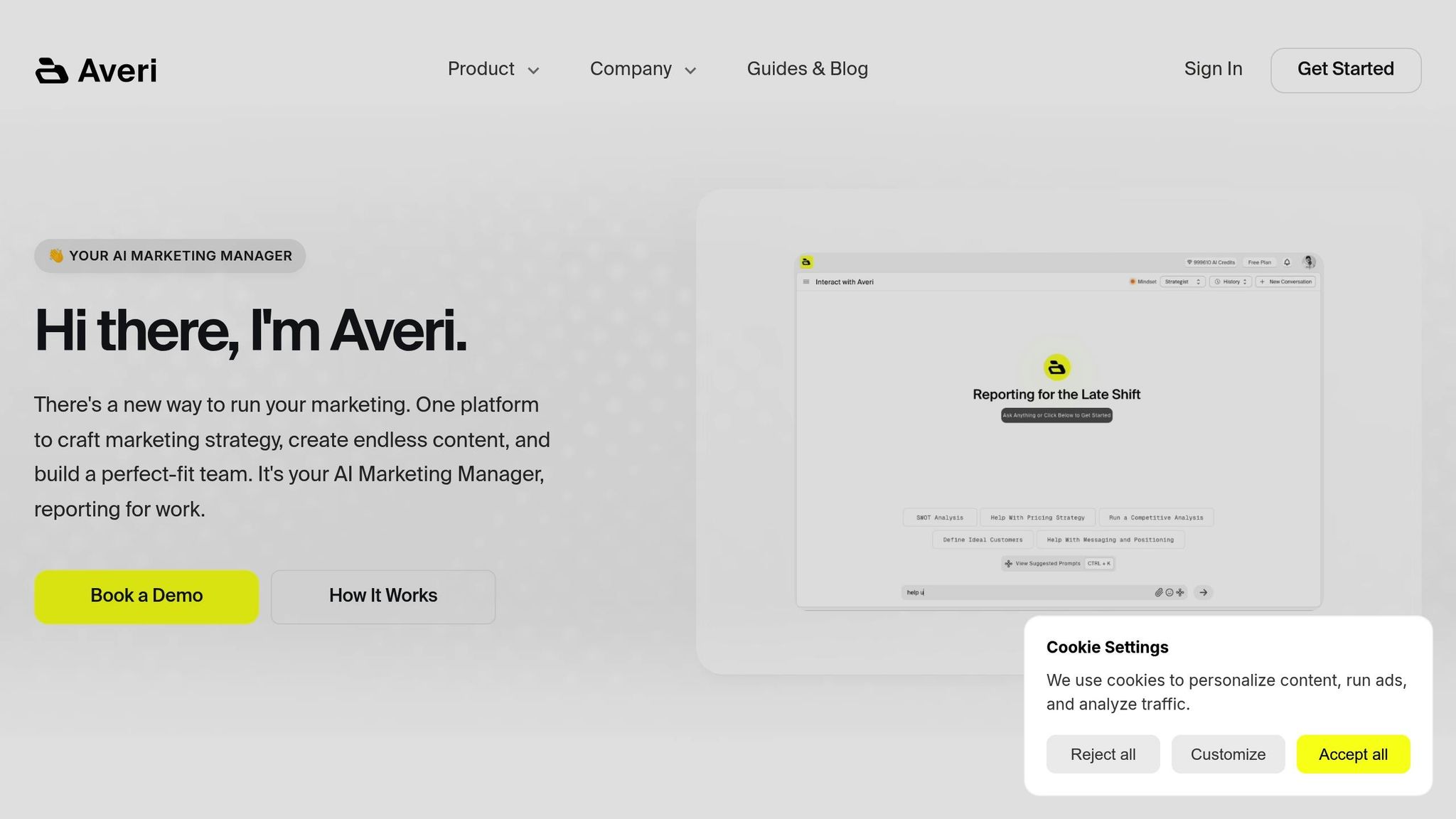
AI workspaces represent a new way of managing customer touchpoints. Platforms like Averi AI create a cohesive environment where strategy, execution, and human expertise work in harmony.
Averi AI's Synapse architecture is designed to intelligently manage tasks, determining when to handle requests automatically and when to involve human specialists. Its AGM-2 foundation model, tailored for marketing, ensures that output aligns with brand voice and context. For instance, if a customer abandons their shopping cart, Averi AI analyzes factors like browsing history, past purchases, and sentiment to craft a personalized follow-up via SMS, email, or in-app messaging. Complex issues can be escalated to vetted specialists without disrupting the workflow.
This adaptive reasoning eliminates the need for juggling multiple tools, simplifying operations and ensuring a smoother customer experience.
Marketplaces and Point Tools: Challenges in Real-Time Optimization
Talent marketplaces depend on freelancers who often lack access to integrated customer data, leading to disjointed operations. Similarly, point tools function in isolation - a chatbot might efficiently manage website inquiries but fail to integrate with email or social media platforms. This lack of connectivity can result in delays and generic responses that fail to meet individual customer expectations.
To clarify these differences, the following table provides a side-by-side comparison:
Comparison Table: AI Workspaces vs. Marketplaces vs. Point Tools
Feature | AI Workspaces (Averi AI) | Marketplaces | Point Tools |
|---|---|---|---|
Real-Time Response | Instant, automated with strategic oversight | Delayed, depending on freelancer availability | Limited to specific functions |
Data Integration | Unified, cross-channel in real time | Fragmented and manual | Siloed, with limited integration |
Personalization Scale | Scalable to millions of interactions simultaneously | Limited by human bandwidth | Basic, rule-based |
Total Cost of Ownership | Consolidated – Averi AI Plus starts at $45/month | Higher due to variable freelancer fees | Low upfront costs but additional hidden expenses |
Quality Control | Consistent, AI-monitored adherence to brand guidelines | Varies based on freelancer expertise | Tool-dependent, often inconsistent |
Workflow Integration | Seamless, end-to-end automation | Requires manual coordination | Needs custom integrations |
Human Expertise | Built-in network of vetted specialists | Requires separate procurement | Not included |
Scalability | Handles growth automatically | Limited by freelancer availability | Difficult to scale across touchpoints |
AI-driven solutions have proven to enhance customer satisfaction by 25% while boosting revenue by 15% [2]. These improvements stem from the ability to deliver personalized, consistent responses in real time across all customer interactions.
Cost is another critical factor. While point tools might seem affordable initially, businesses often face additional expenses from managing multiple subscriptions and custom integrations. Similarly, talent marketplaces can become costly when multiple freelancers are needed to handle complex workflows. By consolidating functions into a unified platform, AI workspaces like Averi AI not only reduce costs but also ensure faster, more cohesive responses, leading to better outcomes with less overhead.
Measuring AI's Impact on Customer Experience
AI is reshaping how businesses engage with customers, but its true value lies in measurable outcomes. By monitoring specific metrics, companies can assess how effectively AI enhances customer interactions across various touchpoints. These metrics not only confirm AI's impact but also pinpoint areas for improvement, forming the basis for refining overall strategies.
Key Metrics for Success
Customer satisfaction scores are a reliable indicator of how well AI enhances interactions. When AI delivers personalized, timely responses, these scores tend to rise. For example, AI can reduce response times from hours to mere seconds, ensuring faster resolutions across multiple channels.
Conversion rates provide a direct measure of engagement and effectiveness. When AI optimizes touchpoints, customers navigate the sales funnel more seamlessly. Metrics such as email click-through rates, cart recovery rates, and lead-to-customer conversions reflect this improvement, showing how AI helps customers progress toward purchase decisions.
Customer retention rates highlight AI's long-term influence. By personalizing interactions, AI fosters stronger relationships, often leading to higher customer lifetime value. Metrics like repeat purchases and subscription renewals underscore how consistent, relevant experiences keep customers coming back.
Revenue per customer offers a financial lens to evaluate AI's impact. This metric tracks how personalized touchpoints encourage customers to spend more or explore additional products. Success in cross-selling and upselling demonstrates AI's ability to identify and act on revenue opportunities during interactions.
Operational metrics reveal cost efficiencies and productivity gains. These include the number of inquiries handled automatically, reductions in human agent workloads, and faster resolution times for complex issues. By automating routine tasks, AI significantly lowers costs per interaction while reserving human resources for more intricate challenges.
Continuous Improvement Through Real-Time Analytics
Real-time analytics take these metrics a step further, enabling businesses to continuously refine their AI systems. Modern platforms analyze every interaction, uncovering patterns and making immediate adjustments to improve outcomes.
Dashboards that display live data - such as response accuracy, satisfaction ratings, and conversion rates - allow for quick interventions before any issues affect a broader customer base.
A/B testing automation empowers AI to experiment with different approaches simultaneously. For instance, it might test two email subject lines or chat response styles, automatically favoring the option that performs better. This ensures strategies evolve based on what resonates most with customers.
Predictive analytics help businesses stay ahead of customer needs. By examining past interactions, AI can forecast when customers might require support, what products they’re likely to purchase, or when they might consider leaving. Acting on these insights allows businesses to proactively offer solutions, support, or promotions.
Customer feedback plays a critical role in refining AI systems. Ratings and comments from users feed directly into AI algorithms, improving responses over time. This creates a self-learning system that becomes increasingly adept at meeting customer expectations.
Ultimately, the success of AI lies in linking touchpoint performance to broader business outcomes. Systems that track both short-term metrics and long-term customer behaviors provide the most actionable insights, ensuring optimization efforts are directed at what truly drives business growth. By focusing on what matters most, companies can harness AI to deliver exceptional customer experiences while achieving measurable results.
Conclusion: Transforming Customer Touchpoints with AI
AI has reshaped the way businesses engage with their customers, replacing guesswork with precise, data-driven strategies. This shift isn't just about automation - it's about creating smart systems that evolve, refine, and get better with every interaction.
The impact is undeniable. AI-powered journey orchestration has been shown to increase customer satisfaction by 25% and boost revenue by 15% [2]. These numbers highlight a move from reactive responses to proactive, meaningful engagement.
Today, real-time personalization at scale is the new benchmark. AI makes it possible to deliver tailored, high-quality interactions to millions of customers simultaneously, something that was unimaginable just a few years ago.
But achieving these results requires more than just piecemeal tools. Integrated AI platforms offer a comprehensive solution, combining strategy, content creation, and human expertise in one seamless system. Platforms like Averi AI demonstrate this evolution, functioning like an all-in-one marketing team. With its Synapse architecture and AGM-2 foundation model, Averi AI not only thinks strategically and retains past work but also knows when to involve human specialists - an edge that standalone AI tools simply can't replicate.
For businesses ready to redefine their customer touchpoints, the roadmap is straightforward: start by analyzing your current customer journey, pinpoint areas where AI can reduce friction, and implement solutions that allow for constant testing and improvement. The brands that succeed will be those that remain adaptable, stay curious, and deliver the right message at the right moment [1].
With AI adoption in customer experience projected to grow by 30% over the next two years [2], delaying implementation is no longer an option. Companies that act now will set the pace for customer engagement in their industries, while those that hesitate risk falling behind in an increasingly competitive environment.
FAQs
How does AI unify data from different platforms to create a seamless customer experience?
AI brings together data from diverse platforms by automatically gathering, analyzing, and combining information from websites, mobile apps, social media, and even physical stores. This process creates a single, unified view of customer interactions, enabling businesses to offer more tailored and consistent experiences.
By automating how data is integrated and simplifying workflows, AI breaks down information silos and ensures that data is both accessible and actionable. This approach not only boosts customer satisfaction but also enhances operational efficiency, empowering companies to address customer needs promptly and effectively.
What advantages do AI workspaces like Averi AI offer compared to talent marketplaces or single-function AI tools for optimizing customer interactions?
AI workspaces like Averi AI bring a smarter, more integrated way to enhance customer interactions. They combine AI-powered strategy, content creation, and campaign planning with the expertise of human professionals. This approach allows businesses to deliver quicker, more tailored responses while adjusting effortlessly to real-time data.
Unlike talent marketplaces, which rely on external freelancers and can result in uneven outcomes, or single-function AI tools that often lack strategic adaptability, AI workspaces provide an all-in-one solution. They simplify workflows, cut down on delays, and strike the perfect balance between AI efficiency and human creativity. This enables businesses to run campaigns effectively without compromising on quality or personalization.
How can businesses evaluate the impact of AI on customer satisfaction and revenue growth?
To gauge how AI influences customer satisfaction and revenue growth, businesses should prioritize monitoring critical metrics such as Customer Satisfaction Score (CSAT), Net Promoter Score (NPS), and retention rates - all indicators of customer loyalty and overall satisfaction.
In addition, keeping an eye on revenue growth, reduced churn rates, and faster response times provides a clear picture of AI's impact on financial performance and operational efficiency. By pairing these tangible metrics with qualitative feedback, companies can develop a comprehensive view of AI's contributions and its role in achieving long-term success.
Related Blog Posts

Zach Chmael
CMO, Averi
"We built Averi around the exact workflow we've used to scale our web traffic over 6000% in the last 6 months."
Your content should be working harder.
Averi's content engine builds Google entity authority, drives AI citations, and scales your visibility so you can get more customers.