How to Build a No-Code Marketing Stack for Healthcare & Wellness

Averi Academy
Averi Team
8 minutes

In This Article
Step-by-step guide to building a HIPAA-aware no-code marketing stack for healthcare: automate lead capture, patient communication, content, and reporting.
Updated:
Trusted by 1,000+ teams
Startups use Averi to build
content engines that rank.
Healthcare marketing faces unique challenges: strict HIPAA compliance, tight budgets, and the need for fast, effective patient engagement. Delays in responding to inquiries or managing manual workflows can cost potential patients. No-code tools and automation solve these issues by enabling secure, efficient systems that handle tasks like patient intake, follow-ups, and content creation.
Key Takeaways:
Speed Matters: Automate lead response to cut delays and improve patient conversion rates.
Stay Connected: Use tools like HubSpot for personalized patient communication, reminders, and follow-ups.
Content Simplified: AI tools like Averi create educational materials quickly while maintaining compliance.
Data Security: Ensure all tools meet HIPAA standards and safeguard patient information.
Steps to Build Your Stack:
Set up a database (e.g., Airtable) for managing leads and marketing data.
Use a CRM (e.g., HubSpot) to streamline patient communication and track engagement.
Automate workflows with platforms like Zapier to connect tools and reduce manual tasks.
Leverage AI tools for compliant, efficient content creation and campaign execution.
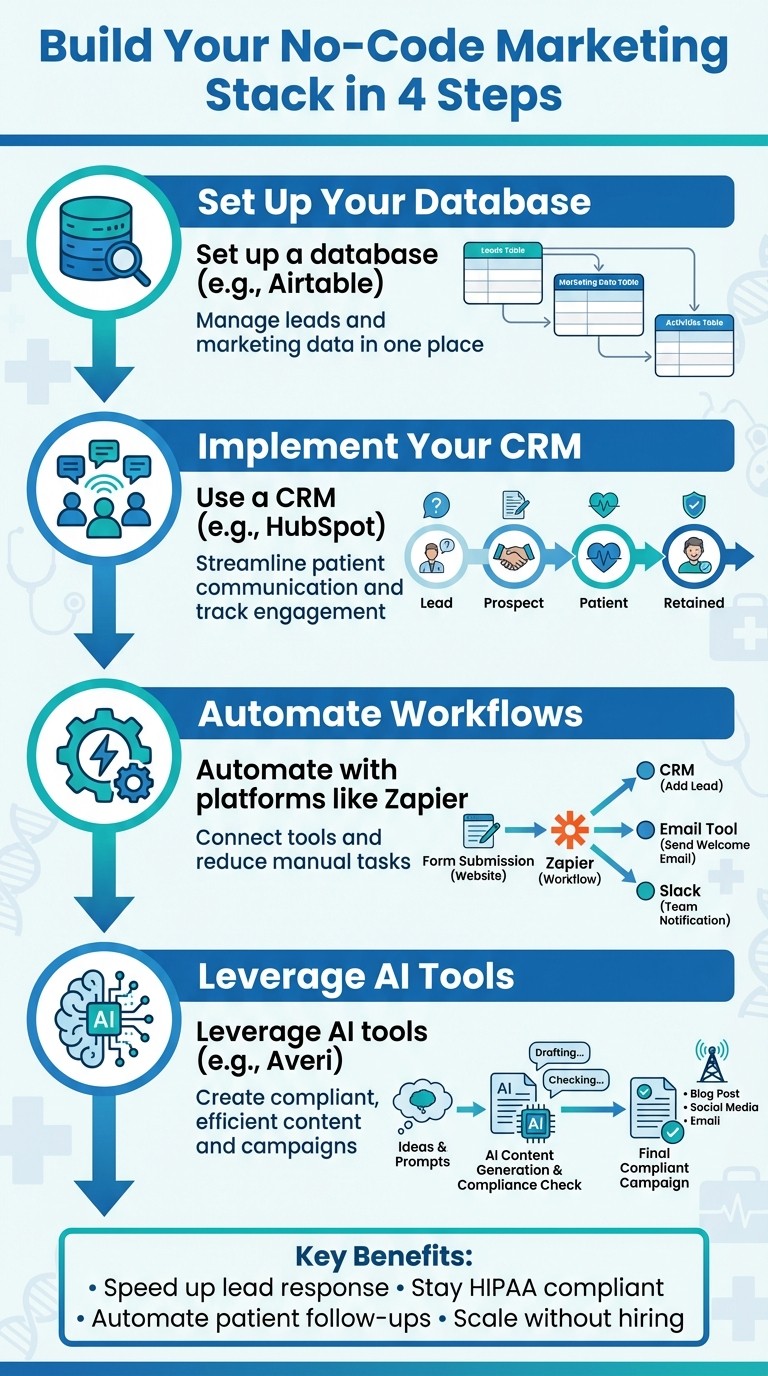
4-Step No-Code Marketing Stack Implementation for Healthcare
4 Game-Changing Automations That Save Private Practice Therapists Hours Every Week
Key Marketing Workflows to Automate
Building an efficient no-code marketing stack for healthcare and wellness starts with automating workflows that attract new patients, streamline communication, and ensure adherence to regulations. The most impactful areas to tackle include inbound lead management, patient communication, delivering educational content, and safeguarding data. These foundational workflows lay the groundwork for incorporating the right no-code and AI-driven tools into your marketing strategy.
Lead Capture and Patient Intake
When a patient fills out a contact form, responding quickly is non-negotiable. In healthcare marketing, timing is everything - delays of even a few hours can significantly lower conversion rates. Automating lead enrichment and immediate follow-ups ensures you connect with potential patients when their interest is at its highest. Tools like Zapier can link your web forms to a CRM, enabling instant follow-ups, seamless data integration into your patient database, and triggering automated response workflows.
Patient Communication and Follow-Up
After capturing leads, maintaining a consistent line of communication is key to keeping patients engaged. Automated systems can handle appointment reminders, follow-ups, and condition-specific educational messages, ensuring patients stay informed and connected.
"Thanks to Copy.ai, we're generating 5x more meetings with our personalized, AI-powered GTM strategy" [1].
Platforms like HubSpot or specialized patient communication tools can deliver these messages at scale, ensuring they remain timely and personalized. Integrating these tools with your CRM allows for seamless tracking and ensures all interactions align with your broader marketing efforts.
Educational Content and Wellness Programs
Automated email campaigns can provide valuable wellness tips, preventive care reminders, and condition-specific educational materials tailored to your patients. AI-powered tools can drastically speed up content creation, turning what once took weeks into tasks completed in minutes [1]. This efficiency empowers smaller teams to maintain robust patient education initiatives without the need for additional staff or costly agencies. Once created, the content is fed into your automation platform for scheduled delivery and performance monitoring.
Compliance and Data Security
In healthcare, meeting HIPAA requirements is non-negotiable. Every tool in your marketing stack must comply with HIPAA standards and offer Business Associate Agreements (BAAs) and SOC 2 Type II certification as basic safeguards. Consolidating workflows into a unified platform enhances data governance [1], ensuring patient information is securely managed and flows seamlessly through your marketing stack into reporting systems.
Choosing No-Code and AI Tools for Your Stack
Building the right toolkit for your healthcare marketing stack requires balancing user-friendliness, compliance with regulations, and scalability - without needing to hire a large IT team. The aim is to create a system where patient data moves securely between tools, workflows operate automatically, and your team can focus on delivering care instead of managing tech. The tools below integrate seamlessly with workflows to create an efficient marketing stack.
Database for Patient and Marketing Data
Airtable serves as a no-code, spreadsheet-style database tailored for non-technical users. It allows you to organize leads, appointments, and campaign data in customizable tables with linked records. For healthcare practices, Airtable consolidates data from various sources into one accessible platform. It can combine web form submissions, CRM records, and campaign performance metrics into a single, unified view. When paired with a HIPAA-compliant EHR system, Airtable can connect via automation platforms to pull non-sensitive marketing data - such as appointment types, referral sources, or patient interests - while ensuring protected health information (PHI) remains secure within the EHR.
CRM and Communication Platforms
HubSpot offers a robust suite of tools for marketing automation, patient communication, and reporting - all within one platform. Its free tier includes contact management, email marketing, and basic automation, while paid plans (starting at $45/month) unlock advanced features like custom reporting, complex workflows, and patient segmentation based on engagement, appointment history, or medical conditions. For smaller teams focused on email outreach, ActiveCampaign (starting at $29/month) provides affordable automation options, while Pipedrive (from $14/month per user) is ideal for practices prioritizing appointment scheduling and follow-ups. To ensure compliance, verify that your CRM includes a Business Associate Agreement (BAA) and meets SOC 2 Type II certification standards.
Automation Platforms for Connecting Tools
Zapier simplifies the process of connecting your database, CRM, calendar, and communication tools. For example, when a patient fills out a contact form on your website, Zapier can automatically create a CRM record, update your Airtable database, send a confirmation email, and notify your intake team - all in just seconds. With over 6,000 app integrations, Zapier eliminates the need for manual data entry or custom software development. Many healthcare practices use it to link tools like Calendly or Acuity Scheduling with their CRM, sync communication platforms with reporting dashboards, and trigger follow-up sequences based on appointment details.
AI-Powered Content Creation and Execution
Averi is an AI-driven marketing workspace designed to create patient-centered content while adhering to your practice’s branding and compliance standards. Its Brand Core feature stores your voice guidelines, medical expertise, and regulatory requirements, ensuring all content aligns with your standards before it reaches patients. The /create mode walks you through a three-step process (Discuss → Draft → Edit) to transform content briefs into ready-to-deploy blog posts, email campaigns, social media updates, and educational materials. For content requiring high medical accuracy or compliance review, Averi’s Human Cortex connects you with vetted healthcare content specialists who can seamlessly integrate your brand’s voice and guidelines. Additionally, the Library feature organizes marketing plans, patient profiles, past campaigns, and approved materials into custom folders, streamlining future projects. At $45/month for the Plus plan, Averi includes 1,200 AI tokens, privacy mode, and custom folder options, making it a key tool for producing compliant, high-quality content that supports patient engagement and education efforts.
How to Build Your No-Code Marketing Stack
Creating a no-code marketing stack involves designing a system where data flows seamlessly, tasks are automated, and your team can focus on what matters most - patient care. The goal is to replace disconnected tools with a unified workflow that keeps patient information organized, automates repetitive tasks, and ensures compliance at every step.
Set Up Your Database and CRM
Start by establishing a solid data foundation that integrates every part of your stack. Use Airtable to create three bases: one for lead tracking, another for campaign management, and a third for patient engagement metrics. Link these bases so that when a lead becomes a patient, their information updates across all tables automatically, eliminating the need for manual updates.
In HubSpot, customize healthcare-specific contact properties, such as appointment type, communication preferences, health interests, and consent status. Define lifecycle stages like Subscriber → Lead → Appointment Scheduled → Active Patient → Returning Patient. Segment your contacts based on their engagement levels, appointment history, or wellness program participation.
To keep your database and CRM in sync, connect Airtable to HubSpot through Zapier. This integration ensures that new Airtable records automatically update HubSpot contacts. If your practice handles sensitive medical information, store protected health information (PHI) exclusively in a HIPAA-compliant EHR system. Use Airtable for non-sensitive data like referral sources, campaign responses, and content preferences.
Automate Lead Capture and Appointments
Streamline lead capture by setting up a Zapier workflow that activates whenever someone submits a contact form on your website. This automation can create a new Airtable record, update HubSpot with the contact's lifecycle stage, and trigger email confirmations and intake notifications. Integrate Calendly or Acuity Scheduling to manage appointments. Zapier can update appointment statuses in both Airtable and HubSpot, send confirmation details, and assign preparation tasks to your team.
To maintain consistent communication, configure automated reminder sequences in HubSpot. After appointments, use follow-up workflows to send educational content related to the visit, gather feedback, and schedule future appointments as needed.
Use AI for Content Creation and Campaigns
Leverage Averi to streamline content creation while ensuring compliance and brand consistency. Start by setting up your Brand Core, which includes your practice’s voice guidelines, areas of medical expertise, compliance requirements, and target patient personas. Upload approved content, brand guidelines, and regulatory documents to create a centralized repository that informs all future content creation.
Use Averi's /create mode to develop patient education materials, email campaigns, and social media posts. Begin with the Discuss phase to outline your strategy - such as a four-week email series on managing diabetes. Move to the Draft phase, where Averi generates content based on your Brand Core, and refine it during the Edit phase. For materials requiring accuracy or compliance checks, activate Averi's Human Cortex to collaborate with healthcare content specialists who can review and refine the content while maintaining alignment with your guidelines.
Organize completed campaigns, patient personas, and templates in Averi's Library. Use custom folders to sort content by campaign type, medical specialty, or format. This growing library not only speeds up future projects but also trains the AI, giving your team and external experts instant access to approved materials.
Track Performance with Reporting Dashboards
Monitor your marketing efforts with a unified reporting system. In Airtable, create dashboards to visualize lead sources, conversion rates, appointment trends, and campaign metrics. Use chart and calendar views to identify patterns, such as the days that generate the most appointment requests or the topics that drive the highest engagement.
In HubSpot, set up custom reports to track patient lifecycle progression, email campaign performance, and workflow completion rates. Build a dashboard to display key metrics like cost per lead, lead-to-appointment conversion rate, and patient retention by wellness program. Automate weekly reports to deliver these insights directly to your team’s inbox.
This streamlined approach simplifies operations and boosts efficiency. For example, Lenovo saved $16 million in a year by automating marketing processes that previously required weeks of manual work and expensive agency fees [1]. By consolidating workflows and leveraging automation, your practice can achieve similar results while maintaining compliance and delivering a better patient experience.
Measuring Results and Scaling Your Stack
Tracking the right metrics and planning for growth are essential steps in ensuring your automation efforts deliver real value. By focusing on meaningful data and a clear strategy, you can refine workflows and scale your stack to grow alongside your practice.
Define Metrics and Build Dashboards
Start by measuring speed-to-lead, which tracks how quickly your automated workflows respond to patient inquiries. Reducing response times from hours to seconds can lead to dramatic improvements in conversion rates. Keep an eye on conversion rates throughout the patient journey - from initial contact to scheduled appointments and ongoing engagement. Additionally, calculate cost savings by comparing automation against previous manual or outsourced processes. Many organizations have seen significant reductions in content production costs by automating tasks that once required weeks and external resources.
Monitor content production velocity to gauge how quickly patient education materials, email campaigns, and social posts are created. AI-powered tools can cut production times from weeks to mere seconds while still meeting compliance standards. Finally, track appointment volume to understand the impact of automated outreach and follow-up sequences on patient engagement and conversions.
Maintain Data Quality and Compliance
Once your metrics are in place, maintaining data accuracy and compliance becomes critical. Conduct monthly audits of your Airtable records and HubSpot contacts to identify duplicate entries, outdated information, or incomplete fields. Use a detailed checklist to verify consent status, communication preferences, and lifecycle-stage accuracy. Test your automated workflows quarterly to ensure they remain compliant with HIPAA regulations and your practice’s privacy policies. When regulations change, update your automation rules immediately to stay in line with the latest standards.
By consolidating data from multiple sources into queryable tables, you create a unified foundation that reduces manual reconciliation and minimizes errors or compliance risks.
Add New Workflows and Use Cases
Expand your automation stack by introducing impactful workflows. For example, set up a referral program to automatically thank referring patients, track referral sources, and reward successful referrals. Use patient satisfaction surveys that are triggered 48 hours after appointments to gather timely feedback. Automate wellness program enrollment with sequences that educate patients about available programs, answer common questions, and handle registrations seamlessly.
"I didn't even know AI workflows were something that I was lacking until someone said, 'Did you know you could do all of this with Copy.ai?'" [1]
Adopting this mindset can help you uncover new automation opportunities. Focus on workflows that reduce repetitive tasks, speed up response times, and enhance patient engagement - all without adding unnecessary complexity to your system.
When to Bring in Experts
There are times when expert input becomes invaluable. For healthcare-specific content, complex campaign strategies, or compliance reviews that require human judgment, bringing in specialists can make all the difference. Combining AI efficiency with human oversight ensures your materials meet clinical accuracy standards while staying true to your brand voice. Consider expert support for high-stakes projects like launching new service lines, developing comprehensive wellness programs, or creating content that addresses sensitive health topics.
Conclusion
Creating a no-code marketing stack for healthcare and wellness doesn’t require a hefty budget or advanced technical expertise. The key is to streamline your tools into a unified system. Opt for a platform that can handle multiple tasks - like lead management, content creation, and patient communication - rather than juggling separate tools for each function. This not only simplifies operations but also delivers noticeable results.
Start by automating the workflows with the most immediate impact. In healthcare, where quick responses are vital, speed-to-lead is a top priority. Your first automation could be as straightforward as connecting an online form to your CRM and triggering a welcome message. Once that’s in place, you can gradually expand to more complex processes.
Consistency is critical when it comes to your brand voice and patient interactions. Centralize your communication standards within your automation platform to ensure every email, social media post, or educational resource reflects your practice’s values while staying compliant with regulations. Use a centralized data system to bring together patient details, marketing insights, and content libraries. This integration transforms disconnected tools into a seamless experience for patients, making their journey more cohesive and efficient.
The path forward is clear: take that first step, track your results, and scale the strategies that resonate with your patients and support the growth of your practice. By doing so, you set the stage for continued improvement and success.
FAQs
How do no-code tools help healthcare marketers stay HIPAA compliant?
No-code tools are designed with healthcare security in mind, offering features like data encryption, access controls, and audit logs to support HIPAA compliance. They also enable secure connections with healthcare systems, ensuring all integrations meet stringent industry standards for safeguarding patient data.
These tools simplify workflows while prioritizing the protection of sensitive information. By doing so, they help healthcare marketers manage data responsibly, maintain compliance, and uphold patient trust.
What are the advantages of using AI for creating healthcare content?
AI brings a range of benefits to healthcare content creation. One standout advantage is the ability to produce content quickly, ensuring timely updates and communication with patients and stakeholders. This speed can be crucial in fast-evolving medical scenarios.
Another key benefit is improved precision. AI minimizes human errors and integrates the latest medical information, helping to ensure the content is both reliable and accurate.
AI also excels at crafting customized messages. By tailoring content to specific patient groups or demographics, it enhances engagement and builds trust. On top of that, automating repetitive tasks reduces costs and allows healthcare teams to focus on more strategic priorities, making AI a powerful tool in healthcare marketing efforts.
How can automation enhance patient engagement in healthcare marketing?
Automation plays a vital role in improving patient engagement by ensuring timely and tailored communication. Whether it's appointment reminders, follow-ups, or educational materials, automation ensures patients receive the right information at the right time, enhancing their experience and building trust in your care.
Beyond communication, automation takes over repetitive tasks, freeing up healthcare professionals to concentrate on nurturing stronger connections with patients. This shift not only helps patients stick to their treatment plans but also encourages lasting loyalty and satisfaction.
Related Blog Posts

Zach Chmael
CMO, Averi
"We built Averi around the exact workflow we've used to scale our web traffic over 6000% in the last 6 months."
Your content should be working harder.
Averi's content engine builds Google entity authority, drives AI citations, and scales your visibility so you can get more customers.